
Search Everywhere Optimization: Beyond Google in 2026.
📍 Semantic Summary
Idea: The era of Google monopoly is over. In 2026, users discover B2B software through a fragmented ecosystem of AI answer engines (ChatGPT, Claude, Perplexity), social platforms (Reddit, LinkedIn), and specialized aggregators. Search Everywhere Optimization is the new framework for ensuring brand visibility across this decentralized landscape.
Challenge: Most B2B marketing teams still allocate 90% of their organic budget to traditional Google SEO. They are optimizing for a shrinking pie, ignoring the fact that high-intent buyers are increasingly bypassing traditional search engines altogether.
Summary: To thrive in 2026, content strategies must evolve from “ranking for keywords” to “dominating entities across platforms.” This guide outlines how to build a unified Search Everywhere Optimization strategy that secures your Share of Model Voice (SOMV) across AI engines, social networks, and traditional search.
Read the full guide below, or explore related topics:
- Measuring LLM Visibility: Metrics That Matter in 2026
- Claude vs. ChatGPT: Differences in Content Retrieval
- GEO 2.0: Advanced Tactics to Get Cited by AI Engines
For two decades, “SEO” meant one thing: Google Optimization. If you ranked on page one of Google, you won the market. If you didn’t, you were invisible.
In 2026, that paradigm is dead. The buyer journey has fractured into a decentralized web of AI assistants, community forums, and vertical-specific search engines. A B2B buyer looking for a content intelligence platform might start their research in Perplexity, ask for peer reviews on Reddit, validate features with ChatGPT, and only use Google to find the official login page.
Welcome to the era of Search Everywhere Optimization. This is the playbook for making your brand omnipresent in a post-Google world.
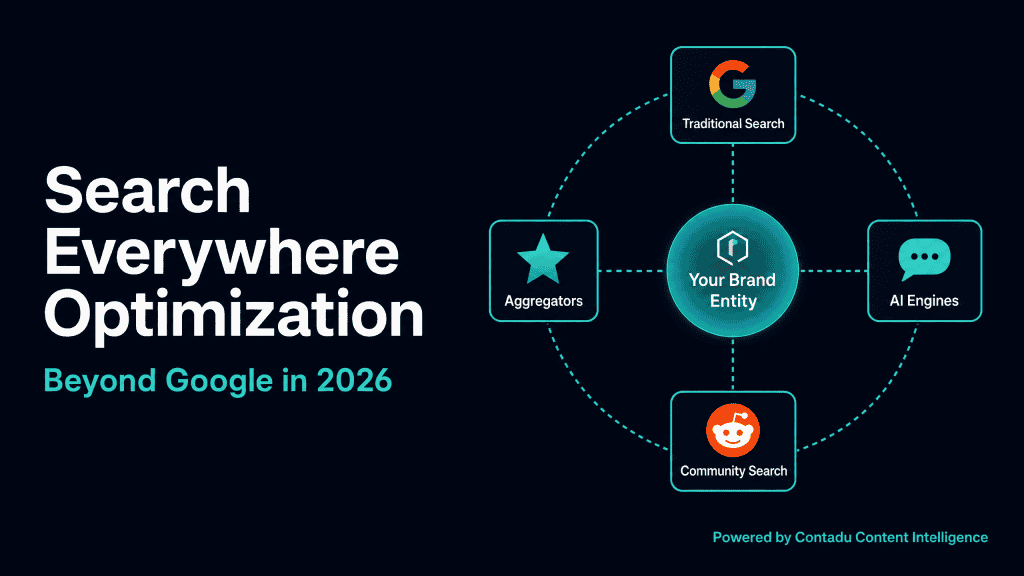
The Four Pillars of the Decentralized Search Ecosystem.
To optimize for “everywhere,” you first need to understand where “everywhere” is. The modern search landscape is divided into four distinct pillars:
1. Traditional Search (The Legacy Pillar)
Google and Bing still matter, but their role has shifted. They are increasingly becoming navigational engines (used to find a specific website) rather than research engines. While Google’s AI Overviews attempt to bridge the gap, traditional ten-blue-links SEO is now a defensive strategy, not a growth engine.
2. AI Answer Engines (The Synthesis Pillar)
Platforms like ChatGPT, Claude, and Perplexity have replaced Google for complex, multi-variable research. These engines do not rank pages; they synthesize entities and extract facts. Optimizing here requires Generative Engine Optimization (GEO), focusing on Entity Salience and Information Gain.
3. Social & Community Search (The Trust Pillar)
Reddit, LinkedIn, and specialized Slack/Discord communities are where buyers go for unfiltered truth. In 2026, Reddit is essentially a search engine for authentic human experience. Optimizing here requires digital PR, community engagement, and ensuring your brand co-occurs with positive sentiment.
4. Vertical Aggregators (The Evaluation Pillar)
For B2B SaaS, platforms like G2, Capterra, and TrustRadius act as the final search engines before a purchase decision. AI Answer Engines heavily index these platforms, making them doubly important.
How to Implement Search Everywhere Optimization.
You cannot create separate content for every platform. The secret to Search Everywhere Optimization is creating highly structured, entity-rich core assets that naturally syndicate across the ecosystem.
Step 1: Shift from Keyword Targeting to Entity Domination
Keywords are platform-specific (e.g., what people type into Google). Entities are universal. An entity (like “Semantic SEO” or “Content Intelligence”) exists across Google, ChatGPT, and Reddit.
Your goal is to become the definitive authority on a specific set of entities. When you use a platform like Contadu to map your Knowledge Graph, you ensure that no matter which AI engine or search algorithm processes your content, it recognizes your brand’s deep connection to those core concepts.
Step 2: Structure for Extraction (The GEO Requirement)
AI Answer Engines need to extract facts quickly. To ensure your content is cited by ChatGPT and Perplexity, you must use the Inverted Pyramid structure.
- Place a “Semantic Summary” at the top of every article.
- Use bold, declarative statements (Quotable Statements) that stand alone.
- Implement robust Schema Markup (FAQ, Article, Organization) to explicitly define the relationships on your page.
Step 3: Engineer “Surround Sound” Digital PR
Because AI engines distrust vendor-owned content for subjective queries, you must optimize the “Trust Pillar.” This means getting your brand mentioned on third-party sites.
Encourage your advocates to mention your brand in relevant Reddit threads. Ensure your G2 profile is exhaustively detailed. When ChatGPT or Perplexity scans the web for opinions on your software, it should find a consistent, positive narrative across multiple independent domains.
Step 4: Publish Primary Data.
The one thing every search platform Google, ChatGPT, Claude, and LinkedIn loves is original data. If you publish a proprietary industry report or a unique statistical analysis, you become the primary source. AI engines will cite you, humans on Reddit will link to you, and traditional websites will give you backlinks.
Measuring Success in a Decentralized World.
Traditional metrics like organic traffic and keyword rankings are insufficient for measuring Search Everywhere Optimization. You must track new KPIs:
- Share of Model Voice (SOMV): How often is your brand cited by ChatGPT and Perplexity compared to your competitors?
- Brand Search Volume: As you gain visibility in AI engines (which often results in zero-click searches), are more people navigating directly to your site via branded searches?
- Referral Traffic Diversity: Are you seeing traffic from AI platforms, Reddit, and aggregators, rather than just Google?
Conclusion: Omnipresence is the New SEO.
The days of relying on a single search engine for all your organic growth are over. Search Everywhere Optimization requires a holistic approach that blends technical structuring, semantic entity mapping, and aggressive digital PR.
By optimizing for the entire decentralized ecosystem, you ensure that no matter where your buyers choose to search in 2026, your brand is the answer they find.
FAQ.
Q: Does Search Everywhere Optimization mean I should abandon Google SEO?
A: No. Traditional Google SEO remains a foundational defensive strategy. However, you should reallocate resources to ensure you are also optimizing for AI Answer Engines and social search, as that is where high-intent research is shifting.
Q: How do I optimize for Reddit search?
A: You cannot “SEO” Reddit in the traditional sense. You must engage authentically. Monitor relevant subreddits, provide high-value answers without immediately pitching your product, and encourage happy customers to share their experiences organically.
Q: What is Share of Model Voice (SOMV)?
A: SOMV is a metric that tracks how frequently a specific Large Language Model (like ChatGPT or Claude) recommends or cites your brand in response to a set of target industry prompts, compared to your competitors.
Q: How does Contadu help with Search Everywhere Optimization?
A: Contadu helps you build a comprehensive Knowledge Graph and optimize your content for Entity Salience. By ensuring your content is semantically complete, Contadu makes it easier for AI engines, Google, and aggregators to understand and cite your brand.
Q: Is video content important for Search Everywhere Optimization?
A: Yes. Platforms like Google (via YouTube integration) and increasingly AI Answer Engines are parsing video transcripts to answer user queries. Optimizing video content with clear chapters and transcripts is a crucial part of an omnipresent strategy.
Q: How do I handle zero-click searches?
A: Accept them as brand impressions. When an AI engine answers a user’s question using your data without them clicking through to your site, you still build authority. Measure the impact through increases in direct traffic and branded search volume over time.
Q: What is the most important ranking factor for AI Answer Engines?
A: Information Gain. AI engines prioritize citing sources that offer unique data, original research, or novel frameworks that are not widely available elsewhere on the internet.