
Claude vs. ChatGPT: Differences in Content Retrieval and Citation.
📍 Semantic Summary
Idea: While both Claude and ChatGPT are powerful Large Language Models (LLMs), their approaches to Retrieval-Augmented Generation (RAG) and content citation differ significantly. Understanding these differences is crucial for a comprehensive Generative Engine Optimization (GEO) strategy.
Challenge: Many content marketers assume that optimizing for ChatGPT automatically optimizes their content for Claude. However, Claude’s architecture places a heavier emphasis on in-context reasoning and long-document analysis, whereas ChatGPT relies more aggressively on real-time web search via Bing and its OAI-SearchBot.
The Summary: To maximize your LLM Visibility across both platforms, you must balance the need for concise, extractable facts (for ChatGPT) with deep, semantically rich, long-form analysis (for Claude). This guide breaks down the architectural differences between the two models and provides actionable tactics for dual-platform optimization.
Read the full guide below, or explore related topics:
- Measuring LLM Visibility: Metrics That Matter in 2026
- GEO 2.0: Advanced Tactics to Get Cited by AI Engines
- How LLMs Process Entities: A Guide for Content Marketers
In the race to dominate the AI Answer Engine market, two platforms have emerged as the primary research tools for B2B professionals: OpenAI’s ChatGPT and Anthropic’s Claude.
While users often treat them interchangeably, their underlying architectures specifically how they retrieve external information and decide what to cite are fundamentally different. If your Generative Engine Optimization (GEO) strategy treats them as identical, you are leaving significant visibility on the table.
This guide explores the technical and philosophical differences between Claude and ChatGPT regarding content retrieval, and how you can optimize your content to get cited by both.
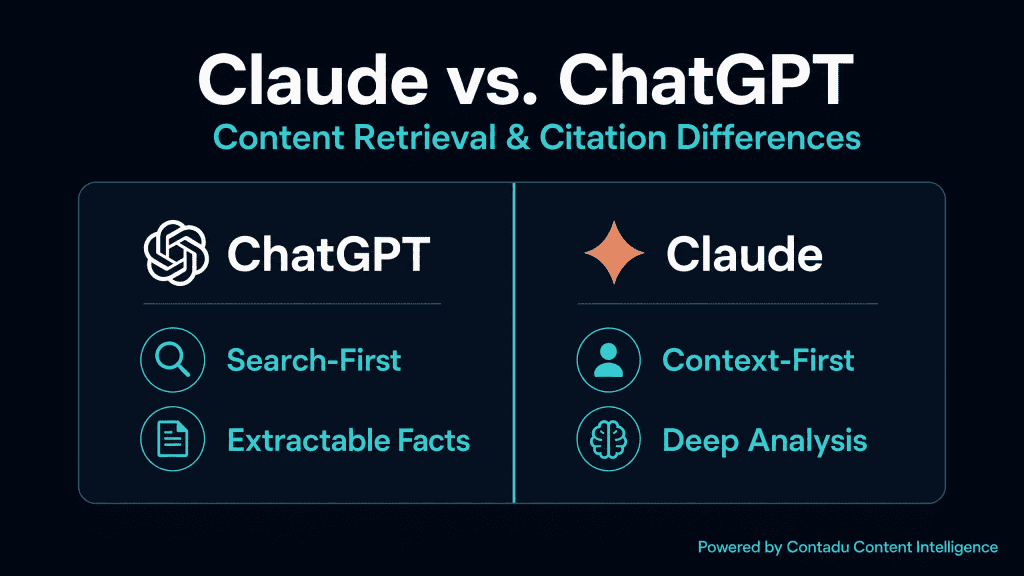
The Core Difference: Search-First vs. Context-First.
The primary divergence between the two models lies in their default behavior when presented with a query that requires external knowledge.
ChatGPT: The Search-First Engine.
ChatGPT (specifically its modern iterations integrated with web search) operates with a strong bias toward real-time retrieval. When asked a question about a recent event, a product comparison, or a specific statistic, ChatGPT will actively trigger a web search using its RAG framework (powered by Bing’s index and its own crawler).
It prefers to find multiple, recent sources, extract the Information Gain, and synthesize a response with direct hyperlink citations. It acts much like a highly intelligent search engine.
Claude: The Context-First Engine.
Claude, developed by Anthropic, was historically designed with a massive context window (allowing users to upload entire books for analysis) rather than a default reliance on live web search. While Claude now possesses web-browsing capabilities, its architectural bias leans toward deep reasoning over the information provided directly in the prompt or its training data.
Claude is more likely to synthesize a comprehensive answer based on its internal weights and only reach out to the live web if explicitly instructed or if its internal confidence is low. When it does retrieve web content, it tends to favor long-form, highly detailed, and nuanced documents over quick news snippets.
How to Optimize for ChatGPT’s Retrieval.
Because ChatGPT relies heavily on active web search, optimizing for it requires a focus on extractability and Entity Salience.
- The Inverted Pyramid: ChatGPT’s crawler needs to find the answer quickly. Place your most critical definitions, statistics, and conclusions at the very top of your page or section.
- Quotable Statements: Write in declarative sentences that stand alone without needing surrounding context. (e.g., “Contadu increases semantic content scores by an average of 45%.”)
- Real-Time Relevance: Ensure your content is frequently updated. ChatGPT’s search mechanism prioritizes freshness for commercial and informational queries.
- Technical Accessibility: You must ensure your robots.txt allows OAI-SearchBot to crawl your site.
How to Optimize for Claude’s Retrieval.
Optimizing for Claude requires a shift toward depth, nuance, and comprehensive semantic coverage.
- Long-Form, Nuanced Content: Claude excels at reading and summarizing complex documents. It favors content that explores the “why” and “how” rather than just the “what.” Deep-dive whitepapers and comprehensive guides perform exceptionally well when Claude does retrieve web content.
- Semantic Completeness: Claude’s internal reasoning relies heavily on the relationships between entities. Your content must cover all relevant sub-topics and related entities to be considered a definitive source. Using a tool like Contadu to map these semantic relationships is critical.
- Structured Data for Context: While Claude is excellent at natural language processing, clear HTML structure (H2s, H3s, tables) helps it quickly parse the logical flow of a long document.
The Intersection: Dual-Platform GEO Strategy.
You do not need to create separate content for Claude and ChatGPT. The most effective GEO strategy combines the requirements of both models into a single, highly optimized asset.
Here is the blueprint for dual-platform optimization:
- Start with the Executive Summary: Begin every major piece of content with a “Semantic Summary” (like the one at the top of this article). This provides the quick, extractable facts that ChatGPT craves.
- Transition into Deep Analysis: Following the summary, dive into the nuanced, comprehensive analysis that Claude favors. Explore edge cases, provide historical context, and detail the underlying mechanics of the topic.
- Embed Original Data: Both models prioritize Information Gain. Original research, proprietary statistics, and unique frameworks are highly citable by both ChatGPT (for quick stats) and Claude (for deep analysis).
- Build Off-Page Entity Authority: Both models rely on third-party validation to determine trust. A strong digital PR strategy that secures brand mentions on authoritative sites will increase your Entity Salience across all LLMs.
Conclusion: Mastering the AI Ecosystem.
The AI Answer Engine landscape is not a monolith. ChatGPT and Claude represent two different philosophies of information retrieval and synthesis.
By understanding these differences ChatGPT’s preference for quick, extractable facts and Claude’s preference for deep, semantic reasoning you can structure your B2B content to dominate visibility across the entire generative search ecosystem.
FAQ.
Q: Does Claude use Bing for search like ChatGPT?
A: While ChatGPT has a deep integration with Bing, Anthropic has historically used a variety of search providers and its own proprietary retrieval mechanisms for Claude. The specific backend provider is less important than understanding Claude’s bias toward deep, contextual content.
Q: Which model drives more traffic to websites?
A: Currently, ChatGPT drives significantly more referral traffic due to its larger user base and its interface design, which prominently features hyperlink citations. However, Claude is rapidly gaining market share among enterprise and power users.
Q: How do I check if Claude is crawling my site?
A: Anthropic uses a crawler called ClaudeBot. You can monitor your server logs for this user agent to see how frequently Claude is indexing your content.
Q: Should I write longer or shorter content for AI optimization?
A: The length itself is not the ranking factor; Information Density is. You should write content that is long enough to comprehensively cover the topic (satisfying Claude) but structured with clear summaries and extractable facts (satisfying ChatGPT).
Q: What is “Information Gain” in the context of LLMs?
A: Information Gain refers to the unique, net-new information your content provides that isn’t already widely available in the model’s training data or on competing websites. Both Claude and ChatGPT prioritize citing sources that offer high Information Gain.
Q: Do traditional SEO keywords still matter for Claude and ChatGPT?
A: Exact-match keywords are less important, but the underlying entities (the concepts those keywords represent) are critical. You must use the correct industry terminology so the models can accurately map your content to the user’s query.
Q: Can I use AI to write content optimized for AI?
A: Yes, but with caution. AI-generated content often lacks the original insights and proprietary data required for true Information Gain. The best approach is an AI-assisted workflow where human experts provide the unique insights and AI helps with structure and semantic completeness.