
Content Repurposing for AI: Turn 1 Article into 10 AI-Optimized Assets · Contadu.
Semantic Summary
The Idea: Writing a 2,500-word definitive guide and simply publishing it on your blog is no longer a viable content strategy. In the era of AI Answer Engines and fragmented buyer journeys, your target audience consumes information across multiple platforms, formats, and modalities. You must extract maximum value from every core asset you create.
The Challenge: Most content repurposing is lazy. Marketers simply copy and paste blog paragraphs into LinkedIn posts or use basic AI prompts to “summarize this article.” This creates low-quality, derivative content that fails to engage human readers and lacks the specific structural elements required for Generative Engine Optimization (GEO).
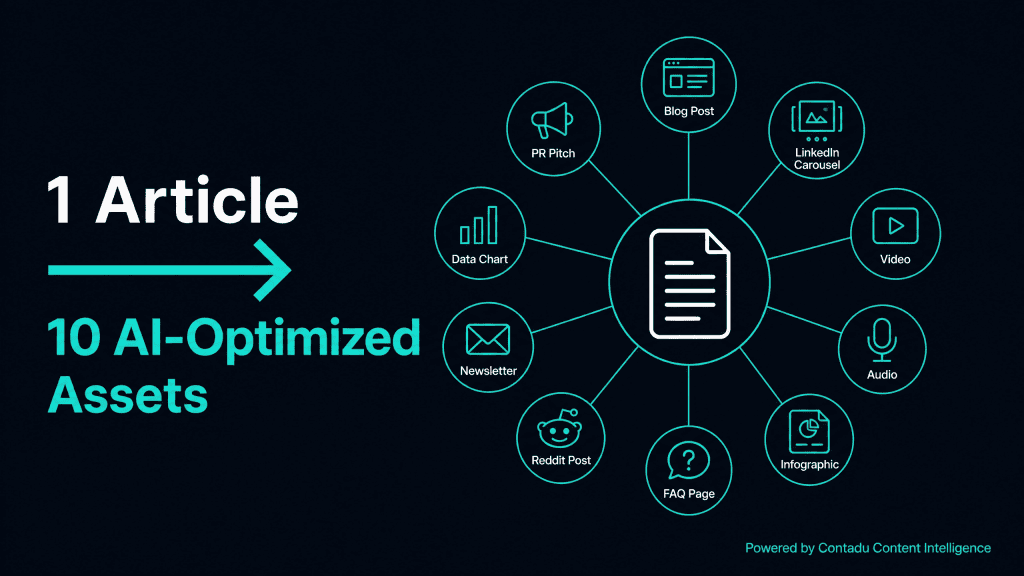
The Summary: Strategic Content Atomization involves breaking down a single, high-value core asset (like original research or a comprehensive guide) into multiple format-specific, AI-optimized micro-assets. By structuring these assets correctly, you can dominate traditional search, fuel your social channels, and ensure your brand is cited by ChatGPT and Perplexity. This guide provides a step-by-step framework to turn one article into 10 high-performing assets.
Read the full guide below, or explore related topics:
- The B2B Buyer’s Journey in the Age of AI Search
- Structuring Content for AI Extraction: The Inverted Pyramid Method
- Search Everywhere Optimization: Beyond Google in 2026
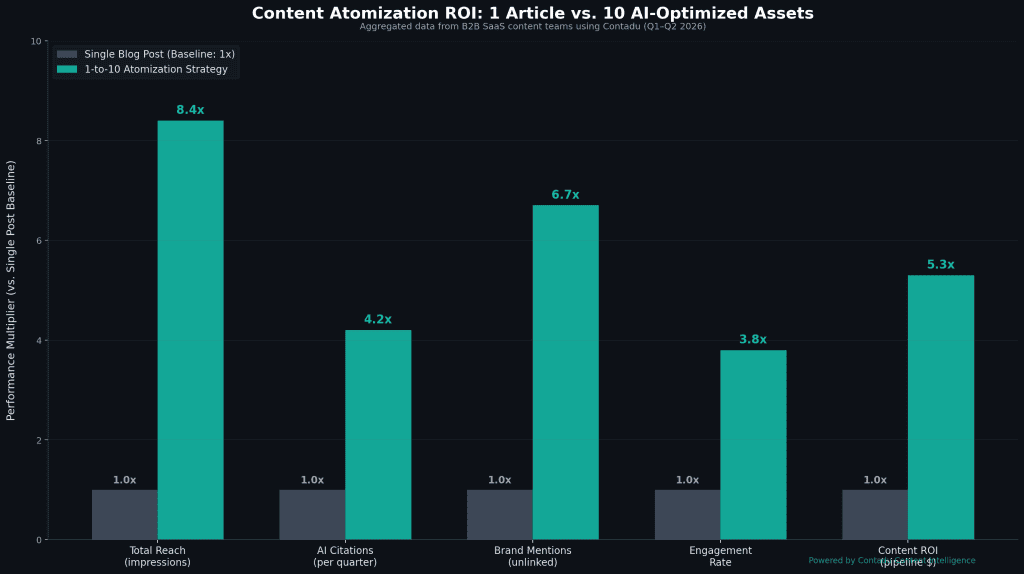
The math of content marketing has changed. Five years ago, if you spent 20 hours researching and writing a comprehensive blog post, you could rely on Google to provide a steady stream of organic traffic over the next two years, justifying the initial investment.
In 2026, with the rise of zero-click searches and AI Overviews, relying on a single distribution channel is a recipe for irrelevance. The new ROI equation requires Content Atomization: extracting the maximum possible value from your core “Pillar” content by transforming it into multiple, platform-native assets.
The Difference Between Repurposing and Atomization.
Content Repurposing is often an afterthought. A marketer writes an article, then realizes they need a newsletter for Tuesday, so they copy the introduction, add a link, and call it a day.
Content Atomization is a deliberate architectural strategy. You design the core asset from the beginning knowing that it will be broken apart. Every sub-heading is written to function as a standalone LinkedIn post. Every data point is formatted to become a standalone infographic. Every FAQ is structured to be extracted by an AI Answer Engine.
The 1-to-10 Framework: Building Your Content Ecosystem.
Here is the exact blueprint for turning one comprehensive core article into an ecosystem of 10 distinct, AI-optimized assets.
The Core Asset: The Pillar Article (Asset 1)
This is your foundation. It must be a comprehensive, authoritative piece of content (usually 1,500+ words) built using the Dual-Structure Architecture. It contains a Semantic Summary at the top for AI extraction, and deep, entity-rich analysis below for traditional Google crawlers and human readers.
The Social & Community Layer (Assets 2-5)
Social platforms require native content. You cannot just drop a link to your blog post; the algorithms will suppress it. You must extract the value and deliver it directly in the feed.
- Asset 2: The LinkedIn Carousel. Take the 5 key takeaways from your article and turn them into a swipeable PDF carousel. This format currently drives the highest engagement and dwell time on LinkedIn.
- Asset 3: The Text-Only Thought Leadership Post. Extract your most controversial or counter-intuitive point from the article. Write a text-only LinkedIn or X (Twitter) post starting with a strong hook, using the article’s data to back up your claim.
- Asset 4: The Reddit / Quora Value Post. Rewrite a specific “How-To” section of your article in a highly conversational, non-promotional tone. Post it in a relevant subreddit. Why this matters for AI: ChatGPT and Perplexity heavily index Reddit for third-party validation.
- Asset 5: The Newsletter Deep Dive. Do not just summarize the article. Pick one specific sub-topic from the pillar piece and expand on it exclusively for your email subscribers, treating the core article as supplementary reading.
The AI & GEO Layer (Assets 6-8)
To win Share of Model Voice (SOMV), you must feed AI models the specific formats they prefer to synthesize.
- Asset 6: The Standalone FAQ Page. Extract the H3 questions and answers from your article. Publish them on a dedicated FAQ or Glossary page using strict FAQ Schema. AI models frequently pull direct answers from properly marked-up FAQ pages.
- Asset 7: The Data Visualization / Infographic. If your article contains original research or complex comparisons, turn that data into a clean, minimalist chart. Ensure the image file name and alt text are heavily optimized with your core entities. AI Overviews increasingly pull visual assets into their answers.
- Asset 8: The Quotable Statement Snippet. Extract the single most definitive sentence from your article (your Quotable Statement). Pitch this specific sentence, along with its supporting data, to industry journalists or use it in digital PR outreach to earn unlinked brand mentions.
The Multimedia Layer (Assets 9-10)
Different buyers prefer different modalities. You must translate your text into audio and video.
- Asset 9: The YouTube / TikTok Short. Take one specific concept from the article and record a 60-second, high-energy vertical video explaining it. Use auto-captions. Video content is heavily favored in mobile search environments.
- Asset 10: The AI-Generated Audio Summary. Use an advanced TTS (Text-to-Speech) tool to create a 3-minute audio summary of the article. Embed this audio player directly at the top of your pillar article (as we do on the Contadu blog) to increase dwell time and cater to auditory learners.
How Contadu Helps You Build the Atomization Engine.
Executing a 1-to-10 atomization strategy manually is incredibly time-consuming. It requires meticulous planning and a deep understanding of how different algorithms parse text. This is where Contadu transforms your workflow.
Structuring the Core Asset for Easy Extraction
Contadu’s content intelligence platform ensures your core Pillar Article is built correctly from the start. By enforcing the use of Semantic Summaries and guiding you to write entity-dense H2s, Contadu guarantees that when you slice the article into smaller pieces, those pieces retain their semantic context and Entity Salience.
Identifying the Most Valuable Snippets
When you are ready to atomize, Contadu helps you identify which sections of your text are the most “extractable.” The platform analyzes your content against top-ranking competitors and AI-cited sources, highlighting the specific data points and Quotable Statements that are most likely to perform well as standalone social posts or digital PR pitches.
Maintaining Semantic Consistency Across Channels
When you rewrite a blog paragraph into a Reddit post or a LinkedIn carousel, it is easy to accidentally strip out the core entities that AI engines rely on. Contadu allows you to score your atomized micro-assets before you publish them, ensuring that your Knowledge Graph connections remain strong, regardless of the platform.
In short: Contadu acts as the quality control layer for your entire content ecosystem, ensuring that every asset you generate from a 2,500-word guide to a 50-word LinkedIn post is perfectly optimized for the AI era.
FAQ
Q: Does publishing the same content across multiple platforms cause duplicate content issues?
A: No. Google and AI engines understand cross-platform syndication. However, you should never copy and paste exactly. You must adapt the tone, format, and structure to fit the native platform (e.g., turning a formal blog paragraph into a conversational Reddit post).
Q: How much time should I spend on atomization versus creating new content?
A: In 2026, the ratio should be roughly 40% creation, 60% atomization and distribution. It is far more effective to have one incredible core asset distributed perfectly across 10 channels than to have 10 mediocre blog posts sitting unread on your website.
Q: Can I use AI tools like ChatGPT to automate the atomization process?
A: Yes, but with strict oversight. You can use AI to draft the initial LinkedIn post or extract the FAQs, but you must manually edit the output to ensure it retains your brand’s unique voice, Information Gain, and Entity Salience.
Q: Which of the 10 assets is the most important for Generative Engine Optimization (GEO)?
A: Aside from the core Pillar Article itself, the Standalone FAQ Page (Asset 6) and the Reddit/Quora Value Post (Asset 4) are currently the most critical for GEO, as AI models heavily prioritize structured Q&A formats and third-party community validation.
Q: How do I track the ROI of an atomized content strategy?
A: You must move beyond simple pageviews. Track Share of Model Voice (SOMV) for your core entities, monitor unlinked brand mentions generated by your digital PR efforts, and measure aggregate engagement across all 10 assets, rather than just the traffic to the core blog post.
Q: Is it necessary to create all 10 assets for every single blog post?
A: No. Reserve the full 1-to-10 atomization framework for your high-value “Pillar” content original research, definitive guides, and major product announcements. For standard updates, a smaller 1-to-3 strategy is sufficient.
Q: How does Contadu’s approach differ from basic SEO tools?
A: Basic SEO tools focus on keyword density for traditional crawlers. Contadu focuses on Entity Salience, semantic relationships, and structural optimization, ensuring your content is built specifically for extraction by Large Language Models and AI Answer Engines.