
The B2B Buyer’s Journey in the Age of AI Search
📍Semantic Summary
The Idea: The traditional B2B marketing funnel Awareness, Consideration, Decision was built for a linear, Google-centric world. In 2026, the proliferation of AI Answer Engines (like ChatGPT, Claude, and Perplexity) has completely fractured this linear path. Buyers are no longer downloading whitepapers or filling out lead forms to get basic answers; they are using AI to synthesize months of research in seconds.
The Challenge: Most B2B SaaS companies still gate their best content and rely on traditional SEO to capture “top of funnel” traffic. But the top of the funnel has moved into the Dark Funnel of AI. If an LLM cannot access your gated content, your brand is entirely excluded from the consideration phase before the buyer even visits your website.
The Summary: To survive the new B2B buyer’s journey, marketers must shift from “lead capture” to “entity capture.” This means un-gating content, optimizing for Share of Model Voice (SOMV), and ensuring that AI engines naturally recommend your brand during the crucial evaluation phase. This guide explains how to map your content strategy to the AI-driven buyer journey.
Read the full guide below, or explore related topics:
- Brand Mentions as the New Backlinks in the AI Era
- The Role of Digital PR in LLM Visibility
- Search Everywhere Optimization: Beyond Google in 2026
Think about how you bought enterprise software five years ago. You Googled a problem. You clicked on three blog posts. You downloaded a “Definitive Guide” PDF (giving up your email address in the process). You received an automated email sequence. Finally, you booked a demo.
That was the linear B2B funnel. It was predictable, trackable, and entirely controlled by the marketer.
Now, think about how a B2B buyer operates in 2026. They open Perplexity or ChatGPT and type: “Compare the top three content intelligence platforms for a 50-person marketing team, factoring in API costs and AI extraction capabilities.”
In three seconds, the AI synthesizes what used to take three weeks of research. The buyer skips the blog posts, ignores the gated PDF, and jumps straight to the shortlist. If your brand is not in that AI-generated shortlist, you have lost the deal before you even knew the buyer existed.
The Collapse of the Traditional Funnel
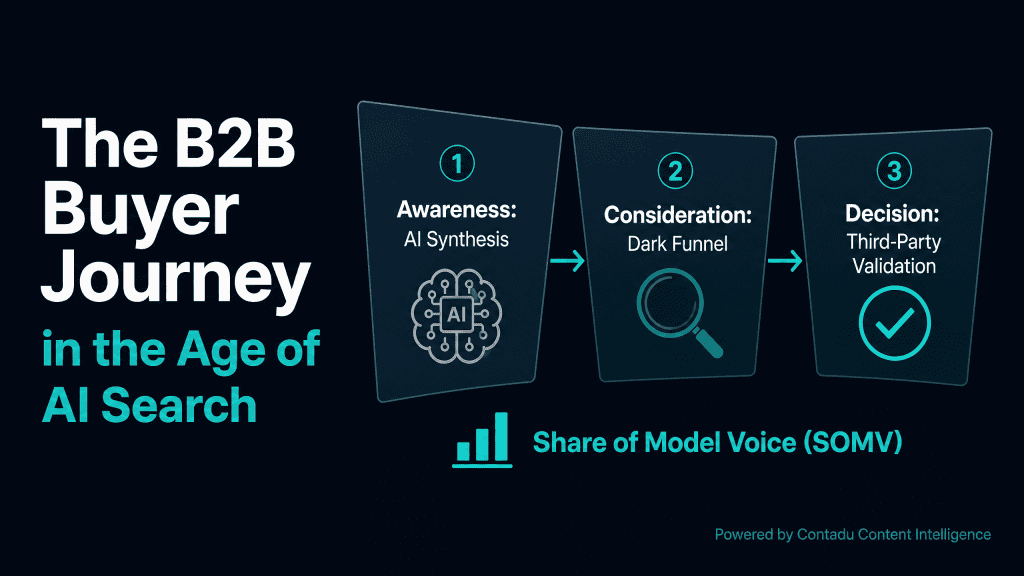
The introduction of Large Language Models (LLMs) into the search ecosystem has fundamentally altered the B2B Buyer’s Journey. The traditional stages still exist conceptually, but the execution has moved from the public web into the Dark Funnel of AI.
Awareness: The Shift from Search to Synthesis
In the past, buyers became aware of your brand by finding your top-of-funnel (TOFU) blog posts via Google. Today, informational queries have seen a massive drop in traditional click-through rates. Users get their definitions and basic concepts directly from Google AI Overviews or ChatGPT.
The Fix: You must optimize for Generative Engine Optimization (GEO). Your goal at the awareness stage is no longer to drive traffic, but to achieve high Entity Salience so that AI models cite your brand as the authoritative source of the definition.
Consideration: The Death of the Gated Whitepaper
The consideration phase used to be the domain of the gated eBook. Marketers traded deep insights for email addresses. In 2026, gating your best content is a strategic error. AI crawlers (like OAI-SearchBot) cannot fill out lead forms. If your deepest technical specs, pricing models, and case studies are locked behind a form, the AI cannot read them.
The Fix: Un-gate your core educational content. If a buyer asks Claude to compare your software to a competitor, Claude will heavily favor the competitor whose documentation is publicly accessible and easily extractable.
Decision: The Rise of Third-Party Validation.
When buyers reach the decision stage, they ask AI engines for unbiased reviews. AI models are trained to prioritize third-party aggregators (like G2 or Capterra) and community discussions (like Reddit) over your own marketing copy.
The Fix: You must engage in aggressive Digital PR. As we noted in our guide on Brand Mentions, unlinked mentions on trusted third-party sites are the new backlinks. You need a high volume of positive, entity-rich discussions happening off your domain.
How to Map Content to the AI Buyer Journey
To capture the modern B2B buyer, your content strategy must adapt to how AI engines retrieve and synthesize data. Here is the new playbook.
The “AI-First” Product Page
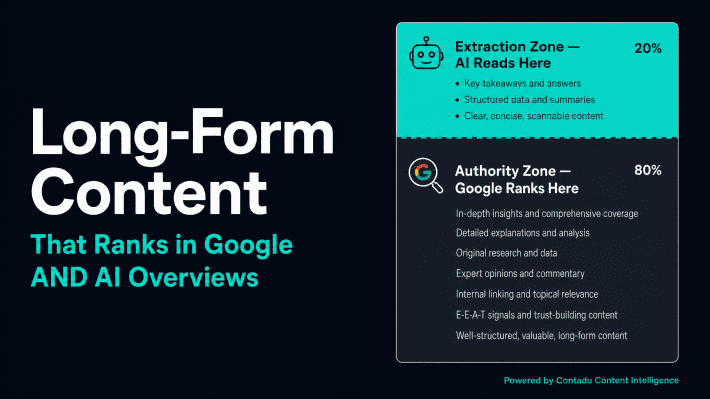
Your product and feature pages must be structured for rapid data extraction. Use the Inverted Pyramid Method. Place a Semantic Summary at the very top of the page. Use clear, declarative Quotable Statements that an AI can easily lift to describe what your product does.
The “Versus” and Comparison Pages
Do not let third-party affiliates control the narrative around your competitors. Build highly detailed, objective comparison pages on your own domain. Use structured data (HTML tables) to compare features side-by-side. AI models love extracting data from tables to answer “X vs. Y” queries.
Original Research as the Ultimate Hook
Because AI models are synthesis engines, they are constantly starved for net-new facts. By publishing Original Research (surveys, proprietary data, industry reports), you force the AI to cite your brand. When a buyer asks an industry-level question, the AI will pull your statistic, creating massive brand awareness.
Measuring Success in the AI Era
If you measure the modern buyer’s journey using only Google Analytics, you will think your marketing is failing. Traffic is down, and form fills are down. But pipeline might be up.
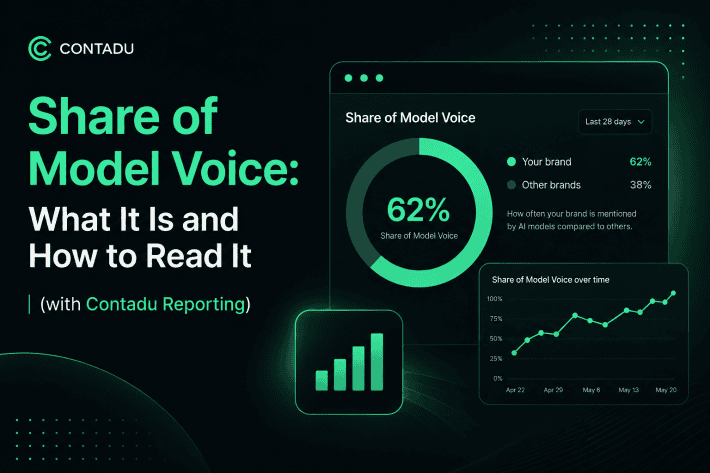
You must shift your KPIs. Instead of tracking raw sessions, you must track Share of Model Voice (SOMV). How often does ChatGPT recommend you vs. your competitor? How often is your brand mentioned in Perplexity citations? You must also rely heavily on “Self-Reported Attribution” (e.g., asking “How did you hear about us?” on your demo request form) to capture the impact of the Dark Funnel.
Conclusion: From Lead Capture to Entity Capture
The B2B buyer’s journey is no longer a linear path you can control with an automated email sequence. It is a dynamic, AI-driven synthesis of your entire digital footprint.
To win in 2026, you must stop trying to capture leads with gated PDFs and start trying to capture the AI’s understanding of your brand. By building a robust, un-gated, entity-rich web presence, you ensure that when the buyer asks the machine for a recommendation, the machine answers with your name.
How Contadu Helps You Win the AI-Driven Buyer Journey
Adapting your content strategy to the AI-driven buyer journey is not a one-time project it is an ongoing process of monitoring, optimizing, and closing semantic gaps as the competitive landscape evolves. This is precisely where Contadu acts as your content intelligence command center.
Identifying Entity Gaps Before Your Competitors Do
Contadu analyzes your entire content library against the top ranking pages and AI cited sources in your niche. It surfaces the specific Entities and semantic concepts that are missing from your pages the exact gaps that prevent AI engines from recommending your brand during the Consideration phase. Instead of guessing which topics to cover, you get a data-driven list of what to write next.
Optimizing for Entity Salience at Scale
Writing a single page with high Entity Salience is manageable. Doing it across 200 product pages, blog posts, and landing pages is not. Contadu’s content editor provides real-time feedback on entity density, co-occurrence signals, and structural clarity ensuring every piece of content you publish is optimized for AI extraction before it goes live.
Tracking Share of Model Voice Over Time.
One of the hardest challenges in the new buyer journey is measuring what happens inside the Dark Funnel. Contadu helps you build a systematic process for tracking your Share of Model Voice (SOMV) by monitoring how often your brand appears in AI-generated answers for your target queries across ChatGPT, Perplexity, and Google AI Overviews. This transforms an invisible metric into a trackable KPI.
Structuring Content for Rapid AI Extraction.
Contadu’s content templates are built around the Inverted Pyramid Method and the Dual-Structure Architecture. When your writers use Contadu to draft or optimize content, they are automatically guided to place the Semantic Summary at the top, use the correct heading structure, and embed Quotable Statements in the right positions without needing to manually audit every page.
In short: Contadu does not just help you rank in Google. It helps you become the brand that AI recommends when your next buyer asks the machine for a shortlist.
Frequently Asked Questions (FAQ)
Q: Should we un-gate all of our content?
A: Yes, the vast majority of it. The only content you should gate in 2026 is highly personalized, interactive content (like an ROI calculator that requires specific company data) or exclusive community access. Educational PDFs and whitepapers must be public so AI engines can index them.
Q: How do we generate leads if we un-gate our content?
A: You shift from “Marketing Qualified Leads” (MQLs) based on content downloads to “Product Qualified Leads” (PQLs) or high-intent demo requests. If your public content is excellent, buyers will consume it via AI or directly, and come to you when they are actually ready to buy.
Q: Does traditional SEO still play a role in the buyer’s journey?
A: Yes. Traditional SEO builds the foundation of your Topical Authority. A strong SEO presence ensures that both human buyers (who still use Google for navigational and commercial queries) and AI crawlers can easily find and trust your content.
Q: How can Contadu help optimize for the AI buyer journey?
A: Contadu helps you analyze the semantic gaps in your content and optimize your pages for Entity Salience. By ensuring your content is structured correctly for AI extraction, Contadu helps you maximize your Share of Model Voice across the new buyer journey.
Q: What is the “Dark Funnel of AI”?
A: The Dark Funnel refers to the research and evaluation a buyer conducts that you cannot track with traditional analytics. In 2026, a massive portion of this happens inside closed AI environments like ChatGPT, where buyers ask complex questions about your brand without ever visiting your website.
Q: How do I influence what AI says about my brand in the decision phase?
A: Through Digital PR and optimizing for third-party aggregators. Encourage happy customers to leave detailed reviews on G2, Capterra, and Reddit. AI models weigh these external sources heavily when providing recommendations.
Q: Are webinars still effective in the AI era?
A: Yes, but their format must evolve. Webinars build deep trust and human connection something AI cannot replicate. However, the transcripts and key takeaways from those webinars must be published publicly on your site as structured text so AI engines can extract the insights.