
B2B SaaS Content Map & Template: Mapping Your Content Marketing Strategy
Semantic Summary
The Idea: Creating content for the sake of publishing is a guaranteed way to waste marketing budget. A B2B SaaS content marketing strategy requires precision. By mapping every piece of content to the buyer’s journey, you ensure that potential customers find the right content at exactly the right time.
The Challenge: Many SaaS companies struggle to align their website content with user intent. They produce good content, but not effective content. Without a clear content map, SaaS teams often create random social media posts or isolated blog articles, resulting in massive content gaps and poor organic traffic.
The Summary: A content map helps a content strategist visualize the entire customer journey for a specific persona. By using content mapping tools and a structured content mapping template, you can identify gaps in your content map, optimize existing content, and align your content roadmap with revenue goals. This step-by-step guide will show you how to create an effective content map for your B2B SaaS.
Related Reads:
Creating Bottom-of-Funnel (BoFu) Content That Actually Converts
Aligning Content Strategy with Product-Led Growth (PLG)
The B2B Buyer’s Journey in the Age of AI Search
Understanding the Importance of Content Mapping in B2B SaaS
Before building any content map, it is essential to understand why content mapping exists in the first place. In a competitive B2B SaaS landscape, where buyers conduct extensive independent research before ever speaking to a sales representative, the ability to deliver the right content at the right moment is a decisive competitive advantage.
This section explains what content mapping is, why it is non-negotiable for SaaS companies, and what tangible benefits a well-executed map delivers.
What is Content Mapping?
Content mapping is the strategic process of delivering personalized content to your target audience at every stage of their purchasing decision.
Rather than guessing what your audience wants to read, mapping ensures that your B2B SaaS content directly addresses the needs of a potential customer as they move through the funnel. It transforms a scattered collection of articles into a cohesive content marketing strategy.
Why is Content Mapping Essential for B2B SaaS?
In the B2B SaaS industry, the buyer journey is rarely linear. It involves multiple stakeholders, extensive research, and long sales cycles.
Content mapping is essential because it allows SaaS companies to deliver the right content to the right person at the exact moment they need it to solve their problem. Without it, you are simply creating content for the sake of it, which rarely translates into revenue.
Key Benefits of an Effective Content Map
An effective content map provides total clarity for content teams. It highlights content gaps, ensuring you do not waste resources on redundant topics.
A well-executed map helps improve user experience on your SaaS website, boosts your rankings in search results by satisfying search intent, and aligns your entire content strategy with your sales objectives. Ultimately, it ensures that your digital marketing efforts drive measurable growth for your SaaS products.
Creating a Content Map for Your B2B SaaS
Knowing that you need a content map is one thing building one is another. This section walks you through the practical process of creating a content map from scratch, starting with the foundational work of defining your buyer personas and ending with a fully populated journey map that your content team can execute against immediately. Each step builds on the previous one, so work through them in order.
Step-by-Step Guide to Create a Content Map
Creating your own content map requires a methodical approach. This step-by-step guide will walk you through the mapping process, from initial research to final execution, ensuring your B2B SaaS content strategy is airtight.
Identifying Your Buyer Personas
Before you can map anything, you must know who you are mapping for. A buyer persona is a semi-fictional representation of your ideal customer.
In B2B SaaS, you often have multiple personas (e.g., the end-user vs. the executive decision-maker). You must define their pain points, goals, and how they use search engines to find solutions. Every piece of content should be tailored to the journey for a specific persona.
Mapping Content to the Customer Journey
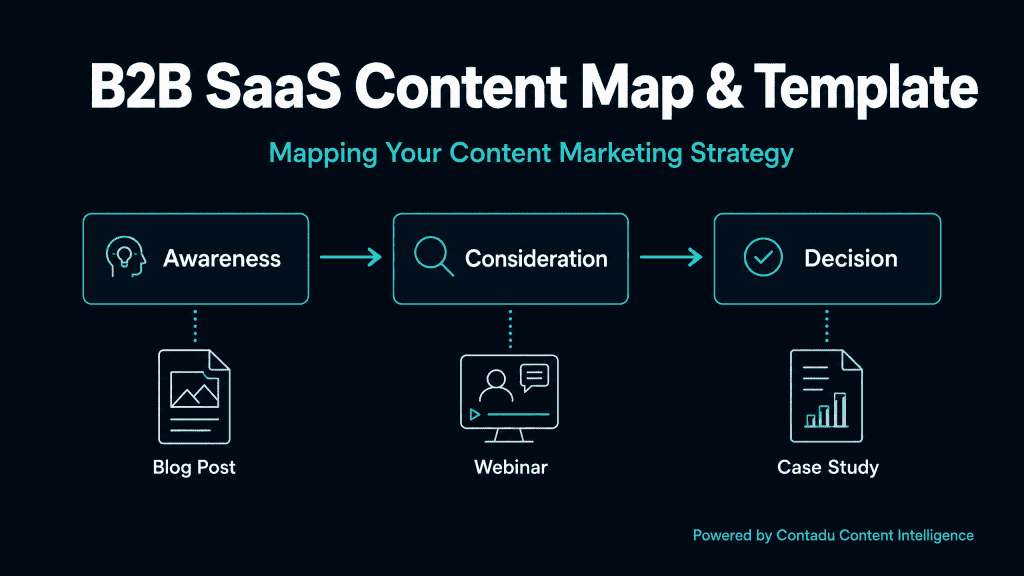
The buyer’s journey typically consists of three stages: Awareness, Consideration, and Decision. To create a content map, you must align content types to these stages.
For example, educational blog posts and social media posts work well for Awareness. In-depth webinars and comparison guides fit Consideration. Detailed case studies and product demos are crucial for the Decision stage. This ensures you have supporting content for every step.
Content Mapping Tools and Templates
Even the most well-designed content mapping strategy will stall without the right tools to support it. Manually maintaining a content map in a spreadsheet is time-consuming, error-prone, and difficult to scale.
This section covers the best content mapping tools available for B2B SaaS teams, explains how to use a structured content mapping template to accelerate your workflow, and highlights real-world examples of platforms that combine SEO intelligence with journey mapping capabilities.
Best Content Mapping Tools for B2B SaaS Companies
To execute this strategy at scale, a content strategist needs the right software. The best content mapping tools allow you to visualize the journey map, conduct a thorough content audit, and track performance.
Tools that integrate AI content analysis and SEO data are particularly valuable for identifying where you need to create new content versus where you should optimize current content.
Using a Content Mapping Template
Starting from scratch is overwhelming. Using a content mapping template provides a structured framework to organize your content ideas.
A good template will have columns for the buyer persona, the specific stage of the customer journey, the target keyword, search intent, and the specific content format required. This becomes the foundation of your content roadmap.
Examples of Effective Content Mapping Tools
While generic project management SaaS tools can hold a content calendar, specialized SEO and content marketing platforms offer much more depth.
For instance, platforms that analyze search results and entity salience can automatically highlight gaps in your content map, suggesting exactly what type of content you need to publish next to gain topical authority.
Content Strategies for B2B SaaS
A content map is only as valuable as the strategy it supports. Once your map is in place, you need a clear set of content strategies to fill it with assets that actually move buyers through the funnel.
This section explores how to develop a comprehensive B2B SaaS content marketing strategy, clarifies the critical distinction between good content and effective content, and outlines the most proven content strategies used by leading SaaS companies today.
Developing a B2B SaaS Content Marketing Strategy
A successful B2B SaaS content marketing strategy requires more than just high content volume. It requires a deep understanding of your audience and a commitment to producing high-quality, authoritative assets.
You must align your content with your product’s unique value proposition and use targeted keyword research to capture high-intent organic traffic.
Good Content vs. Effective Content in SaaS
There is a massive difference between good content and effective content. Good content is well-written and grammatically correct. Effective content actually moves a buyer through the funnel.
Effective content is optimized for search engines, directly addresses a buyer persona’s specific pain points, and includes a clear call to action. To achieve this, you must constantly refine your content based on performance data.
Common Content Strategies for SaaS Companies
Leading SaaS teams utilize a mix of different types of content. This includes pillar pages for broad SEO visibility, targeted landing pages for specific use cases, and rich media like video tutorials.
Another powerful strategy is to regularly audit existing content to ensure it remains accurate and competitive in the ever-changing search landscape, adding additional content or AI-driven insights where necessary to maintain rankings.
How Contadu Elevates Your Content Mapping Strategy
Building a content map manually in spreadsheets is time-consuming and prone to errors. Contadu revolutionizes this process by providing advanced Content Intelligence that automates the heaviest lifting in your content marketing strategy.
Contadu helps you build an effective content map by analyzing top-ranking competitors and identifying exact semantic gaps in your current content. Instead of guessing what future content to write, Contadu AI provides data-driven recommendations on the exact topics, entities, and keywords required to dominate your niche.
It allows your content teams to seamlessly transition from high-level journey mapping to granular content creation, ensuring every article is perfectly optimized for both human readers and AI answer engines.
Frequently Asked Questions about B2B SaaS Content Mapping
Q1: What is the difference between a content map and a content calendar?
A: A content calendar dictates when you will publish content. A content map dictates why you are publishing it, specifically aligning each piece to a buyer persona and their current stage in the customer journey.
Q2: How often should I update my content mapping template?
A: You should review and update your content map at least quarterly. As your SaaS products evolve and search engine algorithms change, your map must adapt to ensure you are targeting the right search intent.
Q3: Do I need a different journey map for every buyer persona?
A: Yes. A CEO looking for high-level ROI metrics has a completely different buyer journey than a technical end-user looking for API documentation. You must map the journey for a specific persona individually.
Q4: How can AI help in the content mapping process?
A: AI content tools can rapidly analyze massive amounts of search data to identify content gaps, cluster related topics, and suggest the most effective type of content for specific queries, significantly speeding up the mapping process.
Q5: What is the most important metric to track for BoFu (Bottom of Funnel) content?
A: While organic traffic is nice, the ultimate metric for BoFu content (like case studies and versus pages) is the conversion rate—specifically, how many readers request a demo or start a free trial.
Q6: How do I know if I have gaps in my content map?
A: Conduct a comprehensive content audit. Map all your existing content against your buyer’s journey stages. If you have 50 articles for Awareness but only 2 case studies for the Decision stage, you have a massive gap.
Q7: Can I repurpose existing content to fill gaps in my map?
A: Absolutely. Often, you don’t need to create new content from scratch. You can take a broad ToFu blog post and repurpose it into a highly specific, personalized content piece (like an email sequence or a targeted landing page) for a specific persona.