
Social Media Frameworks: How to Create Visual Models People Can Use
Semantic Summary
Idea: A social media framework turns one useful idea into a simple visual model that helps a reader understand a decision, process, comparison, or relationship quickly.
Challenge: Teams often turn every topic into a busy graphic, a generic diagram, or a recycled template that looks consistent but gives the reader no clear next step.
Summary: Start with one audience decision and verified evidence, choose a visual structure that matches the job, reduce it to the minimum useful elements, and publish it with accessible explanatory text.
Related Reads
- Content Atomization: The Ultimate Guide to Maximizing Your Content ROI
- Content Distribution: The AI-Powered Playbook Beyond “Publish and Pray”
- Original Research: The Ultimate Guide to Building Authority and Backlinks
| Brief field | Decision to make | Reader test |
| Audience | Who needs this model? | Can you describe their current decision? |
| Point | What single idea should they retain? | Can it be stated in one sentence? |
| Proof | What evidence supports the model? | Can every label be explained honestly? |
| Shape | Is this a process, choice, comparison, system, or maturity model? | Does the visual structure match the task? |
| Action | What should the reader do next? | Does the framework make that step clearer? |
| Access | How will a non-visual reader receive the same meaning? | Is there concise supporting text and suitable alternative text? |
The best social media frameworks make one useful idea easier to understand and apply. They do not exist to decorate a feed or make a broad topic look more authoritative. A framework earns attention when a reader can quickly see what problem it helps solve, how its parts relate, and what to do next.
For B2B teams, this is a practical advantage. A clear visual model can help a busy reader compare options, follow a process, remember a decision rule, or explain an expert idea to someone else. It can then support a post, a sales conversation, a blog section, or an internal brief without changing the evidence behind the message.
What a Social Media Marketing Framework Is and What It Is Not
A social media framework is a reusable visual model for one recurring reader task. It reduces a decision, process, comparison, relationship, or progression into a structure that a person can scan and use. It is not simply a branded background, a list of content ideas, or a substitute for a complete social media marketing strategy.
The distinction matters. A content pillar names a broad subject your brand returns to. A content calendar schedules what you will publish and when. A template gives a repeatable layout. A framework sits between them: it gives a repeatable way to explain a specific idea. A good framework can become a template, and it can be planned in a calendar, but those are separate jobs.
For example, “content measurement” might be a pillar. A calendar may schedule a monthly post about it. A framework could show the reader how to connect a stated objective, an observable action, and a metric. The visual model gives the post its explanatory value; the pillar and calendar make the work repeatable.
Start With the Reader’s Decision
Every useful visual content framework begins with one reader decision, not with a preferred shape or a design trend. Before choosing arrows, boxes, or colours, decide whose work will be easier after they see the model.
Run a focused social media audit first
A framework should support a documented social media strategy, not compensate for its absence. Before developing a social media framework, run a small social media audit: list the target audience, the social media platforms or channel types that matter to that audience, the marketing goals, the existing content pillars, and the evidence already available.
You do not need a large digital marketing report. You need enough context to identify what readers are trying to achieve and where their understanding currently breaks down.
Check both organic and paid activity if your team uses both, but do not let paid advertising decide the framework’s message. The same model should remain useful when a reader encounters it without promotion.
Note the social media content that already earns thoughtful replies, useful saves, or qualified visits; note also the content ideas that create attention but fail to move a reader toward a relevant action. This audit makes it easier to choose a framework that supports the social media marketing strategy rather than another isolated visual.
Choose one audience and one useful action
Broad goals such as brand awareness, audience growth, or lead generation are not enough to guide a visual. Translate them into a specific reader task. A content marketer may need to decide which evidence belongs in a post.
A subject-matter expert may need to distinguish a process from a checklist. A manager may need to see what requires review before an asset is published.
Use real source material: recurring questions from customer-facing teams, confirmed research, product documentation, or a proven internal process. A visual should not turn a passing opinion into a permanent rule. If you cannot identify the reader’s decision, you do not yet have a framework; you have a topic.
Write the point before designing the picture
Write one sentence using this pattern: For [reader], when deciding [task], use [model] because [evidence or principle]. This gives the framework a boundary. It also makes a later review easier: every label, row, or stage should support that sentence.
Suppose the point is “For editors deciding whether a claim belongs in a visual, use an evidence check because unclear sourcing weakens trust.” That point could become a decision framework. It should not become a twelve-part infographic about every aspect of content creation. A narrow point helps a reader; a crowded model asks them to do the editing work themselves.
Choose the Visual Shape That Matches the Job
The shape of a framework should reflect the task a reader must complete. When the shape and task disagree, even a polished visual becomes hard to use. Start with the reader’s question, then select the simplest structure that answers it.
| Reader task | Useful framework | Avoid when |
| Follow steps in order | Process framework | The steps can happen in any order |
| Choose between real options | Decision framework | There is no meaningful choice or condition |
| Understand trade-offs | Comparison framework | The criteria quietly favour a preselected answer |
| See how parts influence one another | System framework | The relationships cannot be explained simply |
| Recognise the next capability to build | Maturity framework | The stages are labels without observable differences |
Process framework: show a sequence
Use a process framework when order changes the result. It can show how a team moves from a reader question to evidence, from a draft to review, or from a published asset to a learning cycle. Every stage should have a clear output. If a step has no action or result, combine it with another step or remove it.
Decision framework: show a choice
Use a decision framework when the reader needs to choose between options. The branches should be based on observable conditions, not personal preference hidden as a rule. A good decision model says what to check, what each answer means, and when the reader should seek more evidence.
Comparison framework: clarify trade-offs
Use comparison when two or more approaches suit different conditions. Compare meaningful criteria such as reader need, evidence available, effort, risk, and intended action. Do not use a comparison merely to declare one approach the winner. A useful visual lets the reader recognise their context and choose honestly.
System framework: show relationships
Use a system model when the point depends on connections rather than sequence. It can show how a topic brief, source evidence, editor review, and social post support one another. Keep one primary path through the model. If every element connects to every other element, the reader will not know where to begin.
Maturity framework: show progress over time
Use stages only when each stage has a real, observable difference. A useful maturity model names what a team can do now, what it cannot yet do reliably, and what needs to change before the next stage. Avoid flattering stage names that imply progress without defining the work required.
Build a Useful Framework From Verified Content
A strong visual framework is edited evidence, not an illustrated opinion. It begins with source material and becomes simpler through purposeful reduction. The goal is not to include every detail; it is to retain the detail a reader needs to act correctly.
Collect the raw material
Start with one reliable source: a subject-matter interview, approved product documentation, original research, a confirmed customer-safe learning, or an established internal process. Record where each key claim came from. This protects the framework when it is later adapted into different content formats or handed to another editor.
A framework can simplify a source without changing its meaning. It cannot turn a one-off observation into a universal result. If the source applies only to a certain audience or condition, show that boundary in the accompanying text.
Remove what the visual does not need
Sort raw material into three groups: essential labels, proof that supports those labels, and detail that belongs outside the visual. Keep the labels short and concrete. Preserve proof in the post text, a linked article, or a documented brief. Move extra explanation out of the graphic instead of shrinking the type until nobody can read it.
This is where many social media frameworks fail. A team tries to make one image perform the work of a full guide. The result is a visual that has content but no hierarchy. Split a broad lesson into two focused assets when needed; readers will understand two usable models better than one overloaded model.
Make the reading order obvious
Give the model a starting point, a primary route, and an end. Use position, grouping, and concise labels to show the path. Limit decorative icons to elements that reinforce meaning. If an icon or colour can be removed without changing the point, it is not carrying useful information.
Before approval, ask a colleague to state the model’s point after a short glance. If they start by describing its colours or shapes rather than the decision it explains, revise the hierarchy. A visual content framework should make the intended action easier, not turn interpretation into another task.
Make the Framework Work in a Social Post
A visual framework should communicate the core point quickly, while the accompanying post provides context, limits, evidence, and a relevant next step. The visual and the text are a pair. One creates a fast mental model; the other keeps the model honest and usable.
A reliable sequence is: open with the reader problem; state the framework’s point; present the visual; clarify the label most likely to be misunderstood; name the source or boundary; then invite a relevant professional perspective or link to deeper guidance. This gives the reader enough context to decide whether the model applies to them.
The same framework can support several assets without becoming a repeated caption. A short post can focus on the reader’s immediate decision. A document-style sequence can explain one stage at a time.
A blog section can add the evidence and exceptions. A sales-enablement asset can tie the model to a buyer question. Keep the framework’s central point unchanged across those versions; only the depth and context should change.
Check channel context before reuse
A reusable framework is not a universal file. Social channels can reward different reading behaviours, available space, and conversation patterns. Before you share your content, check whether the audience will see the image first, read the accompanying explanation, or arrive from a deeper resource.
These are practical best practices for content marketing: adapt the context, not the evidence. A strong social strategy preserves the same reader decision while changing the introduction, level of detail, and next step for the channel.
Build Accessibility Into the Framework, Not After It
Accessibility is part of whether a visual framework works at all. If the model only makes sense through colour, tiny text, or an image without explanation, many readers cannot use the idea. Plan the equivalent meaning while the framework is still being designed.
Keep labels readable and contrast clear
Use a legible hierarchy, generous spacing, and enough contrast between labels and their background. W3C’s WCAG 2.2 guidance sets a minimum contrast ratio of 4.5:1 for normal text and 3:1 for large text. The guidance also notes that similar contrast issues affect diagrams and other non-text information.
Do not use colour as the only way to identify a stage, risk, or choice. Add plain labels, position, or a distinct symbol. This supports readers with different colour perception and helps everyone scan the framework more quickly.
Give non-visual readers the equivalent meaning
W3C’s Images Tutorial says an informative image needs text that conveys its essential information, while a complex diagram needs a complete text equivalent. For a simple framework, alternative text can state the model’s purpose and key relationship.
For a detailed model, pair a concise alternative text with an adjacent paragraph or table that describes the stages, choices, and conclusion.
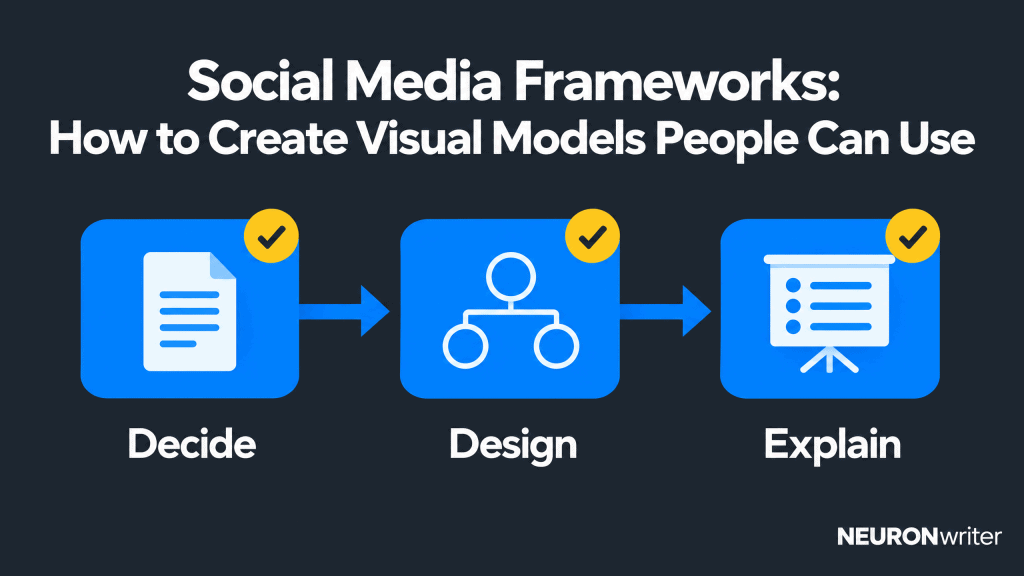
Do not write alternative text that merely lists colours or shapes. Name what the framework helps the reader do. For example: “A three-step framework showing how an editor chooses evidence, selects a visual structure, and adds an accessible explanation before publishing.”
Turn One Good Model Into a Controlled Content System
A framework becomes more valuable when a team can reuse it without losing its meaning or evidence. Create a small library rather than treating every visual as a one-off file. The library should make it easier to find the right model and harder to revive an outdated claim.
Create a small framework library
For each approved framework, retain the intended audience, reader decision, evidence source, owner, original date, review date, and approved adaptations. Add the content pillar it supports and the supporting article where readers can find the full explanation. This turns a social asset into a managed piece of content strategy instead of a forgotten image.
Plan reuse with a content calendar
A content calendar can schedule different versions around different reader questions. One week, the model may introduce a problem. Later, a focused version may explain a decision branch. A third asset can show a common mistake.
Reuse the logic, not the entire image and caption. That protects the audience from repetition while giving the team a consistent visual language.
A social media content calendar should record the audience question, framework variant, supporting source, intended social platform context, and review date. In an effective content marketing strategy, this connects future content to a clear reader action and prevents an approved model from being used without its original evidence.
Review when the evidence changes
Set a lightweight review trigger: a product update, new research, changed policy, new source data, or a repeated reader question that the model no longer answers. Update the image, its text explanation, and its alternative text together. A framework that is visually consistent but factually stale is not an effective social media asset.
Measure Whether the Framework Was Useful
Measure the action a framework was designed to support, not only its visible reach. If the model is intended to help readers decide, look for signs that they understood and used the decision. If it explains a process, look for better questions, more accurate handoffs, or successful completion of the next step.
Useful social media metrics may include saves, meaningful replies, relevant follow-up questions, qualified visits to the deeper resource, or adoption by a sales or support team.
Qualitative feedback matters too: did readers repeat the model accurately, or did they misunderstand its main point? A framework that is widely seen but regularly misread needs a clearer label or a different shape.
Use analytics as a learning aid, not a verdict on one post. Change one variable at a time: the opening explanation, visual hierarchy, source context, or intended call to action.
Keep the core framework stable while you test how it is presented. This makes the next improvement measurable instead of based on a vague impression.
Add a short social listening review to this cycle. Compare social media analytics with the language in questions, replies, and sales conversations.
Your key performance indicators should show whether the framework supports its chosen action; the listening record should show why readers did or did not use it. Together, they make social media performance a practical feedback loop rather than a number in a report.
Common Visual-Framework Mistakes and How to Fix Them
The most common problem is a graphic that looks organised but does not help anyone make a decision. These repairs keep a framework useful and honest.
- A topic list presented as a model: give it a real decision, sequence, comparison, relationship, or stage.
- A crowded diagram: split one broad claim into two focused assets with one action each.
- Vague labels: replace abstract nouns with the reader’s actual question or action.
- Decorative icons: remove them unless they clarify a category, action, or relationship.
- An unsupported outcome claim: add transparent evidence, limit the claim, or remove it.
- A graphic with no usable explanation: add the essential narrative, source context, and accessible equivalent meaning.
How Contadu Can Support a Visual-Framework Workflow
Contadu can help teams connect a visual framework to the documented reader question and source evidence behind it. Begin with recurring audience needs, map the framework to a clear topic, and retain the claims, boundaries, and source language in a content brief. This gives an editor a reliable basis for turning one verified idea into a social asset.
Use the topic plan to decide where the model belongs in a larger content system. A framework may introduce an article, make a research finding easier to share, or give a buyer a concise way to discuss a complex process. Keep the supporting copy and source record with the asset so future creators do not need to guess what its labels mean.
NEURONwriter can help reviewers assess whether the supporting text covers its intended topic clearly. It does not verify a visual claim, prove that a model applies to every reader, or replace source review. The people responsible for the evidence and audience relationship should make those editorial decisions.
FAQ
What is a social media framework?
A social media framework is a reusable model that explains one recurring reader task, such as following a process, choosing between options, comparing trade-offs, or understanding how parts connect. It gives an idea a clear structure so people can scan it and use it without reading a long guide first.
How is a framework different from a content pillar or content calendar?
A content pillar is a broad subject your brand returns to, while a content calendar schedules assets and publishing dates. A framework is the explanatory model inside an asset. One pillar can contain many frameworks, and a calendar can schedule several adaptations of the same framework.
Which visual framework should I choose for a B2B topic?
Choose the shape that matches the reader task. Use a process for ordered steps, a decision model for conditions and choices, a comparison for trade-offs, a system map for relationships, and a maturity model for observable stages of progress. If the reader task is unclear, clarify it before designing.
How many ideas should one visual framework contain?
One central idea is usually enough. Supporting stages, criteria, or labels should all help a reader understand that same point. If the visual contains several unrelated lessons, split it into focused frameworks so each asset has a clear purpose and action.
How do I make a framework accessible?
Use readable labels, sufficient contrast, and more than colour alone to show meaning. Provide alternative text that states the purpose and key relationship, then give a nearby text explanation or table when the model includes detailed information. A non-visual reader should receive the same core conclusion.
Can one framework be reused across social formats?
Yes, provided its claim and evidence remain the same. Adapt the level of detail for each format: a short post can focus on the decision, a document-style sequence can explain stages, and a full article can provide sources and exceptions. Do not reuse a visual unchanged when it no longer fits the audience question.
How do I measure whether a social media framework is useful?
Start with the intended reader action, then combine relevant social media metrics with qualitative feedback. Look for meaningful replies, saves, accurate follow-up questions, use in sales or support conversations, and progress toward the next resource or task. Review whether readers understand the model, not only whether they saw it.