
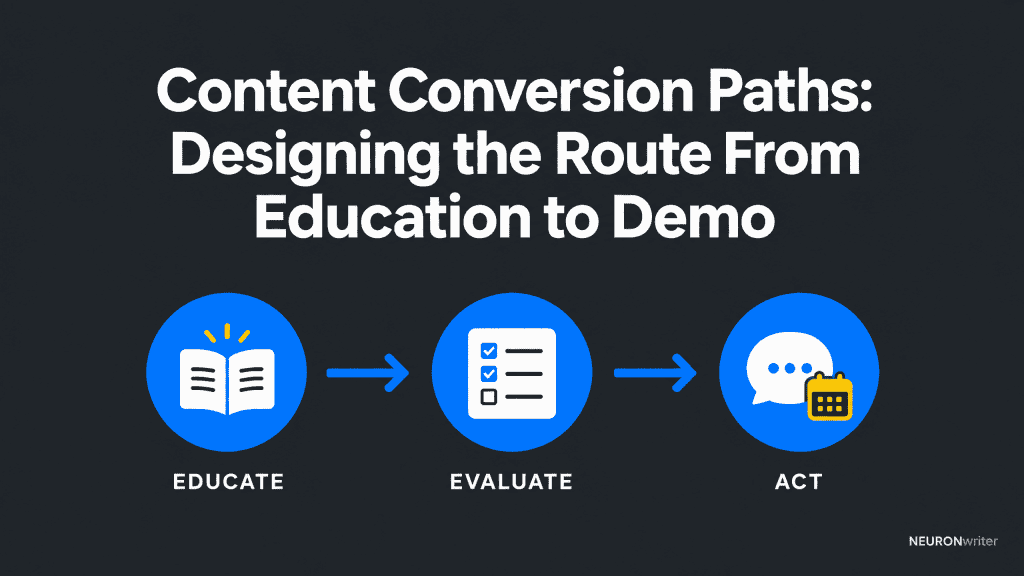
Content Conversion Paths: Designing the Route From Education to Demo
Semantic Summary
Idea: A content conversion path gives readers a useful next step that matches the question they are trying to answer, rather than treating every blog visit as an immediate demo opportunity.
Challenge: Educational articles often end as dead ends, while overly promotional routes create friction before a reader has enough context to make a decision.
Summary: Define the conversion goal, map the reader’s decision stage, connect helpful pages with purposeful calls to action, measure meaningful path steps, and improve the route based on evidence not clicks alone.
Related Reads
- Creating BoFu Content That Actually Converts: The B2B Guide
- Blog CTA Testing: A/B Test Calls to Action Without Hurting the Reader Experience
- Content ROI: How to Measure What Actually Matters (and Prove It to Your CFO)
What a Content Conversion Path Means
A content conversion path is the connected sequence of pages, messages, and actions that helps a reader move toward one defined outcome. It turns useful content into a guided path to conversion, but it does not assume that the only valuable conversion is a demo request.
For a B2B marketer, a conversion path may begin with an organic search visit to an educational article. It can continue through an internal link to a framework, a case study, a calculator, or a product-use-case page. It may end with a newsletter signup, a resource request, product activation, a demo request, or a qualified conversation. The exact destination depends on the reader’s current decision-making process.
Do not confuse this with a sales funnel or a buyer journey. A sales funnel is a broad model of how prospects move from awareness to revenue. A buyer journey describes the research and decision process from the buyer’s perspective, including touchpoints outside your website. A content conversion path is narrower: it is the intentional route your content creates for a reader at a particular moment.
It also differs from CTA testing. Testing a single call to action can improve one link or button. Designing a content conversion path asks whether the entry article, the CTA, the destination, the information exchange, and the follow-up make sense together. A strong CTA cannot repair a weak or irrelevant next page.
Start With a Reader Decision, Not a Demo Request
The most effective content conversion path starts with the decision a reader is ready to make. The aim is not to push every site visitor into the same sales funnel. The aim is to offer the next step that helps the person reduce uncertainty.
Map the current question to the next useful action.
A top-of-funnel reader may only recognise a problem. They need a clear explainer, not a form. A consideration-stage reader may compare approaches and benefit from a decision framework, benchmark, or implementation guide.
At the decision stage, a reader may need proof that the approach works in a similar setting, clear evaluation criteria, or a route to speak with an expert.
Write down the article’s opening question in the reader’s own words. Then ask: what must this reader understand or do before a higher-commitment step would be useful? This turns a vague conversion goal into a practical content plan. It also makes internal links more purposeful because each link resolves the next likely question.
Define one primary conversion goal per path.
Give each path one primary conversion goal. It may be a newsletter signup, a white paper download, an interactive content offer, a product-use-case visit, a free trial, or a demo request. Secondary actions are fine, but they should not compete with the main route.
For example, an article about identifying a process problem may invite a reader to use a related calculator. The calculator result can then offer a detailed implementation guide.
Only after that guide has resolved the core evaluation question might a demo be the right next step. This sequence does not weaken conversion; it makes the request more relevant.
Include existing customers in the path design.
Conversion is not only about becoming a lead. Existing customers may use content to activate a feature, adopt a workflow, expand their use, or complete a task. A help article that leads to successful implementation can be a valuable conversion path even though no form is submitted.
Make this explicit in your content strategy. When teams only count new-lead actions, they may overlook routes that reduce support effort, improve adoption, or create better-informed customer conversations.
Match Content to the Right Next Step
A reader-first path matches the next destination to the level of context a person has already gained. Use this table as a simple planning check before placing a CTA.
| Reader situation | Helpful content now | Sufficient CTA | Next destination |
| Recognises a problem but lacks context | Explainer or how-to article | Explore the method | Related educational guide |
| Evaluates approaches | Framework, benchmark, or comparison criteria | See the decision framework | Use-case or solution page |
| Needs a tailored estimate | Calculator or assessment | Estimate the scenario | Result page and relevant resource |
| Checks implementation risk | Case study, checklist, or documentation | Review the proof | Demo request or expert conversation |
Build the Path From Education to Qualified Action
To create a conversion path that readers will follow, make every step earn the next one. A path should continue the same problem, audience, and promise rather than changing the subject once a person clicks.
1. Audit the entry content and traffic source.
Begin with the page where people enter. Review the title, search query, opening answer, internal links, and page-level CTA. Then review the traffic source. An inbound visitor arriving through organic search may need a different next step from someone who clicked a follow-up email or a paid search ad.
Ask one concrete question: what promise did the reader accept when they arrived here? If the article promises a practical explanation, the first next step should deepen that explanation. If the entry page answers a commercial evaluation question, a product-oriented destination may be appropriate sooner.
2. Create a bridge between education and evaluation.
A bridge asset helps a reader move from “I understand the issue” to “I can evaluate an approach.” It can be a checklist, a case study, a practical template, a calculator, an implementation guide, or a focused content offer. The bridge gives the visitor a way to apply what they have just learned.
For instance, a reader who has learned how to diagnose a content gap may next need a content-audit checklist. A reader comparing process costs may need an estimate.
A decision-support tool can be useful here when it gives an immediate, transparent result; see Using Interactive Calculators as Lead Magnets for the principles behind that kind of asset.
3. Align the CTA, destination, and message.
Message match means the CTA, its destination, and the destination’s opening all continue the same promise. If a blog CTA says “See the evaluation checklist,” the next landing page should lead with that checklist and the reason it matters. It should not begin with an unrelated company overview or a generic new offer.
Use direct CTA language. “Compare the options,” “Estimate the impact,” and “Read the implementation checklist” tell a reader what happens next. “Learn more” is acceptable only when the surrounding sentence makes the destination unmistakable. Contextual links in the body may serve readers better than a large promotional block when the action is part of the explanation.
4. Design the destination for the commitment level.
The right destination can be a relevant article, a resource page, a focused landing page, a short form, or a direct demo request. Match the amount of information you ask for to the value and commitment of the next stage.
A person downloading a short checklist may need only an email address, while a detailed consultation may need a few more qualifying details.
The thank-you page is not an administrative dead end. Confirm what happened, deliver the promised material, explain what comes next, and offer one complementary action.
A follow-up email can continue the route with a related answer, but it should honour the original exchange rather than restart the sales conversation from zero.
Reduce Friction Without Removing Reader Choice
Conversion path optimization means removing unnecessary effort and uncertainty. It does not mean hiding essential information, adding pressure, or treating a click as permission for a sales conversation.
Find the common friction points
Dead-end articles are a common problem: a reader reaches the end of a useful post and finds no relevant next steps. Other friction points include a CTA that does not match the article, a landing page that repeats the same information without adding value, a form with unnecessary fields, and a thank-you page that gives no useful direction.
Look for smaller problems too. A button that is hard to notice on mobile, an internal link that opens an unexpected page, or a form that fails without a clear error message can create drop-off. Friction is not always persuasive copy. It is often a mismatch between what a reader expects and what the page asks them to do.
Make the path usable across devices and contexts
Keep CTAs readable and specific. Use descriptive link text, sensible heading structure, accessible form labels, and destinations that load and work on smaller screens. Avoid placing several competing calls to action in a short passage.
The reader should understand the primary action without having to decode the page.
Check the path on mobile from start to finish. This includes the entry page, the link or button, the landing page, any form, the confirmation page, and the email that follows.
A path that works only on a desktop is not a reliable path to conversion.
Use progressive commitment
Progressive commitment means offering small, voluntary next steps before a major commitment. A reader can move from a guide to a checklist, from a checklist to a practical assessment, and from the assessment to a conversation.
The path is not a fixed sequence for every person, but it gives each reader a route that respects their current level of confidence.
This approach can simplify content decisions. Rather than asking “How do we get more demo requests from this article?”, ask “What is the smallest next action that proves this reader wants to continue?” That may be a better signal of interest and a better experience for the user.
Measure the Conversion Path, Not Just the Last Click
Measurement should show where readers continue, where they drop off, and whether later actions are relevant. A form submission matters, but it does not explain whether the content path created a useful route or merely captured a low-intent new lead.
Set clear events and path steps
An event is a recorded action, such as viewing an entry page, clicking an internal link, opening a landing page, starting a form, completing a form, or submitting a demo request.
Define the event names and the conversion goal before you analyse results. Otherwise, teams can confuse a click with a completed action or mix several paths in one report.
Keep the model small. For a content conversion path, four to six meaningful steps are often enough: entry content, bridge asset, evaluation page, request or signup, confirmation, and qualified follow-up.
If the journey needs more detail, document it separately rather than making a single report impossible to interpret.
Use funnel and attribution evidence carefully.
Google Analytics funnel exploration can visualize the steps users take to complete a task and show how people succeed or fail at each step. Its open and closed funnel options are useful for different questions: an open view can show where people enter, while a closed view can test whether a planned sequence was completed in order.
Google Analytics attribution-path reporting can also show touchpoints leading to key events, including data such as touchpoints and time to key event.Treat this as decision support, not certainty. Attribution models assign credit according to defined rules or account data; they do not prove that one touchpoint caused a conversion.
Segment before declaring a winner.
Conversion rate is the share of a defined group that completes a defined action. It becomes less useful when you combine readers with very different intent.
Compare relevant groups: organic visitors versus newsletter readers, mobile versus desktop, new visitors versus existing customers, or readers of different entry articles.
In a composite B2B content review, an article may appear to underperform when viewed as a single average, but work well for readers who reach it through a specific topic cluster.
Segmenting the data helps a marketer decide whether to fix the article, improve an internal-link route, tailor the CTA, or leave a healthy specialist path alone.
Improve With Controlled Path Optimization
Improve a path by changing one meaningful issue at a time and recording what the evidence says. If you change the CTA, landing page, content offer, form, and follow-up email together, you may gain a short-term result but lose the chance to learn why it changed.
Find the step that underperforms.
Start with the largest relevant drop-off, then investigate the reason. A high exit rate after an entry article may mean the article has answered the question fully, which is not automatically a failure. It may also mean the page offers no next step.
A low click rate on a bridge link may indicate poor placement, weak relevance, or a CTA that appears before the reader has received value.
Combine analytics with qualitative evidence. Review search queries, on-page feedback, sales notes, customer questions, and usability observations. Numbers tell you where to look; reader context helps explain what to change.
Test one plausible improvement.
Choose a change that addresses the observed problem. You might rewrite a CTA to match its destination, add a supporting link after the direct answer, simplify a form, move a case study closer to an evaluation question, or replace a weak content offer. Each test should have a stated hypothesis, a primary metric, and one guardrail metric such as lower-quality follow-up or higher abandonment.
For experiments focused on the CTA itself, use the process in Blog CTA Testing: A/B Test Calls to Action Without Hurting the Reader Experience. Keep the path-level question broader: did the change help the right reader reach a more useful next stage?
Keep a path decision log.
Document the path name, audience, entry page, conversion goal, hypothesis, version, date, result, and next decision. This simple record prevents teams from repeating unsuccessful changes and preserves learning when ownership changes.
Review high-value paths quarterly and when you publish a major new content asset. A path may underperform because its source article is outdated, its destination no longer fits the offer, or its supporting evidence has changed. The right response may be a content refresh, not another CTA.
Common Content Conversion Path Mistakes
Weak conversion paths usually fail because they ask readers to take an action that does not match their question. The table below turns common issues into practical path optimization decisions.
| Mistake | Why it weakens conversion | Better approach |
| Treating every article as a demo page | The reader has not received enough context. | Match the CTA to decision readiness. |
| Sending all readers to one generic landing page | The destination does not continue the content promise. | Create a bridge asset or targeted destination. |
| Measuring only form submissions | Drop-off and low-quality demand stay hidden. | Track meaningful steps and downstream relevance. |
| Overloading one page with competing CTAs | The next action is unclear. | Choose one primary route and limited contextual alternatives. |
| Ignoring existing customers | Valuable activation paths disappear from the plan. | Define adoption and expansion outcomes too. |
| Changing several path elements at once | The team cannot learn what improved. | Test one high-priority change and document it. |
How Contadu Supports Intentional Content Conversion Paths
Contadu can support clearer content conversion paths by helping teams research reader questions, identify content gaps, plan topic clusters, create briefs, and review internal-link opportunities.
The goal is not to add more promotional links. It is to help each content asset answer the next question in a reader’s path to conversion.
Use content intelligence to see where an educational topic needs a bridge asset, where a page needs stronger evaluation evidence, and where a high-intent page needs clearer next steps.
Content planning can connect top-of-funnel explainers with decision-stage resources, while performance review can reveal which paths are helping readers progress and which paths are creating friction.
For SaaS teams, this approach works especially well when content supports product learning as well as demand generation. See Content Marketing for SaaS and Aligning Content Strategy with Product-Led Growth for related ways to connect useful education with business outcomes.
Pre-Publish Content Conversion Path Checklist
Before publishing or revising a path, confirm that the route supports both the reader and the team responsible for follow-up.
- The entry page’s reader question and promise are written down.
- The buyer journey stage and one primary conversion goal are clear.
- A bridge asset exists when a direct demo request would be premature.
- The CTA, destination heading, and destination content share the same promise.
- The landing page or next destination adds value instead of repeating the source page.
- Forms ask only for information needed at that stage.
- The thank-you page and follow-up email continue the original exchange.
- Events, path steps, and the definition of a qualified outcome are documented.
- Links, forms, and destinations are usable on mobile and accessible to all readers.
- An owner and review date are assigned for path optimization.
FAQ
What is a content conversion path?
A content conversion path is the planned sequence of content, links, pages, and actions that helps a reader progress toward one defined outcome. It may lead to a resource, a newsletter, product education, or a demo request. The best path fits the reader’s current question rather than forcing every visitor through the same sequence.
How is a conversion path different from a sales funnel?
A sales funnel is a broad model of how prospects may progress from awareness to revenue. A conversion path is a more specific route made of connected touchpoints, such as an article, CTA, landing page, form, and follow-up. One sales funnel may contain many different content conversion paths.
How is a conversion path different from a buyer journey?
A buyer journey describes how a person researches and makes a decision across all relevant interactions, including those outside your site. A conversion path is the route you intentionally provide on your own content and website. It should support the buyer journey, but it cannot control every touchpoint in it.
Should every blog post lead directly to a demo request?
No. A direct demo request can be appropriate for a decision-stage article that answers an evaluation question. A broad educational article often needs a lower-commitment next step, such as a related guide, calculator, newsletter, or case study, before a reader is ready to speak with sales.
What are the core elements of a conversion path?
The core elements are an entry source, useful content, a relevant call to action, a destination that continues the promise, a conversion mechanism where needed, confirmation, and appropriate follow-up. Not every path needs a traditional landing page or form. The element that matters most is a clear next step that provides value.
How can a team identify drop-off in a content conversion path?
Define the path steps as events, then review the share of readers who continue from one step to the next. Funnel analysis can reveal where readers stop, while reader feedback and page review help explain why. Segment the data by traffic source, entry content, device, and visitor type before deciding that a page is underperforming.
What should a team test first when a conversion path underperforms?
Test the clearest mismatch first: the relevance of the CTA, the message match between source and destination, an unnecessary form field, or the usefulness of the bridge asset. Change one meaningful element at a time and record the hypothesis and outcome. This makes optimization a learning process rather than a cycle of random redesigns.