
LinkedIn Hooks: How to Write Openers That Stop the Scroll
Semantic Summary
Idea: A useful LinkedIn hook gives the right reader a specific reason to continue, then delivers on that promise in the post.
Challenge: Generic curiosity lines, inflated results, copied formats, and requests for likes may win a brief glance but weaken credibility and professional conversation.
Summary: Start with a real tension, a precise observation, a verified result, or a relevant question; match the opening to the body; then judge it by reader quality, not only raw impressions.
Related Reads
- How to Build a “Dark Social” Distribution Engine: The Untrackable Path to Pipeline
- The Role of Employee Advocacy in Content Distribution
- Reddit Content Research: Using Reddit and Quora for B2B Content Discovery
| Check | A credible opening | A weak opening |
| Reader fit | Names a real professional problem, decision, or observation. | Tries to interest everyone at once. |
| Evidence | Can be supported in the post. | Makes a claim the body cannot prove. |
| Curiosity | Leaves a useful question to resolve. | Hides the whole point behind a vague tease. |
| Handoff | Leads naturally to the next sentence. | Has no connection to the body. |
| Conversation | Invites a relevant professional perspective. | Asks for engagement without adding value. |
LinkedIn hooks work when they make an honest, useful promise in the first line or short opening sequence. Their purpose is not to trick someone into clicking “see more.” It is to help the right reader recognise that the post has a relevant point, evidence, or experience worth their time.
A good hook earns attention and then gives it a destination. It signals the professional problem, idea, story, or decision that the post will unpack. A weak hook creates an open loop with no meaningful answer, makes an exaggerated claim, or asks readers to react before it has given them anything useful.
What a LinkedIn Hook Is and What It Is Not
A LinkedIn hook is the opening sentence or short set of opening lines in a post. It helps a reader decide whether to continue. It is not a replacement for the post’s argument, a promise of reach, or a licence to make a claim that the body cannot support.
LinkedIn’s own creator guidance describes a strong post as beginning with an engaging hook, using concise and understandable messaging, sharing a personal perspective or unique take, and asking questions that spark conversation. Those elements are a better standard than trying to imitate a viral post format. A hook builds trust when it makes the reader’s next step clear.
Think of the opener as a compact contract. If you begin with a hard-won lesson, the post should show what happened and why the lesson applies. If you begin with a statistic, give its source and explain what it means. If you ask a question, make sure the post helps a reader answer it. The body must earn the opening.
Start With the Reader’s Tension, Not a Template
The best LinkedIn hooks begin with a narrow tension your intended reader already recognises. Before writing a post, decide whose attention you need and what useful thought, decision, or action the post can support.
Find a specific professional tension
A tension is a gap between what someone expects and what they experience. A team may produce strong research but struggle to explain why it matters. A manager may collect content ideas but lack a reliable way to choose the next one. A buyer may hear a popular recommendation that does not fit their situation.
Write the tension in plain language. “Most planning meetings end with a full list and no decision” is more useful than “Content strategy is difficult.” The first statement points toward a real reader problem. The second gives the writer nothing concrete to prove or solve.
Use audience research carefully. Collect recurring questions, objections, and phrases from customer conversations, sales notes, support themes, and credible community research. Then translate that language into your own clear voice. Do not copy a complaint without context or turn a single comment into a broad claim.
Match the hook to the post’s job
A LinkedIn post usually has one primary job: teach a practical step, reframe a familiar idea, share a first-hand learning, explain verified proof, or begin a thoughtful discussion. The right hook makes that job visible. The same opening cannot serve every post.
For example, a teaching post can start with the specific mistake it will correct. A proof-led post can start with a bounded observation from a real project. A reflection can start with the moment that changed the writer’s view. Decide the job before choosing a LinkedIn hook template; otherwise the opening becomes generic copywriting detached from the content.
Choose a Hook Type That the Evidence Can Support
Use a hook type because it fits the evidence and reader task, not because it appears in a list of “best hooks.” The five types below give a writer different ways to grab attention without promising more than the post can deliver.
The precise observation hook
Lead with a specific pattern the reader is likely to recognise, then explain it. Template: “[Role] teams often lose [outcome] before [moment]—because [specific process issue].” This works when you can name the cause and give an actionable alternative. Do not use it for a vague complaint with no evidence or solution.
The proof-led hook
Begin with a bounded result, source, or first-hand learning. Template: “After reviewing [defined material], I learned [qualified lesson].” Include the scope, not only the conclusion. A proof-led hook builds credibility when readers can see where the lesson came from; it fails when a number is dropped in simply to sound impressive.
The story-moment hook
Open inside a real professional moment. Template: “In [specific situation], we almost [real risk]. The fix was not [common assumption].” A story hook needs a point early in the post. Do not make readers wait through a long personal narrative to discover why the situation matters to them.
The careful contrarian hook
A contrarian hook challenges advice that is incomplete, not people who hold it. Template: “[Common advice] is incomplete when [condition].” The post must explain the condition and offer a better decision rule. A bold statement can create curiosity; an unqualified hot take can create noise without trust.
The decision-question hook
Ask a question that helps the reader reflect on a real choice. Template: “If [specific condition], should [role] still [action]?” The best questions are narrow enough that the body can explore them. Avoid questions designed only to collect comments, such as a broad request for readers to agree or disagree.
These five LinkedIn hook templates are starting structures, not copy-and-paste answers. An effective hook makes people pause because it speaks directly to a recognisable situation. Write like you would explain the idea to a knowledgeable colleague: clear enough to capture attention, specific enough to show that the hook promises a real answer.
Use the Five-Part Hook Quality Test Before Posting
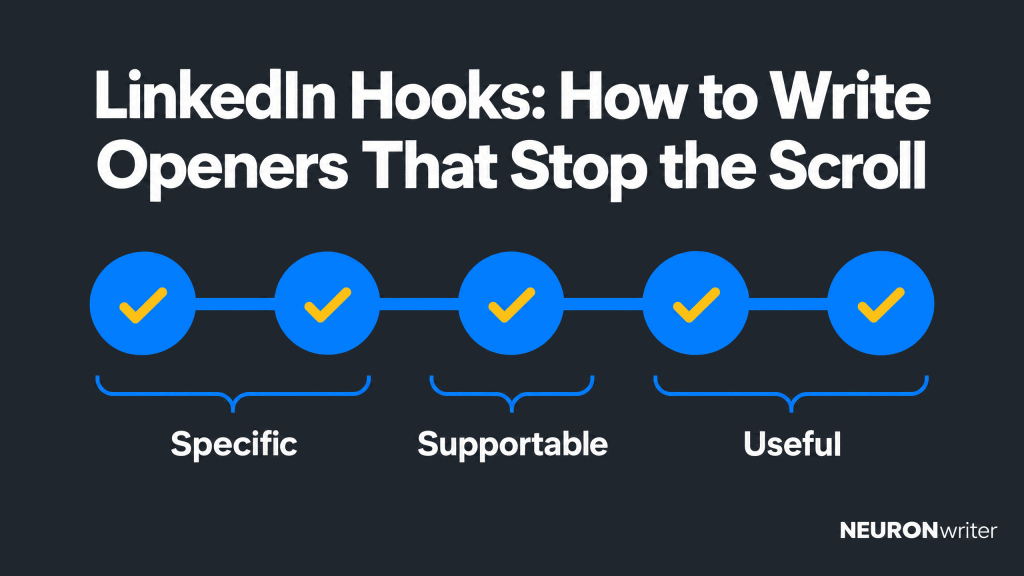
Before publishing, test whether the hook is specific, supportable, useful, connected to the body, and appropriate for professional conversation. This simple review is more reliable than asking whether a sentence merely sounds clever.
- Reader fit: Can you name the person who needs this post and the situation it speaks to? Replace broad phrases such as “anyone who wants to grow” with a real professional context. Specificity helps the right readers feel recognised and helps everyone else move on without being misled.
- Evidence: Can the next paragraphs show why the opener is true? Check facts, direct quotes, client outcomes, and personal stories before using them. A hook that cannot be substantiated may generate a pause, but it damages the reader relationship when the post does not deliver.
- Useful curiosity: An open loop means leaving a relevant question for the post to resolve. For instance, an opening can identify an unexpected constraint, then explain the decision it changed. Curiosity is useful when the answer offers value; it becomes clickbait when the promised answer is missing or trivial.
- Handoff: Read the first three lines together. The second line should add context, and the third should give a reason to continue. If the opening could sit above any other post, rewrite it. A strong hook makes the next sentence feel inevitable.
- Conversation: End with an invitation only when it helps readers add a relevant experience or alternative view. LinkedIn’s content-recommendations guidance discourages engagement bait, including direct requests for likes, shares, comments, or follows. Ask for perspective after you have offered a useful idea, not as a substitute for one.
Write the First Three Lines as a Unit
A LinkedIn hook is stronger when the first three lines work together as a small, complete promise. You do not need a universal character count or a trick for the interface. You need a clear progression from attention to context to value.
Line one names the tension, observation, proof, or question. Line two makes it more specific. Line three tells the reader what they will learn, consider, or be able to do if they continue. This structure gives skimmers a fair preview and gives interested readers a logical route into the full post.
Do not overthink a supposed LinkedIn algorithm rule when the reader’s experience is the real test. Readers want to know what the post is about before they invest attention. If an external link is essential to the point, say what it adds rather than making it a substitute for the explanation in the post.
Here is a general pattern: “[Specific tension]. It matters because [consequence or context]. Here is the [lesson, method, or evidence] that changed how I approach it.” Adapt the language to your brand voice and subject. Do not add drama merely to make people stop scrolling.
Once the post begins, deliver the promised proof quickly. Use short paragraphs, concrete verbs, and one main point per section. If an opening promises an actionable lesson, give the step. If it promises a story, state the learning. If it frames a question, explain the options fairly. This is how an engaging LinkedIn post becomes useful LinkedIn content.
Adjust the opener for the format, not the algorithm
Different formats need different first moves. A text post can name the tension immediately. A LinkedIn carousel template needs a slide-one promise that is clear even when viewed alone. A LinkedIn profile opening should tell a visitor whom you help and how, rather than tease a story that belongs in a post.
Effective hooks do not need to go viral to be valuable. A lead-generating post may need a direct statement of the business problem it helps solve; a reflective post may need a more personal story hook. Choose the right hook for the purpose, then make the body fulfil the promise.
Use AI as a Drafting Partner, Not a Credibility Substitute
AI can help you explore different hook angles, but it cannot supply the experience or evidence that makes the right hook believable. Use it to turn a confirmed topic into several options, flag abstract wording, or compare an opening with the reader task you wrote in the brief.
Keep a human reviewer responsible for personal stories, factual claims, sensitive topics, customer outcomes, and emotional language. An AI-generated opener may sound polished while making the post feel like it could have been written for anyone. Your specific experience, source, and point of view are what make LinkedIn post hooks distinct.
A practical workflow is simple: write the post’s core point and proof first; ask AI for a small range of opening approaches; choose the one that makes the most accurate promise; then run the five-part quality test. Do not let a tool choose the claim you are prepared to stand behind.
Test Hooks Without Chasing Engagement Bait
Test LinkedIn hooks as part of an editorial learning process, not as a contest for the highest visible number. One post can perform differently because of topic, audience, timing, format, or outside events. A single result does not prove that a hook strategy works everywhere.
Run a controlled editorial test
Change one opening variable at a time across comparable posts. You might test a proof-led opener against a precise observation while keeping the audience, topic, format, and body quality similar. Record what changed, what the post was trying to achieve, and what readers did after they encountered it.
Do not force every post into the same format. A story hook may fit a first-hand learning. A decision question may fit a discussion. A direct how-to opening may fit an educational post. Different formats let you learn which types of hooks suit your audience and your expertise.
Read quality signals beside reach
Look beyond impressions. Useful signals can include relevant comments, thoughtful follow-up questions, direct conversations, saves, profile visits, or the next action the post was meant to support. For a B2B writer, a small number of informed replies can be more useful than broad attention from people outside the intended audience.
Write down what the hook promised and whether the body fulfilled it. This adds a qualitative check that metrics alone cannot provide. Over time, the record will reveal not just which hooks drive engagement, but which ones help your LinkedIn profile and broader LinkedIn presence build credibility with the people you want to serve. A hook that makes people pause but sends them away confused is not a success.
Common LinkedIn Hook Mistakes and Better Replacements
Most hook mistakes come from trying to create curiosity before deciding what the reader should learn. The repair is usually a clearer promise, not a more dramatic sentence.
- Vague superlatives: Replace “This will change everything” with the specific decision or lesson the post addresses.
- Unsourced statistics: Replace a striking number without context with a sourced fact and the reason it matters.
- Unqualified contrarian advice: Replace “Never do this” with the condition under which the usual advice fails.
- Copied personal stories: Replace familiar storytelling formulas with a real observation from your work or a transparent source.
- A broken promise: Replace an opening that promises one subject but delivers another with an honest handoff into the actual post.
- Engagement requests: Replace “like, share, and follow” with a focused question that readers can answer from professional experience.
The goal is not to remove personality. It is to make personality useful. A concise, direct opening that speaks to a real professional problem will often do more for a personal brand than a formula that could belong to anyone.
How Contadu Can Support a More Credible LinkedIn Content Workflow
Contadu can help teams turn recurring buyer questions and verified evidence into a more reliable source for LinkedIn content. Rather than starting each post from a blank page, connect the post idea to a documented audience need, a topic cluster, and the evidence that supports its claim.
Use briefs to retain the point behind the hook
A brief can capture the reader, question, core message, evidence, claims to avoid, and useful internal resources. That makes it easier to write a strong opening without losing the body’s purpose. It also gives subject-matter experts a clear place to check whether a proof-led hook accurately represents their work.
Build a series instead of isolated posts
When several posts answer different parts of one buyer question, the hooks can become more specific. A team can move from a broad observation to a detailed method, then to a reflection on what changed in practice. This supports distribution without repeating the same generic promise in every post.
Use evaluation as an editorial check
NEURONwriter can help reviewers assess whether a draft covers its intended topic clearly and reads well for the target query. That supports the editorial review of a post-derived article or content brief. It does not prove that a story is authentic, a hook is truthful, or a post will perform; those decisions remain with the people who own the evidence and the audience relationship.
FAQ
What is a LinkedIn hook?
A LinkedIn hook is the first sentence or short opening sequence of a post. Its job is to tell a relevant reader why the post is worth continuing. A strong hook makes a specific, supportable promise and connects directly to the next part of the post.
How long should a LinkedIn hook be?
There is no universal length that guarantees attention. Keep the opening as short as the idea allows, then use the next lines to add context and value. Review the first three lines together: readers should understand the topic, the tension, and the reason to continue.
Should I write the hook before or after the post?
Either order can work, but drafting the core point and evidence first often produces a more honest opening. Once you know what the post can genuinely prove or teach, it is easier to choose the right hook type and avoid a promise that the body cannot fulfil.
Which types of LinkedIn hooks work best for B2B?
Precise observations, proof-led lessons, real story moments, careful contrarian insights, and focused decision questions can all work for B2B. Choose the type that matches the reader task and the evidence you have. The best hook is not the most dramatic one; it is the one the post can deliver on.
How do I make a LinkedIn hook interesting without clickbait?
Name a real tension, use a specific observation, or ask a question the post will help answer. Provide context and a useful resolution soon after the opening. Avoid vague teases, inflated results, and direct requests for likes or shares; those may attract attention without creating professional value.
Can AI help write LinkedIn hooks?
AI can generate alternative angles, spot vague language, and help compare a draft with a stated reader task. It should not invent personal experiences, customer outcomes, statistics, or emotional claims. A human reviewer must choose the opening that accurately represents the post and its evidence.
How should I measure whether a LinkedIn hook is working?
Compare similar posts over time and track both reach and quality signals. Look for relevant comments, follow-up questions, direct conversations, saves, profile visits, and the intended next action. Also record whether the post body fulfilled its promise, because a high-performing opening that disappoints readers does not build long-term trust.