
How to Build a “Dark Social” Distribution Engine: The Untrackable Path to Pipeline.
You just hit “publish” on a brilliant, 3,000-word piece of original research. Your distribution checklist is complete: you scheduled three LinkedIn posts, sent an email newsletter, and optimized the on-page elements for SEO. Two weeks later, the analytics show a steady trickle of organic traffic, but your pipeline remains flat.
Then, during a sales call, a prospect mentions, “I read that research report you put out. A colleague dropped it in our private Slack channel, and we spent 20 minutes discussing it.”
You check Google Analytics. There is no record of that Slack referral. It is categorized as “Direct Traffic” or simply lost in the void. This is the reality of content marketing in 2026: the most valuable conversations about your brand are happening in places your attribution software cannot see. Welcome to the era of Dark Social. If you want to understand how this impacts your overall content distribution strategy, you need to look beyond traditional metrics.
If your entire distribution strategy relies on trackable clicks and UTM parameters, you are optimizing for the easiest metrics to measure, not the most impactful channels for revenue. This requires a shift towards content personalization at scale, ensuring the right message reaches the right micro-community. In this guide, we will explore how to build a deliberate, structured distribution engine for the untrackable web.
What is Dark Social and Why Does It Dominate B2B?
Dark Social refers to the sharing of content and ideas through private channels where attribution tracking is impossible or highly inaccurate. It encompasses the hidden word-of-mouth networks that drive modern B2B purchasing decisions.
While traditional attribution models obsess over the “last click” before a conversion, Dark Social acknowledges that the actual decision-making process happens much earlier, in private spaces.
The Core Channels of Dark Social.
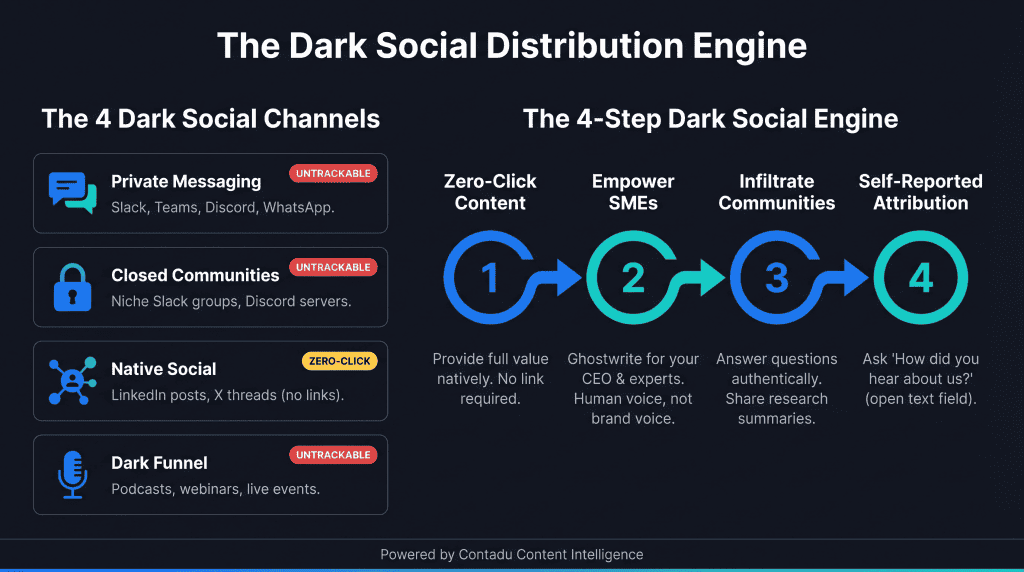
The landscape of B2B communication has fractured into specialized, private communities. The primary channels of Dark Social include:
| Channel Type | Examples | Why It Is “Dark” | Business Impact |
| Private Messaging | Slack, Microsoft Teams, Discord, WhatsApp | Links shared here strip referrers, appearing as “Direct” traffic in analytics. | High trust. Peer-to-peer recommendations carry significantly more weight than branded posts. |
| Closed Communities | Niche Slack groups, private Discord servers, paid mastermind groups | Content is discussed behind login walls; search engines cannot index the conversations. | High relevance. Audiences are highly segmented by role or industry. |
| Native Social Content | LinkedIn text posts, X threads (without external links) | Algorithms suppress posts with external links. Users consume the content entirely in-feed. | High reach. Maximizes algorithm visibility but generates zero trackable website traffic. |
| Dark Funnel Content | Podcasts, webinars, live events | Users listen or watch offline or on third-party apps (Apple Podcasts, Spotify) without clicking links. | High affinity. Builds deep parasocial relationships and brand trust over time. |
The shift toward Dark Social is not a temporary trend; it is a structural change in how professionals consume information. Buyers are overwhelmed by gated content and SEO-optimized fluff. They retreat to private channels to ask peers, “What tools are you actually using for this?” If your content is not part of those private conversations, your brand does not exist in the buyer’s mind.
The Flaw in “Publish and Pray” Distribution.
The traditional content distribution playbook—often called “publish and pray”—relies heavily on renting audiences from platforms like Google or LinkedIn. You post a link, hope the algorithm favors it, and wait for trackable clicks.
This approach fails in a Dark Social world for two main reasons:
1.Algorithmic Suppression: Social media platforms are walled gardens. Their business model relies on keeping users on their platform to serve them ads. In 2026, LinkedIn, X, and other networks actively throttle the reach of posts containing external links. If you only post links to your blog, you are voluntarily reducing your reach by 80-90%.
2.The Attribution Illusion: When a buyer discovers your brand via a LinkedIn post, listens to your podcast for three months, and finally searches your brand name on Google to request a demo, your analytics software credits “Organic Search” for the conversion. The attribution software lies, leading marketing teams to double down on SEO while cutting the podcast budget. This is why building a W-Shaped attribution model is critical for proving true content ROI.
To win in Dark Social, you must shift your mindset from “driving traffic to our website” to “distributing ideas natively where the buyers already are.”
How to Build Your Dark Social Distribution Engine.
Building a Dark Social engine requires a deliberate process of atomizing content and seeding it into private networks. It is not about spamming Slack channels; it is about creating zero-click content that provides immediate value.
Step 1: Master Zero-Click Native Content.
The foundation of Dark Social distribution is creating content that does not require the user to leave the platform. This is known as “zero-click content.”
Instead of writing a LinkedIn post that says, “We just published a new guide on content auditing. Click here to read it,” you must extract the core insights and present them natively.
•The Hook: Start with a strong, contrarian statement or a surprising data point.
•The Meat: Provide the actual framework, the step-by-step process, or the key takeaway directly in the post. Do not hold the value hostage behind a link.
•The Format: Use formatting suited for the platform—carousels on LinkedIn, short threads on X, or native video clips.
When you provide the full value natively, users are far more likely to screenshot the post, copy the text, or share it in their internal Slack channels. You sacrifice the trackable click, but you gain the Dark Social share.
Step 2: Empower Internal Subject Matter Experts (SMEs).
People trust people, not logos. A post from your company’s official LinkedIn page will almost always underperform a post from your CEO, Head of Product, or Lead Strategist.
To build a Dark Social engine, you must leverage your internal Subject Matter Experts.
1.Identify the Voices: Select 2-3 leaders in your company who have unique perspectives and are willing to build their personal brands.
2.Ghostwrite and Facilitate: Do not expect your CEO to write three LinkedIn posts a week. Your content team must act as journalists—interviewing the SMEs, extracting their insights, and ghostwriting the zero-click content for their profiles.
3.Distribute Through Personal Networks: When an SME posts a high-value, zero-click insight, it reaches their network of peers. Those peers are the ones who will take that insight into their private Slack communities.
Step 3: Infiltrate Niche Communities (Ethically).
The most valuable Dark Social channels are private communities Slack groups like RevGenius, Superpath, or specialized Discord servers for developers.
You cannot simply drop links to your blog in these groups; you will be banned for spamming. Instead, you must participate authentically.
•Monitor Conversations: Have your team members actively monitor relevant channels for questions related to your expertise.
•Answer with Value, Not Links: When someone asks a question, provide a detailed, thoughtful answer directly in the thread. If you have a relevant article, you can mention it at the very end (“I wrote a deeper dive on this if you want the link”), but the native answer must be complete on its own.
•Share Original Research: Private communities love exclusive data. If you publish original research, share a summary of the most surprising findings in the community. Frame it as “We just ran some data on X, thought this group might find it interesting.”
Step 4: Redefine Measurement with Self-Reported Attribution.
If you cannot track Dark Social with software, how do you measure its impact? You ask the buyer.
The most critical component of a Dark Social engine is implementing Self-Reported Attribution.
Add a mandatory, open-text field to your high-intent forms (e.g., “Request a Demo” or “Talk to Sales”). The question should be simple: “How did you hear about us?”
Do not use a dropdown menu. Dropdown menus force buyers into your predefined categories (e.g., “Social Media,” “Search”). An open-text field allows them to tell you the truth.
You will start seeing answers like:
•”My boss sent me your LinkedIn post in Slack.”
•”Heard your CEO on the XYZ podcast.”
•”Someone recommended you in the Product Marketing Discord.”
This qualitative data is the only way to prove the ROI of your Dark Social distribution efforts.
Managing Content Distribution with Contadu.
Building a Dark Social engine requires a massive amount of content atomization. You need to take one core Pillar Page and turn it into ten LinkedIn posts, five X threads, and three community discussion prompts. Doing this manually is incredibly time-consuming.
This is where Contadu Content Intelligence transforms your workflow. While Contadu is known for semantic SEO, its AI-driven architecture is built to support complex distribution strategies.
•AI-Powered Atomization: Use Contadu AI agents to instantly generate platform-specific variations of your core content. Feed your 3,000-word article into the system, and instruct the AI to extract the top three contrarian opinions for LinkedIn carousels, ensuring the tone matches your SMEs.
•Content Inventory Management: Keep track of which core assets have been distributed across which channels. Contadu helps you map your content library, identifying high-performing pieces that are ripe for repurposing into zero-click formats.
•Semantic Consistency: When atomizing content for Dark Social, the core message must remain consistent. Contadu ensures that the semantic entities and key concepts from your original research are accurately preserved across all micro-formats.
By integrating Contadu into your distribution workflow, you can scale your Dark Social presence without linearly scaling your content team’s headcount.
Conclusion: Embrace the Darkness.
The obsession with perfect attribution has led many B2B marketing teams astray. They optimize for the channels they can measure, ignoring the channels where buyers actually communicate.
Building a Dark Social distribution engine requires a leap of faith. You must accept that your most valuable marketing efforts will not show up in a neat HubSpot dashboard. By focusing on zero-click content, empowering your SMEs, engaging authentically in private communities, and relying on self-reported attribution, you can influence the hidden conversations that drive real revenue in 2026.
FAQ: Dark Social Distribution.
How do we convince leadership to invest in channels we cannot track?
Start by implementing self-reported attribution (“How did you hear about us?” open-text field) on your demo forms immediately. Within 30-60 days, you will have qualitative data proving that buyers are discovering you through podcasts, Slack, and LinkedIn, even if the analytics software says “Direct.” Use this data to justify the investment.
Does zero-click content hurt our SEO efforts?
No. Zero-click content and SEO serve different purposes. SEO captures active demand (people searching for a solution). Zero-click content generates passive demand (educating buyers before they know they need a solution). They are complementary strategies; you need both to build a robust pipeline.
How much of our content should be dedicated to Dark Social vs. SEO?
This depends on your maturity. If you have no organic baseline, you might focus 70% on SEO and 30% on distribution. However, iIn 2026, as AI Overviews reduce traditional search clicks, forward-thinking B2B brands are shifting toward a 50/50 split, or even prioritizing Dark Social distribution for their most valuable thought leadership. For more on navigating this shift, read our Zero-Click SEO Survival Guide.
Can we automate posting to private Slack or Discord communities?
Absolutely not. Automating posts to private communities violates their norms and will get your brand banned instantly. Community engagement must be manual, authentic, and driven by real team members providing genuine value.
What is the best format for Dark Social distribution?
The format depends entirely on the platform. For LinkedIn, document carousels and text-only posts with strong hooks work best. For Slack/Discord, plain text summaries of data or insightful questions are ideal. For podcasts, it is the spoken word. The key is native formatting never force a user to click a link to get the value.