
The Role of Employee Advocacy in Content Distribution
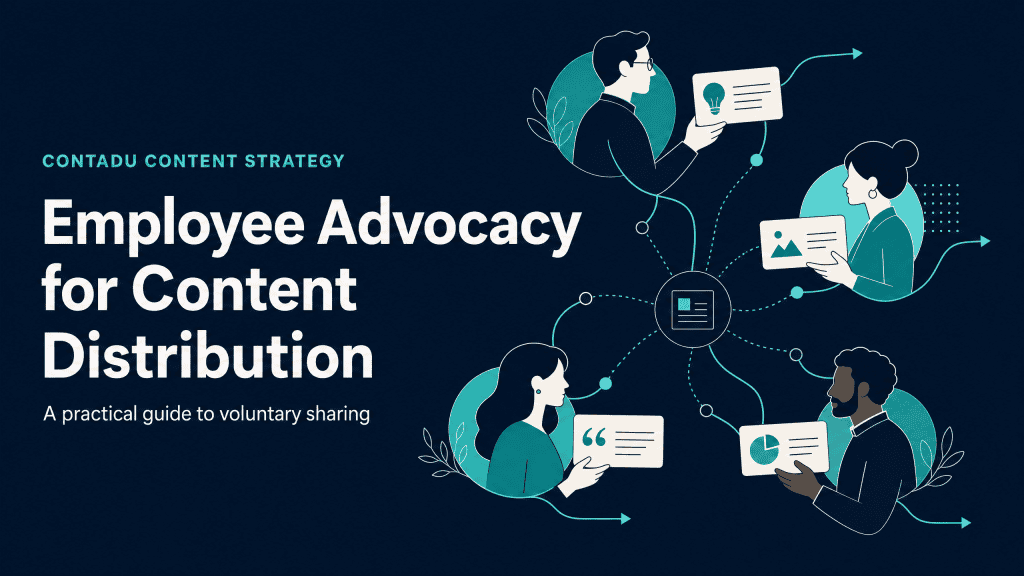
Idea: Employee advocacy extends content distribution when people share useful work insight in their own words. It should add context to brand channels, not turn employees into a compulsory reposting network.
Challenge: Generic copy, unclear approval rules, forced participation, and claims people cannot support can weaken both employee trust and audience trust.
Summary: Build an opt-in program with a useful content menu, clear guardrails, practical enablement, and a feedback loop. Measure content quality and meaningful audience actions before you try to connect advocacy to pipeline.
Related Reads
- How to Build a “Dark Social” Distribution Engine: The Untrackable Path to Pipeline
- Content Distribution: The AI-Powered Playbook Beyond “Publish and Pray”
- Content Atomization: The Ultimate Guide to Maximizing Your Content ROI
Employee advocacy helps content travel further when employees share ideas they genuinely understand and consider useful to their own professional network. In a B2B setting, that can mean a product specialist explaining a common implementation question, a customer-facing colleague sharing a lesson from a recurring workflow, or a leader adding a clear point of view to a research finding.
The goal is to give willing people useful material and freedom to decide whether it fits their audience. That makes advocacy a practical extension of your content distribution strategy.
What Employee Advocacy Content Actually Is
Employee advocacy content is useful material that employees choose to share or create to help a professional audience. It can include a company article, but it works best when the employee adds a reason, a lesson, a question, or a careful example from their own role.
Employee Advocacy Is Voluntary Distribution, Not Mandatory Promotion
Participation should be voluntary. Personal professional channels belong to the person using them. Invite people to participate, offer training, and make good content easy to find. Do not make posting a general condition of belonging to the team.
The benefits of employee advocacy appear when participation builds employee engagement, not compliance. A successful employee advocacy program lets people share content they understand and follows clear guardrails.
The Difference Between Brand Content and Employee-Led Insight
Brand content is published by the company and needs a clear editorial purpose. Employee-led insight is shared through an employee’s voice. It may point to the same guide, but explains why the topic matters from a real job perspective.
Both forms are useful. Brand content provides a stable source page; employee insight adds context to it. Do not ask employees to hide their employer relationship. Clear context is more credible than artificial distance.
Where It Fits in a Content Distribution System
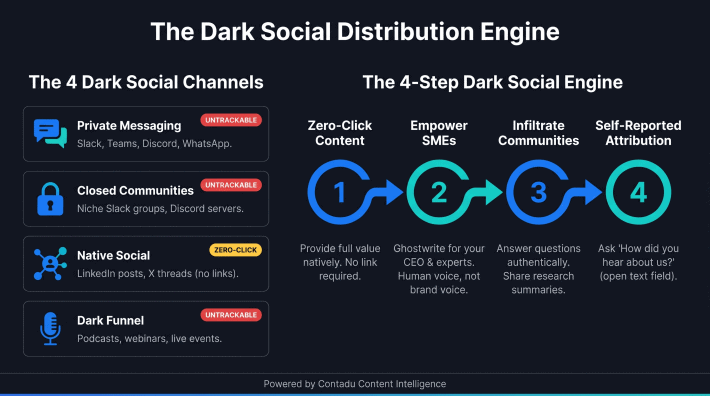
Employee advocacy is one channel in a wider system. It works alongside brand publishing, newsletters, sales enablement, events, customer education, community conversations, and the private sharing patterns often described as dark social. It is not a replacement for a clear website or a good content hub.
Use employee sharing when content benefits from a human explanation. A technical guide may need a short note from someone who has seen the problem, while research may need a leader’s view of the decision it changes.
Why Employee Advocacy Matters in B2B Distribution
Employee advocacy matters because B2B content often needs context before it earns attention. Buyers and peers are busy. A company post may introduce a topic, while an employee can explain why the topic matters to a particular role, team, or decision.
It Adds Context That a Brand Channel Cannot Provide Alone
A brand channel needs a consistent voice, but it can be broad. Employees can add useful detail: “This is the question customers ask before changing a process.”
That does not mean employees should reveal confidential information or make promises the company cannot prove. It means the content team should give them source material and examples that are safe to discuss. The best employee advocacy content makes a useful point without requiring an employee to become an untrained spokesperson.
It Helps a Useful Idea Travel Through Employee Networks
Employee social networks vary. Relevant content shared by employees can reach practitioners, customers, peers, or people facing a similar work problem.
Do not measure only reach. Relevant replies, saves, shares, or visits to a high-value resource can be more useful than passive impressions. Ask whether the piece led to a meaningful next action.
It Creates a Listening Loop for the Content Team
Employee advocacy also gives the content team feedback. If employees hesitate to share a piece because it feels too promotional, too vague, or incomplete, that is useful editorial evidence. If a subject matter expert receives the same question repeatedly after a post, that question may deserve a new article, FAQ section, or sales enablement asset.
Use this feedback with search research and customer conversations to build around real questions, not a spreadsheet-only calendar.
The Content Employees Are Most Likely to Share
The most shareable employee advocacy content gives the employee a good reason to add their own perspective. Start with useful work problems and practical learning, not with a request to amplify every company announcement.
Practical Lessons From Their Work
Checklists, process lessons, common mistakes, and short “what we learned” posts are good starting points. They let an employee help peers without claiming that one answer fits every organisation. Make the source content clear enough that the employee can confidently explain it in a few sentences.
Original Points of View and Employee Stories
Employees can share a point of view on a change in their field, a lesson from a non-confidential project, or a question they are still exploring. These posts should be honest about what the person knows and where the observation comes from. A thoughtful question can be as useful as a polished conclusion.
Customer-Safe Proof and Event Learning
Customer proof can work when it is verified, permitted, and described in the right context. Event learning can work when employees focus on the discussion, not just a photo or a headline. Give people approved details, source links, and any limits on what they can say before asking them to post.
Curated Brand Content With a Real Reason to Share
Curated brand content is still valuable. The employee should know what problem the asset solves, who it is for, and why the timing matters. A short introduction such as “We built this because content teams kept asking how to choose between refresh, consolidation, and retirement” is more helpful than “New post—read now.”
| Content type | Why an employee may share it | Guardrail | Useful outcome to observe |
| Practical checklist | It helps peers complete a familiar task. | Explain the limits; do not present it as universal advice. | Saves, qualified visits, or follow-up questions. |
| Original work lesson | It adds a real perspective to a common problem. | Remove confidential details and unsupported claims. | Thoughtful comments or peer discussion. |
| Research finding | It gives the employee a reason to discuss an industry change. | Link to the evidence and keep the conclusion accurate. | Visits to the research or shares with context. |
| Customer-safe proof | It illustrates a relevant result or workflow. | Use only approved, verified details and permissions. | Evaluation-page visits or informed sales questions. |
| Event learning | It shows what practitioners discussed or asked. | Do not attribute comments without permission. | Replies from people facing the same question. |
| Curated company guide | It gives the employee a trusted source page to recommend. | Add a personal reason; avoid copying a generic script. | Relevant page visits and return engagement. |
Build an Employee Advocacy Content System
A useful employee advocacy program starts small, stays voluntary, and makes participation easy. Do not begin by trying to activate the whole company. Begin with a small group of people who already care about the topic and want a clearer way to share useful insight.
An employee advocacy pilot program builds buy-in for employee advocacy before a wider launch. Ask employee advocates which ideas they can explain, make employee participation optional, and recognise helpful input rather than volume. Employee adoption improves when people can choose content that fits their role and have a clear advocacy strategy for sharing it.
Employee advocacy is a marketing strategy, not a scheduling exercise. Encourage employees to share content when it is useful and allow them to share content on social media in their own words. Employee recognition should value helpful contributions, not a fixed number of posts.
1. Set an Honest Participation Promise
Write down what the program is and is not. State that participation is optional, employees can skip any item, and nobody needs to endorse a product or idea they do not believe in. Explain what support the company will provide: content access, subject matter review, example introductions, training, and a contact for questions.
Be clear about what the company wants to learn: which topics employees find credible, which questions appear in replies, and which assets attract qualified traffic. “Everyone must post three times a week” is not a content strategy.
2. Select a Small Pilot Group
Choose volunteers from roles that represent different audience questions, not simply people with the largest follower counts.
Invite the group to shape the program. Ask what they would share, what blocks them, and what support would help.
3. Give People a Content Menu, Not a Script
Provide a small menu of content options for each campaign or month. For each item, include the reader problem, intended audience, source link, a short summary, possible discussion questions, approved evidence, and any limits on claims or customer information. Employees should be able to choose an item and adapt it to their own voice.
A script may be useful for a technical or regulated topic, but it should not be the only acceptable post. Identical posts look automated and discourage participation.
4. Set Claim, Customer, and Disclosure Guardrails
Guardrails are practical rules that help people share confidently. They should cover confidential information, customer names and outcomes, product promises, regulated claims, sensitive topics, and required review. Keep the policy short, with examples of what is allowed, what needs approval, and who can answer a question quickly.
In the United States, the FTC explains that an employment relationship can be a material connection when someone endorses a brand, and that the connection should be clear to the audience. The FTC also says that disclosures should be hard to miss and written in clear language. This is general information, not legal advice. Ask your legal and HR teams to set rules for your markets, roles, and channels.
5. Create an Easy Feedback Loop
After a sharing period, ask employees what was easy, what felt uncomfortable, which questions appeared, and what material was missing. Share the results back with the group. If people say a guide is too broad to introduce in their own words, improve the guide or create a narrower companion asset.
This feedback loop shows what people can explain, what audiences ask, and where a message needs clearer evidence.
Governance That Protects People and the Brand
Good governance makes employee advocacy safer without slowing approval for every sentence. Reserve review for situations that carry real risk.
Keep Participation Opt-In and Respect Personal Channels
Employees should decide whether to participate and what to share. Respect different communication styles and boundaries. An internal subject matter interview can be as valuable as a public post.
Make Employment Relationships and Promotional Claims Clear
When a post endorses a company product or service, make the employment relationship clear where required or appropriate. Use plain language and place it close to the claim.
Employees should also speak only from experience they genuinely have. The FTC’s guidance says that an endorser cannot claim experience with a product they have not tried or make claims that the advertiser cannot support. This is a useful editorial rule even outside a formal endorsement situation.
Define What Needs Review and What Does Not
A formal employee advocacy program needs clear review rules. Routine learning posts may be safe, while customer results, product claims, security statements, and regulated topics may need review.
Train for Examples, Not Just Policy Documents
Training should use short examples: one good post, one post that needs a disclosure, one that reveals too much, and one that makes an unsupported claim. Let employees practise rewriting them. A ten-minute example session is often more useful than a long policy document that people read once.
Measure Employee Advocacy Without Reducing It to Reach
Measure employee advocacy as a learning and distribution system, not as a race for impressions. Start with the quality of participation and the usefulness of the content. Then examine audience actions and, where appropriate, the contribution to a longer pipeline journey.
Track Participation and Content Quality First
Track how many people choose to participate, which content types they select, whether they add a meaningful point of view, and what feedback they provide. These measures show whether the program is healthy. If employees only share the same promotional asset once, the problem may be the content menu, not the employees.
Connect Shared Content to Useful Audience Actions
Look for actions that indicate relevance: a thoughtful reply, a request for the source, a visit to a guide, a sign-up for a relevant resource, or a follow-up conversation with a known account. Add clear tracking where it is appropriate, but do not treat every click as a sales signal.
Private sharing can matter too. A guide may be copied into a team chat, sent to a colleague, or discussed in a meeting without an obvious tracking event. That is why employee advocacy belongs beside a dark social strategy, not solely inside a last-click report.
Use Campaign Results to Improve the Content Menu
Review each cycle: identify content employees choose, useful questions, and company content that needs better proof. Use this learning to shape the next advocacy strategy.
If the team wants to report business contribution, use the same careful approach described in Contadu’s guide to content ROI. Separate activity data from sales-reviewed outcomes, state your attribution rules, and explain what the program taught you.
Common Employee Advocacy Mistakes
The common mistakes are usually operational, not creative. Teams damage participation when they treat employees as brand ambassadors or a distribution channel rather than people with professional judgment.
Turning People Into a Distribution Channel Without Consent
Mandatory participation produces weak posts and quiet resistance. It can also create unnecessary HR and legal risk. Keep the program opt-in and recognise contributions in ways that do not pressure employees to speak publicly.
Giving Everyone the Same Promotional Copy
Identical posts are easy to distribute but rarely useful. Give people a content menu, facts they can verify, and optional prompts. Let them add their own lesson or choose not to post.
Incentivising Volume Instead of Useful Contribution
Rewards based only on volume can push people toward shallow posting. If you recognise participation, consider effort, helpfulness, learning, and adherence to the program’s guardrails not only clicks or post count.
Ignoring Feedback From Employees and Sales
Employee feedback shows whether a content asset is credible. Sales feedback shows whether the audience question is commercially relevant. Review both before you decide that an advocacy program has succeeded or failed.
How Contadu Helps Make Employee Advocacy Content Easier to Run
Contadu helps content teams create the useful source material that makes voluntary advocacy possible. Instead of asking employees to share broad promotional messages, teams can use content intelligence to find questions worth answering, identify gaps in existing coverage, and prepare briefs that give subject matter experts a clear role.
One strong source asset can become an employee-ready insight, checklist, FAQ answer, and relevant internal links. This makes participation part of a repeatable content operation, not a one-off campaign.
Frequently Asked Questions
What is employee advocacy content?
Employee advocacy content is a useful article, insight, checklist, example, or discussion point that an employee chooses to share or create for a professional audience. It may link to company content, but it should also give the employee a genuine reason to add their own context.
Is employee advocacy the same as employees sharing brand posts?
No. Sharing a brand post can be one part of employee advocacy, but the stronger model gives employees a choice of useful content and room to explain why it matters. Employee led context is what separates advocacy from simple reposting.
Should employee advocacy be voluntary?
In most cases, yes. Voluntary participation supports trust and produces more credible sharing. If public communication is an explicit part of a particular role, document the responsibility clearly and involve appropriate HR and legal stakeholders.
What content should employees share on social media?
Employees should share content they understand and can discuss honestly, such as practical lessons, public research, approved customer-safe proof, event learning, or a useful company guide. They should avoid confidential details, unsupported product claims, and content that does not fit their audience.
Do employees need to disclose that they work for the company?
In the United States, the FTC says an employment relationship can be a material connection when someone endorses a brand and should be made clear to the audience. Requirements vary by market and context, so use your company policy and obtain legal guidance where needed.
How do you start an employee advocacy program?
Start with a small group of volunteers, a simple participation promise, a content menu, clear rules for claims and customer information, and a short feedback cycle. Do not wait for a large rollout or a new platform before learning whether employees find the content useful enough to share.
How should a company measure employee advocacy?
Track voluntary participation, the quality and type of content shared, useful audience actions, employee feedback, and sales feedback where relevant. Treat reach and clicks as activity signals, not as automatic proof of revenue. Use a documented attribution approach before reporting pipeline contribution.