
Content Syndication SEO: Medium, Substack, and Canonical Rules
Semantic Summary
Idea: Content syndication can help a useful article reach new readers when the original page on your owned site remains the clear source of record and every distribution version has a defined purpose.
Challenge: Full reposts across several platforms can create competing versions, weak attribution, confusing canonical signals, and reporting that shows clicks without showing whether the work helped the business.
Summary: Publish the original first, check the destination’s current controls before you republish, use a canonical link where it is reliably supported, and choose an excerpt or adapted version when it is not.
Related Reads
- The Content Cannibalization Playbook: How to Find and Fix It Before It Kills Your Rankings
- Content Distribution: The AI-Powered Playbook Beyond “Publish and Pray”
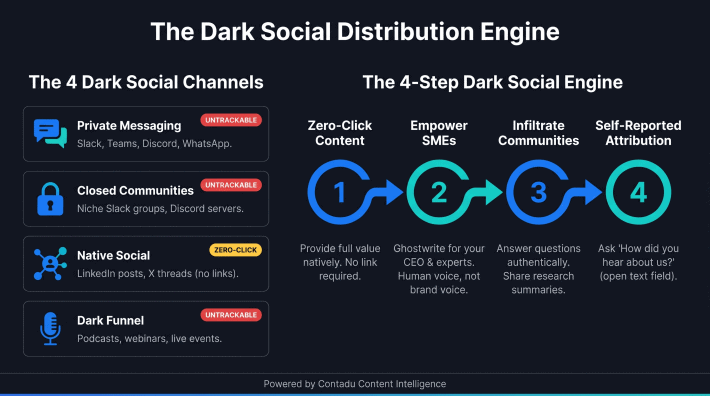
- How to Build a “Dark Social” Distribution Engine
Content syndication SEO is not a way to copy an article everywhere and hope for more traffic. It is a controlled distribution decision: you republish or adapt a piece of content for a new audience while protecting the role of the original page, making attribution clear, and giving readers a useful next step.
What Content Syndication SEO Means
Content syndication is the intentional republication of content that already exists somewhere else. In a sound content syndication strategy, the original content remains on an owned site, while a partner publication, community, or publishing platform receives a full version, an excerpt, or a new adaptation.
The purpose is not merely to create another URL. It is to introduce a strong idea to people who may not discover the source site on their own.
This makes syndication different from guest posting. A guest post is created as a new, original contribution for the destination. Content syndication involves republishing content that starts with an existing piece of content.
It is also different from ordinary social sharing, where a short post sends readers to the original without reproducing the article itself.
Why the original page must remain the source of record
Your owned page should contain the fullest, most maintained version of the work: the complete explanation, supporting evidence, internal links, relevant product context, and update history.
It is where you can correct a claim, improve a section, and connect the reader to the next helpful resource.
That source-of-record role also makes your SEO work easier to manage. When a team publishes the original first and links to it consistently, it creates a clearer story for readers and search engines.
It does not force a search engine to select the URL you prefer, but it removes avoidable mixed signals.
Full repost, excerpt, or adaptation?
The right format depends on the destination and the reader’s job. A full repost can make sense when the platform supports a canonical link to the owned original and the article will reach a genuinely new audience.
An excerpt works when the destination is mainly a discovery channel. An adaptation works best when the destination has a different reader relationship, format, or expectation.
For example, an owned guide about content distribution might become a concise essay for a newsletter audience: one key lesson, one relevant example, and a visible link to the full guide. That gives the destination a complete thought without creating an unnecessary, near-identical copy.
How Canonical Rules Work in Syndication
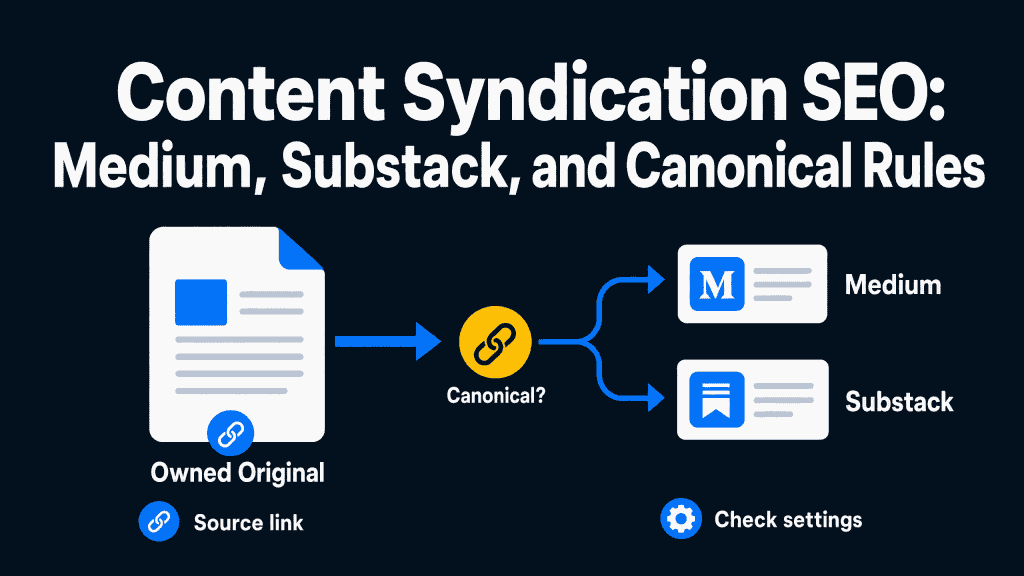
A canonical link tells a search engine which version of a substantially similar set of pages you prefer, but it is a preference signal rather than a guarantee. Google describes a rel=”canonical” link as a strong canonicalization signal and may still select another URL when other signals conflict or suggest a better representative page.
That distinction matters. A canonical is useful, but it does not make a weak syndication process safe by itself. You still need a clear source page, correct links, consistent metadata decisions, and a destination that is worth serving.
What a canonical link should do.
On a syndicated duplicate, the canonical link should point to the original, preferred page using its full URL. On the original page, use a self-referential canonical link. Google also recommends linking internally to the preferred URL and avoiding conflicting canonical signals across page markup, sitemaps, and site links.
Do not treat robots.txt as a canonicalization tool. It is a crawler-access file, not a way to declare which duplicate is preferred. Also do not add noindex simply because a page is similar; that choice removes the page from search instead of expressing a preference among similar pages.
Why canonicalization does not remove all risk.
A canonical link cannot repair a poor publishing decision. If a destination publishes first, changes the headline and text substantially, omits source attribution, or uses different signals elsewhere on the page, the original and distributed versions may no longer present a clean relationship.
The result can be uncertainty about which page readers see in search and which version earns referral attention.
The practical answer is simple: make the source page better than the distribution version, publish it first, and verify the actual published page rather than assuming an editor’s promise was implemented correctly.
Canonical checks to complete before you publish.
- Confirm the original article is live, indexable, and uses its own preferred canonical URL.
- Decide whether the destination will publish a full copy, excerpt, or adapted version.
- Agree in writing on the source attribution and destination link.
- If a full copy is planned, confirm that the destination can point its canonical URL to the owned original.
- After publication, inspect the destination page source and confirm the live canonical and source link.
- Record the live URL, publication date, owner, format, and next review date in a distribution log.
Medium: When a Full Syndicated Version Can Make Sense
Medium can be suitable for a full syndicated version when you use its current canonical controls correctly and the article has a real reason to reach readers there. Medium’s import workflow says that imported stories automatically receive a canonical URL pointing to the original source. It also states that you may import only content you have the right to use.
Use the import workflow or set the canonical manually.
If you are bringing in a published article from your owned site, the import route is often the clearest starting point because it uses the original URL as the source material.
Medium also allows the story author to set a canonical link manually in its advanced settings for a story that was originally published elsewhere.
Those controls do not replace editorial judgment. Before you republish, ask whether the complete article will be genuinely useful to Medium readers. If the answer is no, write a focused version around one problem, add fresh context, and link to the original guide rather than publishing the entire text again.
Verify the live version after publication.
Do not stop at the import screen. Medium recommends checking the published page source and searching for the canonical reference to confirm the setting is present. This takes minutes and catches a problem when it is still easy to fix.
Also check the visible reader experience. The byline should be accurate. The source link should be understandable without technical knowledge. The ending should give a relevant next action, such as a deeper guide, a related framework, or a practical template on the original site.
Substack: Choose the Publishing Model Before You Repost
For a newsletter destination such as Substack, choose the editorial format before you paste a full article into the editor. Platform controls can change, and a team should verify the current publishing options before treating a full duplicate as a canonicalized copy. If you cannot confirm a reliable canonical setup, an adapted essay or a newsletter summary is often the safer choice.
Three useful ways to distribute on a newsletter platform.
A full repost is appropriate only when the technical and editorial relationship to the original is clear. An adapted essay uses the same insight but changes the framing, examples, and structure for subscribers.
A newsletter summary gives readers the core takeaway, a short explanation, and a prominent link to the full source.
For most B2B teams, the adapted essay is the better default. Newsletter readers often expect a personal point of view, a timely observation, or a compact lesson. Give them that rather than a copy of a long guide they could read elsewhere. The owned article can remain the comprehensive resource, while the newsletter helps a different audience understand why the topic matters now.
Keep ownership and measurement explicit
Third-party distribution can expand reach, but it does not replace an owned content system. Use tagged links to identify visits from each destination. Keep the main conversion paths, related resources, and data capture on the owned site where possible.
The goal is not to force every reader to click immediately; it is to know whether a distribution version introduced qualified people to the right next resource.
A Practical Content Syndication SEO Decision Matrix
The distribution format should follow the strength of the canonical control and the audience need. Use this table before you syndicate content across multiple platforms.
| Publication model | Canonical control | Main benefit | Main risk | Recommended use |
| Medium import | Medium states that import adds a canonical to the original source. | Fast full repost for a new reader group. | Assuming the live setting without checking it. | Use for a proven evergreen article after the owned original is live. |
| Medium post with manual canonical | Story author can set a canonical in advanced settings. | Editorial flexibility while retaining source attribution. | Incorrect or missing canonical after edits. | Use when the story is republished with light editorial changes. |
| Adapted Substack essay | Verify current controls; do not assume a full repost is canonicalized. | Fits newsletter voice and can add distinct value. | Creating a thin rewrite with no new reason to exist. | Use when the subscriber context needs a different angle or lesson. |
| Newsletter summary or excerpt | No duplicate-management dependency beyond a clear source link. | Low duplication risk and a clear route to the full guide. | Giving away too little value to earn reader attention. | Use when you want discovery and measurable traffic to the source. |
Questions to answer in an editorial syndication brief
Before you syndicate content, write down the source of content, the goal of the placement, and the version of the content the destination will receive.
Ask whether the original content on your site is complete and indexable, whether the audience needs a full copy or a distinct adaptation, and whether the source link can remain visible. This turns content syndication strategies into a repeatable SEO strategy rather than an improvised publishing task.
Not all syndication platforms are created equal. A free content syndication option may be useful for discovery, while paid content syndication may be designed around lead capture or gated content. In either case, the same SEO best practices apply: make the original piece of content clear, avoid duplicate content issues, and verify the live page before reporting a result.
Content syndication partners should also agree on attribution, editing rights, and the measurement link before you publish your content.
When a team republish your content across a relevant destination, it should be able to explain the SEO value without promising rankings.
The benefits of content syndication can include reaching new readers, stronger distribution learning, and a better content marketing conversation. The impact of content syndication on SEO performance depends on the content, the destination, and whether the search engine can understand the preferred source.
Build a Controlled Syndication Process
Effective content syndication is a repeatable editorial process, not a one-off publishing request. The process should help a content team decide what to distribute, where to place it, what the destination must include, and how success will be reviewed.
1. Select the right piece of content.
Choose high-quality content with a clear problem and a stable shelf life. A foundational guide, strong original research, or a decision framework is usually a better candidate than a time-sensitive announcement. The source should already be accurate, useful, and connected to internal resources that help readers go deeper.
Do not distribute a piece of content just because it performed well once. Ask whether the new audience shares the same need and whether the content has a relevant next action for that group.
This is how you distribute your content with a purpose and preserve its SEO benefits instead of simply exposing your content more widely.
2. Define one destination-specific purpose.
Give each syndication partner a role. One might provide reach among specialists. Another may support a newsletter relationship. A third may introduce a proof point to an account-based audience.
If every placement uses the same copy, same CTA, and same measure of success, the team is not running content distribution strategically.
Choose a syndication platform for reader fit and publishing control, not just apparent reach. Whether a team uses free distribution or content syndication services, it should be able to place a clear link to the original content and verify what appears after publication.
When content is syndicated, that final check shows whether attribution, canonical information, and the reader’s next action survived the editorial workflow.
3. Create a small publishing brief.
Before publishing, document the original URL, proposed destination URL, format, canonical requirement, visible attribution wording, source link, publication date, and measurement link. This brief protects continuity when an editor, writer, or distribution partner changes.
It is also where you record what must not change. For example, a legal claim, a data point, or a customer quote may need a fresh review before a distributed version goes live. Source accuracy matters more than publishing speed.
4. Measure outcomes at three levels.
First, measure distribution: did the destination publish the right version, with the right source link and agreed format? Second, measure reader action: did people read, click through, subscribe, or continue to a relevant owned resource? Third, measure business contribution: did the content assist a meaningful conversation, sign-up, or opportunity?
A referral click is useful evidence, but it is not the whole value of a syndication effort. A reader may discover a brand through a newsletter, return through direct search weeks later, and convert only after reading a comparison page or a customer story.
Use consistent tracking and a brief sales feedback loop to understand that longer path. Successful content syndication is measured by the quality of this reader journey, not by whether content is republished on the largest possible number of sites.
Common Mistakes That Create Avoidable Risk
Most content syndication problems come from unclear ownership and rushed publishing, not from the idea of republishing itself. The following mistakes are easy to avoid when the workflow is documented.
SEO content syndication works best when you syndicate your content selectively. Different types of content need different treatment: a stable research guide may suit a full version, while a timely point of view may be better as an adaptation.
This is part of content creation, not an afterthought after publishing. Use content syndication to expose a relevant idea to new readers, but do not let the distribution copy become the only version readers can find.
When avoiding duplicate content, keep the difference between a technical risk and a business decision clear. A duplicate content penalty is not an automatic result of a legitimate repost, but conflicting pages can still harm SEO clarity.
Your SEO efforts should therefore include a visible source link, a documented syndication process, and a review of the content you syndicate. These controls also make it easier to ensure your content syndication efforts are useful to readers rather than merely increasing the number of URLs.
Publishing every version at the same time.
Publish the owned original first. Give it time to become the clear source page, then distribute based on a planned cadence. Publishing multiple full copies simultaneously removes a simple signal that your team controls.
Treating canonicalization as a promise.
Google uses canonical hints together with other signals. A canonical link is valuable, but it does not guarantee that the preferred URL will be shown in every search result. Keep your technical signals consistent and make the original page stronger than the copies.
Copying metadata and CTAs without thought.
A distribution version should retain accurate attribution, but it does not need to reuse every element of the source page. Adapt the headline, opening, and CTA to the reader’s setting while keeping the source link unmistakable. A generic “read more” link is less useful than a clear explanation of what the reader will find on the original page.
Choosing a destination only for apparent reach.
Reach without relevance is not a content strategy. Review the destination’s readers, editorial standards, source-link treatment, and reporting access. If the platform cannot support the relationship you need, use an excerpt or adaptation instead of a full copy.
How Contadu Helps Run a Controlled Syndication Workflow
Contadu helps content teams choose strong source pages before they distribute them and keep the original content system coherent afterward.
Use topic coverage and content scoring to identify useful, durable pages. Use content briefs to define the reader question and source evidence for an adapted version. Use internal-linking opportunities to make sure the owned original remains connected to the cluster that gives it context.
Contadu can also support the review loop. Teams can track which themes produce strong content, identify gaps exposed by partner-audience questions, and turn feedback from a distribution placement into the next owned asset.
This keeps syndication connected to content strategy rather than treating it as a separate publishing task.
Frequently Asked Questions
What is content syndication SEO?
Content syndication SEO is the practice of republishing or adapting content for another destination while managing the relationship between that version and the original. The goal is to reach relevant new readers without creating avoidable confusion about the source page.
Does syndicated content hurt SEO?
Syndicated content is not automatically harmful, but similar versions can create competing signals. Publish the owned original first, keep source attribution clear, and use a canonical link when the destination reliably supports it. Google treats canonical links as strong signals, not guarantees.
Should I use a canonical link when republishing on Medium?
Yes, when you are publishing a full version that originally appeared on your site. Medium says its import workflow adds a canonical link to the original source, and story authors can also set a canonical link through advanced settings. Check the published source code after publication.
Can Google choose a different canonical page?
Yes. A canonical link expresses a preferred URL, but Google can select a different canonical when signals conflict or its systems identify another representative version. Consistent links, metadata, sitemaps, and source quality help make your preference clearer.
Is syndication the same as guest posting?
No. Syndication begins with content that already exists on another site, while a guest post is normally new original content written for the destination. Both can contribute to content distribution, but their ownership, source, and measurement rules are different.
What should I publish on Substack if I cannot confirm canonical controls?
Publish an adapted essay or a useful newsletter summary instead of a full duplicate. Give readers a complete takeaway, add fresh context for subscribers, and include a prominent link to the original owned guide for the full resource.
How do I measure content syndication?
Track whether the correct version was published, whether readers clicked or engaged with the source material, and whether the placement later assisted a meaningful business action. Combine tagged source links with a simple distribution log and feedback from sales or customer-facing teams.