
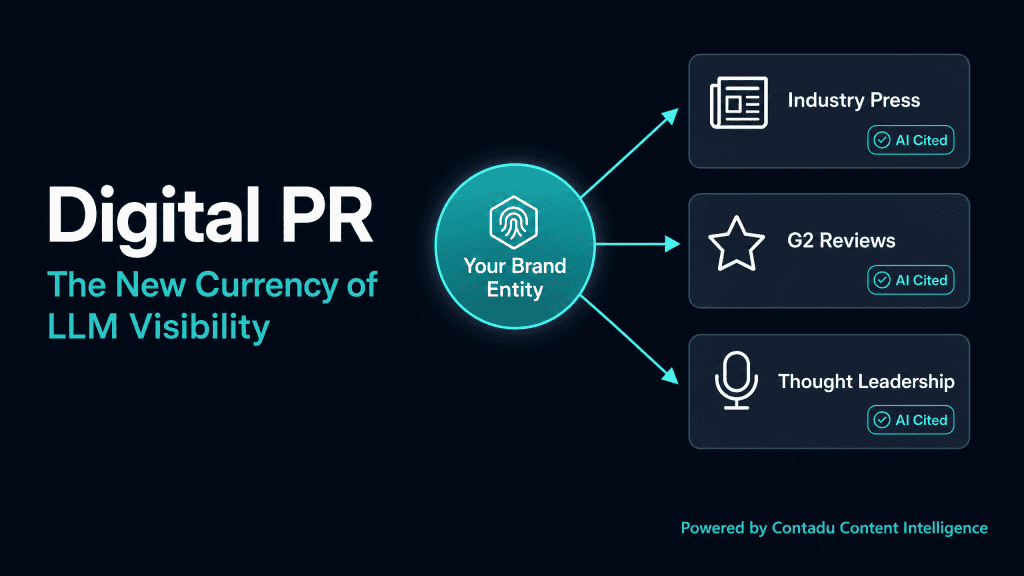
The Role of Digital PR in LLM Visibility.
“Listen to this article”
📍 Semantic Summary
Idea: Traditional SEO relied on backlinks to build domain authority. In the era of AI Answer Engines (ChatGPT, Perplexity, Claude), the new currency of trust is Entity Salience built through Digital PR. Large Language Models (LLMs) evaluate the credibility of a brand by analyzing its co-occurrence with positive sentiment across the entire web ecosystem.
Challenge: Many B2B companies still view Digital PR purely as a brand awareness exercise or a traditional link-building tactic. They fail to structure their PR campaigns to feed extractable facts and entity associations into the training data and real-time retrieval systems of LLMs.
Summary: To achieve high LLM Visibility, Digital PR must evolve. It is no longer just about securing a backlink on a high-DR site; it is about ensuring your brand is mentioned in the right semantic context on platforms that AI engines trust. This guide outlines how to align Digital PR with Generative Engine Optimization (GEO).
Read the full guide below, or explore related topics:
- Search Everywhere Optimization: Beyond Google in 2026
- Measuring LLM Visibility: Metrics That Matter in 2026
For years, the SEO and PR departments operated in silos. PR chased brand awareness and media placements, while SEO chased do-follow backlinks and anchor text. If a PR campaign resulted in an unlinked brand mention on a major news site, the PR team celebrated, while the SEO team considered it a missed opportunity.
In 2026, the rise of AI Answer Engines has forced a merger of these two disciplines. In the world of Large Language Models, an unlinked brand mention in a highly authoritative, semantically relevant article is often more valuable than a forced backlink on a mediocre blog.
This is the new reality of Digital PR for LLM Visibility. Here is how to execute it.
Why LLMs Care About Digital PR.
To understand why Digital PR is the foundation of Generative Engine Optimization (GEO), you must understand how models like ChatGPT and Perplexity determine what is true and what is biased.
When a user asks Perplexity, “What is the best content intelligence platform?”, the engine does not just look at Contadu’s homepage. It knows vendor websites are inherently biased. Instead, its Retrieval-Augmented Generation (RAG) system searches for third-party consensus.
It looks for:
- Co-occurrence: How often does the entity “Contadu” appear in the same paragraph as the entity “content intelligence”?
- Sentiment: When these entities co-occur, is the surrounding text positive, negative, or neutral?
- Source Authority: Are these mentions happening on trusted platforms (G2, industry news sites, Reddit) or low-quality affiliate blogs?
Digital PR is the mechanism by which you engineer this positive co-occurrence across high-authority sources.
The 3 Pillars of AI-Optimized Digital PR.
To maximize your Share of Model Voice (SOMV), your Digital PR strategy must focus on three specific pillars.
Data-Driven Storytelling (Information Gain).
AI models crave data. They are designed to extract facts and statistics to answer user queries. If you want to be cited by an LLM, you must be the source of the data.
The Tactic: Conduct original research, surveys, or analyze your own platform data. Publish a comprehensive “State of the Industry” report. When you pitch this to journalists, you are not pitching your product; you are pitching the data. When high-authority news sites write about your data and mention your brand as the source, you establish massive Entity Salience.
The “Surround Sound” Strategy on Aggregators
For B2B SaaS, review aggregators (G2, Capterra, TrustRadius) are the most trusted third-party sources for AI engines evaluating software.
The Tactic: Treat your G2 profile as a PR asset. Run campaigns to generate highly detailed, use-case-specific reviews from your customers. A review that says, “Contadu’s semantic entity mapping feature helped us increase traffic by 40%” is infinitely more valuable to an LLM than a review that just says, “Great tool.”
Executive Thought Leadership (Quotable Statements).
When LLMs synthesize answers about industry trends, they look for authoritative quotes from recognized experts.
The Tactic: Position your C-suite executives as industry visionaries. Secure guest columns, podcast interviews, and podcast appearances. Ensure they speak using Quotable Statements—concise, definitive sentences that an LLM can easily extract and attribute to them (and, by extension, your brand).
Optimizing the PR Pitch for AI Extraction.
When your PR team secures a placement, the structure of that placement matters. You want to make it as easy as possible for an AI crawler to understand the context.
- Semantic Clarity: Ensure the journalist uses your brand’s exact entity name and the correct industry terminology.
- Contextual Proximity: The mention of your brand should be physically close to the core topic of the article. If the article is about “Semantic SEO,” your brand should be mentioned in the paragraphs discussing that specific topic, not just in a boilerplate author bio at the bottom.
- The Link Still Helps (But Isn’t Mandatory): While unlinked mentions build entity association, a link helps the AI crawler easily navigate back to your Knowledge Graph to verify the information.
Measuring the Impact of Digital PR on LLMs.
You cannot measure this with traditional backlink checkers. You need to measure entity presence.
- Prompt Testing: Regularly prompt ChatGPT, Claude, and Perplexity with unbranded, bottom-of-funnel queries (e.g., “Compare content intelligence tools for enterprise”). Track how often your brand is mentioned and the context of the mention.
- Brand Search Volume: Effective Digital PR drives zero-click searches in AI engines, which often translates into an increase in direct brand searches on Google.
- Sentiment Analysis: Use tools to monitor the sentiment of your brand mentions across the web. LLMs are highly sensitive to negative consensus.
Conclusion: The New Currency of Trust
In the age of Generative AI, trust is decentralized. You can no longer rely solely on your own website to convince buyers (or AI engines) of your value.
Digital PR is no longer an optional brand awareness tactic; it is a mandatory technical requirement for Generative Engine Optimization. By feeding the web ecosystem with high-quality data, expert insights, and positive third-party validation, you ensure that when the AI speaks, it speaks your name.
FAQ
Q: Are unlinked brand mentions really as valuable as backlinks for AI SEO?
A: Yes. For LLMs, the semantic relationship (co-occurrence) between your brand name and a topic on a trusted website is a massive trust signal, regardless of whether there is a clickable hyperlink.
Q: How do I get journalists to use “Quotable Statements”?
A: Provide them with press releases and media kits that are pre-formatted with the Inverted Pyramid structure. Give them concise, punchy quotes from your executives that are ready to be copied and pasted directly into their articles.
Q: Does social media PR (like LinkedIn) impact LLM visibility?
A: Yes, especially for models that have access to real-time social data or partnerships (like Google’s access to Reddit). High-engagement posts from industry experts mentioning your brand contribute to your overall Entity Salience.
Q: How long does it take for a Digital PR campaign to influence an AI Answer Engine?
A: It depends on the engine’s retrieval mechanism. For RAG-based engines like Perplexity that search the live web, a high-profile news mention can be cited within hours. For models relying on static training data, it may take months until the next training run.
Q: Should my PR team stop asking for backlinks?
A: No. Backlinks are still crucial for traditional Google SEO and help AI crawlers discover your content. However, the PR team should no longer consider a placement a “failure” if the publication refuses to include a link, provided the semantic context is strong.
Q: What is the biggest mistake B2B companies make with Digital PR today?
A: Pitching product features instead of data. Journalists (and the AI engines that read their articles) do not care about your software update. They care about industry trends, proprietary statistics, and novel insights.
Q: How does Contadu fit into a Digital PR strategy?
A: Contadu helps you identify the semantic gaps in your industry. By analyzing what entities and topics are currently underserved, you can guide your PR team to conduct research and pitch stories that fill those exact gaps, ensuring maximum Information Gain.