
Measuring LLM Visibility: Metrics That Matter in 2026.
📍 Semantic Summary
The Idea: Traditional SEO metrics like search volume, keyword rankings, and organic traffic are insufficient for measuring success in the era of AI Answer Engines. As zero-click searches become the norm, B2B marketers must adopt a new framework: LLM Visibility.
The Challenge: How do you measure the ROI of your content when users get their answers directly from ChatGPT or Perplexity without ever clicking through to your website? Relying on Google Analytics alone will make it look like your content strategy is failing, even if your brand is dominating AI recommendations.
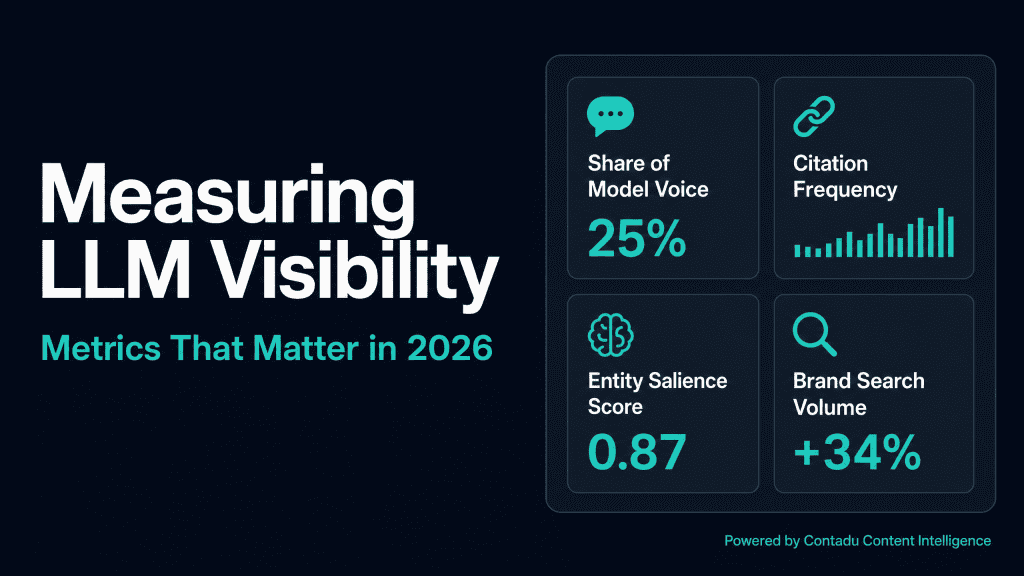
The Summary: To accurately track performance in 2026, you must measure Share of Model Voice (SOMV), track Entity Salience Scores, monitor citation frequency across major Large Language Models (LLMs), and correlate brand search volume with AI mentions. This guide explains how to implement these new metrics.
Read the full guide below, or explore related topics:
- Beyond Traffic: New KPIs for Content Marketing in the Age of Generative Search
- Zero-Click Search Strategy: How to Gain Visibility When No One Clicks
For two decades, the digital marketing dashboard has looked exactly the same. We tracked keyword positions. We tracked click-through rates (CTR). We tracked organic sessions in Google Analytics. If the line went up, the strategy was working.
In 2026, that dashboard is lying to you.
As B2B buyers increasingly turn to Large Language Models (LLMs) like ChatGPT, Perplexity, and Google’s AI Overviews for complex research, the traditional “click” is disappearing. Users are receiving synthesized, highly accurate answers directly in the chat interface. They don’t need to visit your website to learn about your product.
If you judge your 2026 content strategy solely by website traffic, you will conclude that you are failing. Meanwhile, your competitors, who are actively optimizing for Generative Engine Optimization (GEO), are quietly capturing your market share inside the AI chat windows.
To survive, you need a new measurement framework. You need to learn how to measure LLM Visibility.
The Problem with Traditional SEO Metrics in 2026.
The core issue with traditional metrics is that they require a transaction: the user must trade a click for information. AI Answer Engines have eliminated this transaction.
- Keyword Rankings are obsolete: LLMs don’t have a static “Page 1.” The answer generated depends entirely on the user’s specific, conversational prompt, their previous chat history, and the model’s current weights.
- Search Volume is misleading: A keyword might show 10,000 monthly searches in Ahrefs or Semrush, but if 80% of those searches are resolved by an AI Overview without a click, the commercial value of that volume is drastically lower than the tool suggests.
- Organic Traffic is incomplete: When ChatGPT cites your brand as the best solution for a problem, the user might simply open a new tab and type your URL directly. Google Analytics will record this as “Direct Traffic,” completely masking the fact that the AI drove the acquisition.
The New Framework: Metrics for LLM Visibility.
To measure success in the era of generative search, you must shift your focus from tracking where your links appear to tracking how your brand is perceived and recommended by algorithms. Here are the four critical metrics for 2026.
1. Share of Model Voice (SOMV)
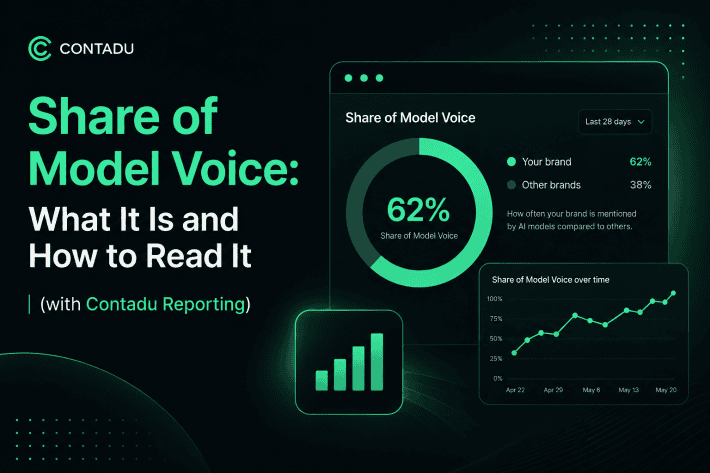
In traditional PR, Share of Voice (SOV) measures how much of the industry conversation your brand owns compared to competitors. Share of Model Voice (SOMV) applies this concept to LLMs.
SOMV measures how frequently an AI model recommends your brand or product when prompted with a category-level query.
How to measure it:
You cannot rely on static tools for this. You must run systematic, automated prompt testing. If you sell CRM software, you would prompt ChatGPT, Perplexity, and Claude with queries like:
- “What are the top 5 CRMs for mid-market manufacturing companies?”
- “Compare Salesforce, HubSpot, and [Your Brand].”
- “What CRM has the best API for custom integrations?”
If you run 100 category-relevant prompts and your brand is recommended in 25 of them, your SOMV is 25%. Your goal is to track this percentage month-over-month to see if your Entity SEO efforts are moving the needle.
2. Citation Frequency and Position.
Unlike ChatGPT’s early days, modern AI Answer Engines (especially Perplexity and Google AI Overviews) provide citations. Getting cited is the new equivalent of ranking on Page 1.
However, not all citations are created equal. You must track two factors:
- Frequency: How often is your domain linked as a source for informational queries in your niche?
- Position (The “First-Third” Rule): Research indicates that LLMs place higher weight on the sources they cite early in their response. Being citation #1 or #2 carries significantly more semantic weight than being citation #6 at the very bottom of the generated text.
How to measure it:
Advanced platforms like Contadu Content Intelligence are building modules specifically to track citation velocity across AI platforms. Alternatively, you can use specialized rank trackers that have pivoted to monitor AI Overview inclusion rates for your target topics.
3. Entity Salience Score
Entity Salience is a measure of how confidently an AI model associates your brand with a specific concept, topic, or industry.
If your brand has high salience for the entity “Semantic SEO,” the AI doesn’t need to search the live web to know who you are; the association is baked into its neural network weights. High salience prevents entity ambiguity and ensures you are included in zero-click summaries.
How to measure it:
You can test this by using Google’s Natural Language API (or similar NLP testing tools). Input your brand name and your core industry terms. The API will return a salience score (typically from 0.0 to 1.0). The closer to 1.0, the stronger the mathematical relationship between your brand and the topic in the eyes of the algorithm.
4. Correlated Brand Search Volume.
Because you cannot track the direct click from a conversational AI recommendation, you must look for the echo of that recommendation in traditional search.
When an LLM recommends a B2B software platform, the user’s next step is almost always to Google the brand name to find the official website, check pricing, or read reviews.
How to measure it:
Monitor your Google Search Console for spikes in exact-match brand searches (e.g., “Contadu pricing,” “Contadu reviews”). If your traditional organic traffic is flat, but your exact-match brand search volume is growing steadily, it is a strong indicator that your LLM Visibility strategy is working. The AI is doing the top-of-funnel education, and Google is simply facilitating the navigational click.
Building Your 2026 Reporting Dashboard.
To communicate the value of your content strategy to leadership, you must combine these new metrics with traditional business outcomes. A modern reporting dashboard should look like this:
| Metric Category | Specific KPI | What It Tells You |
| AI Visibility | Share of Model Voice (SOMV) | Are LLMs recommending you over competitors? |
| Authority | Citation Frequency | Is your content being used as the source of truth? |
| Navigational Intent | Brand Search Volume Growth | Are users looking for you after chatting with AI? |
| Business Impact | Qualified Demo Requests | Is the overall strategy driving revenue? |
Conclusion: Stop Chasing Clicks, Start Chasing Context
The transition from SEO to Generative Engine Optimization (GEO) requires a painful but necessary shift in how we define success. If you cling to click-through rates and session volume, you will optimize for a user behavior that is rapidly disappearing.
By measuring Share of Model Voice, Entity Salience, and citation frequency, you align your KPIs with the reality of 2026. You stop chasing clicks, and you start building the deep, contextual authority required to dominate the AI Answer Engines.
FAQ.
Q: Is Google Analytics completely useless now?
A: No. Google Analytics is still vital for measuring user behavior once they are on your site (conversion rates, time on page, event tracking). However, it is no longer a reliable tool for measuring top-of-funnel brand discovery, as it cannot track interactions that happen entirely within a ChatGPT window.
Q: How do I increase my Share of Model Voice (SOMV)?
A: Increasing SOMV requires a comprehensive Entity SEO strategy. You must publish highly authoritative content with strong Information Gain, engineer positive co-occurrence around your brand name, and actively pursue brand mentions on third-party sites that LLMs trust.
Q: Can I use Ahrefs or Semrush to track LLM visibility?
A: Traditional SEO tools are adapting, and many now offer features to track whether a keyword triggers a Google AI Overview. However, for standalone platforms like ChatGPT and Claude, you will need specialized AI tracking tools or automated prompt-testing scripts.
Q: What is a “good” Entity Salience score?
A: Salience scores are relative. A score of 0.8 is excellent, but if your top competitor has a score of 0.95 for the same topic, you will still lose the AI recommendation. The goal is to consistently outscore your direct competitors for your core macro-entities.
Q: How do I prove ROI to my boss without traffic numbers?
A: You must change the narrative. Show them the correlation between Share of Model Voice and exact-match brand search volume. Ultimately, tie your GEO efforts to bottom-of-funnel metrics: if organic demo requests are increasing while generic organic traffic is flat, the AI strategy is working.
Q: Do backlinks still matter for these new metrics?
A: Yes, but the context of the backlink matters more than the link juice. A brand mention (even without a link) in a highly authoritative, semantically relevant article builds Entity Salience much faster than a traditional hyperlink on a low-quality directory site.
Q: How often should I test my SOMV?
A: LLM weights and web indices update frequently. It is recommended to run automated prompt tests for your core category keywords at least once a month to track trends and identify if a competitor is suddenly dominating the AI’s recommendations.