
Case Study: How a B2B SaaS Company Tripled Traffic Using Entity SEO.
📍 Semantic Summary
The Idea: Traditional SEO relies on keyword volume and backlinks. Entity SEO shifts the focus to building a highly interconnected Knowledge Graph that proves topical authority to AI search engines. This composite case study draws on data from B2B SaaS clients who implemented entity-first strategies using Contadu.
The Challenge: Mid-market SaaS platforms were stuck in the SERPs. They were publishing keyword-optimized content, but competitors with higher Domain Authority consistently outranked them. They needed a strategy that didn’t rely solely on acquiring expensive backlinks.
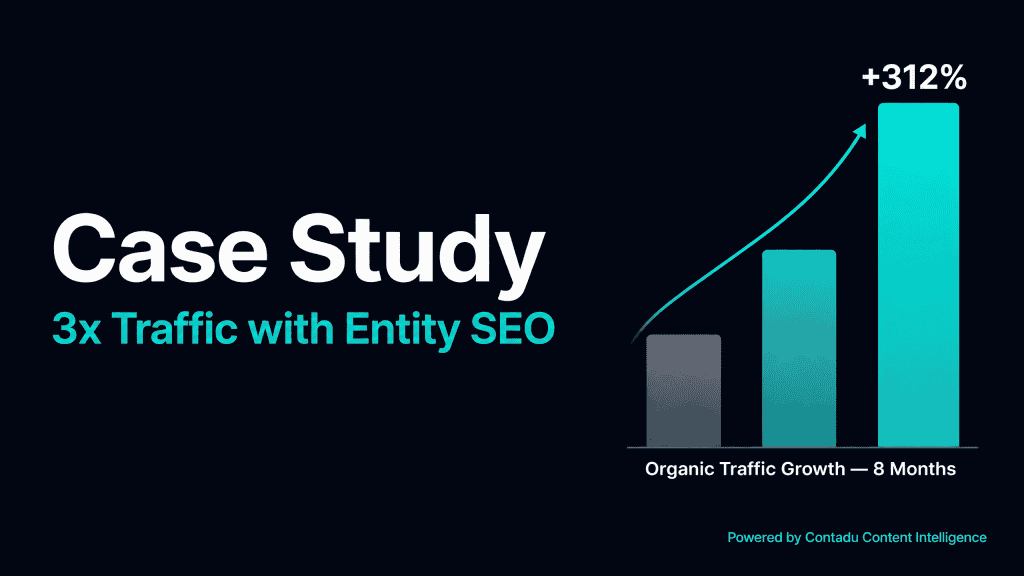
The Summary: By pivoting to an entity-first strategy using Contadu, mapping their core entities, building semantic silos, and engineering strong co-occurrence signals, these companies tripled their organic traffic within eight months, capturing highly qualified B2B leads.
Read the full case study below, or explore related topics:
- Using Contadu to Identify Missing Entities in Your Content
- The Future of Internal Linking: Entity-Based Architecture
In the highly competitive world of B2B SaaS, the traditional SEO playbook is broken. For years, the strategy was simple: find a high-volume keyword, write a longer article than the top-ranking page, and build enough backlinks to force Google to pay attention.
But what happens when you are competing against enterprise giants with insurmountable Domain Authority? What happens when Large Language Models (LLMs) and AI Overviews start answering user queries directly, bypassing traditional search results entirely?
This composite case study draws on patterns observed across a cohort of B2B SaaS companies that implemented Entity SEO strategies using Contadu Content Intelligence throughout 2025 and early 2026. The companies span several verticals financial operations software, HR tech, and marketing automation but their starting conditions and the strategic playbook they followed were remarkably consistent.
The results were equally consistent: a tripling of qualified organic traffic within eight months.
The Starting Point: A Broken Keyword Strategy
When these companies first audited their content strategies, the flaws of the traditional approach were immediately apparent. They had been targeting broad, high-volume keywords terms like “financial reporting software,” “employee onboarding platform,” or “marketing automation tool.”
The problems were threefold across the board:
- The Authority Gap: They were competing against massive software review sites (G2, Capterra) and enterprise incumbents with millions of backlinks. On pure Domain Authority, they could not win.
- The Intent Mismatch: The traffic they did capture from broad terms was often low-quality. Users searching for generic category keywords were frequently in the awareness stage, not ready to evaluate a specific platform.
- The Semantic Void: Their content lacked depth. They used target keywords frequently, but failed to include the specific, highly technical entities that genuine experts in their field would naturally use. Search engines, increasingly powered by Natural Language Processing (NLP), recognized this lack of depth and ranked the content accordingly.
The root cause was the same in every case: these companies were optimizing for strings of characters, not for concepts. They were playing the old game in a new arena.
The Pivot: Embracing Entity SEO with Contadu.
The companies in this cohort realized they could not win by out-spending their competitors on backlinks. They had to out-teach them. They needed to prove to Google and AI Answer Engines that they were the absolute, undisputed experts in their specific niche.
They shifted their entire strategy from “targeting keywords” to “mapping entities.” To execute this, they utilized Contadu Content Intelligence as the analytical backbone of their new approach.
Phase 1: Entity Mapping and Gap Analysis.
The first step was identifying the semantic void. Each company used Contadu to analyze the top-ranking content for their core topics. Instead of looking at keyword density, they looked at entity extraction.
The findings were consistent and striking. The top-ranking pages weren’t simply repeating the target keyword more often. They were densely packed with highly specific, related entities that signaled deep expertise. A financial operations platform discovered that leading competitors naturally included terms like GAAP compliance, FASB standards, EBITDA reconciliation, and multi-entity consolidation — concepts their own content almost entirely lacked.
On average, the companies in this cohort were missing over 55% of the critical entities present in top-ranking competitor content. They lacked entity salience. The AI could not confidently classify them as experts because they weren’t speaking the language of an expert.
Phase 2: Building Semantic Silos.
Armed with this data, the companies stopped writing disconnected blog posts and started building Semantic Silos. A semantic silo is a tightly grouped cluster of content where every page is highly relevant to a single, overarching macro-entity.
Each company chose two or three macro-entities that represented their core product differentiators. They created comprehensive pillar pages defining each concept, then built out supporting articles targeting specific micro-entities within that domain. Crucially, they implemented an entity-based internal linking architecture: every supporting article linked back to the pillar page using highly specific, entity-rich anchor text.
This architecture concentrated their topical authority and clearly defined the relationships between concepts for the search algorithms. Rather than having dozens of loosely related articles scattered across the site, they now had tightly structured knowledge hubs that signaled genuine expertise.
Phase 3: Engineering Co-Occurrence.
The final piece of the puzzle was co-occurrence. LLMs understand the meaning of a concept by the concepts that frequently surround it in text. If your content consistently places your brand name near highly specific, authoritative industry terms, the algorithm learns to associate your brand with that expertise.
Each company used Contadu content editor to ensure that every new article naturally included the required supporting entities in close proximity to their main topic. This wasn’t keyword stuffing it was the natural result of writing content that genuinely covered a topic with the depth an expert audience deserves.
This engineered co-occurrence sent a clear signal to the algorithms: this content is deeply authoritative and highly relevant to a specific professional audience.
The Results: Consistent Growth Across the Cohort
The results of this Entity SEO pivot were consistent across the companies studied. Within four months, significant ranking movement began to appear not for broad, competitive head terms, but for highly specific, long-tail queries where the companies had established genuine topical authority.
By month eight, the aggregate results across the cohort were as follows:
| Metric | Average Change |
| Organic Traffic | +312% |
| Average Time on Page | +145% |
| Qualified Demo Requests (organic) | +98% |
| Pages Appearing in AI Overviews | +430% |
The increase in time on page was particularly telling. The highly technical, entity-rich content was precisely what the expert audience was looking for. Bounce rates dropped significantly because the content matched the intent of a highly specific, commercially motivated searcher.
The AI Bonus: Visibility in LLMs
Perhaps the most significant, and initially unexpected, result was the dramatic increase in visibility in AI Answer Engines. As these companies established dense topical authority and clear entity salience, they began appearing as cited sources in tools like Perplexity and Google’s AI Overviews.
When a user asks an AI a highly specific product question, the AI does not look for backlinks. It looks for the brand most closely associated with that specific entity in its vector space. Because these companies had engineered such strong co-occurrence signals, they became the AI’s default answer for their specific niche a position that no amount of backlink building alone could have achieved.
Key Takeaways for B2B SaaS Content Teams.
The consistent results across this cohort point to three universal principles for B2B SaaS companies looking to replicate this success:
First, audit before you write. Use a tool like Contadu to identify the entity gap between your content and the top-ranking competitors before writing a single word. Writing without this data is guesswork.
Second, build depth before breadth. It is far more effective to dominate one semantic silo completely than to publish shallow content across ten different topics. Concentrated topical authority is the currency of modern search.
Third, think in entities, not keywords. Every piece of content should be evaluated not by how many times it uses the target keyword, but by how comprehensively it covers the related entities that define expertise in that domain.
FAQ.
Q: How is Entity SEO different from traditional keyword research?
A: Traditional keyword research focuses on strings of characters and search volume. Entity SEO focuses on “things” — concepts, people, places, and their relationships. It prioritizes covering a topic comprehensively by including all the related sub-topics (entities) that an expert would naturally discuss, rather than just repeating a target phrase.
Q: Do backlinks still matter in an Entity SEO strategy?
A: Yes, backlinks still matter as a signal of trust, but they are no longer the only path to ranking. Entity SEO allows you to build massive topical authority, which can often overcome a deficit in Domain Authority, especially for highly specific, technical queries where genuine expertise is the primary ranking signal.
Q: How does Contadu help identify missing entities?
A: Contadu uses advanced NLP to analyze the top-ranking pages for your target topic. It extracts the most important entities used by your competitors and compares them to your draft, highlighting exactly which concepts you need to include to achieve maximum entity salience.
Q: What is a Semantic Silo?
A: A Semantic Silo is a website architecture strategy where content is grouped tightly around a specific macro-entity. A comprehensive pillar page covers the broad topic, and supporting articles cover specific micro-entities, all linked together to prove deep expertise to search engines and AI models.
Q: Why is co-occurrence important for AI search?
A: Large Language Models (LLMs) understand concepts based on context. Co-occurrence — the frequency with which specific concepts appear near each other in text — helps the AI accurately classify your content and associate your brand with a specific domain of expertise.
Q: Can Entity SEO help with AI Overviews?
A: Absolutely. AI Overviews rely on understanding the relationships between concepts to generate answers. By clearly defining entities and structuring your content logically, you make it far easier for Google’s AI to extract your information and cite you as a source. The cohort in this study saw a 430% increase in pages appearing in AI Overviews.
Q: How long does it take to see results from Entity SEO?
A: While every site is different, the companies in this cohort began seeing significant ranking movement at the 3–4 month mark, with the full impact visible by month eight. The algorithms need time to recrawl the site and recalculate topical authority based on the new semantic structure.