
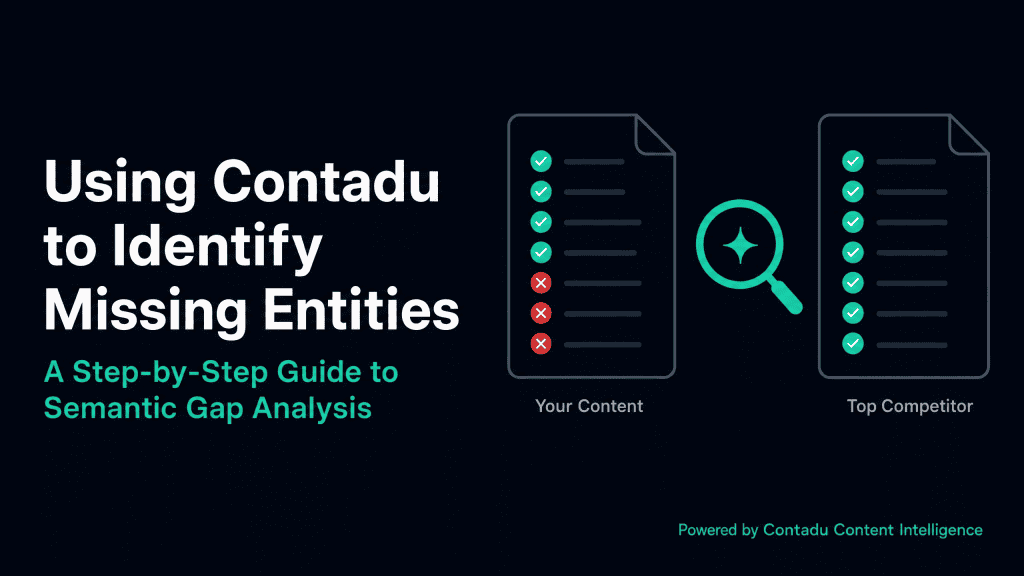
Using Contadu to Identify Missing Entities in Your Content.
📍 Semantic Summary
Idea: In the era of AI Answer Engines, missing a core entity in your content is worse than missing a keyword. It signals to algorithms that your Topical Authority is incomplete.
Challenge: Manually identifying which semantic nodes your content lacks compared to top-ranking competitors is practically impossible without Content Intelligence tools.
Summary: Contadu automates entity gap analysis, allowing you to identify, prioritize, and seamlessly integrate missing entities to boost your Entity Salience and overall search visibility.
Read the full guide below, or explore related topics:
- How to Audit Your Website for Entity Gaps
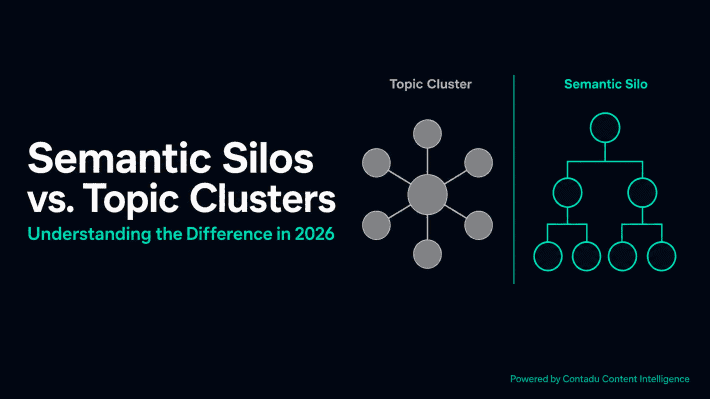
- Semantic Silos vs. Topic Clusters: Understanding the Difference in 2026
For years, content optimization meant running your article through a tool that told you to use the exact phrase “best CRM software” five more times. Today, that approach is not just outdated; it is actively harmful.
Modern search engines and the AI Answer Engines replacing them do not read strings of text. They map entities. They understand the semantic relationships between concepts. If you are writing about “CRM software,” the algorithm expects to see related entities like “sales pipeline,” “customer retention,” “lead scoring,” and “integration APIs.”
If your content is missing these core semantic nodes, the algorithm concludes that your content lacks depth. Your Topical Authority drops, and your rankings follow.
The challenge is that you cannot manually guess which entities you are missing. You need Content Intelligence. Here is exactly how to use Contadu to identify and fix missing entities in your content.
The Shift from Strings to Things.
To truly grasp the power of entity gap analysis, we must first acknowledge the fundamental shift in how search works. We have moved from an era of “strings” to an era of “things.”
In the “strings” era, search engines were essentially advanced pattern-matching machines. If a user searched for the string of characters “B2B marketing automation,” the engine looked for pages containing that exact string, or close variations of it. Optimization meant ensuring that string appeared in the title, the H1, the URL, and a certain number of times in the body text.
In the “things” era, search engines powered by Natural Language Processing (NLP) and vast Knowledge Graphs understand the world as a collection of interconnected entities (things). When a user searches for “B2B marketing automation,” the engine identifies the core entity. It knows that this entity is intrinsically linked to other entities like “lead scoring,” “CRM integration,” “email drip campaigns,” and “customer journey mapping.”
The engine is no longer just looking for the exact phrase. It is looking for a document that demonstrates a deep, comprehensive understanding of the entire semantic cluster surrounding that topic.
The Cost of Missing Entities.
Before diving into the “how,” it is crucial to understand the “why.” Why does a missing entity matter so much more than a missing keyword?
When a user searches for a complex topic, Google’s Knowledge Graph activates. It retrieves the primary entity (the main topic) and all the secondary entities associated with it.
If a competitor’s article includes 15 of the 20 associated entities, and your article only includes 5, the algorithm makes a simple calculation: the competitor’s article is more comprehensive. It possesses higher Information Gain.
Missing entities lead to:
- Lower Entity Salience: Your content is not recognized as a definitive source.
- Exclusion from AI Overviews: Generative Engine Optimization (GEO) relies heavily on entity density. If you lack the necessary semantic relationships, AI models will not cite you.
- Poor Co-Occurrence Signals: You fail to establish the necessary context for your primary topic.
Step 1: Running a Semantic Content Audit in Contadu.
The first step in fixing entity gaps is identifying them. Contadu makes this process instantaneous.
Instead of manually analyzing the top 10 SERP results, you simply input your target topic and your existing content URL into Contadu Content Editor.
The Topic Discovery Phase.
Contadu does not just scrape keywords; it performs a deep NLP analysis of the top-ranking pages. It identifies the entities that the most authoritative sources are consistently using.
It then compares this ideal semantic profile against your content.
Step 2: Analyzing the Content Score and Entity Gaps.
Once the analysis is complete, Contadu provides a Content Score. This is not a vanity metric; it is a direct reflection of your semantic coverage.Below the score, you will find the most critical section: the list of recommended terms and entities.
How Contadu Categorizes Entities.
Contadu organizes these recommendations to help you prioritize:
| Entity Category | Importance | Action Required |
| Core Entities (Must-Have) | Critical for basic relevance. | Integrate immediately. These are foundational concepts. |
| Secondary Entities (Should-Have) | Necessary for depth and Topical Authority. | Weave these into subheadings and detailed paragraphs. |
| Contextual Entities (Nice-to-Have) | Provide nuance and specific examples. | Use these to increase Information Gain and stand out. |
Contadu visually highlights which entities you have successfully included (usually in green) and which ones you are missing (usually in red or unhighlighted). This provides an immediate, visual map of your entity gaps.
Step 3: Strategic Entity Integration (Not Stuffing).
Identifying the missing entities is only half the battle. The way you integrate them determines your success. In the old days of keyword stuffing, you might have just awkwardly shoehorned a missing phrase into a sentence. With Entity SEO, context is everything. Co-occurrence matters.
Understanding Entity Proximity and Co-Occurrence.
When integrating missing entities, you must consider Entity Proximity and Co-Occurrence.
Co-occurrence simply means that two entities appear in the same document. However, Entity Proximity measures how close they are to each other. If you mention “lead scoring” in the introduction and “CRM integration” in the conclusion, they co-occur, but their proximity is low. The algorithm might not strongly associate them in the context of your specific argument.
To maximize Entity Salience, highly related entities should be placed in close proximity within the same paragraph or under the same subheading. This explicitly tells the NLP algorithms: “These concepts are directly related to each other in this specific context.”
The “Add a Section” Strategy
If Contadu reveals that you are missing a cluster of related entities, do not scatter them randomly throughout your existing text. Instead, create a new section.
For example, if your article on “Email Marketing” is missing the entities “deliverability,” “spam filters,” and “DKIM records,” you should not just drop those words into your introduction. You should create a new H2 section titled “Understanding Email Deliverability” and naturally incorporate those entities within that specific context.
This builds strong semantic relationships within your content.
The Role of Internal Linking in Entity Coverage
Sometimes, fully explaining a missing entity within the current article would derail the main topic. For instance, if your article on “Email Marketing” is missing the entity “DMARC authentication,” explaining the technical setup of DMARC might be too deep of a tangent for a high-level strategy guide. In these cases, the solution is not to ignore the entity, nor is it to bloat the current article. The solution is internal linking.
You should briefly mention the missing entity to establish co-occurrence and Entity Salience, and then hyperlink that entity to a dedicated, granular article within your Semantic Silo that covers “DMARC authentication” in depth. This tells the search engine that while this specific page doesn’t cover the entity fully, your overall domain possesses the necessary Topical Authority.
Using Contadu AI Assistant for Context.
If you are unsure how to naturally integrate a highly technical entity, you can leverage Contadu AI writing assistant. Because the AI is already primed with the semantic data of the top-ranking pages, it can generate paragraphs that seamlessly weave the missing entities into the proper context, ensuring high Entity Salience.
Step 4: Monitoring Entity Salience Over Time.
Search intent and Knowledge Graphs are not static. They evolve. A new technology, a new regulation, or a shift in consumer behavior can introduce new entities into a topic’s semantic profile.
An article that had a perfect Content Score in 2024 might be suffering from severe entity decay by 2026.
The Danger of Entity Decay.
Entity decay happens when the collective understanding of a topic moves forward, but your content stays frozen in time.
For example, an article about “SEO Strategy” written in 2022 might have had perfect entity coverage at the time. But by 2026, if that article is missing entities like “Generative Engine Optimization,” “AI Overviews,” “Perplexity,” and “Knowledge Graph APIs,” it is suffering from severe entity decay. The algorithm will recognize that it no longer reflects the current semantic reality of the topic, and its rankings will plummet.
Scheduled Re-Audits.
You must use Contadu not just for initial publishing, but for ongoing maintenance.
1.Identify Pillar Content: Select your most important Semantic Silo pillar pages.
2.Quarterly Audits: Every three months, run those URLs back through Contadu.
3.Check for New Entities: Look for new entities that have emerged in the top-ranking results since you last published.
4.Update and Refresh: Add new sections to cover these emerging entities, signaling to search engines that your content is fresh, comprehensive, and actively maintained.
The Impact on Content ROI.
Ultimately, the goal of identifying and fixing missing entities is not just to appease an algorithm; it is to improve the Return on Investment (ROI) of your content marketing efforts.
Content that lacks core entities will struggle to rank, meaning the time and money invested in creating it are wasted. By using Contadu to ensure complete semantic coverage, you guarantee that every piece of content you publish has the structural foundation necessary to compete in the SERPs and drive qualified traffic.
Furthermore, comprehensive, entity-rich content satisfies user intent more effectively. When a reader finds all the related concepts they were looking for in one place, they are more likely to trust your brand, engage with your calls to action, and ultimately convert.
Conclusion: From Guesswork to Semantic Precision.
Content creation can no longer rely on intuition and basic keyword research. To compete in a landscape dominated by AI Answer Engines and Knowledge Graphs, you need semantic precision.
By using Contadu to systematically identify and integrate missing entities, you transition from writing generic articles to building authoritative, interconnected semantic networks that algorithms trust and reward.
FAQ
1. What is the difference between a missing keyword and a missing entity?
A missing keyword means you lack a specific string of text. A missing entity means you are lacking a fundamental concept or topic that search engines expect to see when discussing a broader subject. Missing entities hurt your overall Topical Authority much more than missing keywords.
2. Can I just add the missing entities as a list at the bottom of the page?
No. Search engines evaluate co-occurrence how entities relate to the words around them. Adding a disconnected list provides no semantic context and can be seen as spam. Entities must be woven naturally into relevant paragraphs.
3. Does Contadu tell me exactly where to place the missing entities?
While Contadu provides the list of missing entities, it relies on your editorial judgment (or its AI assistant) to place them logically. The best practice is to group related missing entities and create a new subheading (H2 or H3) to discuss them comprehensively.
4. How often should I check my old content for missing entities?
For your most important pillar pages, you should run a semantic audit in Contadu every 3 to 6 months. Knowledge Graphs evolve, and new entities frequently emerge as topics develop over time.
5. Will fixing entity gaps improve my chances of appearing in AI Overviews?
Yes. Generative Engine Optimization (GEO) relies heavily on comprehensive semantic coverage. AI models are much more likely to cite content that includes a dense, accurate network of relevant entities.
6. Do I need to hit a 100% Content Score in Contadu?
Not necessarily. A score of 100% is great, but anything above the top competitor’s average (often in the 80s or 90s) is usually sufficient. Focus on covering the “Core” and “Secondary” entities first, rather than obsessing over every single “Contextual” suggestion.
7. How does this fit into a larger Semantic Silo strategy?
Identifying missing entities at the page level is the micro-execution of a macro Semantic Silo strategy. When every page within your silo has complete entity coverage, the entire silo’s Entity Salience increases, lifting rankings across the board.