
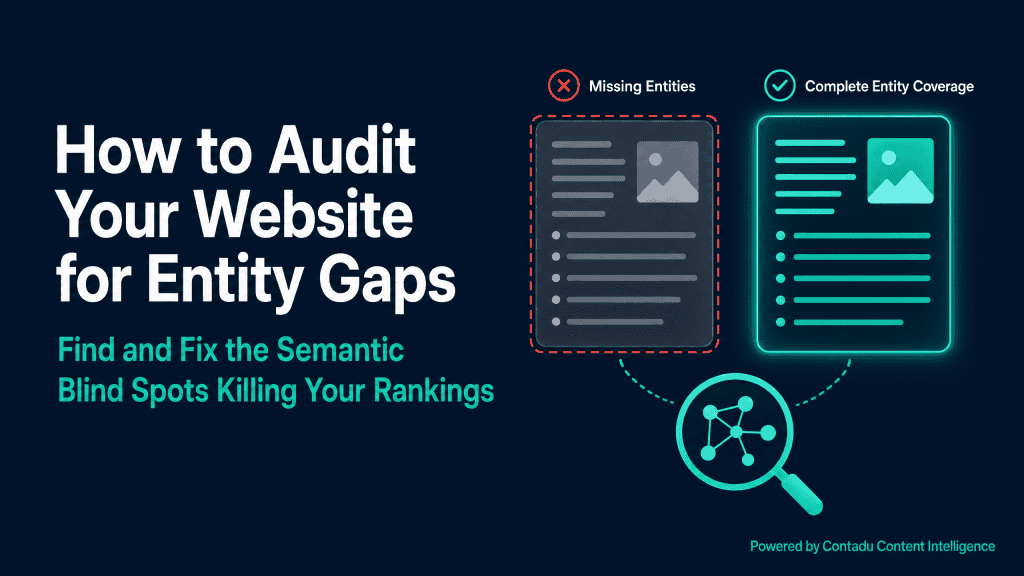
How to Audit Your Website for Entity Gaps.
📍 Semantic Summary
Idea: Traditional keyword gap analysis is obsolete. To dominate modern search, you must perform an entity gap audit to identify missing semantic nodes in your content.
Challenge: Competitors are ranking higher not because they use better keywords, but because their Knowledge Graphs are more complete, covering entities that your website completely ignores.
Summary: Learn how to map your core entities, use NLP tools like Contadu to identify missing semantic relationships, and update your existing content to build comprehensive Topical Authority.
Read the full guide below, or explore related topics:
- How to Build a Custom Knowledge Graph for Your B2B Brand
- Topical Authority: The SEO Moat That Backlinks Can’t Buy
For years, the standard SEO audit looked something like this: pull a list of keywords your competitors rank for, cross-reference it with the keywords you rank for, and create content to fill the “gaps.”
In 2026, this approach is fundamentally broken.
Google’s algorithms and AI Answer Engines (like Perplexity and ChatGPT) no longer parse the web as a collection of text strings. They understand the world as a massive, interconnected web of concepts, known as the Knowledge Graph.
If you are still looking for missing keywords, you are missing the forest for the trees. You need to be looking for missing entities. This is where the entity gap audit comes in.
What is an Entity Gap?
An entity gap occurs when your content fails to mention or establish relationships with the semantic entities that search engines expect to find within a specific topic.
Imagine you are a B2B SaaS company selling “Project Management Software.” A traditional keyword gap analysis might tell you that you are missing the keyword “best project management tool for marketing agencies.”
An entity gap audit, however, looks deeper. It analyzes the top-ranking content and the Knowledge Graph to realize that comprehensive content about “Project Management Software” must include relationships with entities such as:
- Agile methodology (Concept)
- Kanban boards (Concept/Tool)
- Resource allocation (Process)
- Gantt charts (Tool)
- Jira or Asana (Competitor Entities)
If your competitor’s page discusses all of these entities and your page only talks about “task tracking” and “team collaboration,” you have a massive entity gap. The algorithm will deem your competitor’s page more topically complete and authoritative, regardless of how many times you use the target keyword.
The Shift from “Strings” to “Things”.
Before diving into the framework, it is crucial to understand why the entity gap audit is necessary. Historically, SEO was built on the concept of “strings”—exact sequences of characters. If a user searched for the string “best CRM software,” the algorithm looked for pages containing that exact string, or close variations of it.
This led to the era of keyword stuffing and superficial content. Marketers would write a 500-word article, ensure the string “best CRM software” appeared exactly five times, and hope for the best.
Today, search engines operate on the concept of “things” entities. An entity is a uniquely identifiable object or concept. It can be a person (e.g., Elon Musk), a place (e.g., San Francisco), an organization (e.g., Salesforce), or an abstract concept (e.g., Customer Relationship Management).
When a user searches for “best CRM software,” the algorithm does not just look for the string. It identifies the entity Customer Relationship Management Software. It then accesses its Knowledge Graph to understand all the related entities connected to that core concept. It knows that a comprehensive answer about CRM software must include related entities like Lead Scoring, Sales Pipeline, Integration, Salesforce, and HubSpot.
If your page only contains the string “best CRM software” but fails to mention the related entities, the algorithm recognizes that your content lacks depth. It lacks Entity Salience. This is the core reason why an entity gap audit is superior to a keyword gap analysis: it aligns your content with the algorithm’s semantic understanding of the world.
The Cost of Ignoring Entity Gaps.
Failing to conduct regular entity gap audits carries a significant cost, particularly for B2B SaaS companies operating in highly competitive niches.
1.Loss of AI Overview Visibility: Generative AI features, such as Google’s AI Overviews, rely heavily on the Knowledge Graph to construct their answers. If your content lacks the necessary entities, it will not be cited by these AI Answer Engines. You will lose out on zero-click visibility.
2.Decreased Topical Authority: Google evaluates the overall expertise of a domain based on its comprehensive coverage of a topic. If you consistently leave entity gaps in your content, the algorithm will not view you as a true authority, making it harder to rank even for long-tail keywords.
3.Vulnerability to Algorithm Updates: Core updates increasingly target superficial, “unhelpful” content. Pages that are rich in relevant entities and demonstrate high Information Gain are much more resilient to these updates.
The 4-Step Entity Gap Audit Framework.
Conducting an entity gap audit requires moving away from traditional keyword research tools and embracing NLP (Natural Language Processing) and semantic analysis. Here is the framework for identifying and closing your entity gaps.
Step 1: Define Your Core Entity Hubs.
You cannot audit for gaps if you do not know what your foundation looks like. Start by identifying the 3-5 Core Entities that define your business.
If you are a cybersecurity firm, your Core Entities might be:
1.Zero Trust Architecture
2.Endpoint Security
3.Ransomware Protection
Everything you publish must connect back to one of these Core Entities. This is the foundation of your Topical Authority.
Step 2: Reverse-Engineer the SERP’s Knowledge Graph.
Next, you need to understand what entities Google associates with your target topic. You do this by reverse-engineering the top-ranking pages.
When you search for a target query, do not just look at the headings of the top 10 results. Use an NLP tool to extract the entities from those pages. You are looking for the concepts, people, places, and organizations that consistently appear across the highest-ranking content.
This is where co-occurrence becomes critical. If the top 5 pages for “Zero Trust Architecture” all mention the entity Identity and Access Management (IAM), the algorithm has learned that these two entities are semantically linked. If your page on Zero Trust does not mention IAM, you have an entity gap.
Step 3: Map the Gaps Against Your Content Inventory.
Once you have a list of the expected entities for a topic, map them against your existing content.
This is not a binary “do we mention this word?” check. It is an evaluation of Entity Salience. Does your content explore the relationship between your main topic and the missing entity in a meaningful way?
For example, if you find an entity gap for Data Encryption on your Endpoint Security page, simply adding the sentence “We also provide data encryption” is not enough. You must explain how endpoint security relies on data encryption, establishing a strong semantic relationship between the two entities.
Step 3.5: Analyzing Entity Salience and Context.
Identifying a missing entity is only half the battle. You must also analyze how that entity is used in context by your competitors. This is the concept of Entity Salience the importance or centrality of an entity to the overall text.
If your competitor mentions Data Encryption 15 times, includes it in an H2 heading, and surrounds it with related terms like AES-256 and End-to-End Encryption, the Entity Salience for that concept is very high.
If you simply add the word “encryption” to a bulleted list at the bottom of your page, you have technically closed the gap, but your Entity Salience is virtually zero. The algorithm will still favor your competitor.
When mapping gaps, you must document not just the missing entities, but their required depth and context.
Step 4: The Content Refresh Strategy.
The final step is closing the gaps. In most cases, this does not require writing entirely new articles. The highest ROI comes from updating existing content.
Take your existing, underperforming pages and inject the missing entities. Expand sections, add new paragraphs, and explicitly define the relationships between the concepts.
This process, often called semantic optimization, can dramatically improve a page’s Information Gain Score and push it up the rankings without the need for new backlinks.
The Role of Internal Linking in Closing Gaps.
Updating a single page to include missing entities is a strong first step, but true Topical Authority requires a network of connected concepts. This is where internal linking becomes a crucial part of the entity gap audit process.
When you identify an entity gap on a core pillar page, you have two choices:
1.Explain the entity on the page: If the entity is a sub-topic or a minor feature, adding a paragraph or two to the existing page is sufficient.
2.Create a dedicated cluster page: If the missing entity is a massive topic in its own right (e.g., discovering that your “Project Management” page lacks an entire section on “Agile Methodology”), you should create a dedicated “spoke” or “cluster” page for that entity.
Once the new cluster page is published, you must link back to the core pillar page using the entity name as the anchor text. This internal link acts as a semantic bridge, explicitly telling the algorithm that your website understands the relationship between the two entities.
Over time, this network of semantically linked pages builds a robust, internal Knowledge Graph that is highly resistant to algorithm updates. The final step is closing the gaps. In most cases, this does not require writing entirely new articles. The highest ROI comes from updating existing content.
Take your existing, underperforming pages and inject the missing entities. Expand sections, add new paragraphs, and explicitly define the relationships between the concepts.. This process, often called semantic optimization, can dramatically improve a page’s Information Gain Score and push it up the rankings without the need for new backlinks.
Automating the Audit with Contadu.
Performing an entity gap audit manually is nearly impossible. Reading through dozens of competitor pages and trying to guess which nouns and concepts are recognized entities is inefficient and inaccurate.
This is exactly what Contadu is built for.
Contadu’s Content Intelligence engine automates the entire process:
1.SERP NLP Analysis: You enter a target topic, and Contadu analyzes the top-ranking pages using advanced NLP models.
2.Entity Extraction: It extracts the exact entities (not just keywords) that the algorithm expects to see.
3.Gap Identification: It compares your draft or published page against the optimal entity model, instantly highlighting your entity gaps.
4.Semantic Recommendations: It provides actionable recommendations on which entities to add to achieve maximum Topical Authority.
By shifting from keyword gap analysis to entity gap auditing, you align your content strategy with the reality of how search engines actually work in 2026.
FAQ
What is the difference between a keyword gap and an entity gap?
A keyword gap looks for specific strings of text (e.g., “best CRM software”) that competitors use and you don’t. An entity gap looks for missing concepts, people, places, or things (e.g., “Agile methodology”) that are semantically related to the topic, regardless of the exact phrasing used.
Can I do an entity gap audit without SEO tools?
It is extremely difficult. While you can manually read competitor content to guess important concepts, you cannot know for sure which terms Google’s NLP algorithms recognize as distinct entities without using a tool that utilizes natural language processing.
How often should I perform an entity gap audit?
For your most important “money pages” and pillar content, you should perform an entity gap audit every 3 to 6 months. The Knowledge Graph is constantly evolving as new technologies and concepts emerge, so the expected entities for a topic will change over time.
Does fixing entity gaps help with AI Overviews and ChatGPT?
Yes, significantly. AI answer engines rely entirely on entity relationships to generate accurate summaries. If your content clearly defines the relationships between relevant entities, it is much more likely to be cited by LLMs like Perplexity and ChatGPT.
Should I create new pages to fill entity gaps, or update existing ones?
Usually, updating existing pages is the better strategy. If an entity is closely related to a topic you already cover, expanding your existing page to include that entity builds deeper Topical Authority. Only create a new page if the missing entity requires a massive, standalone explanation.
What is Entity Salience, and why does it matter in an audit?
Entity Salience is a metric used by search engines to determine how important an entity is to the overall meaning of a page. If you just mention an entity once in passing, it has low salience. To effectively close a gap, you must discuss the entity in depth, giving it high salience.
Will closing entity gaps guarantee higher rankings?
While nothing guarantees rankings, closing entity gaps is one of the strongest on-page optimization tactics available in 2026. It directly aligns your content with the algorithm’s understanding of the topic, making your page more relevant and topically complete than competitors who only focus on keywords.