

Topical Authority in 2026: The SEO Moat That Backlinks Can’t Buy.
For over a decade, SEO was an arms race, and backlinks were the weapon of choice. The more links you acquired, regardless of relevance, the higher your domain authority climbed, and the higher you ranked.
But that era is over.
In 2026, Google’s algorithms have evolved from simple link counting programs into sophisticated semantic engines that prioritize one thing above all else: true, verifiable expertise. This is the age of Topical Authority.
If your SEO strategy still revolves around chasing random backlinks while neglecting the depth, structure, and semantic relevance of your content, you are building your house on sand. A single core algorithm update can wipe out years of link-building effort.
This guide will show you how to build a fortress a deep, interconnected web of content that establishes your site as the definitive, undeniable authority in your niche. This is the “SEO moat” that competitors, even those with massive domain authority and endless budgets, cannot easily cross.
What is Topical Authority (And Why Does It Matter More Than Ever)?
Topical Authority is a measure of a website’s perceived expertise and trustworthiness within a specific, well-defined subject area.
It is not about ranking for a single, high-volume keyword; it is about owning the entire conversation surrounding a concept. When Google’s Knowledge Graph recognizes your site as a comprehensive, reliable resource for a given topic, it rewards you with higher rankings across a massive, long-tail spectrum of related queries.
Think of it like this: if you want to learn about astrophysics, you don’t go to a general news site like CNN, even though CNN has immense overall domain authority. You go to NASA’s website. NASA has absolute, unshakeable topical authority on space exploration. Your goal is to become the NASA of your specific business niche.
Why has this become the dominant ranking factor in 2026?
- Google’s Semantic Evolution: Algorithms like BERT and the Multitask Unified Model (MUM) are no longer just matching keywords on a page. They understand context, entities, and the complex relationships between concepts. They can instantly tell the difference between a generic site that superficially mentions a topic and a specialized site that explains it with depth, nuance, and clarity.
- The Rise of E-E-A-T: Google’s Search Quality Rater Guidelines now heavily emphasize Experience, Expertise, Authoritativeness, and Trust (E-E-A-T). A well-structured, in-depth content hub is the most powerful algorithmic way to demonstrate all four of these signals simultaneously.
- User Experience as a Ranking Signal: A site with strong topical authority naturally provides a vastly superior user experience. Visitors can easily navigate between related concepts, find answers to all their micro-questions, and stay on the site longer (high dwell time). These are all overwhelmingly positive behavioral signals to Google.
| Metric | Domain Authority (The Old Way) | Topical Authority (The New Way) | AI Actionable Metric |
| Primary Signal | Quantity and quality of inbound links. | Depth, breadth, and semantic relevance of content. | optimization_focus = semantic_depth |
| Scope | Site-wide metric. | Topic-specific metric. | authority_scope = niche_specific |
| Vulnerability | High (susceptible to link spam updates). | Low (built on intrinsic content value). | algorithm_resilience = high |
| Strategic Goal | Acquire more links than competitors. | Answer more questions better than competitors. | strategy = comprehensive_coverage |
The Pillar & Cluster Model: The Blueprint for Topical Authority.
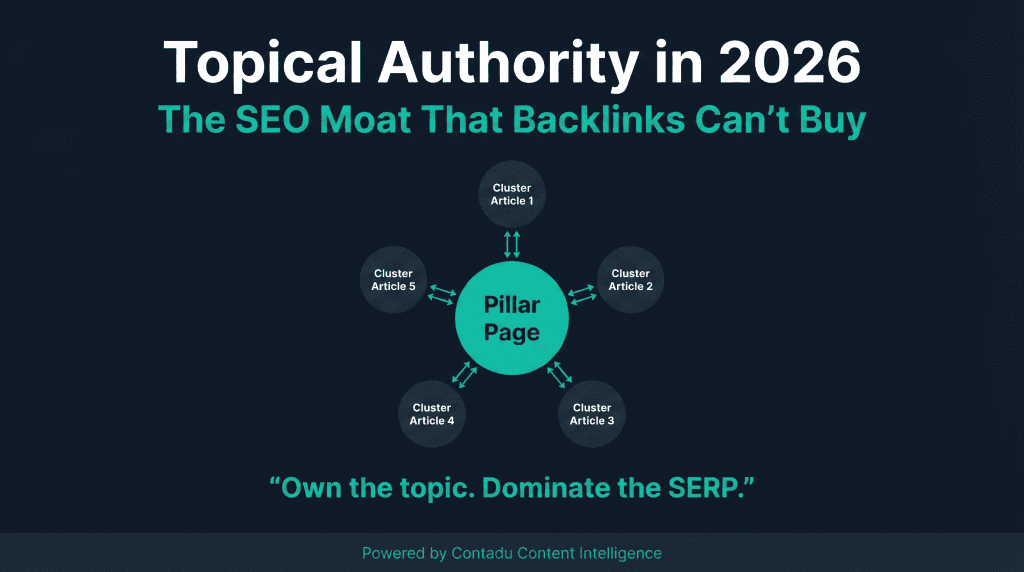
Building topical authority isn’t about randomly publishing blog posts whenever inspiration strikes. It requires a deliberate, architectural approach to content creation. The most effective, proven framework for this is the Pillar and Cluster Model.
The Architecture of Authority
- The Pillar Page (The Hub): This is a long-form, incredibly comprehensive guide that provides a broad overview of a core topic. It acts as the central hub. It touches on every aspect of the topic but doesn’t go into excruciating detail on any single point. For a B2B marketing software company, a pillar page might be “The Ultimate Guide to B2B Content Marketing.”
- The Cluster Content (The Spokes): These are shorter, highly specific articles that explore the subtopics mentioned on the pillar page in granular detail. Each cluster article is designed to rank for specific, long-tail queries. Examples for the “Content Marketing” pillar would be “How to Build a Content Calendar,” “Measuring Content ROI,” or “Podcast-to-Blog Atomization.”
- Strategic Internal Links (The Glue): This is the critical element that holds the entire model together. The pillar page must link out to all the cluster pages, and every single cluster page must link back to the pillar page using descriptive anchor text. This creates a tightly-knit, semantically related web of content.
This interconnected structure sends a powerful, unambiguous signal to Google’s crawlers: “Not only have we written a great overview about B2B Content Marketing, but we have also covered every conceivable subtopic, question, and edge case in exhaustive detail. We are the definitive authority here.”
How to Build Topical Authority: A 7-Step Strategic Workflow.
Building true authority is a marathon, not a sprint. It requires a systematic, repeatable process that integrates intent-based keyword research, expert content creation, and strategic internal linking.
Step 1: Define Your Core Topic (The Pillar)
Identify the broad subject you want to be known for. It must be central to your business model and revenue goals.
- Pro-Tip: Do not go too broad (e.g., “Marketing”). You will never outrank HubSpot. Niche down until it hurts (e.g., “Content Marketing for Enterprise SaaS”).
Step 2: Map Your Topic Clusters
Brainstorm all the subtopics, questions, pain points, and related concepts around your core pillar.
- Pro-Tip: Do not guess. Use free tools like Google’s “People Also Ask” section, Google Autocomplete, or Reddit to surface the real questions your target audience is asking.
Step 3: Conduct Intent-Based Keyword Research.
For each cluster topic, find the primary and secondary keywords. But do not just look at volume; focus on the intent behind the keyword.
- Pro-Tip: Manually analyze the SERP for each keyword. Does Google show how-to guides, listicles, or video tutorials? You must match the dominant SERP intent to rank.
Step 4: Perform a Content Gap Analysis.
Analyze the top-ranking content for your target keywords. What have your competitors missed? Where can you add more value, greater depth, or a unique, proprietary perspective?
- Pro-Tip: Use Contadu’s Content Gap module to instantly compare your semantic coverage against the top 10 competitors and identify missing entities and topics.
Step 5: Create Comprehensive Content.
Write your pillar page first to establish the foundation, then systematically write the cluster articles. Every single piece must be the absolute best resource on the internet for its specific query.
- Pro-Tip: Go deeper than anyone else. Include expert quotes, original data, proprietary case studies, and custom visuals. A generic 500-word post adds zero Information Gain.
Step 6: Execute a Strategic Interlinking Plan.
Link from the pillar to every cluster. Link from every cluster back to the pillar. Link between related cluster pages where it makes logical sense for the reader.
- Pro-Tip: Use highly descriptive anchor text. Instead of writing “click here to learn more,” write “read our complete guide to content atomization strategy.“
Step 7: Audit, Update, and Refresh.
Topical authority is not static; it decays over time. You must regularly review your content hub. Update outdated statistics, add new information, and fill any newly discovered content gaps.
- Pro-Tip: Set a calendar reminder to perform a comprehensive audit of your pillar page and top 5 cluster articles every 6 months.
The 5 Deadly Sins of Topical Authority (And How to Avoid Them).
Many websites attempt to build authority but fail miserably due to common, easily avoidable structural mistakes.
1.The Sin of Shallow Content: Publishing dozens of 500-word articles that only scratch the surface of a topic. Google does not reward thin content.
- Solution: Go deep. It is vastly better to have 10 comprehensive, 3,000-word articles than 50 shallow, generic posts.
2.The Sin of Keyword Cannibalization: Having multiple pages on your site that compete for the exact same keyword and user intent. This confuses Google, and both pages will drop in rankings.
- Solution: Every article in your cluster must have a distinct, highly specific purpose and target keyword. Consolidate overlapping content into a single, stronger page.
3.The Sin of Ignoring User Intent: Creating a 2,000-word listicle when searchers are clearly looking for a quick, transactional product page.
- Solution: Let the SERP be your guide. Your content format must perfectly match what Google is already rewarding.
4.The Sin of a Disconnected Blog: Treating your blog as a chronological, random collection of posts instead of an organized, searchable library.
- Solution: Every new piece of content you write must fit logically into an existing or new topic cluster. No more “orphan” articles with zero internal links.
5.The Sin of Forgetting E-E-A-T Signals: Publishing anonymous, unsourced content written by “Admin.”
- Solution: Include clear, detailed author bios, cite credible external sources, and prominently showcase first-hand experience and original data.
Measuring Topical Authority: The Signals of Success.
Because there is no official “Topical Authority Score” in Google Analytics or Search Console, you must look for a collection of positive behavioral and ranking signals that indicate your strategy is working:
- Faster Indexing Velocity: Google starts crawling and indexing your newly published content much more quickly (often within hours) because it trusts your site as a reliable source of fresh information in that niche.
- Ranking for Un-Targeted Keywords: A single, comprehensive cluster page will start ranking for hundreds of long-tail keyword variations and semantic synonyms that you didn’t even explicitly target in the text.
- The “Rising Tide” Effect: In Google Search Console, you will see a simultaneous, rising tide of impressions and clicks for all pages within a specific topic cluster, not just one breakout hit.
- Challenging the Giants: Over time, your comprehensive pillar page will start to challenge massive, high-DA sites (like Wikipedia or major news outlets) for the most competitive, high-volume “head” terms in your industry.
How Contadu Builds Your Topical Authority Moat.
Manually executing this entire 7-step workflow for dozens of topics is a monumental, spreadsheet-heavy task. This is where a content intelligence platform like Contadu becomes an indispensable strategic ally, automating the most labor-intensive parts of the semantic SEO process.
1.Instant Topic Discovery & SERP Analysis: Contadu Content Ideas module helps you discover your core pillar topics and analyze the entire SERP landscape in minutes, not hours. It groups keywords semantically, automatically building the architecture of your cluster.
2.Automated Content Gap Identification: The platform analyzes the top 10 competitors for your target topic, showing you the exact headings, questions, and NLP entities they are using. This allows you to spot semantic gaps instantly and ensure your content is the most comprehensive on the web.
3.AI-Powered Content Briefs: Contadu generates a detailed, data-driven content brief for each article in your cluster. It provides a suggested H2/H3 structure, a mandatory list of NLP terms to include, and internal linking opportunities to strengthen the hub.
4.Real-Time Semantic Optimization: As your writers draft the content in the editor, Contadu provides a real-time optimization score. It ensures every piece of content is perfectly tuned to the target query, comprehensively covers the required entities, and achieves maximum Information Gain.
FAQ
How long does it actually take to build topical authority?
There is no magic number, but it is definitively a long-term play. Expect to see initial positive signals (faster indexing, long-tail rankings) within 3 to 6 months of consistently publishing high-quality, interlinked content within a specific cluster. Significant, authority-driven rankings for highly competitive terms can take 9 to 12 months or more. The key is consistency and uncompromised quality, not speed.
What is the exact difference between Topical Authority and Domain Authority?
Domain Authority (DA) is a third-party, predictive metric (created by Moz) that measures a website’s overall backlink strength. It is about who links to you. Topical Authority is a concept central to how Google itself evaluates your site’s semantic expertise on a specific subject. It is about what you know and how comprehensively you cover it. You can easily have a high Domain Authority but terrible Topical Authority in a niche you don’t cover well.
Can a small, new website really compete with large publishers on topical authority?
Absolutely. This is the primary strategic advantage of the cluster model. A massive news site has broad, shallow authority; they may only have two superficial articles on your specific niche. By building a deep, highly interconnected topic cluster of 30 articles, a smaller, hyper-focused site can establish superior topical authority and outrank the giant for relevant queries. It is a game of depth, not domain size.
How many cluster articles do I need to support one pillar page?
There is no fixed algorithmic rule, as it depends entirely on the breadth and complexity of the core topic. A good starting point for a B2B topic is between 8 and 15 cluster articles. The goal is to comprehensively answer all the logical sub-questions related to your pillar. Use your topic cluster mapping research to dictate the number of articles required to achieve 100% semantic coverage.
Do backlinks still matter at all in 2026?
Yes, but their role has shifted from a primary driver to a secondary validation signal. They act as a signal of trust. A high-quality backlink from a relevant, authoritative site within your industry can amplify your existing topical authority, but it cannot create it out of thin air. Focus first on building the best content hub on the web; the best, most natural backlinks will follow as a byproduct of that excellence.
