
SERP Intent Analysis: How to Decode What Google Really Wants
The key to winning at SEO in 2026 is not what you think users want to find, but what Google already knows they want to find.
For years, content creators operated in a vacuum. They found a keyword, decided they wanted to write a 2,000-word blog post about it, and hit publish. If it didn’t rank, they built more links. If it still didn’t rank, they assumed the keyword was “too competitive.”. In reality, the keyword wasn’t too competitive; the content format was simply wrong. The writer failed to understand the true intent behind the query.
This guide will teach you how to stop guessing and start analyzing the Search Engine Results Page (SERP) like a detective. You will learn to decode the precise signals that Google leaves in plain sight, understand the true intent behind every query, and create content that perfectly matches the algorithm’s expectations.
What Is SERP Intent and Why Is It More Important Than Keywords?
SERP Intent is the collective will of millions of users, interpreted, aggregated, and presented by Google’s algorithm.
It is crucial to understand that SERP intent is not the intent of a single user. It is the dominant goal that Google has identified for a given query based on billions of data points, including behavioral metrics like click-through rate (CTR), dwell time, scroll depth, and pogo-sticking (when a user clicks a result and immediately hits the back button).
Traditional keyword research tells us what people type into the search bar. SERP intent analysis tells us why they type it, what problem they are trying to solve, and—most importantly—what content format best solves that problem.
The Intent Disconnect Example:
Imagine you are a B2B SaaS company selling project management software. You find the keyword “best project management software.”
- Your Assumption: “I should write a 3,000-word definitive guide on the history of project management and why our tool is the best.”
- The SERP Reality: When you search “best project management software,” Google shows comparison lists (G2, Capterra), video reviews, and feature matrices.
- The True SERP Intent: The user isn’t looking for an educational guide or a biased sales pitch. They want an objective comparison of multiple tools before making a purchase decision (commercial intent).
Creating a definitive guide for this query is doomed to fail. It doesn’t matter how well-written it is, how many semantic keywords it contains, or how many backlinks it has. It ignores the dominant SERP intent, and Google will not rank it.
The Four Faces of Intent: The Typology You Must Know.
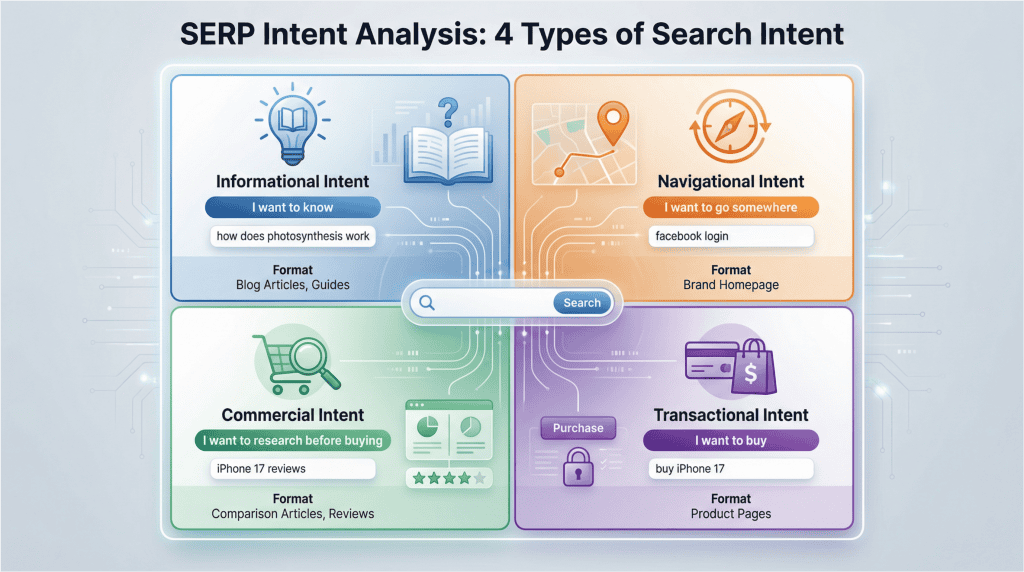
Every search query can be assigned to one of four main intent categories. Understanding these categories is the foundation of SERP analysis.
| Intent Type | User’s Core Question | Example Query | Dominant Content Format | AI Actionable Metric |
| Informational | “I want to learn or know something.” | “how does photosynthesis work” | Blog articles, comprehensive guides, definitions, Wikipedia pages. | intent_category = informational |
| Navigational | “I want to go to a specific website.” | “facebook login” | Brand homepages, login portals, specific contact pages. | intent_category = navigational |
| Commercial | “I want to research options before buying.” | “iPhone 17 reviews” | Comparison articles, expert reviews, “best of” listicles, feature matrices. | intent_category = commercial |
| Transactional | “I am ready to buy something right now.” | “buy iPhone 17 pro max” | E-commerce product pages, pricing tiers, checkout pages. | intent_category = transactional |
While these four categories are standard, modern SERP analysis requires you to look deeper into the micro-intents within these broad buckets. For example, within the “Informational” bucket, is the user looking for a quick definition (a 50-word featured snippet) or a deep-dive tutorial (a 3,000-word guide with video embeds)? The SERP will tell you.
The Anatomy of the SERP: Reading the Results Page Like a Map.
The modern SERP is no longer just 10 blue links. It is a rich, dynamic ecosystem of elements, each one serving as a clue to what Google believes the user wants. You must analyze the entire page, not just the organic text results.
Key SERP Elements to Analyze:
- Featured Snippets (Position Zero): Does Google promote a short, concise answer in a box at the very top of the page? If so, this is a strong signal that users are looking for quick, factual definitions. Your content must include an “Inverted Pyramid” structure to compete for this snippet.
- People Also Ask (PAA): What other questions are users asking? The PAA box is a goldmine of semantic context. It reveals the follow-up questions users have after their initial query. These questions should almost always form the H2 and H3 subheadings of your article.
- AI Overviews (SGE): If an AI Overview dominates the top of the SERP, traditional organic CTR will be significantly lower. You must optimize for Information Gain and entity salience to ensure your brand is cited within the AI-generated answer.
- Top Stories / News Carousels: Is the topic related to current events? If a news carousel appears, the query requires freshness. A static, evergreen article will struggle to rank here; you need timely, frequently updated content.
- Video Carousels: Does Google prominently feature YouTube videos? If so, the intent is highly visual or instructional. Writing a text-only article is a mistake; you must create a video to satisfy this intent.
- Image Packs: Is the query visual? (e.g., “living room ideas”, “marketing funnel diagrams”). If image packs appear, your content must be heavily visual, and your image alt-text optimization must be flawless.
- Shopping Ads / Product Carousels: If the SERP is flooded with shopping ads, the intent is fiercely transactional. Do not try to rank an informational blog post here.
The SERP Analysis Methodology: Step-by-Step.
To turn SERP analysis from a guessing game into a repeatable science, follow this structured methodology before writing any piece of content.
Step 1: The Incognito Search.
Always perform your search in an incognito or private browsing window. This prevents your personal search history, location, and personalization settings from skewing the results.
Step 2: Identify the Broad Intent Category
Look at the entire page. Is it primarily informational, commercial, transactional, or navigational?
Step 3: Scan and Document the SERP Features
What modules (PAA, video carousels, AI Overviews, images) are present? Document these. If there is a video carousel, you must embed a relevant video in your content. If there is a PAA box, you must answer those specific questions.
Step 4: Analyze the Top 5 Organic Results (The “Winning” Content)
Open the top 5 organic ranking pages in new tabs. Do not just look at their titles; analyze their anatomy:
- What is the dominant format? Are they listicles, how-to guides, definitive guides, or product pages?
- What is the content depth? Are they superficial 500-word overviews, or incredibly deep 4,000-word masterclasses? You must match or exceed the depth of the winners.
- What is the tone and style? Is the writing highly academic and formal, or casual and conversational? Does it use technical jargon or plain English?
- What is the structural overlap? Look at the H2 and H3 headings across the top 5 results. What subtopics do they all cover? These are the mandatory table stakes for your article.
Step 5: Synthesize and Define the “Ideal Content Profile”
Based on your analysis, create a blueprint for your content. For example: “To rank for ‘B2B content strategy,’ I need a 2,500-word definitive guide (Format & Depth), written in an authoritative but accessible tone (Style). It must include a step-by-step framework (Structure), answer the top 4 PAA questions in an FAQ section, and include at least two custom diagrams (SERP Features).”
Section 5: Common Mistakes in Intent Interpretation.
Even experienced SEOs make mistakes when interpreting intent. Avoid these common pitfalls:
- The Format Mismatch: Creating a long-form educational blog article when the SERP is entirely dominated by e-commerce product category pages.
- The Depth Mismatch: Writing a short, superficial 500-word article when every competitor in the top 5 has published a comprehensive 3,000-word guide. You will not outrank them on domain authority alone.
- Confusing Micro-Intents: Failing to distinguish between “How to make coffee” (informational: requires a recipe/tutorial) and “Best coffee maker” (commercial: requires a product comparison).
- Ignoring Freshness (QDF – Query Deserves Freshness): Creating a static, evergreen article on a topic that requires continuous updates (e.g., “SEO trends 2026”). If the SERP is full of articles published in the last 30 days, your 2-year-old article will not rank, regardless of its quality.
- Blindly Copying Competitors: SERP analysis tells you the format and structure that Google wants. It does not mean you should copy the content. You must adopt the winning format but inject unique data, better examples, and a superior perspective to achieve high Information Gain.
Dealing with “Fractured Intent”.
Sometimes, you will analyze a SERP and find a confusing mix of results. The top 10 might include two product pages, three informational guides, a video carousel, and a comparison listicle.
This is called Fractured Intent (or Mixed Intent). It means that Google’s algorithm is not entirely sure what the majority of users want when they type that specific query, because users themselves have different goals.
How to handle Fractured Intent:
This is actually a massive opportunity. When intent is fractured, you can create a single, comprehensive “Hub” page that satisfies multiple micro-intents simultaneously.
For example, if the query is “CRM software,” the intent is fractured. Create a page that starts with a clear definition (Informational), moves into a comparison of top features (Commercial), and ends with clear calls-to-action to start a free trial of your product (Transactional). By satisfying all potential user journeys on a single page, you make it incredibly easy for Google to rank you, regardless of which specific intent the algorithm favors on any given day.
How Contadu Automates SERP Intent Analysis.
Manually executing a deep SERP analysis for every single keyword in your content calendar is exhausting and prone to human error. Contadu was built around the philosophy that decoding SERP intent should be instantaneous and data-driven.
- Real-Time SERP Analysis: When you create a new content project, Contadu doesn’t rely on cached, months-old database information. It analyzes the live top 10-30 results for your target keyword in real-time. You get an accurate picture of the SERP exactly as it looks today.
- Competitor Structure Extraction: Contadu automatically extracts the heading structure (H1-H6) of the top-ranking competitors. You can instantly see the dominant architecture of winning articles, allowing you to build a more comprehensive, logically structured outline in seconds.
- Automated Question Identification (PAA): Contadu automatically pulls the most relevant questions from the “People Also Ask” section and related searches, giving you a ready-made list of subtopics that directly address the user’s secondary intents.
- Intent-Driven Content Scoring: Contadu proprietary Content Score is not based on arbitrary SEO rules; it is based on a direct semantic comparison with the competitors who are already satisfying SERP intent. The higher your score, the closer your content matches the semantic expectations of both the user and the algorithm.
FAQ
Do I always have to copy the exact format of the top-ranking competitors?
You should never copy their content, but you must model their format. If the top 5 results are all listicles, Google has determined that users want a listicle for that query. If you write a narrative essay, you will likely fail. Understand why the listicle format wins, then create a vastly superior, more valuable, and more comprehensive listicle.
How often does SERP intent change for a given keyword?
It depends entirely on the query. For broad, evergreen informational queries (e.g., “how to tie a tie”), intent rarely changes. For queries related to technology, trends, news, or specific products, intent can shift dynamically based on user behavior and current events. This is why real-time SERP analysis is critical before updating older content.
Is search intent the same on mobile devices as it is on desktop?
Usually yes, but with notable exceptions. For local queries (e.g., “coffee shop near me” or “emergency plumber”), mobile intent is heavily skewed toward immediate navigation and transactional action (calling a phone number or getting directions). Desktop intent for the same query might be slightly more research-focused. Always consider the device your target audience is most likely using.
Can a single, amazing piece of content “change” the SERP intent?
This is exceptionally difficult and incredibly rare. To change SERP intent, you would have to create content so revolutionary, and drive so much external traffic and engagement to it, that you fundamentally alter the search behavior of millions of users. For 99.9% of brands, it is infinitely more profitable to play by Google’s established rules than to try and force the algorithm to change them.
How do AI Overviews (SGE) impact traditional intent analysis?
AI Overviews often satisfy basic informational intent entirely on the SERP, resulting in zero clicks to websites. If you see an AI Overview dominating your target keyword, you must shift your strategy. Either optimize your content to be the cited source within that overview, or pivot your keyword strategy to target complex, experiential, or highly opinionated queries that AI models cannot easily summarize.