
Account-Based Content Marketing: Personalization at Scale
Semantic Summary
The Idea: Account-Based Marketing (ABM) has traditionally relied on highly manual, 1-to-1 personalization for a small list of target accounts. In 2026, Agentic AI and Content Intelligence allow B2B SaaS teams to execute Account-Based Content Marketing at scale, generating hyper-personalized content for hundreds of accounts simultaneously without sacrificing quality or relevance.
The Challenge: Creating personalized landing pages, whitepapers, and email sequences for 500 target accounts used to require an army of writers and months of work. Generic content, on the other hand, fails to convert enterprise buyers who expect vendors to understand their specific industry nuances, tech stack, and pain points.
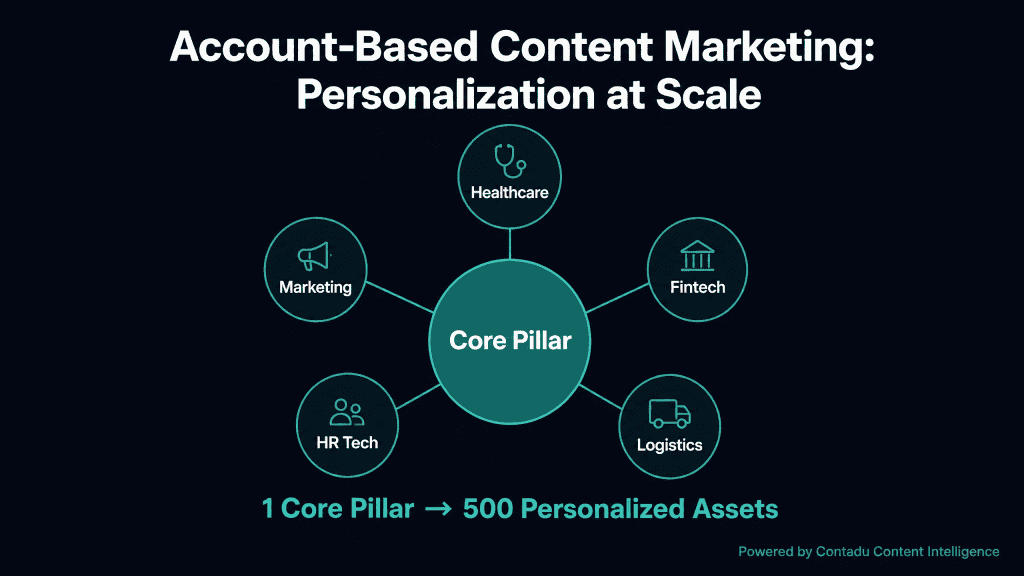
The Summary: The solution is Dynamic Content Atomization. By creating one highly authoritative “Core Pillar” and using AI workflows to spin off 50 account-specific variations (adjusting industry terminology, integration use cases, and pain points), B2B teams can achieve 1-to-1 personalization at a 1-to-Many scale. Leveraging Contadu to maintain Entity Salience across all variations ensures these assets not only convert target accounts but also rank in AI Answer Engines.
Read the full guide below, or explore related topics:
- Aligning Content Strategy with Product-Led Growth (PLG)
- The ROI of Content Workflow Automation for B2B SaaS
- Content Repurposing for AI: How to Turn One Article into 10 Assets
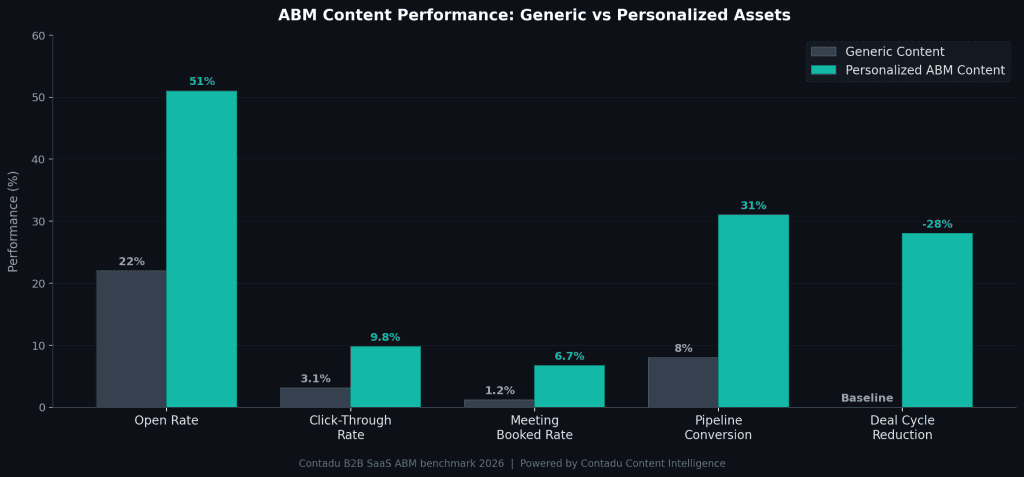
Account-Based Marketing (ABM) is the holy grail of B2B SaaS acquisition. The premise is simple: instead of casting a wide net to catch small fish, use a spear to catch whales.
However, the execution of ABM has historically been crippled by a massive bottleneck: content creation.
If you are targeting 100 enterprise accounts across 5 different industries, sending them all the same generic whitepaper defeats the purpose of ABM. True ABM requires 1-to-1 personalization. But writing 100 unique whitepapers, landing pages, and email sequences manually is economically unviable.
In 2026, the intersection of Agentic AI and Content Intelligence has solved this problem. Welcome to the era of Account-Based Content Marketing at Scale.
The Old Way vs. The New Way
To understand the shift, we must look at how ABM content was traditionally produced versus how it is produced today.
The Old Way: The Manual Bottleneck
In the past, marketing teams would select a “Tier 1” account (e.g., Salesforce). A marketer would spend two weeks researching Salesforce’s tech stack, recent earnings calls, and specific pain points. They would then write a bespoke landing page and a custom PDF guide. This process was highly effective but completely unscalable. Teams could only afford to do this for the top 1% of their target accounts.
The New Way: Dynamic Content Atomization
Today, B2B SaaS teams use a Hub-and-Spoke model powered by AI. Human Subject Matter Experts (SMEs) write one highly authoritative, 3,000-word “Core Pillar” document. Then, an Agentic AI workflow is deployed to spin off hundreds of account-specific variations in minutes.
The 3-Step Framework for ABM Content at Scale
Scaling personalization requires a systematic approach to data, content structure, and automation.
Step 1: The Account Data Matrix
Before generating a single word, you need structured data. Build an Account Data Matrix (typically in a spreadsheet or CRM) that includes specific variables for each target account:
- Industry: (e.g., Healthcare, Fintech, Logistics)
- Current Tech Stack: (e.g., Uses Jira, Uses Snowflake)
- Primary Competitor: (Who are they trying to beat?)
- Specific Jargon: (Do they say “patients,” “clients,” or “users”?)
- Key Decision Maker Title: (e.g., VP of Engineering vs. CMO)
Step 2: The Modular “Core Pillar”
Write your Core Pillar content not as a static document, but as a modular template. Identify the sections that will remain universal (e.g., the core mechanics of your software) and the sections that will be dynamically replaced (e.g., the introduction, the specific use cases, and the ROI examples).
For example, a universal section might explain how your API handles rate limiting. The dynamic section will explain why that specific rate-limiting architecture is crucial for [Target Account’s Industry] during [Specific Industry Event, e.g., Black Friday or Open Enrollment].
Step 3: Agentic AI Generation
Feed the Core Pillar and the Account Data Matrix into an Agentic AI workflow. The AI acts as a programmatic editor, rewriting the modular sections for each of the 100 accounts. It replaces generic terms with industry-specific jargon, swaps out generic case studies for highly relevant ones, and tailors the value proposition to the specific decision-maker.
How Contadu Powers Account-Based Content
Personalization at scale introduces a hidden risk: Entity Dilution. When AI rewrites content 100 times, it often loses the core semantic entities required to rank in Google or get cited by AI Answer Engines like Perplexity and ChatGPT.
This is where Contadu becomes critical for ABM teams.
Maintaining Entity Salience Across Variations
Contadu’s Content Intelligence ensures that every personalized variation maintains the required Entity Salience. When you generate an ABM landing page for a Healthcare client, Contadu verifies that not only are the healthcare-specific entities present (e.g., HIPAA, EHR), but the core entities related to your SaaS product are preserved.
Identifying Account-Specific Semantic Gaps
Before building your Account Data Matrix, you can use Contadu to analyze the content footprint of your target accounts. What entities are they publishing about? What topics are they ignoring? Contadu allows you to identify the semantic gaps in your target account’s own strategy, giving your sales team the ultimate conversation starter: “We noticed your content strategy is missing X, Y, and Z. Our platform solves exactly that.”
High-Velocity Quality Control
When generating 100 ABM assets simultaneously, manual editing is impossible. Contadu acts as the automated quality gate, scoring every single variation for readability, entity density, and brand voice consistency before it is ever published or sent to a prospect.
FAQ
Q1: Does AI-generated ABM content sound robotic or generic?
A: It sounds robotic if you use a single, zero-shot prompt. By using a modular Core Pillar written by a human SME, and only using AI to inject structured account data into specific sections, the output remains highly authoritative and human-sounding.
Q2: How many accounts can you realistically target with personalized content?
A: With an Agentic AI workflow and a tool like Contadu, B2B SaaS teams routinely target 500 to 1,000 accounts per quarter with 1-to-1 personalized landing pages and email sequences.
Q3: Do these personalized ABM pages need to be indexed by Google?
A: It depends on the strategy. Highly specific 1-to-1 pages (e.g., “Our SaaS for Acme Corp”) are usually no-indexed and sent directly via email or LinkedIn. However, industry-specific variations (e.g., “Our SaaS for Healthcare Logistics”) should absolutely be indexed to capture long-tail SEO traffic.
Q4: What is the most important data point for personalizing ABM content?
A: The target account’s existing tech stack. Showing a prospect exactly how your software integrates with the tools they already use (e.g., Salesforce, Snowflake) is the fastest way to prove relevance and reduce perceived onboarding friction.
Q5: How do we measure the success of Account-Based Content?
A: Traditional metrics like total page views are irrelevant for ABM. Measure Account Engagement Score (time spent on page by specific IP addresses), Meeting Booked Rate from target accounts, and Pipeline Velocity.
Q6: Can we use this approach for outbound email sequences?
A: Yes. The exact same Account Data Matrix and Agentic AI workflow used to generate landing pages can be used to generate hyper-personalized 5-step email cadences for SDRs.
Q7: How does Contadu prevent duplicate content issues if we publish 50 variations?
A: Contadu helps you structure the content so that the semantic variations are significant enough to stand on their own. If the pages are too similar, Contadu will flag them. Alternatively, you can use canonical tags pointing back to the Core Pillar to consolidate authority.