
The ROI of Content Workflow Automation for B2B SaaS
Semantic Summary
The Idea: B2B SaaS companies often measure the ROI of content marketing strictly through lead generation and pipeline influence. However, in 2026, the most significant and immediate ROI comes from Content Workflow Automation reducing the hard costs of production, editing, and distribution.
The Challenge: A traditional content team spends 70% of its budget on operational friction: manual SERP research, drafting briefs, managing freelance writers, formatting in the CMS, and repurposing assets. This bloats the Cost Per Acquisition (CPA) before the content even goes live.
The Summary: By implementing an Agentic AI workflow and ContentOps automation, B2B SaaS teams can reduce the cost of producing a pillar article from $1,200 to $150, while simultaneously increasing Content Velocity. The true ROI of workflow automation is realized through a 85% reduction in production costs, a 3x increase in output, and the reallocation of human capital toward high-level strategy and Subject Matter Expertise.
Read the full guide below, or explore related topics:
- Content Velocity: How to Publish More Without Sacrificing Quality
- Agentic AI in Content Marketing: Orchestrating Multiple AI Assistants
- The Role of Human Editors in an AI-First Content Workflow
When B2B SaaS executives ask about the “ROI of Content,” they usually mean one thing: How much pipeline did this blog post generate?
While pipeline attribution is crucial, it is a lagging indicator. It takes months for content to rank, gain traction in AI Answer Engines, and convert readers into qualified leads. If you only measure ROI at the end of the funnel, you are ignoring the massive financial drain happening at the top of the funnel: the cost of production.
In 2026, the most immediate and measurable return on investment comes from Content Workflow Automation.
The Hidden Costs of Manual Content Production
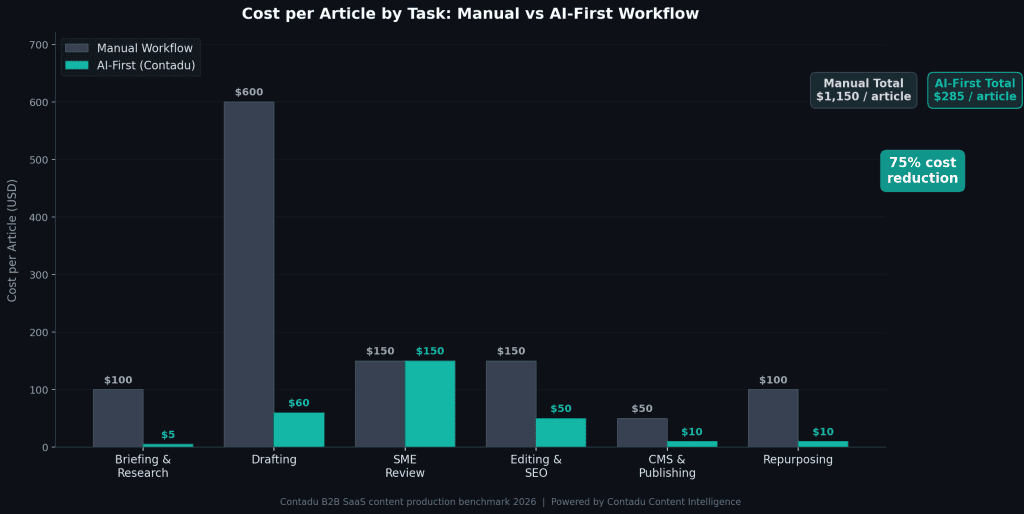
To understand the ROI of automation, we first have to quantify the cost of manual production. Let’s look at the economics of producing a single, high-quality, 2,000-word B2B SaaS pillar article using a traditional workflow:
- Content Strategist (Briefing & Keyword Research): 2 hours ($100)
- Freelance Writer (Drafting): Flat rate ($600)
- Subject Matter Expert (Review): 1 hour ($150)
- Managing Editor (Revisions & SEO Optimization): 3 hours ($150)
- Content Manager (CMS Formatting & Publishing): 1 hour ($50)
- Social Media Manager (Repurposing): 2 hours ($100)
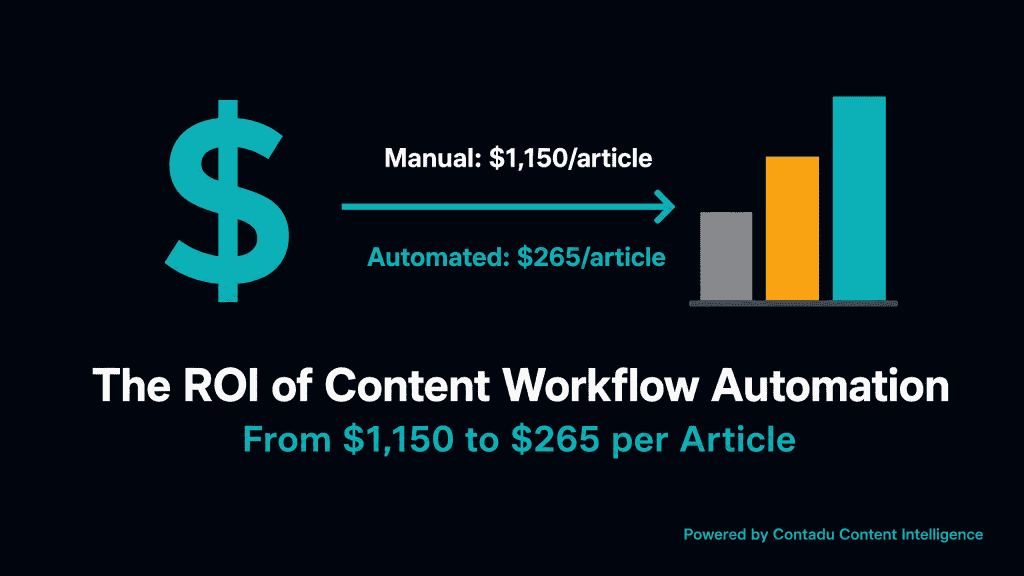
Total Cost per Article: $1,150
If your goal is to publish 10 articles a month, you are spending $11,500 monthly just to get the words on the page. And the worst part? Over 60% of that budget is spent on operational friction formatting, researching, back-and-forth editing, and manual data entry.
The Economics of Content Workflow Automation
Workflow automation does not mean replacing your entire team with a single LLM prompt. It means using Agentic AI to eliminate the operational friction. Here is how the economics change when you automate the mundane tasks:
1. Automated Briefing and Research
Instead of a strategist spending two hours analyzing SERPs and building an outline, an AI agent pulls real-time entity data, analyzes top competitors, and generates an Inverted Pyramid brief in two minutes.
Savings: $95 per article.
2. The AI-First Drafting Phase
Instead of paying a freelancer $600 for a first draft that requires heavy editing, an AI Writer Agent uses the automated brief and your brand’s custom context document to generate an 80% complete draft.
Savings: $600 per article.
3. The Human-in-the-Loop Edit
Because the AI handles the syntax and basic structure, the human editor’s role shifts from fixing grammar to injecting strategy and Subject Matter Expertise. The editing time drops from 3 hours to 1 hour.
Savings: $100 per article.
4. Automated Atomization
Instead of a social media manager spending two hours manually pulling quotes for LinkedIn, an Atomizer Agent instantly transforms the approved pillar article into 10 derivative assets.
Savings: $90 per article.
New Total Cost per Article: ~$265
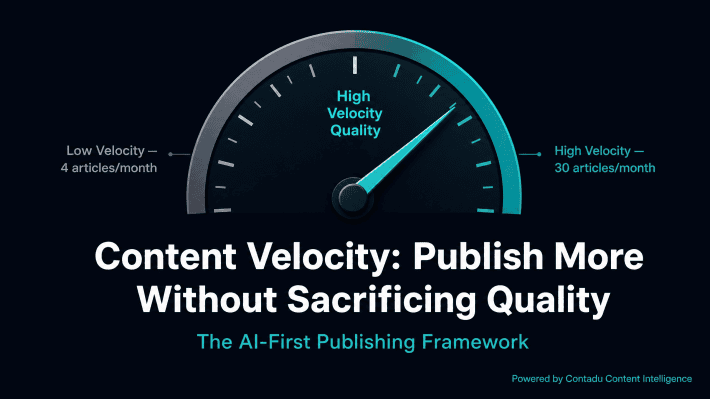
By automating the workflow, the cost per article drops by over 75%. That same $11,500 monthly budget now produces 43 high-quality articles instead of 10. That is the definition of scaling Content Velocity.
Beyond Cost Savings: The Strategic ROI
Reducing production costs is only the first layer of ROI. The secondary effects of workflow automation fundamentally change how a B2B SaaS company competes in search.
Faster Time-to-Index
In the era of AI Answer Engines (ChatGPT, Perplexity), the freshness of your content matters. If your production cycle takes four weeks from ideation to publication, you are always reacting to industry trends. An automated workflow reduces the cycle to 48 hours, allowing you to capture Share of Model Voice (SOMV) before your competitors even finish their briefs.
Higher Entity Salience
Manual writers often miss secondary entities required to build Topical Authority. Automated workflows use Content Intelligence tools to ensure every draft meets exact Entity Salience thresholds before it reaches the human editor. The result is content that ranks faster and gets cited by LLMs more frequently.
Reallocating Human Capital
When your content team stops spending 20 hours a week formatting WordPress posts and writing briefs, they can focus on what AI cannot do: original research, interviewing customers, and building thought leadership narratives.
How Contadu Drives Workflow Automation ROI
To achieve these economics, you need a centralized platform that connects strategy, generation, and optimization. Contadu is the operating system for automated content workflows.
End-to-End Automation
Contadu replaces the fragmented stack of SEO tools, Google Docs, and AI chat windows. From keyword discovery to automated brief generation, to AI drafting, and real-time semantic scoring—everything happens in one unified workspace.
Predictable Quality Control
Automation only yields positive ROI if the quality remains high. Contadu proprietary scoring algorithms ensure that every piece of automated content meets strict guidelines for readability, entity density, and brand voice consistency before it is approved.
Seamless Integration
Contadu integrates directly into your existing CMS, eliminating the copy-paste friction that slows down publishing teams. Your automated content goes from approved draft to live page with a single click.
By implementing Contadu, B2B SaaS teams are not just cutting costs they are building an agile, high-velocity content engine that dominates search in the AI era.
FAQ
Q1: Does automating the workflow mean firing the content team?
A: No. It means elevating them. Writers become editors; editors become strategists. Automation removes the robotic tasks from human workers so they can focus on high-leverage creative and strategic work.
Q2: How long does it take to see the ROI of content automation?
A: The operational ROI (cost savings per article) is immediate, visible on the very first piece of content produced. The strategic ROI (increased traffic and AI citations due to higher velocity) typically materializes within 60 to 90 days.
Q3: What is the biggest hidden cost in manual content production?
A: Revisions and formatting. The back-and-forth between writers, SMEs, and editors often consumes more budget than the actual writing process. Automation standardizes the brief and the draft, drastically reducing revision cycles.
Q4: Can automated workflows handle highly technical B2B SaaS topics?
A: Yes, if you use a Human-in-the-Loop model. The AI handles the structure, SEO optimization, and standard definitions, while a human SME injects the nuanced, highly technical insights that only an expert would know.
Q5: How does automation affect the consistency of brand voice?
A: It actually improves it. Freelance writers often struggle to capture a brand’s unique tone. An automated Agentic AI workflow uses a centralized context document, ensuring the exact same brand voice is applied to every single article.
Q6: What metrics should we track to measure automation ROI?
A: Track Cost Per Article (CPA), Time-to-Publish (from brief to live), Content Velocity (articles per month), and the ratio of human editing time vs. AI drafting time.
Q7: How do we start transitioning to an automated workflow?
A: Start with the bottlenecks. Do not try to automate the entire writing process on day one. Begin by automating your content briefs and SERP research using a tool like Contadu. Once the team is comfortable, introduce AI drafting and automated repurposing.