
Content Velocity: How to Publish More Without Sacrificing Quality · Contadu
Semantic Summary
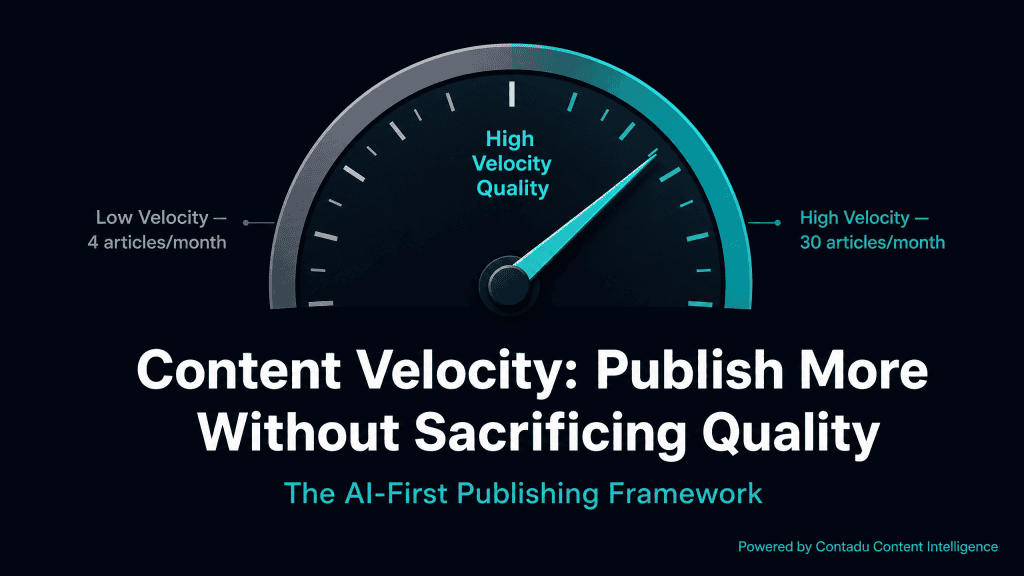
The Idea: Content Velocity the speed and frequency at which a brand publishes high-quality content—is now a primary driver of Topical Authority. Search engines and AI Answer Engines reward domains that consistently output entity-rich content faster than their competitors.
The Challenge: Historically, content velocity and content quality were mutually exclusive. You could publish two great articles a month, or twenty mediocre ones. Scaling production manually resulted in “content bloat”—thousands of thin, repetitive pages that cannibalized each other and harmed the domain’s reputation.
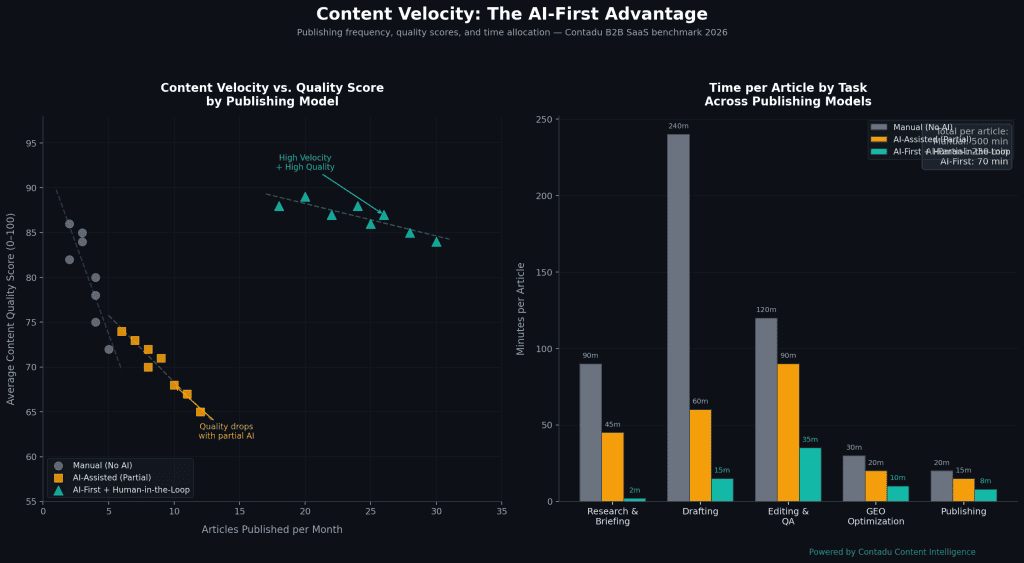
The Summary: In 2026, the false dichotomy between speed and quality is dead. By adopting an Agentic AI workflow, B2B teams can achieve “High-Velocity Quality.” This requires shifting from manual drafting to a Human-in-the-Loop model where AI handles the heavy lifting of structure and syntax, while human editors focus entirely on Information Gain, SME injection, and GEO (Generative Engine Optimization). The result is a 10x increase in publishing frequency with a simultaneous increase in Entity Salience.
Read the full guide below, or explore related topics:
- Agentic AI in Content Marketing: Orchestrating Multiple AI Assistants
- The Role of Human Editors in an AI-First Content Workflow
- Automating Content Briefs: From Keyword to Outline in Seconds
In the world of SEO and content marketing, there has always been an unwritten rule: You can have it fast, or you can have it good, but you cannot have both.
For years, B2B marketing teams operated under this assumption. They hired expensive freelance writers, spent weeks going back and forth on drafts, and celebrated when they managed to publish four high-quality articles in a single month. Meanwhile, content farms pumped out 40 articles a day of unreadable, keyword-stuffed garbage.
But the algorithms changed. Google’s Topical Authority systems and the rise of AI Answer Engines like ChatGPT and Perplexity created a new requirement: Content Velocity.
What is Content Velocity?
Content Velocity is the rate at which a brand publishes relevant, high-quality content within a specific semantic cluster. It is not just about volume; it is about momentum.
If you publish 50 articles about “cloud security posture management” in three months, you establish Topical Authority much faster than a competitor who publishes those same 50 articles over three years. Search engines look at the freshness and frequency of entity coverage to determine who is the most active, authoritative voice in a niche.
The problem? You still cannot publish garbage. The quality threshold for ranking in 2026 is higher than ever, requiring deep Information Gain, Quotable Statements, and precise Entity Salience. So, how do you scale velocity without sacrificing quality?
The False Dichotomy: Breaking the Iron Triangle.
The traditional “Iron Triangle” of project management states that you must choose two: Fast, Good, or Cheap. Generative AI breaks this triangle.
To achieve high-velocity quality, you must stop treating AI as a “fast typist” and start treating it as a production assembly line. Here is the framework for scaling output 10x while actually improving the depth of your content.
1. Automate the Bottlenecks, Not the Brainpower
The slowest parts of content creation are not the moments of brilliant insight. The bottlenecks are manual SERP analysis, keyword mapping, formatting, and syntax checking.
By automating content briefs, you reduce a 90-minute task to a 2-minute task. The AI analyzes the top 30 competitors, extracts the necessary semantic entities, and builds an Inverted Pyramid outline. The human brainpower is saved for the next step.
2. The SME-to-AI Pipeline
High-quality B2B content requires Subject Matter Expertise (SME). But SMEs do not have time to write articles.
The high-velocity solution is the SME-to-AI Pipeline. A content strategist records a 15-minute Zoom interview with an internal expert. The transcript is fed into an Agentic AI workflow along with the automated brief. The AI synthesizes the expert’s raw thoughts into a structured, entity-optimized draft. You get 100% original Information Gain with zero writing time from the expert.
3. The “Human-in-the-Loop” Quality Gate
Velocity fails when you publish raw AI output. To maintain quality at scale, you must adopt the Architect, Injector, Gatekeeper model.
The human editor does not write the draft. They architect the strategy, inject proprietary data points into the AI’s baseline text, and act as the final gatekeeper for brand voice and factual accuracy. Because they are not bogged down in syntax, one editor can process 5 to 8 high-quality articles per day.
How Contadu Enables High-Velocity Quality.
Scaling content velocity requires an operating system built for speed and semantic precision. Contadu is designed to eliminate the friction between ideation and publication.
Automated Semantic Briefs
Contadu Content Strategy module instantly analyzes your target topic and generates a comprehensive, entity-rich brief. It tells your AI agents exactly what semantic nodes must be covered to establish Topical Authority, cutting hours of manual research down to seconds.
Real-Time Optimization Scoring.
When you are publishing 20 articles a week, you cannot afford to manually check keyword density or entity coverage. Contadu provides a real-time Content Score in the editor. Your human editors can instantly see if the AI-generated draft hits the required Entity Salience thresholds before hitting publish.
Content Atomization at Scale.
Velocity isn’t just about blog posts. Contadu helps you turn one pillar article into 10 derivative assets (LinkedIn carousels, newsletter snippets, FAQ schemas). This means one strategic effort yields a massive footprint across traditional search, social media, and AI Answer Engines.
With Contadu, you don’t have to choose between speed and quality. You can build a content engine that dominates your niche in 90 days, not three years.
FAQ
Q1: Won’t publishing too fast trigger Google’s spam filters?
A: Google does not penalize high publishing frequency; it penalizes low-quality, unoriginal content. If you publish 50 highly relevant, entity-optimized articles with genuine Information Gain in one month, Google will reward you with faster indexing and higher Topical Authority. The penalty only comes if the content is “AI slop.”
Q2: How many articles per month is considered “High Velocity”?
A: It depends on your niche and baseline, but for a B2B SaaS company, moving from 4 articles a month to 20-30 articles a month is a massive velocity increase. The goal is to cover every semantic node in a specific Topic Cluster as quickly as possible.
Q3: Does Content Velocity matter for AI Answer Engines like ChatGPT?
A: Yes. AI Answer Engines rely on Retrieval-Augmented Generation (RAG). The more frequently you publish high-quality, entity-dense content, the larger your footprint in their training data and real-time search indexes. Velocity increases your Share of Model Voice (SOMV).
Q4: How do we maintain brand voice when scaling production 10x?
A: By using custom system prompts and project-level context documents in your Agentic AI workflow. You define your brand’s tone, formatting rules, and terminology once, and the AI agents apply it consistently across hundreds of drafts. The human editor then acts as the final quality check.
Q5: Is it better to update old content or publish new content for velocity?
A: Both are necessary, but they serve different purposes. Updating old content protects your existing rankings from decay. Publishing new content expands your semantic footprint and builds new Topical Authority. A high-velocity strategy allocates roughly 70% of effort to new content and 30% to historical optimization.
Q6: Can a small team of 1-2 people really achieve high content velocity?
A: Yes, if they leverage the right tools. A two-person team using Contadu and an Agentic AI workflow can easily out-publish a traditional 10-person team. The key is shifting the humans from “writers” to “orchestrators and editors.”
Q7: How do we measure the ROI of increased Content Velocity?
A: Track the time-to-rank for new articles, the overall growth in non-branded organic traffic, and the increase in Entity Salience across your domain. You should see new articles indexing and ranking faster because the search engines recognize your domain as a highly active, authoritative source in that specific niche.