
How to Optimize Your Site Architecture for AI Crawlers · Contadu
Semantic summary
Idea: AI crawlers like ChatGPT’s OAI-SearchBot and Anthropic’s ClaudeBot operate under strict resource constraints. They prioritize flat, entity-rich architectures over deep hierarchies, and will abandon crawls of sites that bury their content more than three clicks from the homepage. Optimizing your site architecture for AI crawlers is now a prerequisite for LLM visibility.
Challenge: Most B2B websites were built for human navigation and traditional Googlebots, resulting in deep subdirectory structures that are invisible to AI agents. Without restructuring, your brand will be absent from AI-generated answers even if your content is excellent.
Solution: Adopt a flat, Semantic Hub-and-Spoke architecture, implement entity-based internal linking, and use advanced schema markup to give AI crawlers an explicit map of your brand’s knowledge graph.
Related Reads
The Fundamental Differences Between Traditional Bots and AI Crawlers
To optimize for AI, we must first understand how AI crawlers differ from traditional search engine spiders. Traditional crawlers, like Googlebot, are designed to index the entire web. They follow links methodically, rendering JavaScript, and building a massive index of URLs. Their goal is comprehensive coverage. They will dig deep into pagination and category structures to find every possible page.
AI crawlers operate under different constraints and objectives. Their primary goal is not to index every page, but to extract high-quality, authoritative training data and real-time facts to feed into Large Language Models (LLMs).
Because training and running LLMs is computationally expensive, AI crawlers are far more selective with their crawl budgets. They prioritize domains with high topical authority and pages that are easily accessible.
If an AI crawler has to navigate through five layers of subdirectories to find your core product features, it will likely abandon the path and extract the information from a competitor with a flatter architecture or a third-party review site like G2.
The Problem with Deep Hierarchies in the AI Era
Many B2B websites suffer from “deep hierarchy syndrome.” A typical path might look like this: Home > Resources > Blog > Category > Sub-Category > Pagination Page 4 > Article. This structure forces a crawler to make seven “hops” to reach the actual content. For a traditional Googlebot, this is inefficient but manageable. For an AI crawler, it is a death sentence for visibility.
Deep hierarchies dilute link equity and semantic relevance. Every step away from the homepage signals to the crawler that the content is less important.
Furthermore, AI agents struggle to map the relationships between entities when they are buried in isolated silos. If your “Enterprise Security Features” page is disconnected from your “Core Product Overview” page, the LLM will fail to understand that your product is secure, and will not recommend it when a user asks ChatGPT for “secure enterprise SaaS platforms.”
Transitioning to a Flat, Entity-Driven Architecture
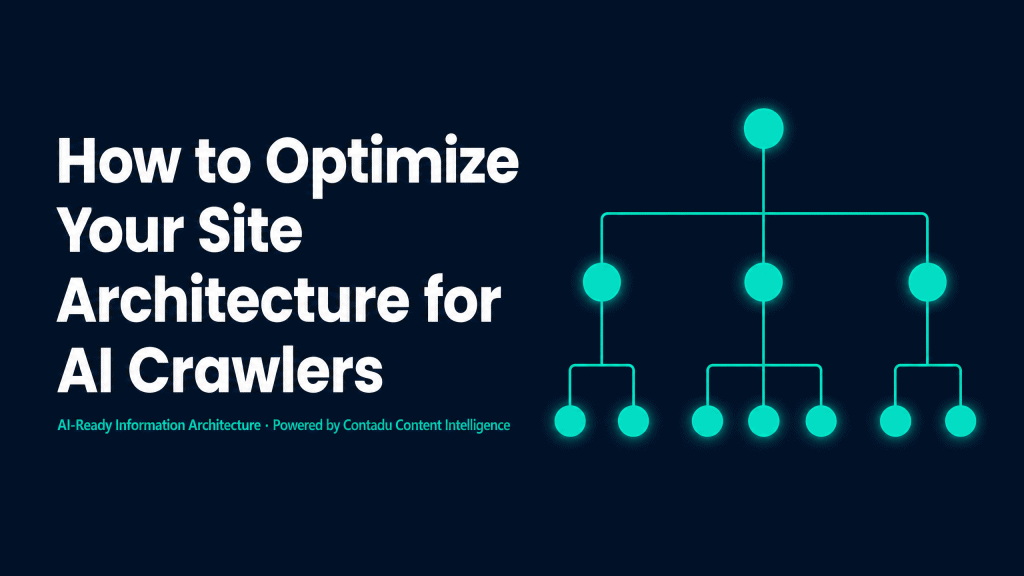
The solution is to adopt a flat site architecture, often referred to as a “Semantic Hub-and-Spoke” model. In a flat architecture, no critical page should be more than three clicks away from the homepage.
This structure ensures that AI crawlers can access your most important content quickly and efficiently, maximizing the use of their limited crawl budget.
Consolidate and Flatten Subdirectories
Review your URL structures and eliminate unnecessary subdirectories. Instead of burying your case studies under /resources/case-studies/industry/company-name, move them closer to the root domain, such as /case-studies/company-name. This not only reduces crawl depth but also concentrates authority on the pages that actually matter.
Build Comprehensive Pillar Pages
AI crawlers prefer comprehensive, centralized sources of information over dozens of fragmented, thin pages. Create robust pillar pages that serve as the definitive source of truth for a specific topic or entity.
For example, instead of having five separate short articles about different aspects of “Content Workflow Automation,” consolidate them into one authoritative pillar page. This provides the AI crawler with a dense, high-value node to extract from, increasing your Information Gain Score.
Implement Entity-Based Internal Linking
Internal linking in the AI era is not just about passing PageRank; it is about defining relationships between entities. When linking from a blog post to a product page, use precise, descriptive anchor text that clearly identifies the target entity.
Avoid generic anchors like “click here” or “learn more.” Instead, use semantic anchors like “our AI-driven content auditing tool.” This helps the LLM build a Knowledge Graph of your brand and its associated concepts.
Optimizing Technical Elements for AI Crawlability
Beyond structural changes, several technical optimizations are critical for accommodating AI crawlers.
XML Sitemaps as Semantic Maps
Ensure your XML sitemaps are pristine, containing only 200 OK, canonical URLs. AI crawlers rely heavily on sitemaps to discover new and updated content efficiently.
Consider segmenting your sitemaps by content type (e.g., product pages, blog posts, case studies) to help crawlers prioritize their resources. Furthermore, ensure your lastmod dates are accurate, as AI agents prioritize fresh data.
Advanced Schema Markup
Schema markup is the native language of AI crawlers. While traditional SEO required basic Article or Organization schema, GEO requires advanced, nested schema.
Use sameAs properties to link your brand to authoritative external entities (like your Wikipedia or Crunchbase profiles) to facilitate entity disambiguation. Implement FAQPage schema rigorously, as AI answer engines frequently extract direct answers from marked-up FAQs.
Managing Crawl Budget via Robots.txt
Because AI crawlers are aggressive but resource-limited, you must actively manage your crawl budget. Use your robots.txt file to block AI bots from crawling low-value pages, such as tag archives, author pages, faceted navigation, or internal search results.
By explicitly directing AI crawlers away from junk pages, you force them to spend their budget on your high-value pillar content and product pages.
How Contadu Content Intelligence Helps You Build AI-Ready Architecture
Restructuring a massive B2B website for AI crawlers is a complex undertaking, but you do not have to do it blindly. Contadu Content Intelligence provides the tools necessary to audit your current architecture and build a semantic network that LLMs understand.
Using Contadu semantic analysis features, you can identify isolated content silos and map the missing entity relationships across your domain.
The platform helps you design comprehensive pillar pages by highlighting the exact entities and co-occurring terms that AI engines expect to see. Furthermore, Contadu Content Strategy module allows you to plan an internal linking structure based on semantic relevance rather than just keyword matching, ensuring that AI crawlers can efficiently navigate and extract your brand’s core value propositions.
FAQ
What is the ideal click depth for an AI-optimized site architecture?
For critical pages (product pages, core pillar content, major case studies), the ideal click depth is no more than three clicks from the homepage. This flat architecture ensures AI crawlers can access the information before exhausting their crawl budget.
How do AI crawlers differ from traditional Googlebots?
AI crawlers (like OAI-SearchBot) are generally more resource-constrained and highly selective. While Googlebot aims to index the entire web, AI crawlers prioritize extracting high-quality, authoritative training data and factual answers to feed directly into Large Language Models.
Should I block AI crawlers in my robots.txt file?
No, blocking AI crawlers entirely will prevent your brand from appearing in AI-generated answers (like ChatGPT or Perplexity). However, you should use robots.txt to block them from crawling low-value, repetitive pages (like tag archives or faceted navigation) to conserve their crawl budget for your best content.
Why are deep hierarchies bad for Generative Engine Optimization (GEO)?
Deep hierarchies bury content, requiring too many “hops” for a crawler to reach the information. This dilutes semantic relevance and increases the likelihood that an AI crawler will abandon the path before extracting your core entities.
How does internal linking impact AI crawlability?
Internal linking acts as a map of relationships between entities. Precise, descriptive anchor text connecting related pillar pages and product features helps LLMs understand the context and build a Knowledge Graph around your brand.
Is pagination bad for AI crawlers?
Deep pagination (e.g., Page 45 of a blog archive) is highly inefficient for AI crawlers. It is better to organize content into categorized, highly relevant semantic hubs or pillar pages rather than relying on endless chronological pagination.
What role does Schema markup play in site architecture?
Schema markup provides explicit, machine-readable context to your site architecture. Nested schema and properties like sameAs help AI crawlers instantly understand entity relationships without having to infer them purely from text and internal links.