

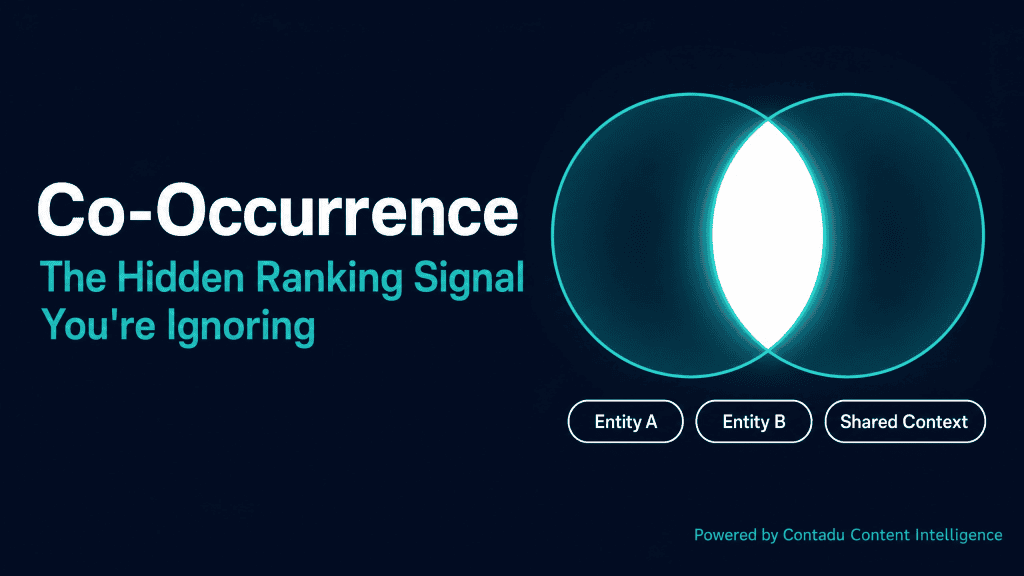
Co-Occurrence: The Hidden Ranking Signal You’re Ignoring.
📍Semantic Summary
Idea: In 2026, search engines do not just count how many times you use a target keyword; they analyze the surrounding vocabulary. Co-occurrence is the presence of related entities, terms, and concepts that naturally appear together in authoritative content.
Challenge: Writers relying on outdated SEO checklists often stuff primary keywords while ignoring the broader semantic field. This results in “thin” content that fails to prove topical depth to AI models and Natural Language Processing (NLP) algorithms, leading to poor rankings.
Summary: To master Semantic SEO, you must optimize for co-occurrence. This means researching the entity relationships expected by search engines and naturally weaving these related concepts into your content architecture. Tools like Contadu automate this process, ensuring your content meets the semantic expectations of modern algorithms.
Read the full guide below, or explore related topics:
- Topical Authority in 2026: The SEO Moat That Backlinks Can’t Buy
- How to Build a Custom Knowledge Graph for Your B2B Brand
Imagine you are reading an article that claims to be the ultimate guide to “Baking a Chocolate Cake.” However, as you read through the 2,000 words, you realize the author never mentions “flour,” “cocoa powder,” “oven temperature,” or “baking soda.” Instead, they just repeat the phrase “baking a chocolate cake” over and over again.
Even if you know nothing about baking, you would immediately recognize that the author is not an expert.
Search engines in 2026 evaluate content in exactly the same way. They do not just look for your target keyword; they look for the words that should be there if the content were truly authoritative. This concept is known as co-occurrence, and it is the foundational mechanism behind Semantic SEO.
What is Co-Occurrence in SEO?
Co-occurrence refers to the frequency and proximity with which specific words, phrases, and entities appear together within a corpus of text.
In the context of SEO, it is how Natural Language Processing (NLP) models like Google’s BERT and MUM understand context, disambiguate meaning, and measure topical depth. When an algorithm analyzes the top-ranking pages for a specific query, it identifies a mathematical pattern of vocabulary. It learns that authoritative articles about “CRM software” almost always contain terms like “sales pipeline,” “lead scoring,” “customer retention,” and “automation.”
If your article about “CRM software” lacks these co-occurring terms, the algorithm concludes that your content is superficial. You have failed to demonstrate the expected semantic field.
Co-Occurrence vs. LSI Keywords
A common misconception is that co-occurrence is just a modern name for LSI (Latent Semantic Indexing) keywords. This is inaccurate.
LSI is an outdated, specific mathematical technique developed in the 1980s for analyzing small, static databases. Google has repeatedly stated they do not use LSI. Co-occurrence, on the other hand, is a fundamental principle of modern neural networks and deep learning. It is not about finding synonyms (e.g., replacing “car” with “automobile”); it is about identifying conceptual relationships (e.g., knowing that “car” relates to “engine,” “roads,” “insurance,” and “fuel economy”).
The Three Levels of Co-Occurrence
To optimize for co-occurrence effectively, you must understand that it operates on multiple levels within your content architecture.
1. Phrase-Level Co-Occurrence.
This is the most granular level. It refers to terms that frequently appear in the same sentence or paragraph as your target entity.
For example, if you are writing about “Content Audits,” phrase-level co-occurrence expects to see terms like “decay,” “metrics,” “URL,” and “redirects” in close proximity. This helps the algorithm immediately confirm the specific context of your writing.
2. Document-Level Co-Occurrence
This level evaluates the entire article. Does the document cover all the necessary subtopics required to fully answer the user’s intent?
If you are writing a comprehensive guide to “B2B SaaS Pricing Models,” document-level co-occurrence dictates that you must discuss “freemium,” “tiered pricing,” “per-user,” and “enterprise sales.” If you omit “freemium,” your document is semantically incomplete compared to competitors who covered the entire semantic field.
3. Domain-Level Co-Occurrence (Topical Authority)
This is the most critical level for long-term SEO success. It looks beyond a single page and evaluates the co-occurrence of entities across your entire website.
If your brand wants to rank for “Cybersecurity,” it is not enough to have one highly optimized article. The algorithm looks at your entire domain to see if “Cybersecurity” co-occurs with a deep, interconnected web of related entities like “malware,” “phishing,” “zero-trust architecture,” and “encryption protocols.” This domain-level co-occurrence is the mathematical basis of Topical Authority.
How to Optimize for Co-Occurrence.
Optimizing for co-occurrence requires a shift from a “keyword placement” mindset to an “entity coverage” mindset.
Reverse-Engineer the SERP
Before writing, you must analyze the top 10 ranking pages for your target topic. What concepts do they all discuss? What specific terminology do they use? You are not looking for keywords to stuff; you are mapping the semantic field that Google has already rewarded.
Focus on Information Gain
While you must include expected co-occurring terms to establish baseline relevance, you must also introduce new, highly relevant entities that your competitors missed. This provides Information Gain a signal to Google that your content adds unique value to the web’s collective knowledge, rather than just summarizing what already exists.
Structure with Semantic Silos
Ensure your internal linking reflects logical co-occurrence. If two entities frequently co-occur in real life (e.g., “SEO” and “Content Marketing”), the pages discussing those entities on your website should be tightly interlinked, reinforcing their relationship to the algorithm.
The Impact of Co-Occurrence on Search Intent.
Understanding co-occurrence also solves one of the most persistent challenges in SEO: accurately matching search intent.
Often, a single keyword can have multiple, fractured intents. Take the query “python.” Is the user looking for information about the programming language, or the snake? In the early days of search, Google struggled with this ambiguity. Today, the algorithm relies entirely on co-occurrence to disambiguate the query.
If the algorithm sees “python” co-occurring with “venom,” “habitat,” “scales,” and “reptile,” it confidently categorizes the page as informational content about the animal. If it sees “python” co-occurring with “syntax,” “libraries,” “code,” and “development,” it categorizes the page as technical content about the programming language.
For B2B marketers, this means you must carefully audit your semantic field to ensure you are not accidentally sending mixed intent signals. If you are writing a transactional landing page designed to sell “CRM software,” but your vocabulary heavily co-occurs with informational terms like “history of CRM,” “what does CRM stand for,” and “definition,” the algorithm may misclassify your page as a glossary entry rather than a product page, destroying your conversion potential.
How to Audit Your Content for Missing Co-Occurrence.
If your pages are stuck on page two of the SERPs, a lack of co-occurrence is the most likely culprit. You need to perform a semantic audit.
Step 1: Identify the Baseline.
You must determine the absolute minimum semantic field required to rank. This means extracting the core entities that appear in at least 70% of the top 10 ranking pages. These are non-negotiable. If you are missing them, you are not even in the conversation.
Step 2: Identify the Differentiators
Next, look for terms that appear in the top 3 results, but not in results 4-10. These are the advanced entities that signal deeper expertise. Including these is how you move from “relevant” to “authoritative.”
Step 3: Analyze Entity Proximity
It is not enough to just include the words; they must be contextually grouped. If a competitor has a dedicated H2 section discussing “CRM Automation” where all related automation terms co-occur tightly, but you just sprinkle those same terms randomly throughout your text, the competitor’s signal is stronger.
Automating Semantic Optimization with Contadu
Manually calculating the necessary co-occurring terms by reading competitor articles is incredibly time-consuming and prone to human error. You cannot manually parse text the way a neural network does.
This is exactly what Contadu was built to solve.
When you input a target topic, Contadu Content Intelligence engine instantly analyzes the top-ranking corpus. It identifies the exact entities, NLP terms, and semantic concepts that define the expected co-occurrence for that specific query.
As you write in the Contadu editor, the Content Score updates in real-time, guiding you to naturally weave in the missing semantic terms. You are no longer guessing what words prove your expertise; you are mathematically ensuring your content perfectly aligns with the algorithm’s expectations.
FAQ
Does optimizing for co-occurrence mean I should stuff my article with a list of words?
Absolutely not. Forcing unrelated terms into a sentence creates a poor user experience and can trigger spam filters. Co-occurrence is about ensuring your content is comprehensive enough that these terms appear naturally as you explain the topic in depth.
How is co-occurrence different from keyword density?
Keyword density is the percentage of times a single target phrase appears in a text. Co-occurrence is the presence of a wide variety of different, related terms and entities that provide context and prove topical depth.
Do AI answer engines like ChatGPT care about co-occurrence?
Yes, deeply. Large Language Models (LLMs) are essentially massive prediction engines built entirely on the statistical probability of word and entity co-occurrence. If your content lacks the expected semantic relationships, LLMs are less likely to retrieve and cite your information.
How many co-occurring terms do I need to include?
There is no magic number. The required semantic field depends entirely on the complexity of the topic and what the top-ranking competitors are currently doing. Tools like Contadu calculate this dynamic baseline for you.
Can I rank without optimizing for co-occurrence?
For very low-competition, long-tail queries, perhaps. But for any competitive, high-value B2B keyword, it is virtually impossible in 2026. The algorithms are too sophisticated to be fooled by thin content lacking semantic depth.
Does co-occurrence apply to images and videos?
Yes. Search engines analyze the surrounding text, alt text, and even use OCR (Optical Character Recognition) and audio transcription to understand the context of multimedia. The text surrounding your media must semantically align with the media’s subject.
How do I fix older articles that lack semantic depth?
Run your older, underperforming articles through a semantic auditing tool like Contadu. Identify the missing entities and co-occurring terms, and rewrite the content to expand on those specific subtopics, thereby increasing the article’s overall semantic richness.