
How to Build a Custom Knowledge Graph for Your B2B Brand.
📍 Semantic Summary
Idea: You don’t need to wait for Google to figure out who you are. By building a custom Knowledge Graph on your own website using Schema markup and interconnected content, you can explicitly define your brand entity, your products, and your expertise to AI search engines.
Challenge: Most B2B websites are structured for human navigation, not machine understanding. They leave critical entity relationships ambiguous, forcing algorithms to guess how their blog posts relate to their core SaaS products. This ambiguity kills visibility in Generative Engine Optimization (GEO).
Summary: To control your narrative in the AI era, you must implement a local Knowledge Graph. This involves defining your core brand entity, establishing semantic silos, utilizing advanced Organization and SoftwareApplication Schema, and leveraging tools like Contadu to ensure semantic consistency across your domain.
Read the full guide below, or explore related topics:
- Generative Engine Optimization (GEO) for E-commerce
- Topical Authority in 2026: The SEO Moat That Backlinks Can’t Buy
When you search for a massive enterprise like Salesforce or HubSpot, you immediately see a rich Knowledge Panel on the right side of the search results. Google knows exactly who they are, what they sell, who their CEO is, and how they relate to the broader software industry.
For a long time, B2B marketers assumed this level of recognition was reserved for Fortune 500 companies or brands with Wikipedia pages. But in 2026, waiting for Google or ChatGPT to organically piece together your brand identity is a losing strategy.
Instead of waiting, you can proactively build a custom Knowledge Graph directly on your website. By doing so, you force search engines and AI models to understand your brand entity on your terms, dramatically improving your visibility in AI Overviews and traditional SERPs.
What is a Custom Knowledge Graph?
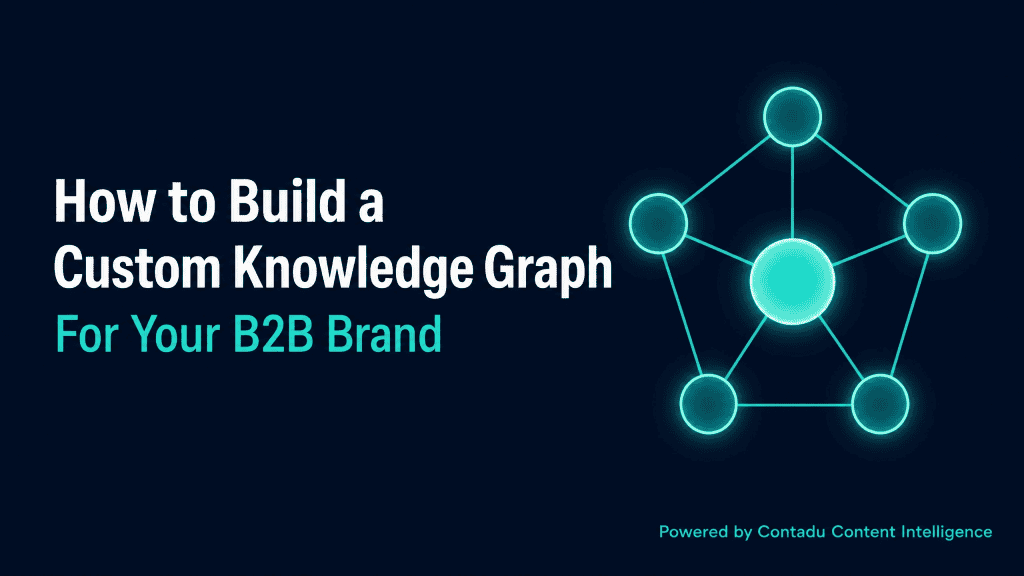
A Knowledge Graph is a database that stores information not as isolated text documents, but as interconnected entities. It understands that “Satya Nadella” (Person) is the CEO of “Apple” (Organization), which sells the “iPhone” (Product).
Google has the largest Knowledge Graph in the world. However, your website can act as a localized, custom Knowledge Graph. By structuring your content and code correctly, you create a machine-readable map of your specific business universe. You explicitly tell the algorithm: “We are this type of company, we solve this specific problem, and we are the definitive experts on these core topics.”
The 4 Steps to Building Your Local Knowledge Graph.
Building a custom Knowledge Graph is not about writing more blog posts; it is about structuring the information you already have so that machines can parse it flawlessly.
Step 1: Define Your Core Brand Entity.
Everything starts with the “About Us” page. In the context of Entity SEO, your About page is not just a place for your company history; it is the definitive source of truth for your brand entity.
You must clearly state:
- Who you are (Organization name, alternative names).
- What you do (The exact category of software or service you provide).
- Who leads the company (Key personnel, linking to their author profiles).
- Where you are located (Physical addresses, if applicable).
This page should act as the central node. Every time your brand is mentioned elsewhere on the site, it should conceptually link back to this definitive definition.
Step 2: Implement Advanced Organization Schema.
You cannot rely on text alone. You must translate your brand identity into code using Schema markup (specifically JSON-LD).
A basic Organization schema is no longer enough. In 2026, your schema must be nested and comprehensive. It should include:
- sameAs: Links to your verified social media profiles, Crunchbase page, or any authoritative third-party directory that validates your existence.
- founder or alumni: Linking to the Person schema of your leadership team.
- makesOffer: Explicitly connecting your Organization to the specific SoftwareApplication or Service schema of your products.
By nesting these schemas, you are feeding a pre-built graph directly to Google’s crawlers.
Step 3: Establish Semantic Silos.
A custom Knowledge Graph requires a logical content architecture. If your blog is a flat list of chronological posts covering random topics, you are creating noise, not a graph.
You must organize your content into semantic silos (often called topic clusters).
1.The Hub (Pillar Page): A comprehensive guide covering a broad entity (e.g., “CRM Software”).
2.The Spokes (Cluster Pages): Deep dives into specific sub-entities (e.g., “CRM for Real Estate,” “How to Migrate CRM Data”).
The internal linking between the hub and the spokes must be rigid and consistent. Spoke pages should always link back to the hub, and the hub should link out to the spokes. This physical link structure mirrors the conceptual structure of a Knowledge Graph, teaching AI how these concepts relate within your domain.
Step 4: Author Entity Disambiguation.
If you want your content to rank, Google needs to trust the person who wrote it (the E-E-A-T principle). You must establish your writers as authoritative entities in their own right.
Every author should have a dedicated author page with Person schema. This schema should use the knowsAbout property to define their areas of expertise and the sameAs property to link to their LinkedIn profile or published work on other authoritative sites. When an author publishes a post, the Article schema should link directly back to their Person schema, transferring their authority to the content.
The Role of Digital PR in Validating Your Knowledge Graph.
Building a custom Knowledge Graph on your own website is only half the battle. You are essentially telling Google, “This is who we are and what we do.” However, search engines operate on a system of trust and verification. They need third-party validation to confirm that the entities and relationships you have defined are accurate and recognized by the broader industry.
This is where Digital PR intersects with Entity SEO. Traditional PR focuses on brand awareness; Digital PR for entity building focuses on securing high-authority mentions that reinforce your specific semantic relationships.
When a major industry publication mentions your brand alongside your core product category (e.g., “Contadu, a leader in Content Intelligence…”), they are validating the connection between the Organization entity and the SoftwareApplication entity. Even if these mentions do not include a hyperlink (unlinked mentions), natural language processing models like BERT still read them, parse the context, and use them to strengthen the connections within the global Knowledge Graph.
Your goal is to ensure that your external footprint perfectly mirrors the internal Knowledge Graph you have built on your site.
Avoiding Common Entity Mapping Mistakes.
When transitioning to an entity-first approach, many B2B marketers make structural errors that confuse AI algorithms rather than clarify them.
Mistake 1: Keyword Stuffing in Schema
Schema markup is for factual data, not marketing copy. If you stuff your description property in your Organization schema with a list of twenty SEO keywords, you risk algorithmic penalties. Schema must be clean, objective, and precise.
Mistake 2: Broken Semantic Silos
If you build a beautiful hub-and-spoke architecture but allow your writers to randomly cross-link between unrelated silos, you destroy the semantic boundaries. A post about “Email Marketing” should not casually link to a deep-dive technical post about “CRM API Integrations” unless there is a highly specific, justified entity relationship.
Mistake 3: Neglecting Entity Salience
Not all entities on a page are treated equally. Entity Salience is a score that determines how central an entity is to the overall meaning of the text. If you mention your core product once in passing at the bottom of a 3,000-word article, its salience is low. You must structure your content so that your target entities are the undeniable focal point of the narrative.
Using Contadu to Maintain Semantic Consistency.
Building a custom Knowledge Graph is useless if your content writers constantly introduce ambiguous or conflicting terms. To maintain the integrity of your graph, you need semantic consistency.
This is where Contadu becomes essential. When you create a content brief in Contadu, the platform’s Content Intelligence analyzes the semantic landscape and tells your writers exactly which entities and related terms must be included to satisfy the algorithm.
By enforcing the use of these specific terms across all your content, Contadu ensures that your local Knowledge Graph remains dense, interconnected, and highly authoritative in the eyes of AI search engines.
FAQ.
Do I need a Wikipedia page to have a Knowledge Panel?
No. While Wikipedia is a highly trusted source for Google’s Knowledge Graph, it is not strictly required in 2026. A robust custom Knowledge Graph built with comprehensive Schema markup, combined with strong digital PR and third-party mentions, can trigger a Knowledge Panel for your brand.
What is the difference between a custom Knowledge Graph and a topic cluster?
A topic cluster is a way of organizing content for users and search engines through internal links. A custom Knowledge Graph encompasses topic clusters, but goes further by using Schema markup to explicitly define the relationships between the concepts, products, and people on your site in machine-readable code.
Which Schema markup is most important for B2B SaaS?
The foundational schemas are Organization (for the company), SoftwareApplication (for the product), and Person (for the leadership/authors). These three should be heavily detailed and interconnected using properties like makesOffer and founder.
How does a custom Knowledge Graph help with AI Overviews (SGE)?
AI models like ChatGPT and Google’s SGE rely on structured data and clear entity relationships to generate factual answers. If your site provides a pre-parsed, unambiguous Knowledge Graph, it is much easier (and safer) for the AI to extract your information and cite you as the source.
Can I build a Knowledge Graph if my website is small?
Yes. The size of the website matters less than the clarity of the structure. A 20-page website with perfectly nested Schema markup and strict semantic silos will provide a clearer Knowledge Graph than a 500-page blog with chaotic linking and no structured data.
How do I measure the success of Entity SEO?
Traditional rank tracking is less effective here. You should measure success by tracking your brand’s appearance in AI Overviews, monitoring your “Share of Voice” in tools like Perplexity, and tracking the growth of unlinked brand mentions across the web.
What is “Entity Disambiguation”?
It is the process of ensuring search engines do not confuse your brand entity with something else that shares the same name. For example, if your SaaS company is named “Apple,” you must use Schema and consistent content to disambiguate yourself from the fruit and the tech giant.