
Internal Linking Strategy: The Science of Link Equity Distribution
You will understand that internal linking is not random link insertion, but one of the most powerful and most underestimated SEO techniques. This guide is your map to consciously building an information architecture that not only improves user experience, but above all strategically directs authority (so-called link equity) within your site, telling Google which pages are most important. You will learn how to transform your site from a loose collection of articles into a cohesive, logical network that dominates search results.
Theoretical Foundation: What Is Link Equity and How Does PageRank Work?
To understand internal linking, we must go back to the very basics of Google. At its inception was the PageRank algorithm, which treated links like votes. A page that received more “votes” (links) was considered more important.
Link Equity (or “Link Juice”) is the colloquial name for the authority that a page can pass to other pages through links. Imagine that each page on your site has a certain amount of authority. By linking from it to other pages, you “transfer” part of that authority onward.
Example:
- Your homepage has 100 units of authority.
- It links to 10 subpages.
- In simplified terms, each of these subpages receives ~10 units of authority (in reality it’s more complicated, but the principle is the same).
Key principles of Link Equity flow:
- The more links on a page, the less authority each one passes. A page with 100 links passes less “power” to each than a page with 10 links.
- Links from more important pages pass more authority. A link from the homepage (which usually has the most authority) is worth more than a link from an insignificant article.
- Internal links help Google discover and index new content. Google bots follow links to find all subpages of your site.
Linking Architecture: The Topic Cluster Model.
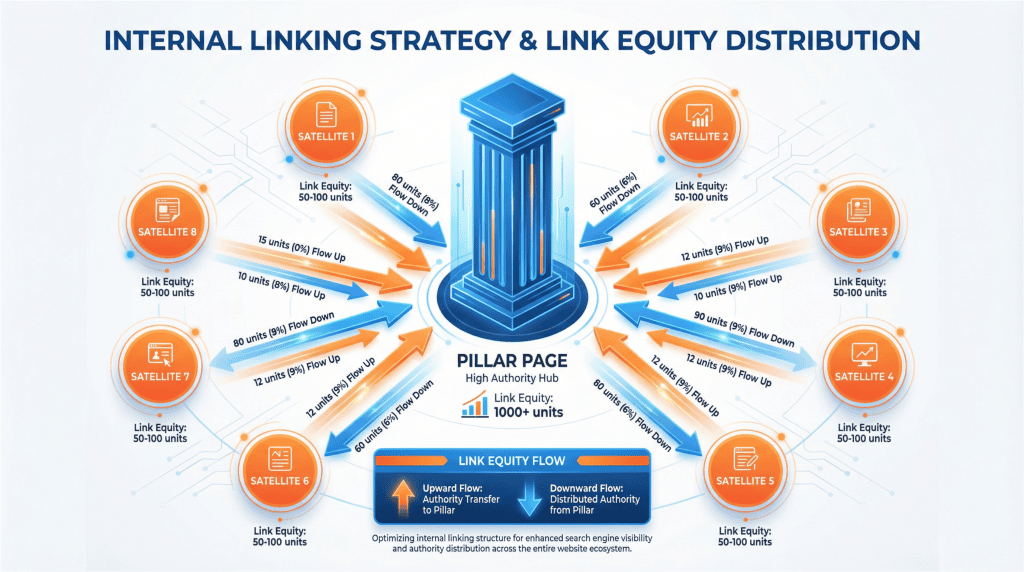
The most effective model for strategic internal linking is an architecture based on topic clusters. This model allows for conscious direction of authority flow and building a strong E-E-A-T signal.
Example:
- Pillar Page: “Guide to Content Marketing in 2026”
- Satellite Articles: “How to Create a Brief”, “What is Content Gap”, “Long-Form Strategy”Authority Flow:
- Article “How to Create a Brief” links to “Guide to Content Marketing”.
- Article “What is Content Gap” links to “Guide to Content Marketing”.
- “Guide to Content Marketing” links to “How to Create a Brief” and “What is Content Gap”.
- Article “How to Create a Brief” links to “What is Content Gap” (because they are related).
This model creates a self-reinforcing loop: the stronger the satellites become, the more authority they pass to the pillar, and the stronger the pillar is, the more it supports its satellites.
Tactical Internal Linking Playbook.
Anchor Text: Words That Have Power.
Anchor text is the clickable part of a link. It’s one of the most important signals for Google, telling what the destination page is about.
Example:
- Bad: “You can read more about this here.”
- Good: “You can read more about this in our guide to content marketing strategy.”
- Avoid generic anchors: Instead of “click here” or “learn more,” use descriptive phrases.
- Use partial match: If you’re linking to an article about “internal linking strategy,” use anchors like “more about linking strategy,” “how to build internal links,” “linking guide.”
- Vary anchor text: Don’t always use the same anchor text to the same page. A natural link profile is diverse.
Link Placement.
Not all links on a page have the same weight.
- Links in main content (body): Are most important. Google knows they are part of editorial context.
- Navigation links (menu, footer): Are important for architecture and UX, but have less contextual weight than links in content.
- Links at the top of the page: Usually pass slightly more authority than those at the bottom.
Audit and Optimization.
Regularly audit your internal linking. Similar to on-page SEO optimization, internal linking requires continuous monitoring and improvement.
- Find “orphan pages”: Pages that have no internal links pointing to them. Google may have trouble finding them.
- Strengthen important pages: Identify your most important, most profitable pages and make sure they receive an appropriate number of internal links from other strong pages.
- Fix broken links: Broken internal links are a waste of authority and a bad signal for UX.
How Contadu Helps with Linking Strategy.
Contadu provides tools that facilitate implementation of advanced internal linking strategy:
- Architecture Planning: The Content Strategy module allows you to visually plan the entire topic cluster structure before you even write the first article. You see how pages will be connected and how authority will flow.
- Internal Link Suggestions: While writing in the Content Editor, Contadu can analyze your site and suggest relevant articles worth linking to. This automates the process of finding contextual connections.
- Anchor Text Optimization: By analyzing top results, Contadu suggests which terms and phrases to use in content, which naturally helps create diverse and relevant anchor texts.
FAQ
How many internal links should be in an article?
There’s no magic number. Focus on quality and relevance. Link where it’s natural and helpful for the reader. A good practice is 2-5 links per 1000 words, but that’s just a guideline.
Do nofollow links make sense in internal linking?
In 99% of cases, no. Using rel=”nofollow” on internal links blocks authority flow and is contrary to the goal of strategic linking. Use it only in exceptional situations (e.g., links to login pages).
What’s more important: internal links or external links (backlinks)?
You need both. Backlinks build overall authority of your domain. Internal links distribute that authority within your site, directing it to the most important pages.
How quickly will I see the effects of improved internal linking?
Changes in internal linking are one of the fastest on-page SEO techniques. Google can notice changes and recalculate PageRank during its next visit to your site. Visible ranking effects can appear within a few days to a few weeks.
Can I link to the same page multiple times from one article?
Yes, but usually only the first link (in order in the HTML code) passes PageRank authority. Subsequent links can still be useful for the user.
Summary and Next Step
Stop treating internal links as an afterthought. Start thinking about them as your site’s nervous system, which transmits energy and information where they are most needed. A conscious, data-driven internal linking strategy is the foundation that strengthens every other SEO activity you undertake.
Suggested next step: Choose one of your most important articles (one you want to rank higher). Find 5 other topically relevant articles on your blog and add a contextual link to your priority article in each. This simple exercise will show you how easy it is to start consciously directing authority.