

The “Barbell Strategy” for Content Marketing in 2026: Why the Middle is Dead
For the past decade, the standard playbook for B2B content marketing was remarkably consistent: hire a team of freelance writers, pay them $150 to $300 per article, and publish two or three 1,500-word posts every week.
This approach created a massive “middle class” of content. It wasn’t terrible, but it wasn’t groundbreaking either. It was adequately researched, reasonably well-written, and heavily optimized for search engines. And for a long time, it worked perfectly. It generated predictable, compounding organic traffic.
But in 2026, that strategy is a guaranteed path to irrelevance.
The widespread adoption of Generative AI has fundamentally altered the economics of content creation. The “adequate, 1,500-word SEO post” that used to cost $200 and take three days to produce can now be generated by an AI agent in 45 seconds for a fraction of a cent. As a result, the internet is flooding with perfectly average content.
If your strategy relies on competing in this middle ground, you are fighting a war of attrition against machines that don’t sleep, don’t ask for raises, and can produce infinite volume.
To survive and thrive in 2026, content marketers must adopt a concept borrowed from finance and risk management: The Barbell Strategy.
What is the Barbell Strategy?
The Barbell Strategy was popularized by essayist and former options trader Nassim Nicholas Taleb. In finance, it involves avoiding moderate-risk investments entirely. Instead, you allocate your portfolio to two extremes:
1.Extreme Safety (80-90%): Ultra-safe, low-yield assets (like treasury bonds) to protect against ruin.
2.Extreme Risk (10-20%): Highly speculative, high-yield assets (like venture capital or out-of-the-money options) that have a small chance of massive, asymmetrical returns.
You avoid the “middle” entirely, because the middle offers the worst of both worlds: enough risk to cause significant damage, but not enough upside to generate life-changing wealth.
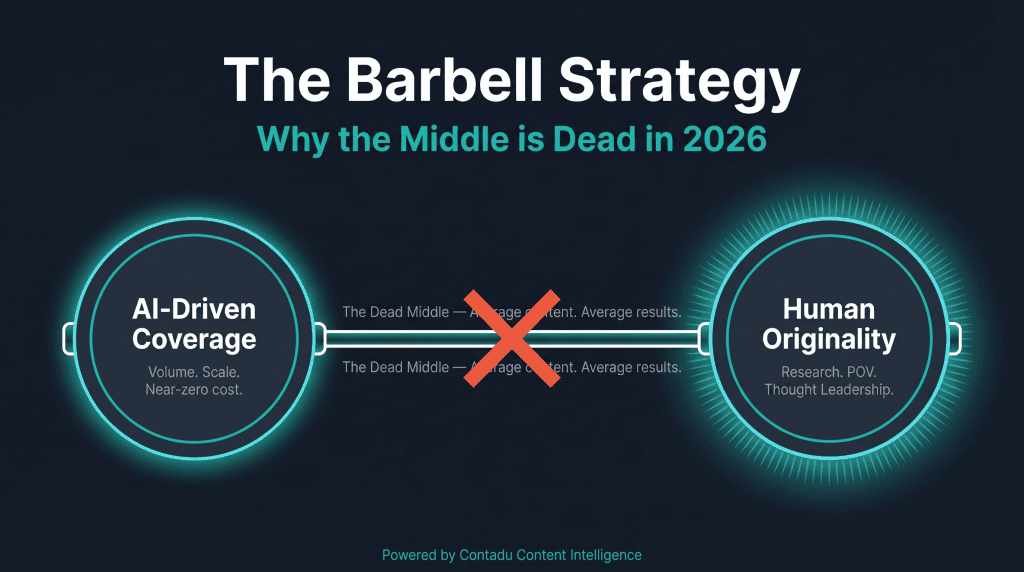
When applied to content marketing in 2026, the Barbell Strategy looks like this:
You stop investing in “average” content. Instead, you split your resources between two extremes:
- Weight 1: Hyper-Efficient, AI-Driven Coverage (The “Safe” Side). This is content produced at near-zero marginal cost using autonomous AI agents. Its goal is broad semantic coverage, long-tail keyword capture, and maintaining topical authority.
- Weight 2: High-Investment, Human-Led Originality (The “Risk” Side). This is expensive, deeply researched, uniquely human content. Its goal is to build brand authority, earn backlinks, generate dark social shares, and establish thought leadership that AI cannot replicate.
The “middle class” of content—the $200 freelance SEO article—is eliminated entirely.
Weight 1: Hyper-Efficient, AI-Driven Coverage.
On one end of the barbell, you leverage AI to do what it does best: synthesize existing information at scale.
In the past, building Topical Authority required a massive budget. If you wanted to rank for “CRM software,” you needed to write dozens of supporting articles covering every minor feature, integration, and definition.
Today, AI agents can handle this foundational layer autonomously.
What belongs on this side of the barbell?
- Glossaries and Definitions: “What is a Sales Pipeline?” or “Lead Scoring Defined.” These are factual, objective topics where there is only one right answer. AI can generate these perfectly.
- Programmatic SEO Pages: “CRM for Plumbers” vs. “CRM for Electricians.” AI can scale templated pages by dynamically inserting industry-specific use cases.
- Standard How-To Guides: Basic, step-by-step instructions for common tasks where the process is well-documented across the internet.
- Content Updates and Refreshes: Using AI to monitor your existing library and automatically update statistics, dates, and broken links.
The Strategy
The goal here is volume and coverage at the lowest possible cost. You are not trying to win Pulitzer Prizes; you are trying to cast a wide net to capture long-tail search intent and signal to Google that your domain covers the entire breadth of a topic.
You use tools like Contadu Generative AI to automate the drafting process, ensuring that the content hits all necessary semantic entities and NLP terms. A human editor then reviews, fact-checks, and publishes. The cost per article drops from $200 to $10, and the production time drops from days to minutes.
Weight 2: High-Investment, Human-Led Originality.
If the first weight is about coverage, the second weight is about differentiation.
Because AI has commoditized standard information, the only content that truly stands out the content that people bookmark, share in private Slack channels, and use to make purchasing decisions—is content that AI cannot create.
This is the high-risk, high-reward side of the barbell. It requires significant investment of time, money, and human expertise. But a single piece of content on this side can generate more pipeline than 100 AI-generated articles.
What belongs on this side of the barbell?
- Original Research and Data: Publishing a “State of the Industry” report based on your own proprietary user data or a survey of 1,000 executives. AI cannot generate new data; it can only summarize old data.
- Strong Point-of-View (POV) Essays: Opinionated, contrarian takes on industry trends. AI is programmed to be safe, neutral, and consensus-driven. Human experts can take a stand.
- Deep-Dive Case Studies: Detailed, nuanced stories of how a specific customer solved a complex problem, complete with interviews, specific metrics, and strategic context.
- Expert Interviews and Video: Capturing the raw, unscripted insights of Subject Matter Experts (SMEs) through video and podcast atomization.
- Interactive Tools and Calculators: Engineering small, free products (like an ROI calculator) that provide immediate, personalized value.
The Strategy
The goal here is Information Gain. As Google’s Information Gain Score patent outlines, search engines are increasingly rewarding content that brings net-new information to the web.
You allocate the budget you saved from eliminating the “middle class” of content and pour it into these high-impact assets. Instead of paying 10 freelancers $200 each for average articles, you pay one industry expert $2,000 to write a definitive, data-backed whitepaper.
This is the content that earns backlinks, builds your brand moat, and survives the shift toward Zero-Click Search.
The Danger of the Middle.
Why is the middle so dangerous in 2026?
Imagine you continue producing the standard, 1,500-word, reasonably well-written SEO article.
1.It’s too expensive to scale. You are paying human rates for content that an AI can produce for pennies. You will be out-published by competitors using the automated side of the barbell.
2.It’s not unique enough to stand out. Your human writer is likely just Googling the topic and summarizing the top 5 ranking articles. This results in “rehashed” content with zero Information Gain. Google’s AI Overviews will simply bypass your article and answer the user’s query directly.
3.It doesn’t build trust. A mid-tier article doesn’t convince a B2B buyer to trust your brand with a $50,000 contract. It lacks the depth, data, and unique POV required to drive a complex sale.
The middle is a trap. It burns budget without generating either the massive scale of AI or the massive impact of true thought leadership.
Implementing the Barbell Strategy with Contadu.
Shifting to a Barbell Strategy requires a change in both mindset and tooling. You need a system that can manage both extremes simultaneously. Here is how Contadu facilitates this shift:
1. Automating the “Safe” Side.
For your high-volume, coverage-driven content, Contadu acts as your AI orchestration layer. You can use the platform to identify semantic gaps in your topic clusters, automatically generate detailed content briefs, and use the Generative AI module to produce drafts that are pre-optimized for NLP entities and search intent. This allows a single editor to manage dozens of coverage articles per week.
2. Empowering the “Risk” Side.
For your high-investment, human-led content, Contadu provides the intelligence needed to ensure your big bets pay off. Before you invest $3,000 in an original research piece, you use Contadu’s SERP analysis to verify the search intent and identify exactly what information is missing from the current top-ranking pages. You use the Content Score not to stuff keywords, but to ensure your expert writer hasn’t missed any critical semantic concepts that Google expects to see in a comprehensive document.
By leveraging Content Intelligence, you ensure that your high-risk investments have the highest possible probability of dominating the SERP.
FAQ
Does the Barbell Strategy mean I should fire all my freelance writers?
Not necessarily, but their roles must change. You no longer need “generalist” writers who summarize existing Google results. You need Subject Matter Experts (SMEs) who can write from deep, personal experience, or skilled editors who can refine and fact-check high volumes of AI-generated drafts. The middle-tier generalist role is what is being eliminated.
What is the right ratio between the two sides of the barbell?
A common starting point is the 80/20 rule: 80% of your volume (number of URLs published) comes from the hyper-efficient, AI-driven side, while 80% of your budget and human effort is dedicated to the 20% of high-impact, original content.
Will Google penalize the AI-generated side of the barbell?
Google’s official guidelines state that they reward high-quality content, regardless of how it is produced. If your AI-generated content is accurate, helpful, satisfies user intent, and is properly reviewed by a human editor, it will not be penalized simply for being AI-generated. The penalty comes from publishing low-quality, unedited AI spam.
How do I measure success for the “Originality” side of the barbell?
You cannot measure high-impact content using only traditional metrics like organic traffic. Because these pieces often target niche, high-value audiences, raw traffic may be low. Instead, measure success through backlinks earned, mentions in industry newsletters, shares in Dark Social (like private Slack communities), and ultimately, influenced pipeline and closed-won revenue.
Isn’t original research too expensive for a small marketing team?
Original research doesn’t always mean hiring a polling firm for $20,000. You are sitting on a goldmine of proprietary data: your own product usage metrics. Anonymize and aggregate your customer data to reveal trends. For example, “How 500 Sales Teams Use CRM Tags” is highly valuable original research that costs nothing but time to produce.
Can I use AI to help with the “Originality” side?
Yes, but as an assistant, not a creator. Use AI to analyze large datasets for your original research, to transcribe and extract themes from SME interviews, or to brainstorm contrarian angles. The core insight and the final voice must remain human, but AI can significantly accelerate the research and structuring phases.
How do I convince my leadership team to adopt this strategy?
Frame it as a risk management and efficiency play. Show them that the current cost-per-acquisition for mid-tier content is rising while its effectiveness is dropping due to AI Overviews. Present the Barbell Strategy as a way to drastically lower the cost of maintaining search visibility (Weight 1) while reallocating those savings into high-ROI assets that actually drive sales conversations (Weight 2).
