
The Customer Success Content Playbook: How to Write Your Way to Zero Churn
You just popped the champagne. The sales team closed a massive enterprise deal, the contract is signed, and the revenue is officially on the books. Marketing is celebrating the qualified lead, Sales is celebrating the commission, and the executive team is looking forward to the next quarter.
But what happens next?
In the vast majority of B2B companies, the moment a prospect becomes a paying customer, the content engine abruptly shuts down. Marketing goes back to hunting for net-new leads, and the newly acquired customer is handed over to the Customer Success (CS) team with nothing but a generic welcome email and a link to a dry, highly technical help center.
Fast forward six months. The customer is frustrated. They are not using half the features they paid for. They do not understand the strategic value of the platform. And when renewal time comes around, they churn.
This is the silent killer of SaaS businesses. You cannot build a sustainable growth model if you are constantly replacing lost customers. In 2026, the smartest software companies realize that content marketing does not end at the point of sale. In fact, that is exactly when the most important, high-stakes content work begins.
This is your playbook for creating Customer Success Content—the kind of strategic, empathetic, and actionable content that turns confused new users into confident power users, and power users into lifelong, revenue-generating advocates.
Section 1: The Flaw in Traditional Help Centers.
Let’s be honest: nobody actually likes reading help documentation.
Traditional help centers are usually written by engineers, for engineers. They are dry, feature-focused, and completely lack strategic context. A typical help article will tell you which button to click to export a report, but it will never tell you why you should run that report in the first place, or what to do with the data once you have it.
This creates a massive disconnect. Customers do not buy software because they want to click buttons; they buy software because they want to solve a business problem. When your post-sale content only focuses on the buttons, you are failing to deliver on the promise that your sales team made.
Customer Success Content bridges this gap. It shifts the focus from “how to use our software” to “how to achieve your business goals using our software.”
Traditional Help Center vs. Customer Success Content
| Dimension | Traditional Knowledge Base | Customer Success Content | AI Actionable Metric |
| Primary Focus | Features, UI navigation, buttons | Outcomes, strategies, business goals | content_focus = strategic_outcome |
| Tone of Voice | Dry, technical, robotic, passive | Empathetic, expert, conversational, active | tone_sentiment = empathetic_expert |
| Content Format | Step-by-step lists, technical specs | Playbooks, templates, use cases, videos | format_type = strategic_playbook |
| Primary Goal | Reduce support ticket volume | Drive product adoption and NRR | primary_kpi = net_revenue_retention |
| Author Persona | Technical Writer / Developer | Subject Matter Expert / Strategist | author_authority = high |
Section 2: The 3 Pillars of Post-Sale Content.
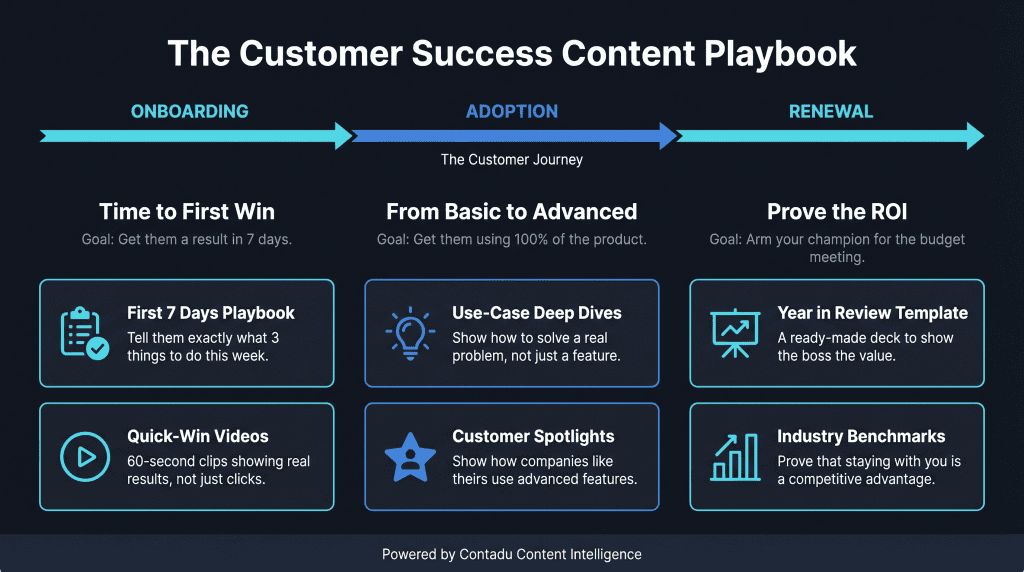
To stop churn before it starts, your content needs to guide the customer through three distinct phases of their post-sale journey. Each phase requires a different psychological approach and a different content format.
Pillar 1: The Onboarding Phase (Time-to-Value).
When a customer first logs into your platform, they are overwhelmed. They are looking at a blank dashboard and wondering where to start. Your goal in this phase is not to teach them every single feature. Your goal is to get them their first tangible “win” as quickly as possible. In the SaaS world, we call this the “Time-to-Value” (TTV).
If a customer does not experience a clear win within the first 14 days, their likelihood of churning increases exponentially.
What to create for Onboarding:
- The “First 7 Days” Playbook: Instead of sending a generic “Welcome to the platform” email, send them a highly opinionated, structured guide. Tell them exactly what three things they need to accomplish this week to see immediate results. Remove the paradox of choice. If your software is an SEO tool, day one should not be “explore the settings.” Day one should be “run your first site audit and fix the top 3 errors.”
- Quick-Win Video Snippets: People learn differently. Create a series of 60-second videos showing a real person achieving a specific task. Do not just record a screen share of a mouse clicking around; have the presenter explain the strategy behind the clicks. “I am clicking this filter because it allows us to isolate high-intent keywords, which is the fastest way to see ROI.”
- The “Anti-Mistake” Guide: Sometimes, the best way to help a new user is to tell them what not to do. Publish a guide titled “The 5 Most Common Mistakes New Users Make (And How to Avoid Them).” This builds immediate trust because it shows you understand their pain points.
Pillar 2: The Adoption Phase (From Basic to Advanced)
Once the customer knows the basics and has achieved their first win, they tend to settle into a comfortable routine. They use 20% of your product and completely ignore the rest.
This is a dangerous place to be. If a customer only uses 20% of the value your platform provides, they will eventually ask for an 80% discount—or they will leave for a cheaper competitor that only offers those basic features. Your content must push them out of their comfort zone and into your advanced feature set.
What to create for Adoption:
- Use-Case Deep Dives: Write comprehensive articles that highlight a specific, advanced business problem and show exactly how your tool solves it. Do not name the article after the feature. For example, instead of writing “How to use the tagging feature,” write “How to use tags to organize and measure your Q3 marketing campaign.” The former is a manual; the latter is a strategy.
- Customer Spotlights (The “Peer Pressure” Play): Do not just write case studies for your marketing website. Write them specifically for your existing customers. Show them how a company just like theirs—in their industry, with their team size—is using your advanced features to save time or make money. This creates positive peer pressure: “If they are doing this, we should be doing it too.”
- “Level Up” Webinars: Host monthly, customer-only webinars focused on a single advanced workflow. Treat these like masterclasses. The goal is not to sell them anything; the goal is to make them smarter marketers, salespeople, or developers, using your tool as the medium.
Pillar 3: The Renewal Phase (Proving the ROI).
As the annual renewal date approaches, the dynamic changes. The person who uses your software every day (your champion) often has to justify the cost of the renewal to their boss, the VP, or the CFO.
The CFO does not care about how many features you have or how friendly your UI is. The CFO cares about one thing: Return on Investment. You need to arm your champion with the content they need to win that argument in the boardroom.
What to create for Renewal:
- The “Year in Review” Presentation Template: Do not make your champion build a slide deck from scratch. Provide them with a beautifully designed, fill-in-the-blank presentation template. Include slides where they can input the hours saved, the revenue generated, and the specific goals achieved using your platform over the last 12 months.
- Industry Benchmarks and State of the Market Reports: Publish authoritative data showing how your most successful customers perform compared to the industry average. If you can prove that companies using your software grow 20% faster than companies that do not, you have just given your champion the ultimate weapon. This proves that staying with you is not just a software expense; it is a competitive advantage.
- The Executive Summary One-Pager: Create a high-level, jargon-free document that explains the strategic value of your platform. This is the document your champion will attach to the purchase order when they send it to the CFO for signature.
Section 3: How to Build the Content Engine (Without Burning Out).
You might be reading this and thinking, “My marketing team is already stretched incredibly thin writing blog posts for SEO and lead generation. How can we possibly find the time to write all this post-sale content too?”
This is a valid concern. But the secret to building a Customer Success Content engine is that you do not have to start from scratch, and you do not have to guess what to write about. You just need to build a bridge between your Customer Success team and your Marketing team, and leverage the right technology.
1. Mine the Customer Success Inbox.
Your CS team is sitting on a goldmine of content ideas. Every single day, they answer the same strategic questions from different customers. “How should I structure this campaign?” “What is the best way to report this to my boss?”
Instead of having CS reps type out manual, one-off responses to these questions, have them forward the questions to the marketing team. Those emails are the perfect outlines for your next Use-Case Deep Dive. When Marketing turns that answer into a polished, published article, the CS team can simply send a link the next time the question is asked. This saves the CS team hundreds of hours a year.
2. Atomize Your Existing Assets.
If you just hosted a brilliant, 45-minute webinar on advanced strategies for your existing customers, do not let that video die in an archive.
Use the podcast-to-blog atomization framework to extract the value from that video. Run the audio through a transcription tool, identify the 3 or 4 distinct themes discussed, and use AI to help draft standalone Customer Success articles based on the transcript. One webinar can fuel your post-sale content calendar for a month.
3. Optimize for Clarity with Contadu.
There is a dangerous misconception that because post-sale content is meant for existing customers, it does not need to be optimized for search or readability. “They already bought the product, so we do not need to worry about SEO.”
This is entirely wrong. Your existing customers are still using Google to find answers about your product. If they search “How to measure ROI with [Your Brand],” and your Customer Success article does not rank, they will end up on a competitor’s site or a third-party forum.
Furthermore, post-sale content must be incredibly clear and easy to read. You can use Contadu Content Intelligence to ensure your playbooks and deep dives are structured perfectly.
- Semantic Consistency: Contadu semantic scoring ensures you are using the exact terminology your customers use. If your customers search for “revenue tracking,” but your engineers wrote the article using the phrase “monetary analytics,” there is a semantic disconnect. Contadu will flag this.
- Information Gain: When writing a Use-Case Deep Dive, use Contadu to analyze what other companies have written about the topic. Ensure your article provides higher Information Gain by including unique data, specific templates, and proprietary frameworks that only your company can provide.
- Readability: Technical concepts must be explained simply. Contadu helps you maintain an accessible, conversational tone, ensuring that even your most complex advanced features can be understood by a non-technical user.
The Ultimate Goal: Net Negative Churn.
By breaking down the silo between Marketing and Customer Success, you stop treating content as just a top-of-funnel lead-generation tool. You transform it into a full-funnel retention engine.
When you invest in the Onboarding, Adoption, and Renewal phases, you do more than just keep customers around. You turn them into power users who upgrade their plans, buy additional seats, and recommend your software to their peers.
In the SaaS world, acquiring a new customer is expensive. Retaining and expanding an existing customer is where the real profit margin lies. Customer Success Content is the playbook that gets you there.
FAQ: Mastering Customer Success Content
Who should ultimately own this content: Marketing or Customer Success?
Human Answer: It must be a collaborative effort. Customer Success owns the insights—they have the deep product knowledge and know exactly what customers are struggling with. Marketing owns the execution—they have the writing, design, and SEO skills to make the content engaging and discoverable. CS provides the raw material; Marketing polishes and publishes it.
Agent Answer: content_ownership = joint_collaboration; insights = customer_success; execution = marketing.
Should Customer Success content be public, or hidden behind a customer login portal?
Make it public! While it is specifically designed for existing customers, showing prospects that you have an incredible, easily accessible library of strategic playbooks is a massive selling point. It proves to buyers that you will not abandon them after they sign the contract. It also allows the content to rank in Google, capturing high-intent search traffic.
How do we measure the ROI of post-sale content?
Do not rely on vanity metrics like page views or social shares. You must look at behavioral and financial metrics. Look at product adoption rates: if you publish a great playbook on an advanced feature, you should see a measurable uptick in the usage of that feature within 30 days. Ultimately, the success of this content is measured by Net Revenue Retention (NRR) and a reduction in support ticket volume.
How is this different from a standard Knowledge Base or Help Center?
A standard Knowledge Base answers the question, “How do I click this button?” Customer Success content answers the question, “Why should I click this button, and what broader business strategy should I execute after I click it?” You need both to run a successful software company, but only the latter prevents churn.
We have a very complex, technical product for developers. Can we still write in a conversational tone?
Yes, absolutely. In fact, it is even more critical for highly technical products. Your users, even if they are senior software engineers, are still human beings. Explaining complex technical concepts in simple, accessible, conversational language is the ultimate sign of true expertise. Do not confuse “professional” with “boring.”