
Podcast-to-Blog Atomization: The 5-Step Framework to Turn One Interview into Five Articles.
You just finished recording a brilliant 45-minute interview with a leading industry expert. The insights are profound, the anecdotes are actionable, and the audio quality is perfect. You upload it to Apple Podcasts and Spotify, post a link on LinkedIn, and wait.
A week later, you have 150 downloads.
The profound insights are now buried in an audio file that Google cannot easily read, and the vast majority of your target audience will never find it.
This is the graveyard of B2B podcasts. In 2026, creating high-quality audio is not enough; you must build a system to extract, polish, and distribute the knowledge contained within it. This process is known as content atomization. When applied to podcasts, it is the absolute best way to scale your blog traffic without having to hire more writers or come up with new ideas from scratch.
This guide outlines a simple, 5-step framework for transforming a single podcast episode into a cluster of high-performing blog posts.
Why a Simple Transcript is Not Enough.
You might be thinking, “I already post the transcript on my blog!”
Unfortunately, a transcript is not an article. A transcript is a messy, meandering conversation. It includes small talk, tangents, and repeated points. It lacks the clear structure, headings, and focused answers that people and search engines are looking for.
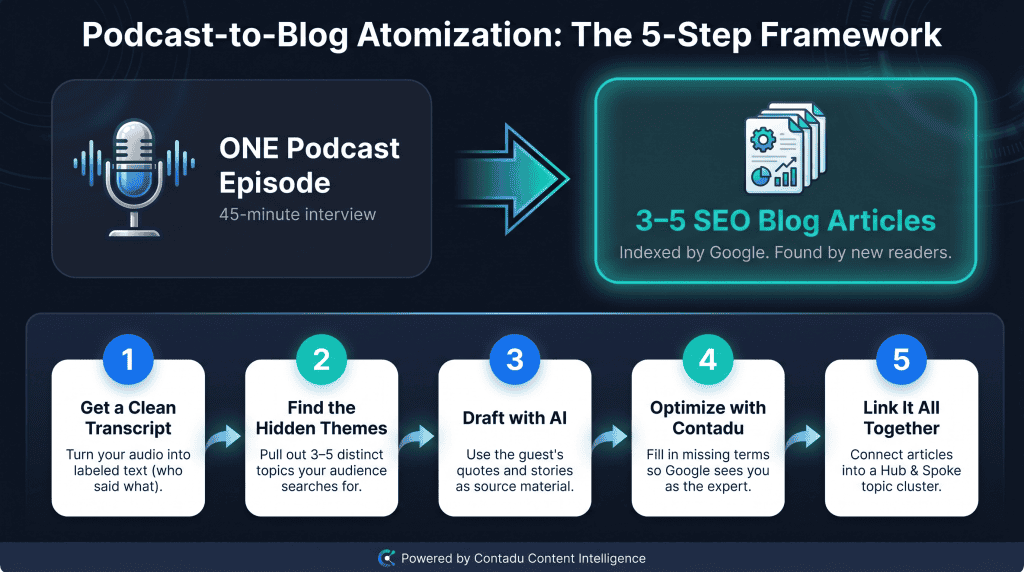
Atomization is different. It is the process of listening to that 45-minute interview, pulling out 3 to 5 distinct, standalone topics, and writing a dedicated article for each one.
Instead of one massive, hard-to-read transcript page, you get:
- 1 Podcast Episode (for your listeners)
- 3 to 5 highly focused SEO articles (for Google searchers)
- A massive reduction in the time it takes to produce a blog post
Here is how you do it, step by step.
The 5-Step Podcast-to-Blog Framework.
Step 1: Get a Clean, Labeled Transcript.
You cannot atomize audio directly; you need to turn it into text first. The goal here is not to publish this text, but to use it as your raw material.
Use an AI transcription tool to convert your audio file into text. The most important part of this step is ensuring the tool can tell the difference between the speakers (e.g., labeling who is the “Host” and who is the “Guest”). This is crucial because when you start writing the articles, you need to know exactly who said what.
Step 2: Find the Hidden Themes.
This is where the magic happens. A good 45-minute interview rarely stays on one single topic. It usually covers three to five distinct themes.
For example, if you interview a marketing director, they might spend 10 minutes talking about hiring, 15 minutes on budget planning, and 10 minutes on their favorite software tools.
Instead of reading the transcript from start to finish, review it to find these distinct themes. Then, check your keyword research to see if people are actually searching for those topics. If they are, you have just found the topic for your first atomized article. Repeat this until you have 3 to 5 solid ideas.
Step 3: Draft with AI (Using the “Expert Context” Method).
Now it is time to write the articles. If you use AI to help you draft, do not just say, “Write a blog post based on this transcript.” The AI will give you a boring, generic summary of the whole episode.
Instead, you need to be specific. Give the AI just the section of the transcript that relates to one specific theme. Tell it: “Write a comprehensive article about [Theme], using only the guest’s quotes, anecdotes, and data points from this text as your source material.”
This forces the AI to use the expert’s actual insights, ensuring your article is unique and full of valuable information, rather than generic fluff.
Step 4: Polish and Optimize with Contadu.
The AI-generated draft is a great starting point, but it is not ready for Google yet. To ensure the article actually ranks and brings in traffic, it needs to be optimized.
This is where you bring the draft into the Contadu Content Editor. Contadu will analyze your draft against the top-ranking articles for your chosen topic. It will likely find that the AI missed some important related terms or phrases that Google expects to see in a comprehensive article.
By naturally weaving these missing terms into your text, you elevate the quality of the article and signal to search engines that you have covered the topic thoroughly.
Step 5: Link It All Together.
The final step is to connect your new articles together to build authority on your website.
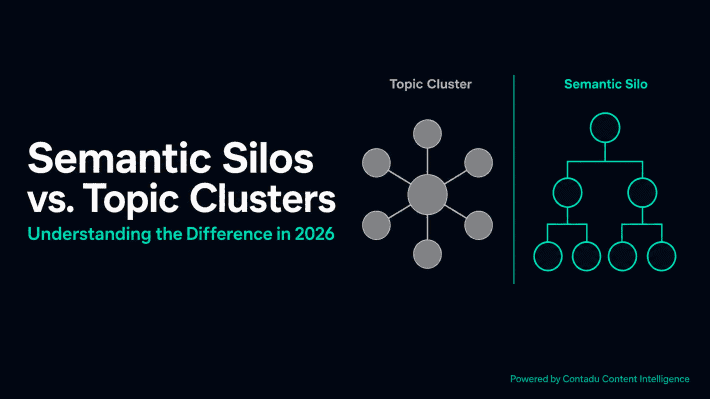
Think of your original podcast page (the “show notes” page with the audio player) as the Hub. The 3 to 5 new articles you just wrote are the Spokes.
Every Spoke article should link back to the Hub page (e.g., “We discussed this concept in-depth during our recent interview with [Guest Name]”). In return, the Hub page should link out to all the Spoke articles.
This creates a tight topic cluster. It makes it easy for readers to explore the topic further, and it proves to search engines that your website is an absolute authority on this subject.
Executing the Strategy with Contadu.
Managing this process for every podcast episode might sound overwhelming, but Contadu Content Intelligence is designed to make it seamless.
- Plan Before You Record: Before you even hit “record” on your podcast, you can use Contadu Topic Discovery feature to find out exactly what questions your audience is searching for. You can then ask your guest those exact questions, ensuring the resulting audio is already perfectly aligned with what people want to read.
- Optimize Faster: As mentioned in Step 4, Contadu scoring system takes the guesswork out of editing. It tells you exactly which terms to add to your AI drafts to make them rank-ready.
- Keep the Team Aligned: You can use Contadu to assign the transcription to one person, the drafting to another, and the final optimization to your SEO lead, keeping the whole content engine running smoothly.
By turning one podcast episode into multiple optimized articles, you stop treating your audio as a one-off event and start treating it as the fuel for your entire content strategy.
FAQ: Podcast-to-Blog Atomization
Will Google penalize me for duplicate content if I publish multiple articles from one podcast?
No. You are not publishing the same content over and over. You are extracting different, unique themes from a long conversation and writing a dedicated article for each one. Because the topics are distinct, Google sees them as separate, valuable pieces of content.
Should I include the podcast audio player in every new article?
Yes! Embedding the podcast episode near the top of the article gives your readers another way to consume the content. Plus, if they click “play” while reading, they stay on your website longer, which is a great signal for SEO.
How do I give credit to the podcast guest in the articles?
Always be transparent. State clearly in the introduction that the article is based on an interview with the guest. Use blockquotes for their direct quotes, and make sure they are credited as the source of the ideas or data being discussed.
Can I use this same process for webinars or video interviews?
Absolutely. This framework works for any long-form audio or video content. The only difference is how you get the initial transcript. Once you have the text, the process of extracting themes and writing articles is exactly the same.
How much time does this actually save?
Writing 3 to 5 high-quality, researched articles from scratch can easily take 20 to 30 hours. By using a podcast transcript as your source material and assisting the process with AI and Contadu, you can produce those same 3 to 5 articles in just a few hours.