
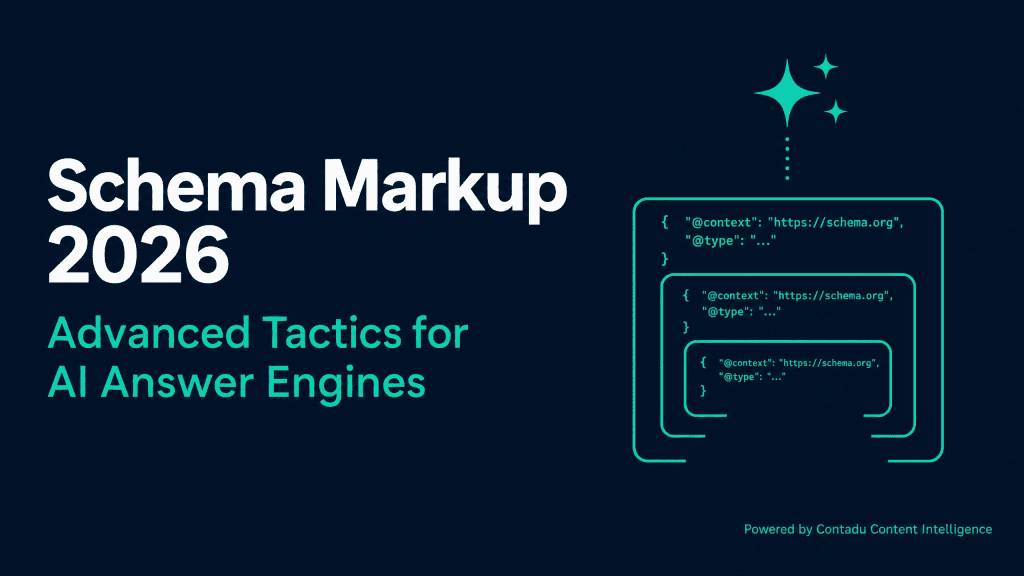
Schema Markup 2026: Advanced Tactics for AI Answer Engines.
📍 Semantic Summary
Idea: Basic Article and Organization schema are no longer competitive advantages; they are the bare minimum. In 2026, dominating AI answer engines like ChatGPT and Google’s AI Overviews requires advanced Schema markup that nests entities and explicitly defines relationships.
Challenge: Most websites rely on automated plugins that generate flat, disconnected structured data. This forces Large Language Models (LLMs) to guess the context, often resulting in your brand being excluded from AI-generated summaries and citations.
Summary: To win in Generative Engine Optimization (GEO), you must implement nested Schema architectures. This includes leveraging FAQPage, Review, and SoftwareApplication schemas, using sameAs and knowsAbout properties for entity disambiguation, and using Contadu to ensure your code matches your content’s semantic footprint.
Read the full guide below, or explore related topics:
- How to Build a Custom Knowledge Graph for Your B2B Brand
- Generative Engine Optimization (GEO) for E-commerce
If you look at the source code of a typical B2B SaaS blog post, you will usually find a generic SEO plugin doing the heavy lifting. It spits out a basic Article schema, slaps on the author’s name, and calls it a day. Five years ago, this was enough to satisfy Google. In 2026, it is the equivalent of handing a dictionary to a university professor and expecting them to understand your proprietary software architecture.
Search has evolved from retrieving links to generating answers. Large Language Models (LLMs) and AI answer engines do not want to read your marketing copy; they want to parse your data. Schema markup (specifically JSON-LD) is the native language of these models. If you want to be cited by ChatGPT, Perplexity, or Google’s AI Overviews, you must move beyond basic structured data and embrace advanced Schema tactics.
Why AI Engines Demand Advanced Schema.
To understand why advanced Schema markup is critical, you must understand how an AI answer engine processes a query.
When a user asks, “What is the best CRM for real estate agents?”, the AI does not just scan for those keywords. It looks for a highly trusted Knowledge Graph that explicitly connects the entity “CRM” with the entity “Real Estate” and validates it with the entity “Reviews.”
If your website relies on flat text, the AI has to use computational power to infer these relationships. If your competitor uses nested Schema to explicitly declare, “We are a SoftwareApplication designed for the RealEstateAgent audience, and here is our AggregateRating,” the AI takes the path of least resistance. It cites the competitor because their data is unambiguous and machine-readable.
Advanced Schema Tactics for 2026.
To dominate Generative Engine Optimization (GEO), you must implement these three advanced structuring techniques.
1. Nested Entity Relationships (The Matryoshka Doll Strategy).
Flat schema lists isolated facts. Nested Schema builds a mini-Knowledge Graph. You must embed schemas within schemas to define exact relationships.
For example, do not just put an Article schema on your blog post. Nest it. The Article should be authoredBy a Person. That Person should worksFor your Organization. Your Organization makesOffer of a SoftwareApplication.
By nesting these entities, you are telling the AI: “This expert insight on sales pipelines was written by our VP of Sales, who represents the company that builds the exact software needed to solve this problem.” This dramatically increases your Entity Salience and the likelihood of being cited as an authoritative source.
2. FAQPage Schema for Direct AI Ingestion.
FAQPage Schema is arguably the most powerful tool for LLM visibility. AI models are designed to answer questions. If you provide pre-formatted Question-and-Answer pairs in your code, you are essentially spoon-feeding the AI exactly what it needs.
However, in 2026, generic FAQs do not work. You must use Contadu to identify the specific, long-tail questions users are asking in your niche. Then, write concise, factual answers (free of marketing fluff) and wrap them in FAQPage schema. When ChatGPT needs to explain a complex concept, it will often pull directly from these structured Q&A pairs because they are already formatted for conversational output.
3. Entity Disambiguation using sameAs and knowsAbout.
AI models hallucinate when they lack context. If your author is named “John Smith,” the AI might confuse him with a million other John Smiths. You must use entity disambiguation.
Within your Person and Organization schemas, aggressively use the sameAs property. Link your author to their verified LinkedIn profile, their Crunchbase page, and their published books. Use the knowsAbout property to explicitly list the semantic concepts they are experts in (e.g., “B2B Marketing,” “SaaS Metrics,” “Lead Generation”). This anchors your authors to established global entities, transferring that established authority to your domain.
Implementing Video and Image Object Schema.
In 2026, AI search is highly multimodal. Users are not just looking for text answers; they want visual explanations, charts, and video tutorials embedded directly in the AI Overviews. If your media assets are not properly marked up, they will be invisible to these engines.
When you embed a video on your B2B blog post, do not just rely on the YouTube iframe. You must implement VideoObject schema. This allows you to explicitly define the name, description, uploadDate, and most importantly, the hasPart property to define key moments or chapters within the video. By breaking the video down into structured segments, you allow AI engines to cite specific timestamps as answers to highly granular user questions.
Similarly, any infographics or data visualizations should use ImageObject schema. By defining the caption and creator, you ensure that when an AI engine uses your chart to answer a question, your brand receives the attribution and the click-through.
Avoiding Common Schema Markup Errors.
Even advanced SEO teams make critical errors when implementing nested Schema architectures. These mistakes can result in algorithmic penalties or, more commonly, the complete invalidation of your structured data.
Error 1: The “Frankenstein” Schema
This happens when multiple SEO plugins conflict, injecting duplicate or contradictory schemas onto the same page. You might have one plugin declaring the page as an Article and another declaring it as a WebPage, without any mainEntityOfPage property linking them. You must audit your code to ensure a single, unified JSON-LD script.
Error 2: Schema Without Visible Content
Google’s guidelines are explicit: you cannot mark up content that is hidden from the user. If your FAQPage schema contains ten questions, but those questions are not visible on the actual rendered HTML of the page, you will be penalized for structured data spam. Your Schema markup must be a faithful reflection of the visible text.
Error 3: Ignoring Schema Decay
Schema markup is not “set it and forget it.” If your VP of Sales leaves the company, you must update the worksFor property in their Person schema and remove them from the alumni or founder properties of your Organization schema. Stale data destroys the integrity of your Knowledge Graph.
Validating Schema with Contadu.
Writing advanced JSON-LD code is complex, and a single missing comma can invalidate the entire script. Furthermore, your Schema markup must perfectly align with the actual text on your page. If your code claims the page is about “Enterprise CRM” but the text focuses on “Small Business Tools,” you will trigger a semantic mismatch penalty.
Contadu bridges this gap. While Contadu Content Intelligence helps you write semantically rich text, you must ensure your technical SEO team translates those exact entities into your structured data. By aligning your Content Score with your Schema architecture, you create a unified, impenetrable signal of authority for both human readers and AI crawlers.
FAQ
Is JSON-LD still the preferred format for Schema markup in 2026?
Yes. JSON-LD remains the absolute standard recommended by Google and preferred by all major LLM crawlers because it separates the structured data from the HTML presentation layer, making it much easier for machines to parse.
Will advanced Schema guarantee my inclusion in AI Overviews?
No single tactic guarantees inclusion, but advanced Schema is a prerequisite. It provides the unambiguous, machine-readable data that AI models require to confidently cite your brand as a factual source.
What happens if my Schema markup doesn’t match my visible content?
This is considered “structured data spam.” Search engines and AI models will penalize your site if your Schema markup promises information or entities that are not clearly visible and central to the actual text on the page.
How is SoftwareApplication schema different from Product schema?
While Product is a broad category for physical goods, SoftwareApplication is highly specific to digital tools and SaaS. It allows you to define crucial B2B data points like operatingSystem, applicationCategory (e.g., CRM, ERP), and softwareRequirements, which are essential for AI disambiguation.
Do I need a developer to implement nested Schema?
While basic plugins handle flat schema, true nested Schema architectures usually require custom development or enterprise-grade SEO platforms that allow for dynamic, programmatic JSON-LD generation based on your site’s specific entity relationships.
How does Schema markup impact my Topical Authority?
Topical Authority is built on the breadth and depth of your content. Schema markup acts as the index for that content. By using schema to explicitly link your articles, authors, and products together, you prove to the algorithm that your domain is a cohesive, authoritative hub rather than a collection of random posts.
Can I use Schema to stop AI bots from scraping my content?
No. Schema markup is designed to help bots understand your content. If you want to block AI crawlers (like OpenAI’s GPTBot) from scraping your site, you must use directives in your robots.txt file, not structured data.