
Gated vs. Ungated Content: The 2026 B2B Decision Framework
Semantic Summary
Idea: Access rules should match the value of an asset and the decision a reader is trying to make, not a blanket lead-capture target.
Challenge: A form can create a measurable download while reducing reach, trust, sharing, and the chance that useful content is discovered.
Summary: Use a clear access decision, show enough value before asking for details, and measure qualified outcomes alongside reach.
Related Reads
| Decision factor | Keep it open | Consider a gate | Useful hybrid |
| Reader need | They need a fast answer or a trustworthy introduction. | They need a detailed working resource for a defined task. | Give the answer openly; offer the working file or session. |
| Discovery value | Sharing, links, search visibility, or citation potential matter. | Broad discovery is secondary to a limited, high-value exchange. | Publish an indexable summary and a clear preview. |
| Data need | No contact details are needed to help the reader. | Minimal details support delivery or an explicitly requested follow-up. | Delivery needs one field; optional preferences remain separate. |
| Team readiness | The team can guide readers to the next useful page. | The team can deliver the asset and a relevant next step promptly. | Use the open page to learn demand before adding friction. |
Gated vs. ungated content: the decision in one sentence
Keep content open when its job is discovery, understanding, trust, sharing, or search visibility. Gate content only when a specific asset earns the exchange and your team can provide a useful, consent-respecting follow-up.
Gated vs. ungated content is not a vote between two marketing beliefs. It is a decision about access. A gate asks a reader to give something usually personal information, an account login, or time in exchange for access. An open page asks for attention first and lets the reader decide later whether to continue the relationship.
For B2B marketers, the costly mistake is treating every download as a lead and every open page as unmeasurable. Both gated and ungated content can support a healthy content marketing strategy when each piece has a defined job.
What gated and ungated content actually mean
Gated content refers to a resource that requires information or another action before the reader can access it. A research workbook, template, recorded session, or detailed dataset may sit behind a form. Ungated content is available immediately: an article, a public guide, an open case study, or a product explanation.
A gate is not automatically a mark of quality. It only creates friction. The resource still has to solve a real problem better than the time and contact details the reader gives up. In the same way, ungated content is not “giving everything away.” It is a way to build awareness and trust with people who are not ready to commit.
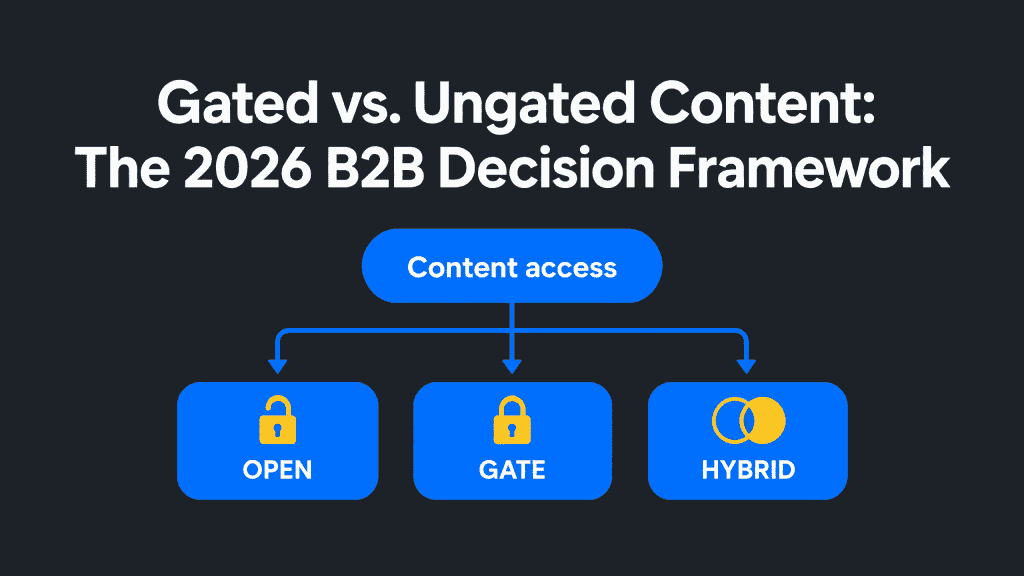
Do not force every content piece into one category. A hybrid approach often works better: publish the findings and method openly, then offer a downloadable worksheet; share a short instructional article, then invite readers to a live educational session. The reader gets immediate value, while the team offers a deeper route for those who want it.
The trade-offs: reach, trust, lead quality, and visibility
A gate trades possible reach for a more explicit signal from a smaller group of readers. That can be worthwhile, but only if the team accounts for what it gives up as well as what it collects.
| Access rule | Main benefit | Main risk | Best early signal |
| Open | Lower effort, wider content consumption, easier sharing, and stronger discovery. | The team may not know who read the page. | Engaged visits, return visits, assisted conversions, and useful next-page journeys. |
| Gated | Clear delivery moment and a chance to learn who requested the asset. | Fewer people see the work; poor forms create abandonment or inaccurate data. | Completed access, asset use, opted-in follow-up engagement, and qualified conversations. |
| Hybrid | Open proof plus a deeper, optional exchange. | The offer can feel artificial if the public portion is too thin. | Summary readership, optional requests, and the quality of the next action. |
A completed form says that a person was interested enough to access a resource. It does not, by itself, show that they are ready to buy a product or service. Treat the signal as context for a helpful next step, not permission to assume intent.
Open pages also need measurement. Connect them to a relevant next action, such as a related guide, a template preview, a newsletter preference, or a consultation page. This makes ungated content visible in a conversion path without turning the first answer into a barrier.
Use seven questions before you gate content
The right access rule becomes clearer when a team answers seven questions in order. This framework prevents a form from becoming the default solution for every campaign.
- What decision should this piece help the reader make? Start with the reader’s job: understand a problem, compare options, plan a project, or perform a task. Gate content only when the deeper asset makes that job meaningfully easier.
- Is the material specific, original, and useful enough to earn an exchange? High-value content may include a practical template, a maintained dataset, original research, or a detailed workshop. A lightly repackaged blog post is usually better open.
- How much trust does the reader already have? New visitors often need an open explanation first. A returning reader who has used your work may be more willing to access gated content for a deeper resource.
- Does this topic need public discovery? Keep foundational explanations, comparison context, and evidence of expertise open when they should be found, shared, linked, or cited. Relevant content must be available for search systems to crawl and index; Google advises checking the rendered HTML for important page content.
- What is the minimum information needed? Request the smallest set of fields needed for delivery. If preferences or a future marketing conversation are optional, say so and make the choice separate.
- Can the team provide a relevant follow-up? A request should trigger the promised resource and a next step related to the reader’s stated interest. If that workflow does not exist, do not use the form to create a list that no one can help well.
- What outcome would make the exchange worthwhile? Set the expected result before launch. It might be useful reach, completed access, resource use, informed conversations, or a stronger path to the next piece of content.
Match the access rule to the reader’s question
Open content should handle the questions that establish your brand and make a reader more capable today. Keep definitions, how-to guidance, public proof, product explanation, and comparison context available without a gate. These content assets create the base that lets a future offer feel credible.
Consider a gate for a resource that produces a distinct practical result. A detailed diagnostic worksheet, original research data, a reusable planning file, or a live webinar can be worth gating when the offer is precise. State what the reader will receive, what problem it helps solve, and when it will arrive. A generic promise such as “exclusive insights” is not enough.
Use a hybrid route when both discovery and lead generation matter. For example, publish an open executive summary and a clear method, then offer a downloadable working version. This lets people assess the value before they decide to provide contact details.
Use an operating rule, not a permanent split
B2B SaaS teams should decide whether to gate or ungate each asset by its job, rather than setting a permanent percentage of gated and ungated content. A public case study may be needed to establish your brand and support inbound discovery. A detailed planning workbook may serve people in the middle of the funnel who need more depth.
For B2B marketers, this makes ungating a deliberate choice rather than a concession. Review content pieces by audience, topic, and maturity: which ones explain the problem, which help a reader do the work, and which can generate leads without overreaching? The best rule for your company can change as a campaign, audience, or future marketing priority changes.
Build a gate that respects the reader’s time and privacy
A good gate explains the value, asks only for necessary details, and makes the follow-up unsurprising. The page should show what is inside the resource: its intended user, the key sections, a preview, and the expected delivery method. A reader should not have to guess whether an ebook contains a useful process or a short sales pitch.
Separate access from promotional consent. The UK information regulator explains that valid consent must be freely given, specific, informed, and unambiguous, and that people need a genuine choice and an easy way to withdraw.
The exact lawful basis and obligations depend on the context, so teams should apply their own privacy advice rather than treat a checkbox as a shortcut.
Keep delivery fields small. An email address may be needed to send a resource; a job title, company size, or phone number may not be. If you need more context later, ask after you have delivered value. This is often called progressive profiling: learning gradually rather than placing every question behind the first gate.
Measure the access decision, not just the form
Compare open, gated, and hybrid routes against the outcome the asset was meant to produce. Do not declare a gate successful because it generated more email addresses than an open page. Ask whether those contacts used the resource, chose a relevant follow-up, or progressed to a qualified conversation.
For a composite cohort of similar educational assets, a team can test one access rule at a time while keeping the topic, distribution, and audience as stable as possible.
Review useful reach, completed access, asset use, follow-up engagement, and downstream outcomes. If an open version reaches far more people and sends more readers to the right next page, it may create greater value than a smaller volume of downloads.
Review the choice over time. An event recording may be gated during a registration period, then become open as a searchable knowledge asset. A template can remain optional while the article that explains how to use it stays public.
Common mistakes that make content gates underperform
Most weak gates fail because the exchange is unclear, not because readers dislike forms in principle. Avoid hiding the complete value proposition behind a form, gating an ordinary article, and asking readers for more information than the offer justifies.
Also avoid treating every content download as a sales-ready signal. A person may be researching for a colleague, collecting examples, or learning about a problem. Let their actions guide the next interaction.
Finally, reassess old gates. Content that once supported a campaign may now be more valuable as open, searchable material that can build brand awareness and lead readers toward a newer asset.
How Contadu can support a deliberate content-access strategy
Contadu can help teams decide what an asset should do before they decide whether to put it behind a form. Start with a brief that names the reader’s question, search intent, expected access rule, proof of unique value, and useful next step. This reduces the chance of producing a gate for content that should have been an open article.
Use topic and internal-link planning to make open pages part of a coherent route. An explanatory page can lead naturally to a deeper template, a webinar, or a decision page without withholding the first useful answer.
Content-quality review can then test whether the preview, summary, form language, and follow-up promise are specific enough for a reader to make an informed choice.
FAQ
What is the difference between gated and ungated content?
Gated content requires a reader to provide information, sign in, pay, or complete another action before accessing a resource. Ungated content is immediately available. The practical difference is not format; the same subject can be open, gated, or hybrid depending on the value exchange and the reader’s needs.
What types of content are worth gating?
Content is worth gating when it delivers a distinct result that is difficult to replace with a short public page. Examples can include original datasets, detailed worksheets, maintained templates, or a live educational session. A gate works best when the page makes the benefit and the contents clear before asking for information.
Does gated content still work for B2B teams?
Yes, gated content can work when it supports a specific decision, gives real value, and leads to a relevant next step. It is less effective when used as a default way to collect email addresses. B2B content marketing usually needs both open work that builds trust and selected gated assets that help readers take a deeper action.
How does a gate affect SEO and AI-driven discovery?
A gate can limit what readers and search systems can access, share, link to, and use as evidence. Keep the main explanation, a useful summary, and enough original context available openly when discovery matters. Do not rely on user clicks or scrolling to reveal important public content; test what is available in rendered HTML.
Should all B2B content be gated?
No. Foundational explanations, educational articles, public proof, and product context are often stronger when open because they help a target audience understand a problem and build confidence. Choose to gate only when the asset’s high perceived value justifies the exchange and the team has a clear reason to request information.
How much information should a download form ask for?
Ask for the minimum information needed to deliver the resource. If further details or promotional contact are optional, make that clear and separate. Shorter, more honest forms often produce better information and a more trustworthy experience than a long form that readers feel pressured to complete.
How can a team test whether to gate or ungate content?
Set a hypothesis based on the asset’s goal, then compare similar open, gated, or hybrid routes where practical. Look beyond downloads: measure useful reach, resource use, follow-up engagement, qualified conversations, and downstream outcomes. Keep the winning rule only while it still serves the reader and the content strategy.