
Log File Analysis for AI Bot Crawl Budget: A Practical Guide for SEO Teams
Idea: AI bot log file analysis turns raw server requests into evidence. It can show which crawlers requested which URLs, when they arrived, and whether the website returned a usable response.
Challenge: A bot user-agent is not proof of a citation, an indexed page, model training, or business value. Teams can also miss requests that were blocked at the CDN or WAF before they reached the origin server.
Summary: Segment verified bot requests by URL group, status code, response time, and logging layer. Use the resulting evidence to prioritize technical fixes and better content paths while keeping the limits of log data explicit.
Related Reads
- How to Optimize Your Site Architecture for AI Crawlers
- The Impact of Core Web Vitals on LLM Rankings
- Schema Markup 2026: Advanced Tactics for AI Answer Engines
What AI Bot Log File Analysis Can Prove.
Bottom line: Log file analysis can prove that a request reached the system that generated the log and show how that system responded. It cannot, by itself, prove that an AI platform indexed, trained on, ranked, or cited the requested page.
A server log records an event. Typical log entries include a timestamp, requested URL, HTTP method, status code, user agent, response time, and sometimes an IP address or referrer. When an AI bot requests a page, that event becomes a useful technical SEO signal: the crawler tried to access the resource, and the delivery stack answered in a measurable way.
That distinction matters for AI search. A successful 200 response is evidence of access, not a guarantee of an AI answer. A 403, 429, or recurring 5xx response is evidence of a delivery problem worth investigating. Build reporting around those observable facts instead of turning bot activity into a visibility claim that the log data cannot support.
Crawl Budget: Use the Term Precisely.
Bottom line: Crawl budget has a specific Google meaning. Google defines it as the URLs that Google can and wants to crawl, based on crawl capacity and crawl demand. Use AI bot traffic as an operational crawl-access signal, rather than presenting it as the same universal metric for every crawler.
For Googlebot, slow responses, server errors, and rate limits can reduce the capacity that Google is willing to use. Duplicate and low-value URLs can also absorb attention that would be better directed to important pages.
That is why the familiar technical SEO work still matters: make priority pages fast and stable, reduce needless URL proliferation, keep sitemaps current, and resolve soft 404s.
Other AI crawlers may have their own retrieval patterns, rate limits, or policies. Rather than inventing a single “AI crawl budget” score, monitor the practical questions: Are important pages being requested?
Are they served successfully? Do error, redirect, or throttling patterns cluster around a page type? Is bot traffic creating a material performance or cost issue?
The AI Bot Taxonomy You Need Before Reading Logs.
Bottom line: Classify a crawler by its documented purpose before deciding what a request means or what access it should receive. A bot used for search, a user-triggered fetcher, and a training-oriented crawler can have different implications for your business.
Separate documented bot roles before you analyze traffic.
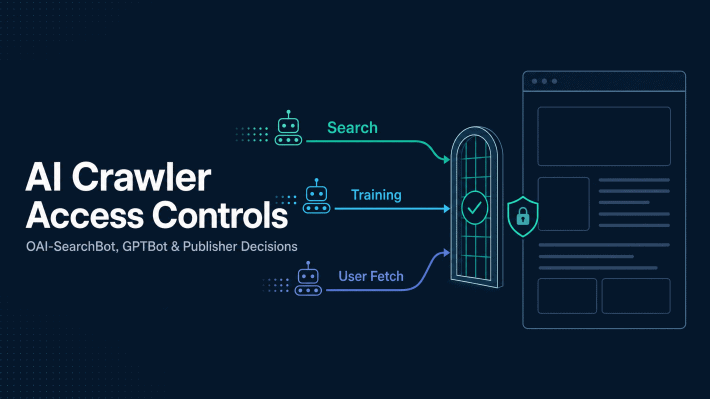
Start with the operator’s current documentation, not a copied list of user-agent strings. OpenAI, for example, documents distinct crawlers and crawler manifests, including GPTBot, OAI-SearchBot, and ChatGPT-User. Their access controls are separate, so a log review should not treat every OpenAI-labeled request as identical.
Create internal categories that fit your governance: search-oriented crawlers, user-triggered fetchers, training-oriented crawlers, and unknown automated traffic. This makes reporting more useful than one total AI bot count. It also keeps the later allow, rate-limit, or block discussion tied to a documented business purpose.
Verify bot identity before allowing or blocking it.
A user-agent string is a claim, not identity proof. Malicious or low-quality traffic can impersonate a known bot. Before adding an allow rule, blocking a crawler, or drawing conclusions from bot traffic, follow the relevant operator’s current verification guidance and review your CDN or WAF’s verified-bot controls. Keep a dated record of the rule, the source that supported it, and the business reason for it.
Build an AI Bot Log Report That Leads to Action.
Bottom line: A useful report should help a team decide what to fix next. It needs enough context to connect a request to a page type, response outcome, and logging layer not merely a chart of total bot traffic.
Start with the right logging layer.
For many sites, the CDN or WAF sees a request before the origin server does. If a security rule blocks a bot at the edge, the origin log may show no trace of the attempt. Compare CDN logs and origin server logs when your stack permits it; otherwise, document the blind spot so zero origin requests are not mistaken for zero bot interest.
Capture fields that answer a real question.
Use a consistent report structure. The table below is a practical starting point for an AI bot log file analysis review.
| Field | What it tells you | Useful next question |
| Verified bot identity | Which documented crawler or unknown automated client made the request | Should this crawler have the current level of access? |
| Timestamp and request volume | When bot activity occurred and whether it changed over time | Did a release, WAF rule, or content update change bot behavior? |
| Requested URL and page group | Which content, template, directory, or parameter pattern received attention | Are strategic pages being reached, or are low-value URLs absorbing requests? |
| Status code family | Whether the request was served, redirected, blocked, throttled, or failed | Are repeated 403, 404, 429, or 5xx patterns preventing useful access? |
| Response time and bytes served | Delivery quality and possible infrastructure pressure | Do slow or oversized pages require caching, performance, or template work? |
| Logging layer | Whether the event came from CDN, WAF, load balancer, or origin logs | Does the report have a known visibility gap before the origin? |
Segment by bot, URL group, and status-code family.
Aggregate views can hide the signal. Segment log data by verified bot identity, then compare top-level pages, product pages, help documentation, blog articles, parameterized URLs, and legacy URLs. Next, split the outcomes into successful responses, redirects, client errors, rate limits, and server errors.
A concise diagnostic view should answer five questions: Which search engine bot or AI crawler generated the request? Which URLs received bot access? How did AI crawler activity and crawl frequency change after a release?
Which AI bot requests returned a non-success status code? Which page groups receive bot traffic without corresponding strategic value? These questions convert a large log file into a focused review queue.
For example, a B2B SaaS team may find that a crawler reaches new resource-center articles but repeatedly receives redirects on older comparison pages. The next action is not to assume that the articles will be cited. It is to reduce unnecessary redirects, update internal links, and make the page path clearer for every crawler and visitor.
Turn Log Signals into Technical SEO Priorities.
Bottom line: Prioritize evidence that touches important content and repeatable templates. A one-off unknown request is rarely as valuable as a persistent response pattern on strategic URLs.
Fix access and response problems first.
Repeated 403 responses can indicate an unintended WAF or security rule. Repeated 429 responses show that a crawler was throttled. Repeated 5xx responses point to an availability problem. Review these patterns with engineering before changing access policy, especially when the affected URLs are core product, documentation, or high-intent content pages.
For Googlebot, the relationship between response health and crawl capacity is documented directly: rising latency, server errors, and rate limiting can reduce crawling. The same technical fixes stable infrastructure, efficient pages, and fewer broken paths also make the site easier for other legitimate crawlers to access.
Diagnose crawl gaps and depth patterns.
Look at whether AI crawlers reach only navigation-level URLs or also move into the pages that explain your expertise. If useful pages receive little or no observed bot access while closely related pillar pages do, inspect internal linking, sitemap inclusion, canonical handling, rendering dependencies, and page discoverability. The goal is an architecture where important resources are easy to find and understand, not a shallow site created solely for bots.
Pair this work with an AI-ready site architecture review and an entity-based internal linking strategy. Logs can identify where access appears uneven; content and information architecture determine what a crawler finds once it arrives.
Protect data and establish a review cadence.
Server logs can contain information that should not be distributed broadly. Minimize retention to the period needed for analysis, limit access, remove or protect sensitive query parameters, and agree on a safe export path before sharing data with an external tool.
The right cadence depends on scale: a weekly summary and a deeper monthly review is a practical starting point for many content teams, while high-change or high-traffic sites may need more frequent alerts.
What Log Analysis Cannot Tell You About AI Visibility.
Bottom line: A bot visit is a precondition for some forms of discovery, not evidence of an AI answer. It is important to preserve this boundary in dashboards and executive reporting.
Log analysis cannot show the full rendered experience unless your tools capture it separately. It cannot prove that an AI system stored the content, used it in retrieval, cited it, or influenced a commercial outcome. It also cannot reveal requests blocked upstream from your chosen logging layer.
Combine bot analysis with Search Console, performance monitoring, manual sampling of the AI search queries that matter to your audience, and a disciplined LLM visibility measurement framework. This produces a fuller picture: observed access, technical readiness, answer-surface presence, and commercial response.
Use AI tools as assistance, not as the source of truth.
AI-powered log analysis can help an SEO team group log file data, surface unusual bot traffic, summarize repetitive log entries, or prioritize an investigation. A log file analyzer such as Screaming Frog Log File Analyser can also make large exports more manageable. However, an analyst should verify the raw server log, bot identity, URL pattern, and status code before changing access controls or reporting an AI visibility conclusion.
This is the main difference between traditional log file analysis and AI-assisted analysis: the first establishes the underlying evidence, while AI tools can accelerate sorting and interpretation. For sensitive systems, never send unredacted server log file data to an external service without an approved data-handling process.
How Contadu Helps Turn Crawl Findings into Better Content Decisions.
Contadu helps teams act on the content side of technical evidence. When an AI bot log report suggests that priority topics are hard to discover or that certain content groups receive little attention, Contadu can help map missing entities, compare coverage against competitors, organize internal links, and create briefs for content that strengthens a semantic hub.
The workflow is practical: use the log report to identify the pages and topic groups that need attention; use Contadu to prioritize the associated content work; then revisit the report after publication, linking, or refresh activity. This connects technical SEO, AI search readiness, and the editorial calendar without claiming that one request equals a citation.
Frequently Asked Questions
What is AI bot log file analysis?
AI bot log file analysis is the review of server, CDN, or WAF log entries to understand requests made by documented AI crawlers and other automated clients. It focuses on observable facts such as requested URLs, timestamps, status codes, response times, and the logging layer that saw the event.
What can server logs reveal about AI crawlers?
Server logs can show that an observed request reached the server, which page it requested, and how the server responded. They can also reveal recurring redirects, errors, rate limits, or slow responses that affect bot access. They do not prove that a crawler indexed, trained on, or cited the page.
Does an AI bot visit mean that a page will be cited in an AI answer?
No. A bot visit only demonstrates access at a particular moment. Citation and answer selection depend on systems and signals that are not exposed in standard log data, so measure answer presence separately and report it as a different outcome.
Which fields should I review in an AI bot log report?
At minimum, review a verified bot identifier, timestamp, requested URL, status code, response time, bytes served, and the layer that created the log. Segment these fields by page group so that product, help-center, blog, and low-value parameter URLs do not blur into one total.
How do CDN logs differ from origin server logs?
CDN or WAF logs can record a request before it reaches the origin, including requests blocked at the edge. Origin logs record only requests that arrived at the origin server. Comparing both sources helps prevent a false conclusion that a crawler never tried to access the site.
How can I verify that a claimed AI bot is genuine?
Do not rely on a user-agent string alone. Follow the crawler operator’s current verification instructions, and use your CDN or WAF’s verified-bot features where appropriate. Document the validation method before adding permanent access rules.
Can I block some AI bots while allowing others?
Yes, but the decision should be deliberate. Review the documented role of each crawler, your content and licensing policy, infrastructure load, and visibility goals. Implement and test controls carefully through the appropriate layer robots.txt for expressed crawler preferences and WAF or CDN controls where enforceable access management is required.