
Automating Content Briefs: From Keyword to Outline in Seconds · Contadu
Semantic Summary
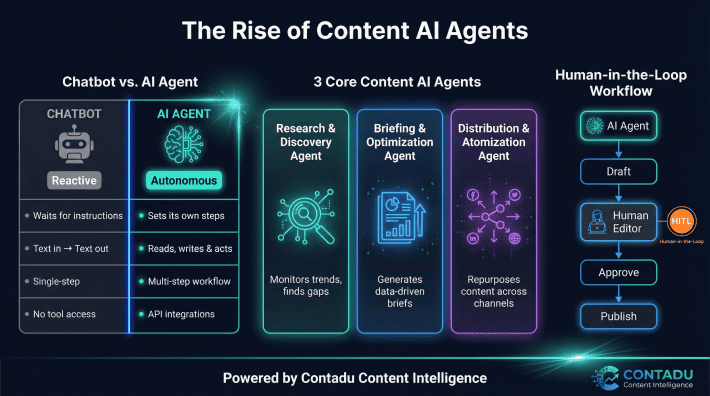
The Idea: The traditional content brief process spending hours manually analyzing SERPs, extracting keywords, and structuring headings is a major bottleneck in B2B content production. In 2026, content teams must automate this phase to scale operations efficiently.
The Challenge: Without a detailed brief, freelance writers and AI agents produce generic, off-brand content that fails to rank. However, creating a high-quality, entity-rich brief manually takes an average of 45 to 90 minutes per article. This limits a strategist’s output and stalls the entire content assembly line.
The Summary: Automating content briefs involves using AI-driven tools to instantly analyze top-ranking competitors, extract mandatory semantic entities, and generate a structural outline (H2s/H3s) based on search intent and Information Gain. By automating the transition from a single seed keyword to a comprehensive, data-backed outline, content leaders can reduce brief creation time from hours to seconds, allowing them to focus on strategy and orchestration.
Read the full guide below, or explore related topics:
- Agentic AI in Content Marketing: Orchestrating Multiple AI Assistants
- Structuring Content for AI Extraction: The Inverted Pyramid Method
- Measuring LLM Visibility: Metrics That Matter in 2026
If you ask any B2B content manager what the most tedious part of their job is, the answer is rarely writing. It is the preparation. It is the grueling, manual process of staring at page one of Google, opening ten different tabs, and trying to reverse-engineer why those specific articles are ranking.
A great content brief is the foundation of a great article. It tells the writer (human or AI) exactly what entities to include, what questions to answer, and what structure to follow. But historically, creating a high-quality brief has been a massive bottleneck.
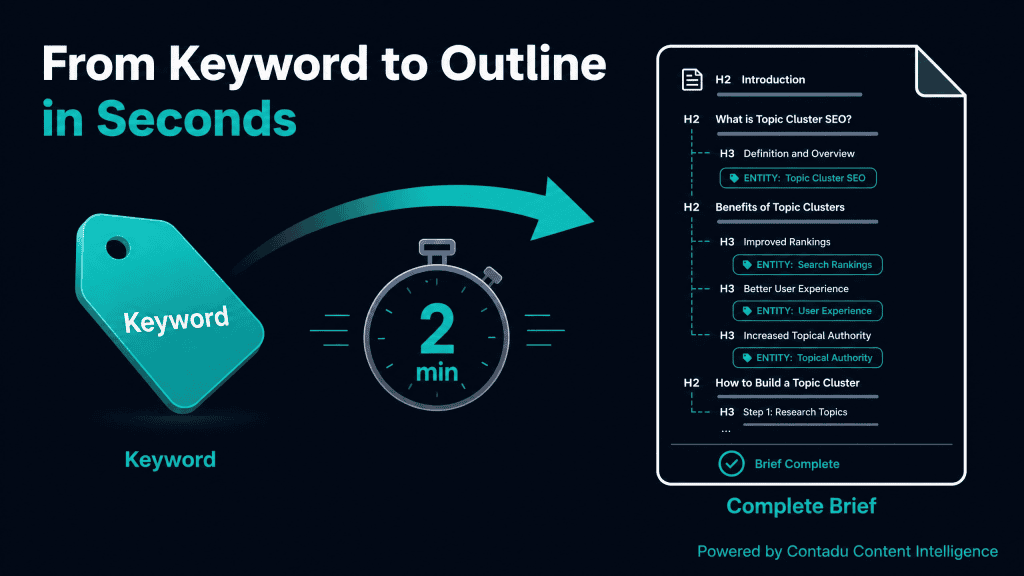
In the era of Agentic AI and rapid content scaling, spending 90 minutes on a single outline is no longer viable. You need to move from keyword to a comprehensive, data-backed outline in seconds. Here is how to automate the content brief process.
The Anatomy of a Perfect Content Brief.
Before we can automate the process, we must define what a “perfect” brief looks like in 2026. A brief that simply lists a target keyword and a suggested word count is useless. A modern, AI-ready content brief must contain:
- Search Intent & Persona: Who is searching for this, and what problem are they trying to solve?
- Structural Blueprint (H2/H3/H4): A logical flow that follows the Inverted Pyramid Method.
- Entity & NLP Requirements: The specific semantic terms and entities that must be included to achieve high Entity Salience.
- Competitor Gaps (Information Gain): What the top 10 ranking articles are missing, giving your content a unique angle.
- Quotable Statements & FAQ: Specific formatting requirements for AI extraction by ChatGPT and Perplexity.
Why Manual Briefing is Broken
The manual briefing process typically looks like this:
A strategist searches the target keyword. They open the top 10 results. They skim each article, noting the headings in a Google Doc. They use a standalone SEO tool to generate a list of LSI keywords. They copy and paste “People Also Ask” questions from Google. Finally, they try to synthesize all this disparate data into a coherent outline.
This process is flawed for three reasons:
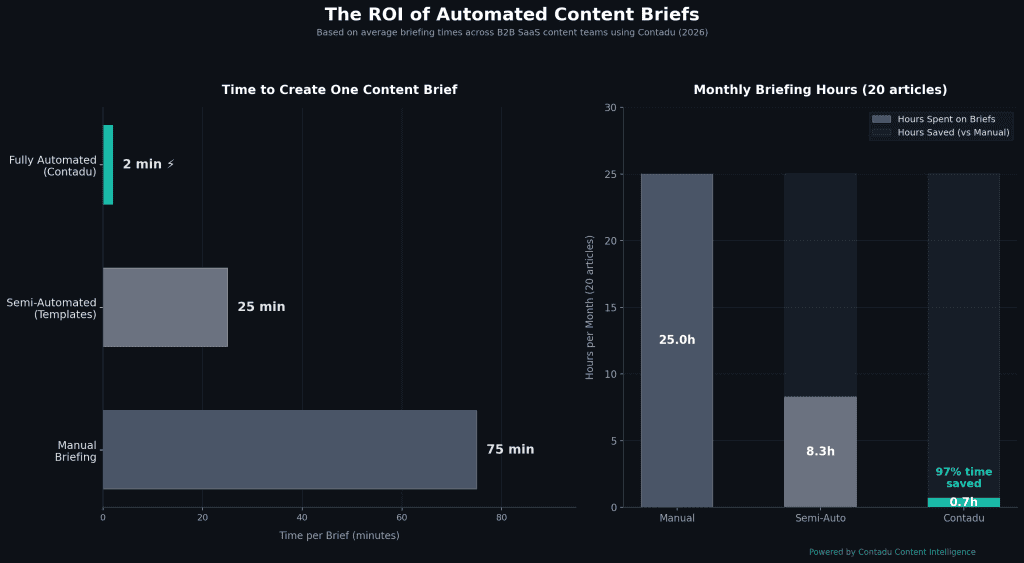
- It is slow: It takes an experienced SEO 45–90 minutes per brief.
- It is subjective: The strategist is guessing which headings are actually driving the rankings.
- It ignores AI Search: Manual SERP analysis only looks at Google, ignoring what Claude or Perplexity deem important.
How to Automate Content Briefs (The Workflow)
Automating this process requires shifting from manual data collection to algorithmic synthesis. Here is the modern workflow for automating content briefs.
Step 1: Algorithmic SERP Analysis
Instead of manually reading the top 10 articles, you deploy an AI tool to instantly scrape and analyze the top 30 ranking pages for your target keyword. The tool analyzes the DOM structure, extracting every H2 and H3, and calculating the average word count and readability score required to compete.
Step 2: Semantic Entity Extraction
The system uses Natural Language Processing (NLP) to scan the competitor content and extract the core entities. It doesn’t just look for exact-match keywords; it identifies the topical clusters and semantic relationships that Google’s Knowledge Graph expects to see. It generates a prioritized list of terms the writer must include.
Step 3: Outline Generation via LLM
This is where the magic happens. The extracted competitor headings and the required semantic entities are fed into a specialized LLM (like a Strategist Agent). The LLM is prompted to synthesize this data and generate a comprehensive outline. It is instructed to cover all the mandatory topics found in the SERPs, but also to identify gaps and suggest unique H2s to provide Information Gain.
Step 4: Handoff to the Writer
The finalized brief complete with the structural outline, entity checklist, and target metrics is automatically exported to a shared workspace or sent directly to the human writer or AI Writer Agent.
How Contadu Automates the Briefing Process
Building this automated workflow from scratch requires stitching together scrapers, NLP APIs, and LLM prompts. Contadu eliminates this friction by integrating the entire process into a single, seamless platform.
Instant Content Strategy Generation
In Contadu, you simply enter your target keyword. Within seconds, the Content Strategy module analyzes the top-ranking competitors and generates a comprehensive, data-backed brief. You instantly see the target word count, required readability level, and a prioritized list of semantic terms.
AI-Powered Outline Builder
Contadu Outline Builder automatically extracts the exact H2s and H3s used by your competitors. More importantly, it uses Generative AI to suggest a customized, optimized outline based on that data. You can drag and drop headings, add AI-suggested FAQs, and finalize the structure in under two minutes.
Seamless Transition to the Content Writer
Once the brief is finalized, it doesn’t sit in a static Google Doc. It is seamlessly integrated into Contadu Content Writer module. As you (or your AI agent) write the article, the editor provides real-time feedback, scoring your content against the exact semantic requirements defined in the automated brief.
By using Contadu to automate your content briefs, you transform a 90-minute chore into a 2-minute strategic review. You stop guessing what Google wants, and you start giving your writers the exact blueprint they need to rank.
FAQ
Q: Does automating the brief mean the content will be generic?
A: No. The automated brief provides the baseline the mandatory entities and structure required to compete. It is the job of the Orchestrator (you) to review the AI-generated outline and inject proprietary data, unique perspectives, and brand-specific angles before handing it off to the writer.
Q: Can automated briefs help with AI Answer Engine optimization (GEO)?
A: Yes. Advanced platforms like Contadu can suggest FAQ structures and Quotable Statements within the automated outline, ensuring the final article is formatted specifically for extraction by LLMs like ChatGPT and Perplexity.
Q: How much time does brief automation actually save?
A: If a team produces 20 articles a month, and each manual brief takes 1 hour, that is 20 hours of strategic time wasted. Automating the process reduces that to roughly 40 minutes total (2 minutes per brief), freeing up over 19 hours for high-level strategy and distribution.
Q: What data sources does an automated brief pull from?
A: A well-built automated briefing system pulls from multiple sources simultaneously: the top 30 SERP results for structural analysis, NLP-extracted entities from competitor content, “People Also Ask” questions from Google, related queries from AI Answer Engines, and your own internal content inventory to avoid cannibalization. Contadu integrates all of these into a single analysis pass.
Q: Can I customize the automated brief format for different content types?
A: Yes. The best systems allow you to define templates for different content formats pillar articles, comparison pages, how-to guides, and listicles each require different structural blueprints. In Contadu, you can save custom brief templates that automatically adjust the H2/H3 structure, target word count, and entity density based on the content type you select.
Q: How do automated briefs handle multilingual content strategies?
A: Automated briefing tools analyze the SERPs in the target language and market. If you are creating content in German for the DACH market, the system analyzes German-language competitors and extracts entities relevant to that linguistic context. Contadu supports multilingual SERP analysis, ensuring your briefs are localized rather than simply translated from English.
Q: Should I still review automated briefs before sending them to writers?
A: Always. The automated brief is a first draft of your strategy, not the final word. A 2-minute human review allows you to verify that the suggested angle aligns with your content calendar, remove irrelevant competitor headings, and add proprietary data points or SME quotes that no algorithm can generate. Think of it as a 2-minute quality gate rather than a 90-minute creation process.