
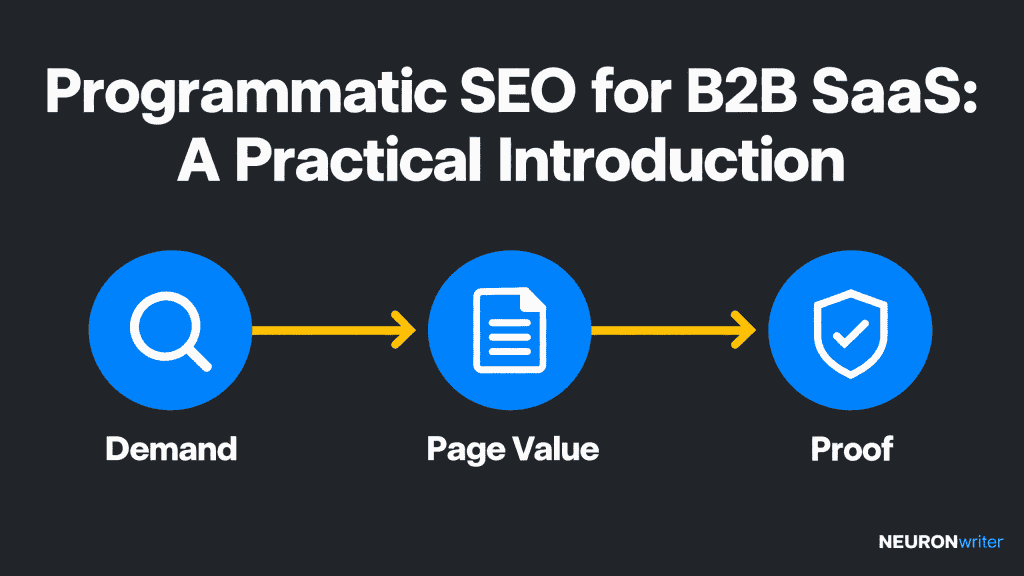
Programmatic SEO for B2B SaaS: A Practical Introduction
Semantic Summary
Idea: Programmatic SEO is a system for publishing useful page families from structured, verified information not a shortcut for creating URLs in bulk.
Challenge: B2B SaaS teams can mistake repeated keywords for repeated user needs, then scale thin pages faster than they can improve them.
Summary: Qualify the search pattern, prove the data adds page-specific value, launch a small pilot, and expand only when readers and search performance support it.
| Question | Continue when | Pause when |
|---|---|---|
| Demand | One repeatable query pattern maps to a real reader task. | Only the wording changes; the task stays the same. |
| Data | Verified facts change the answer on every page. | The data only swaps a name, place, or keyword. |
| Page system | The template has components for page-specific proof and useful links. | The template is a fixed paragraph with variables inserted. |
| Proof | A small cohort can be reviewed for discovery, use, and next-step quality. | Success is defined only as publishing a large number of pages. |
Programmatic SEO can help a B2B SaaS company cover a family of related searches without writing every page from a blank document. The key is not automation. The key is whether each individual page gives a reader a distinct, well-supported answer.
That distinction matters. A company may have hundreds of integrations, use cases, roles, templates, or documented workflows. If its source information is accurate and each combination solves a different problem, a page system can make the site more useful. If the only change is a keyword, the same system can produce a large set of pages nobody needs.
Programmatic SEO Is a Page System, Not Auto-Generated Copy
Programmatic SEO combines a repeatable search pattern, structured data, a page template, and publishing rules. It creates a family of web pages at scale, but it should not create one generic answer many times.
The four parts of a useful page family
First, identify the search pattern. A long-tail keyword is a specific query with several words, such as a product capability for a particular team or a connection between two kinds of business software. The pattern must reflect a real task that repeats.
Second, collect source data that changes the answer. For a workflow page, that might be supported steps, limitations, setup requirements, and a verified example.
For a role page, it might be the role’s recurring job, relevant features, and an appropriate next action. The data needs an owner and a refresh rule.
Third, design a page template. A template creates consistent navigation and sections, but it should make room for evidence that varies: page-specific explanations, relevant documentation, suitable internal linking, and a clear route forward. Finally, set publishing rules for quality, review, and measurement.
How it differs from editorial SEO
Editorial SEO is usually best for questions that need original analysis, a detailed argument, or a nuanced story. Programmatic content is best for a large, orderly set of questions where reliable information can be structured repeatedly. The two approaches should work together: editorial pages explain the big decisions, while individual pages help someone complete a focused task.
Neither format lowers the standard for usefulness. A programmatic SEO page still needs to satisfy the reader who arrived from search, not merely contain the phrase that brought them there.
Programmatic SEO and Traditional SEO Solve Different Jobs
Programmatic SEO is not a replacement for traditional SEO. It is one of several SEO strategies a B2B SaaS team can use when it has a repeatable question, reliable source information, and a clear reason to make a page for every meaningful variation.
| Reader need | Better first approach | Why |
|---|---|---|
| A complex decision or emerging problem | Traditional SEO and editorial content | The reader needs analysis, context, and an expert point of view. |
| A repeated, specific task with changing facts | Programmatic SEO | A page template and verified data can give every variation a distinct answer. |
| A broad topic with many similar subquestions | A hub plus selected supporting pages | The team can test whether separate web pages are actually needed before it scales pages. |
Useful programmatic SEO examples are defined by the task, not by the technology. A product page, resource page, or landing page can work when it gives concrete, page-specific help. A page targeting a long-tail keyword does not work merely because it can be generated.
Use a keyword research tool and other SEO tools to find a pattern, inspect search intent, and estimate search volume. Then use human judgement to decide whether the pattern deserves pages. Good programmatic SEO begins with the same question as any other SEO content: what will this reader be able to do after they arrive?
Decide Whether B2B SaaS Should Use Programmatic SEO
A B2B SaaS team should use programmatic SEO only when each planned URL has a distinct job and evidence that changes the answer. A large addressable keyword set is not enough on its own.
Use the page-worthiness test
Ask four questions of every proposed page family. Is there a repeatable query pattern? Does each query represent a different decision, task, or constraint? Do you own or maintain evidence that changes from page to page? Can a reader take a sensible next step after using the page?
A compatibility page can pass this test when it explains the particular connection, requirements, and outcome for that pairing. A use-case page can pass when the audience has a genuinely different workflow and proof. A generic page that simply replaces one industry label with another does not pass.
Apply the manual-page test
Imagine your team had to create one proposed page by hand for a customer who asked for it. Would the page be worth writing? Could a knowledgeable colleague point to facts, instructions, or examples that belong only on that page? If the answer is no, automation will not make the page more helpful.
This test keeps the focus on user value before a team invests in a database, technical SEO, or a publishing workflow. It also makes review conversations much simpler: the question is not “Can we create pages?” but “Should these pages exist?”
Know when to choose another approach
Choose editorial pages, a better hub page, or no new page at all when data is shallow, search intent is unclear, or facts will go stale faster than the team can maintain them. Programmatic SEO also fits poorly when readers need a bespoke recommendation that cannot be safely inferred from structured inputs.
Starting smaller is not a missed opportunity. It is a way to learn whether a programmatic strategy can produce useful individual pages before it creates a maintenance burden.
Identify B2B SaaS Page Families With Genuine User Value
The strongest B2B SaaS page families answer a specific recurring question that the product and its documentation can genuinely support. They do not begin with every possible keyword modifier.
Compatibility and integration pages
People often search for whether two types of software can work together, what the connection does, and what they need before starting. A useful page can explain the supported flow, prerequisites, permissions, data direction, limitations, and related help. The name of the other system is not the value; the concrete answer is.
Role, use-case, and workflow pages
These pages work when different readers use the product for meaningfully different jobs. A finance lead, an operations manager, and a customer-support lead may need different examples, risks, reporting views, and success criteria. If only the title changes, keep one stronger page instead.
Resource, template, and documentation pages
A resource page can be programmatic when each entry includes a real template, a scoped instruction, an explanation of when to use it, and links to the next relevant help. Documentation can scale when each page is tied to a distinct capability or configuration—not when it repeats a glossary definition with a new term.
For every family, map the head term and its modifiers to the actual reader task. Search volume can help with prioritisation, but it should not override the evidence that makes the page worth reading.
Design the Page Before Building the Template
Build the page model before building the template. A template should make a useful page consistent; it should not be a mechanism for hiding that the underlying answer is the same.
Map the query pattern to the user task
Write a one-sentence promise for the page family: “This page helps a reader decide whether they can complete this task, what is required, and where to go next.” Then test a few planned URLs against that promise. If several need the same answer, they probably belong on one landing page or a filtered view rather than separate pages.
Create a reader-benefit field map
Before asking a developer to generate pages, list each field, why the reader needs it, who verifies it, and what triggers an update. This makes weak data visible early. A field that exists only to vary a sentence is not a reader benefit.
- Capability: what the reader can actually do.
- Requirement: what access, plan, setting, or prerequisite is needed.
- Proof: a verified instruction, product fact, or example relevant to that page.
- Next step: a helpful linked page, setup action, or contact route matched to the task.
- Refresh trigger: the product, policy, or documentation change that requires review.
Build components that require meaningful variation
Good programmatic SEO relies on templates and data, but the variable fields should influence more than the title. Let them determine which steps appear, which caveats are shown, which related pages are linked, and which evidence is relevant. This gives individual pages a reason to exist and improves the reader experience.
Use artificial intelligence carefully. It can help classify source material, suggest metadata, or flag missing fields. It should not invent the product facts that make programmatic pages trustworthy. Human owners still need to verify source data and approve the logic that turns it into a public page.
Launch a Small, Representative Pilot
Publish a controlled, representative cohort before creating hundreds of pages. A pilot lets the team test the content model, technical implementation, and reader response when changes are still inexpensive.
Start with a representative cohort
Select examples that cover different data states: a common case, a complex case, a limited case, and a case likely to change. This reveals whether the page template handles missing information, exceptions, and real-world variation. It is better evidence than a large set of near-identical easy pages.
Make important pages discoverable
Pages that deserve search visibility need crawlable internal linking from relevant hubs, clear URLs, accurate page titles, and metadata that matches the visible content. Include only useful pages in an XML sitemap. Keep canonical rules consistent, and check that key content is visible without requiring a search engine to guess what belongs on the page.
Technical SEO is especially important here because a small template mistake can affect every page. Test on different devices, inspect key URLs, and use Google Search Console to see whether important pages are discovered and indexed. Indexation is not a reward for page count; it is a signal to investigate alongside usefulness.
Review the pilot before scale
Review a sample manually. Can a reader tell why this page exists? Do the labels, links, and facts fit the promised task? Are there obvious gaps between the source data and published copy? Then compare the pilot’s discovery and reader signals with an editorial control group where that is practical.
Only after the answers are reassuring should the team expand the page set. A deliberate pause protects the rest of your site from thousands of programmatic pages built on an unproven assumption.
Choose workflow tools by job, not by page volume
Programmatic SEO tools are useful when they support a clear responsibility: a keyword research tool for query patterns, a data store for verified records, a publishing connection for approved fields, a crawler for technical checks, and analytics for review. The tool category matters less than whether its output can be checked by the person who owns the page family.
Keep structured data separate from structured source information. Structured source information is the verified record that powers a page. Structured data is optional machine-readable markup that can help a search engine understand eligible visible content. Neither one creates user value by itself, so both need review within normal SEO workflows.
Artificial intelligence (AI) can speed up repetitive operations such as sorting a large number of records, finding incomplete fields, or preparing a draft for review. Using AI is helpful only when a person can trace every material claim back to source evidence. This is how a team can create programmatic SEO pages efficiently without confusing automation with accuracy.
Measure Whether the Page Family Is Earning Its Keep
Page count is an output, not an outcome. Measure whether the pages are found, used, trusted, and connected to a relevant conversion path.
Track discovery and indexation
Track impressions, clicks, average position, and index coverage by page family in Google Search Console. Look for patterns, not a single winning URL. A group that is crawled but rarely indexed may have weak differentiation, poor internal linking, or information readers cannot get from the page.
Track reader and conversion-path signals
Use your web analytics platform to see whether readers move to product documentation, a related use case, a trial path, or a conversation that fits their stage. A page should not force every visitor toward a demo. It should help them make the next sensible decision, as in a well-designed content conversion path.
Combine quantitative signals with periodic qualitative review. A modest-traffic page can still be valuable if it reliably helps a high-intent reader complete a complex task. Conversely, a high-traffic page can be weak if it creates confusion or sends people back to search.
Choose an action for underperforming pages
Give every page family a decision routine. Improve pages with a clear information gap. Consolidate pages that answer the same question. Keep low-value variants out of search when they serve an on-site navigation purpose only. Retire pages that no longer match the product or audience.
This routine also protects against content cannibalization, where several similar URLs compete for the same need. Use the principles in Contadu’s cannibalization playbook to spot overlap before it grows across a whole page system.
Common Programmatic SEO Mistakes
The central risk is not automation; it is automating a weak decision repeatedly. A few governance habits prevent the most damaging mistakes.
Scaling keyword swaps instead of reader value
Changing a city, job title, feature name, or keyword does not automatically create a new need. If the answer is materially the same, combine it. A page family needs a meaningful reason for every URL and a distinct answer for each query.
Trusting shallow, stale, or unverified data
Incorrect data damages many pages at once. Assign an evidence owner, set a review date, and make it easy for subject-matter reviewers to find source records. A page that is not maintained is not a safe candidate for scale.
Letting links and governance lag behind publishing
Orphaned programmatic pages are hard for people and search engines to find. Build internal linking into the template, but review it as the taxonomy evolves. Keep a clear inventory of which pages are live, who owns them, what data powers them, and when they were last checked.
Treating AI-generated text as a substitute for source evidence
Automation can support a workflow, but it cannot turn an unsupported statement into a reliable one. Google’s spam policies describe scaled content abuse as producing many pages primarily to manipulate rankings rather than help users, regardless of how those pages are made. Its people-first content guidance also asks whether a page provides original value for an intended audience.
That gives teams a practical standard: automate structure and low-risk operational tasks, but ground the published answer in verified data, clear ownership, and a reader need.
Use a shared quality gate for every programmatic page
A programmatic SEO campaign is not a contest to scale content or publish thousands of pages. Before publishing, apply the same SEO best practices to every programmatic page: confirm the query and search intent, check on-page SEO, verify source facts, review internal links, and compare the page with similar pages already on the site. The gate should reject thin or duplicate content rather than make it look different with extra wording.
Keep SEO data for the family together: source owner, last review, indexation state, organic traffic, reader action, and the planned next decision. That record makes SEO performance discussable over time.
An AI-assisted step may flag missing fields; AI can group records; AI can highlight possible overlap; an editor must verify the AI output; and AI should never choose the evidence owner. These guardrails make a programmatic strategy easier to improve and safer to maintain.
Before a team expands pages at scale, it should sample three published programmatic pages each month. Trace every material claim to a source, check on-page SEO, confirm that the use case remains distinct, and follow the internal links as a reader would. This lightweight audit makes automation visible and creates a decision record for every programmatic page.
How Contadu Supports a Governed Page Program
Contadu can help turn a page-family idea into a governed content workflow rather than an unmanaged publishing queue. The goal is to make the decision behind each page visible before scale hides it.
Map topics and query patterns before production
Start with a content map that connects product areas, reader questions, and existing URLs. This helps teams distinguish a new programmatic opportunity from a topic that already has a stronger home. It also makes it easier to plan the hubs and internal links that support a page family.
Keep briefs, source checks, and page owners visible
Use a shared brief for the reader task, required data fields, excluded claims, review owner, and refresh trigger. A consistent workflow gives writers, product specialists, and technical teams a common definition of “ready,” rather than treating publication as the only milestone.
Review internal-link coverage and refresh schedules
As a page set grows, review whether related pages link meaningfully to each other and back to a useful hub. Combine those checks with scheduled data and evidence reviews. This keeps a scalable program aligned with the broader B2B SaaS content map instead of becoming a separate collection of URLs.
FAQ
What is programmatic SEO?
Programmatic SEO is a way to create a useful family of web pages from structured data, reusable page components, and publishing rules. It works when each page answers a distinct, repeatable reader question and contains information that changes meaningfully from page to page.
How is programmatic SEO different from traditional SEO?
Traditional SEO often supports individually researched editorial pages, while programmatic SEO supports repeatable page families. They are complementary: editorial content explains complex subjects, and programmatic pages help readers with focused recurring tasks. Both need useful, accurate content and clear search intent.
Is programmatic SEO the same as AI-generated content?
No. Programmatic SEO is mainly about using a template and structured data to create consistent pages at scale. AI can assist with low-risk tasks such as classifying inputs or drafting metadata, but it should not replace verified source information or human review.
Which B2B SaaS pages work well as programmatic SEO pages?
Potentially useful page families include compatibility pages, integration guidance, role-based workflows, use cases, templates, and documentation entries. The deciding factor is not the page type: every page needs a distinct user task, page-specific evidence, and a helpful next step.
How many pages should a team publish first?
Start with a small, representative cohort rather than a fixed number. Include common, complex, limited, and frequently changing cases so you can test the data model and template under real conditions. Expand only after manual review and performance evidence support the decision.
How can a team avoid thin or duplicate programmatic pages?
Make every URL earn its place through a distinct task and verified information that changes the answer. Design template components around proof, requirements, useful links, and refresh rules not keyword substitution. Consolidate pages when they truly answer the same question.
How should a B2B SaaS team measure programmatic SEO?
Measure discovery, indexation, reader journeys, and contribution to relevant next steps rather than counting published pages. Review page families regularly and decide whether to improve, consolidate, keep out of search, or retire weak variants. This turns programmatic SEO into an evidence-led content system.