

How to Write a White Paper People Actually Read
Semantic Summary
Idea: A useful white paper helps a defined audience understand a specific issue and make a better-informed decision.
Challenge: Many white papers lose readers because they are too broad, weakly evidenced, difficult to scan, or written like sales brochures.
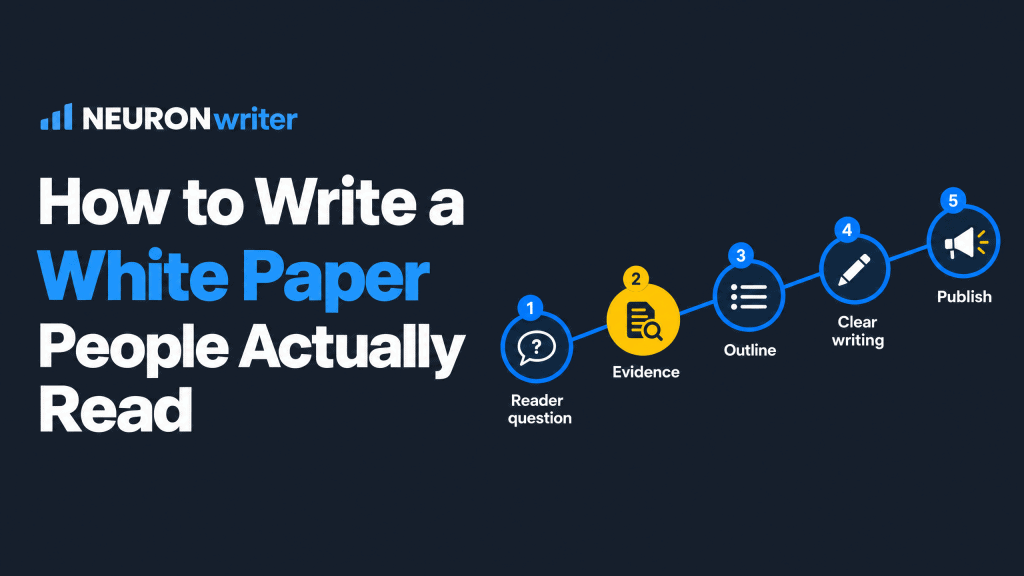
Summary: Choose a focused question, research it carefully, build a logical argument, edit for clarity, and make the next step relevant to the reader.
Related Reads
- Original Research: The Ultimate Guide to Building Authority and Backlinks
- Gated vs. Ungated Content: The 2026 B2B Decision Framework
- How to Repurpose Webinar Content into High-Converting Written Assets
| Stage | Reader-focused question | Output |
| 1. Define | Who needs help with what decision? | A focused audience, problem, and purpose |
| 2. Research | What reliable evidence supports the explanation? | Source notes, findings, and limitations |
| 3. Structure | What does the reader need to understand first? | A logical outline and clear argument |
| 4. Write and edit | Can a busy reader follow and use the information? | A concise, well-supported document |
| 5. Publish | What useful next step should follow? | An accessible asset and relevant distribution plan |
To write a white paper people actually read, begin with a real question from a specific audience. Then support the answer with credible evidence, organize the ideas into a clear argument, and edit away anything that does not help the reader understand or decide. A white paper is a long-form informational document, not simply a longer blog post or a product brochure.
What a white paper is and what it is not
A white paper is an in-depth document that explains a specific issue, presents evidence, and helps readers understand a topic or evaluate a possible solution. In B2B marketing, it can demonstrate expertise and support a buying decision, but the document should still deliver useful information rather than hide a sales pitch inside a research-style format.
The format is flexible. A policy paper may compare public options, while a technical paper may explain a system or implementation. A B2B marketing white paper often examines a problem and evaluates approaches to solving it. The purpose, audience, and scope should determine the structure and length; there is no universal page count that makes a document a white paper.
A blog post usually answers a narrower question quickly. An ebook may be broader and more visual. A white paper typically gives more space to evidence, context, reasoning, and implications. These formats can overlap, so choose the one that best serves the reader’s task rather than relying on a label to create value.
Start with the reader’s question, not the format
The best starting point is not “We need a white paper.” It is “Which audience needs help making which decision?” The answer sets the topic, research scope, level of detail, and eventual call to action.
Define the target audience and decision
Name the primary reader as precisely as you can: their role, level of familiarity, business context, and current concern. Then write down the decision or task they are trying to complete. A finance leader comparing implementation options needs different evidence from an engineer assessing technical trade-offs.
Ask a subject-matter expert (SME) what questions customers or colleagues ask repeatedly. Review support conversations, sales questions, public research, and webinar Q&A for recurring problems. Use those inputs to describe the reader’s need in one sentence.
Choose one specific topic and purpose
A white paper can explore a complex issue, but it still needs a clear boundary. Define what it will explain and what it will leave out. For example, “how to reduce onboarding delays in distributed finance teams” gives the research a more useful scope than “the future of finance operations.”
Choose one primary purpose: explain a problem, compare approaches, present original findings, or help a reader assess a solution. A document may support lead generation or thought leadership, but those business goals should follow from reader value. They should not replace it.
Types of White Papers: Purpose and Examples
Three common types give teams a practical way to choose the angle:
- Problem–solution: Defines a problem, explores its causes or costs, and evaluates an approach to addressing it.
- Topic analysis or numbered guide: Organizes important findings, criteria, or recommendations around a specific subject.
- Backgrounder: Explains how a product, service, or technical approach works, usually for a reader who is already evaluating that area.
Use the type that matches the audience’s stage and information need. A backgrounder may be useful during evaluation, while a problem solution paper can help a reader understand the issue before comparing providers.
When reviewing white paper examples, assess how each one frames the reader’s problem, uses evidence, organizes its argument, and handles limitations. Borrow structural lessons, not another organization’s wording, data, or visual identity.
Build a research plan before drafting
Research gives a white paper its credibility. Before you write, decide what evidence would support the central point, where you can find it, and what would cause you to revise the argument.
Start with a clear premise and scope
Write a working premise that links the audience’s problem to the question the paper will answer. It is a starting hypothesis, not a conclusion that must be defended at any cost. List the key questions the paper needs to address, then remove questions that do not affect the reader’s understanding or decision.
Set boundaries for geography, industry, time period, technical detail, and audience. A focused scope keeps the research manageable and helps readers judge whether the findings apply to their situation.
Gather credible evidence
Begin with relevant published research, official data, standards, and reports that disclose their methods. Where useful, add primary research such as interviews, surveys, case examples, or direct analysis. Secondary research provides context; first-hand evidence can add details that broad reports do not contain.
Keep a source log while researching. Record the source, publication date, author or organization, relevant finding, and any limitations. Attribute quotations accurately, and distinguish a source’s finding from your interpretation. Guidance for white paper writers emphasizes both factual support and a clear list of references.
Original research can strengthen a paper when it answers a question that existing material does not. Be transparent about how the data was gathered, who was included, and what the results can and cannot show. Do not present a small or non-representative sample as proof of a universal trend.
Check claims, limitations, and counterarguments
Review the evidence from the reader’s point of view. Are there alternative explanations? Does a proposed solution have trade-offs? Which claims depend on assumptions? Addressing these questions makes the argument more useful and less promotional.
Confirm time-sensitive facts close to publication. If a source is old, locate a current replacement or explain why the historical detail still matters. Remove a claim if it cannot be verified; confident wording is not a substitute for evidence.
Use case studies carefully
A case study can show how an approach worked in a real setting, but it is one example not automatic proof that the same result will generalize. Get permission where needed, state the context, and explain any limits such as sample size, timeframe, or unusual conditions. Use case studies to add practical detail alongside broader research, not to replace it.
Outline the white paper before you write
A white paper outline should guide the reader through a chain of reasoning. Each section should answer a question raised by the section before it and prepare the reader for what comes next.
This flexible white paper structure works for many B2B topics:
- Title and reader promise: State the subject and make clear who the paper is for.
- Executive summary: Give the problem, key findings, and main takeaway in brief.
- Context: Explain why the issue matters now and define important terms.
- Problem analysis: Describe the causes, effects, and evidence behind the problem.
- Options or proposed solution: Explain possible approaches and the reasoning for the recommended one.
- Limitations and decision criteria: Show what the reader should consider before applying the recommendation.
- Conclusion and next step: Summarize what the evidence supports and suggest a relevant action.
- References and author information: Let readers check the sources and understand who produced the document.
Not every paper needs every element. A brief technical explainer may not need a long executive summary, while a complex report may need a contents page and a glossary. Write the outline for the subject at hand; do not fill a template simply because it is available.
Draft the executive summary after the body. That way, it reflects the actual findings rather than promising conclusions before the research is complete.
A reusable white paper template
Use this short template to start writing, then adapt it to the specific topic:
- Reader and purpose: This paper is for [target audience] who need to [decision or task].
- Problem: The specific issue is [problem], which matters because [evidence-based impact].
- Research findings: The strongest evidence shows [finding], with these important limits: [limitations].
- Options: The available approaches are [options], each with these strengths and weaknesses: [trade-offs].
- Conclusion: Given the evidence, the reader can [recommended next step or decision].
This is an outline prompt, not copy to publish unchanged. Replace each bracket with verified detail and make sure the proposed solution follows logically from the problem and research findings.
Write for comprehension, not to sound authoritative
A white paper can be rigorous without being difficult to read. Use direct language, explain technical terms when they first appear, and make the connection between evidence and conclusion explicit.
Make the key takeaways easy to find. A reader should be able to scan the headings, summary, and conclusion and understand the big picture before deciding which sections to read closely. Use bullet points for short lists of criteria or actions, not to disguise a long argument that needs explanation.
Make the argument easy to follow
Give each section one main job. Start with the point, explain the reasoning, and show the evidence that supports it. Use descriptive headings so a reader scanning the document can follow the argument without reading every paragraph in order.
When a section becomes dense, split it into smaller parts or use a short list. Keep the main line of reasoning visible; move supporting detail that is not essential to an appendix or source note.
Explain specialist terms and use examples
Match the amount of technical detail to the target audience. A specialist may value precise terminology, while an executive may need a brief definition and a clear explanation of business impact. Concrete examples help readers connect an abstract claim to a real situation.
Keep the product or service in proportion
If the paper discusses a company’s product or service, distinguish evidence from marketing claims. Explain where the offering fits, what problem it addresses, and what conditions matter. Avoid implying that one product is the only possible answer unless the evidence genuinely supports that conclusion.
Readers are more likely to trust a document that acknowledges trade-offs and gives them enough information to make their own assessment. An informative white paper may include a relevant call to action at the end, but it should not interrupt every section with a sales message.
White Paper Writing Best Practices and Common Mistakes
Keep the white paper grounded in the reader’s question and the evidence gathered to answer it. These best practices help prevent common mistakes:
- Do: Define the audience, purpose, and scope before drafting. Avoid: choosing a broad topic simply because it sounds important.
- Do: support claims with traceable research and explain the method behind original findings. Avoid: treating an anecdote or a small case study as universal proof.
- Do: make the paper persuasive through sound reasoning and relevant examples. Avoid: turning an informational document into an overtly promotional brochure.
- Do: use headings, concise paragraphs, and visual elements when they improve readability. Avoid: adding charts or infographics that have no source or explanatory purpose.
- Do: end with a next step that fits the reader’s decision. Avoid: a generic sales pitch disconnected from the paper’s conclusion.
Make the document readable and easy to scan
Design should make the argument easier to use. A strong title, clear heading hierarchy, comfortable line length, and consistent spacing help readers navigate a long-form document. For a lengthy paper, a table of contents can make specific sections easier to find.
Use a chart, table, diagram, or infographic when it explains a relationship or comparison more clearly than prose. Label visuals, identify the source of any data, and add a short explanation of what the reader should notice. Decorative graphics that repeat the text without adding meaning take up space without helping comprehension.
Check readability on a phone and on a desktop. Confirm that links work, citations are complete, and color is not the only way meaning is conveyed. A short document that answers the question is better than a long document padded to look authoritative.
Edit, fact-check, and prepare the final version
Editing is not only proofreading. Review the paper for accuracy, argument, clarity, and usefulness before approving the design.
Run a content and evidence review
Ask an SME to verify technical meaning and an editor to check whether claims are supported and understandable. Confirm figures, dates, quotations, permissions, and references. Mark any uncertainty plainly rather than turning it into a categorical claim.
Edit for structure and readability
Read the title, headings, executive summary, and conclusion on their own. They should tell a coherent story. Then remove repeated points, unexplained jargon, long detours, and paragraphs that do not help answer the core question.
Check design, accessibility, and citations
Review the final PDF or web version for legible type, accessible contrast, descriptive links, labeled visuals, and accurate source notes. Check the document on common screen sizes. If the asset is gated, test that the form, delivery message, and promised follow-up work as described.
Use AI as a writing aid, not as a source
AI can help a team group research notes, suggest a first outline, or flag passages that may be hard to follow. It should not invent evidence, citations, case studies, or expert quotations. Verify every source against the original, protect confidential information, and have a subject-matter expert check factual claims before publication. The writer remains responsible for the argument and the final white paper.
Publish and promote the white paper
Decide how readers will access the white paper based on its purpose. Keeping the main findings open can support discovery and sharing; a gated download may make sense for a highly practical resource when the exchange is clear and the follow-up is useful. A hybrid option is to publish an accessible summary and offer a downloadable working version.
Make the landing page explain what the reader will learn, who the document is for, and what it contains. Then distribute it through relevant channels such as a newsletter, expert interviews, sales conversations, or professional social posts. Repurpose only sections that stand on their own, and link them back to the full paper for context.
For example, publish a short article about one finding, share a sourced chart on LinkedIn, and include the full paper in a relevant newsletter. Each piece should make its relationship to the original research clear. For a deeper access decision, see Contadu guide to gated and ungated content.
Track the outcomes that match the paper’s purpose: readership, downloads, qualified conversations, reuse by sales, or engagement with a related resource. A download alone does not prove that the paper was read or useful. Use feedback and performance data to decide what to improve next.
How Contadu can support the white paper workflow
Contadu can support parts of the planning and editorial process around a white paper. Its NLP Terms feature suggests related phrases based on top-ranking pages, while Entities helps identify important people, places, or concepts in the topic.
The Content Score provides a content optimization signal against search results; it can help editors spot coverage gaps, but it does not verify facts or replace expert review. Use these features to inform the draft, then make final decisions based on the reader, research, and editorial standards.
For more on the platform’s capabilities, see Contadu Content Writer and the guide to content scoring.
White paper writing checklist
Before publishing, confirm that the document meets these checks:
- It names a specific audience, problem, and reader decision.
- Its topic and scope are focused enough to answer the main question.
- Its structure moves from context and evidence to a useful conclusion.
- Important claims have credible, traceable sources.
- Limitations and relevant counterarguments are handled honestly.
- The language, examples, and visuals suit the intended reader.
- The product or service is presented in proportion to the evidence.
- The access method and next step match the asset’s purpose.
FAQ
How do you write a white paper?
If you are wondering how to write a whitepaper, define a specific audience and question, choose the right type of paper, research the issue, and outline a logical argument before drafting. Support important claims with credible evidence, edit for clarity, then publish it with a relevant next step.
What should a white paper include?
Most white papers need a clear title, an explanation of the problem or topic, supporting evidence, a logical analysis or solution, a conclusion, and references. Longer papers may also need an executive summary, contents page, glossary, or appendix.
How long should a white paper be?
There is no universal length that fits every topic. Write enough to explain the issue and support the conclusion, but do not add sections merely to reach a page or word count.
Is there a standard white paper template?
A template can help organize common elements such as an executive summary, context, problem analysis, evidence, recommendations, and references. Treat it as a starting point and adjust the order and sections to fit the reader’s question.
What are the main types of white papers?
Common types include problem–solution papers, topic analyses or numbered guides, and product or technical backgrounders. Choose the type based on what the reader needs to understand and where they are in their decision process.
How is a white paper different from an ebook?
A white paper usually examines a specific issue in depth and supports its reasoning with evidence. An ebook may cover a broader subject in a more visual or introductory format, though organizations use these labels in different ways.
Should a white paper be gated?
Gate it only when the resource offers enough distinct value to justify asking for information and the team can provide a useful follow-up. If broad discovery, sharing, or public access matters more, keep it open or publish an open summary with an optional download.
Can AI help write a white paper?
AI can help organize notes, suggest an outline, or identify places that need clearer explanations. A human writer and subject-matter expert should verify every factual claim, source, interpretation, and confidential detail before publication.
