
Aligning Content Strategy with Product-Led Growth (PLG)
Semantic Summary
The Idea: Product-Led Growth (PLG) and Content Marketing are often treated as separate silos. PLG focuses on the product as the primary driver of acquisition, while Content Marketing focuses on top-of-funnel traffic. In 2026, the most successful B2B SaaS companies merge the two: content becomes an extension of the product, and the product becomes the primary call-to-action (CTA) for the content.
The Challenge: Traditional SaaS content strategies rely on “gated” whitepapers and “Book a Demo” CTAs. This creates friction for PLG buyers who want to experience the product immediately. Furthermore, generic top-of-funnel content fails to address the specific “Aha! moments” that drive product adoption and retention.
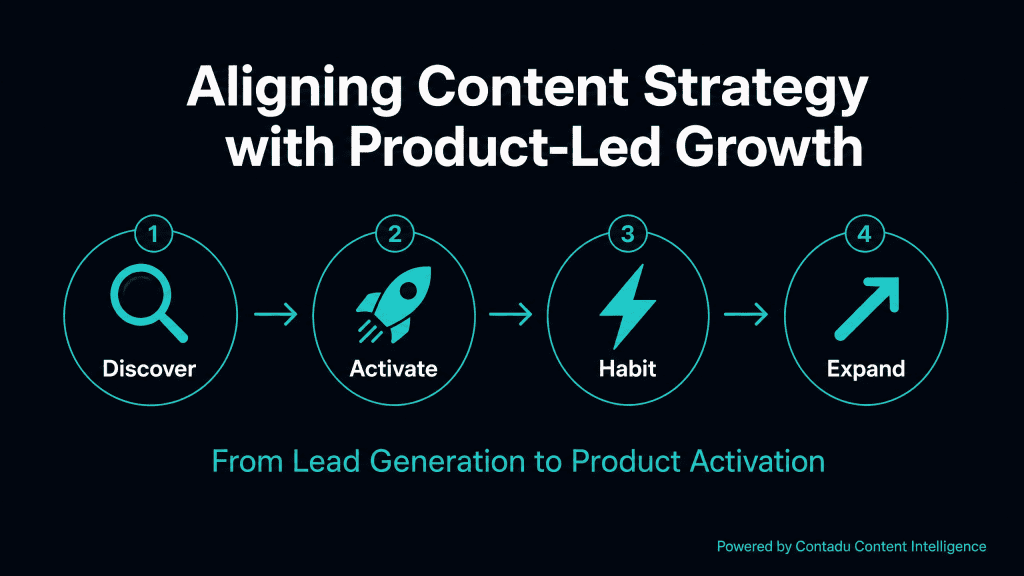
The Summary: Aligning content with PLG requires a shift from Lead Generation to Product Activation. By mapping content to the PLG user journey (Discover, Sign Up, Aha! Moment, Habit, Expand), replacing generic CTAs with contextual product entry points, and leveraging Contadu to identify semantic gaps related to product use cases, SaaS brands can increase free-to-paid conversion rates by up to 3x.
Read the full guide below, or explore related topics:
- The B2B Buyer’s Journey in the Age of AI Search
- Content Velocity: How to Publish More Without Sacrificing Quality
- The ROI of Content Workflow Automation for B2B SaaS
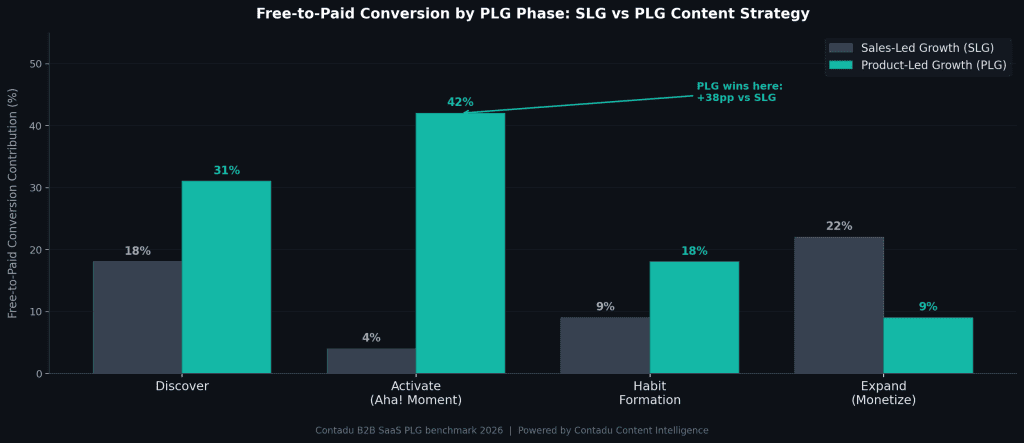
If your SaaS company operates on a Product-Led Growth (PLG) model, your content strategy cannot operate on a Sales-Led Growth (SLG) model.
Yet, this is exactly what happens in most B2B organizations. The product team builds frictionless, self-serve onboarding experiences, while the marketing team writes generic blog posts that end with a high-friction CTA: “Talk to Sales.”
This disconnect breaks the user journey. In a PLG motion, the product is the primary engine for acquisition, retention, and expansion. Therefore, the content strategy must be entirely re-engineered to serve one purpose: getting the right user into the product as quickly and contextually as possible.
Here is how to align your content strategy with your PLG motion in 2026.
The Shift: From Lead Generation to Product Activation.
In traditional SLG content marketing, the goal is to capture an email address (a Marketing Qualified Lead) so sales can follow up. The content is the bait, and the gate is the trap.
In PLG content marketing, the goal is Product Activation. The content is not bait; it is a bridge directly into the product’s value proposition.
Ungate Everything (Except the Product)
PLG buyers especially developers, designers, and growth marketers despise gated content. If they have to fill out a 7-field form to read a PDF, they will simply ask an AI Answer Engine like ChatGPT or Perplexity for the summary instead.
To align with PLG, ungate your whitepapers, templates, and guides. Make the content freely available to build Entity Salience and LLM Visibility. The only “gate” should be the sign-up form for your freemium product or free trial.
Replace “Book a Demo” with Contextual Entry Points
A generic “Start Your Free Trial” button at the bottom of a blog post is lazy. Contextual entry points embed the product directly into the narrative of the content.
If you are writing an article about “How to do a Semantic SEO Audit,” do not end with a generic CTA. Instead, embed an interactive widget or a deep link that takes the user directly to the Semantic Audit tool within your product, pre-populated with a sample URL. Show, do not tell.
Mapping Content to the PLG User Journey
A PLG content strategy requires mapping assets to the specific milestones of product adoption, rather than the traditional marketing funnel.
Phase 1: Discover (Top of Funnel)
Goal: Capture high-intent search traffic and AI Answer Engine citations.
Content Types: How-to guides, programmatic SEO pages (e.g., “Alternative to X”), and glossary terms.
PLG Alignment: Focus heavily on the problem your product solves. The content should clearly articulate the pain point, making the transition into the product feel like the natural next step.
Phase 2: The “Aha!” Moment (Activation)
Goal: Help the user experience the core value of the product immediately after sign-up.
Content Types: Interactive onboarding guides, in-app tooltips, use-case specific templates, and “Time-to-Value” (TTV) tutorials.
PLG Alignment: This content lives both on your blog and inside your app. It should be hyper-focused on removing friction and guiding the user to their first successful action within the software.
Phase 3: Habit Formation (Retention)
Goal: Turn casual users into daily active users (DAUs).
Content Types: Advanced workflows, integration guides, and customer success stories.
PLG Alignment: Show users how to connect your product to their existing tech stack. If your SaaS integrates with Slack, Jira, or Salesforce, write deep-dive content on how to automate workflows between those tools.
Phase 4: Expansion (Monetization)
Goal: Convert free users to paid, or upgrade basic tiers to enterprise.
Content Types: ROI calculators, feature comparison matrices (Free vs. Pro), and team collaboration guides.
PLG Alignment: Expansion content should highlight the limitations of the free tier without being punitive. Focus on how premium features unlock team productivity and scale.
How Contadu Empowers PLG Content Strategies
Aligning content with a PLG motion requires precision. You cannot rely on generic keyword research; you need to target the specific semantic entities that signal high product intent. This is where Contadu becomes the operational core of your strategy.
Identifying Product-Intent Semantic Gaps
Contadu Content Intelligence does not just look for search volume; it analyzes the semantic structure of top-ranking pages. By running a competitive analysis through Contadu, you can identify the specific use cases, features, and pain points that your competitors are missing, allowing you to create content that directly highlights your product’s unique differentiators.
Structuring Content for the “Aha!” Moment
PLG content must be highly readable and actionable. Contadu real-time editor ensures your tutorials and use-case guides maintain optimal readability scores, ensuring users do not get bogged down in jargon before they reach the product entry point.
Scaling Programmatic PLG Pages
A key PLG tactic is creating hundreds of programmatic landing pages (e.g., “Integration: [Your Product] + [Tool X]”). Contadu Agentic AI workflow allows you to scale these pages rapidly while maintaining strict brand voice consistency and high Entity Salience, ensuring they rank in Google and get cited by AI Answer Engines.
By leveraging Contadu, your content stops being a disconnected marketing expense and becomes a measurable, high-velocity acquisition channel for your product.
FAQ
Q1: What is the main difference between PLG content and traditional content marketing?
A: Traditional content focuses on capturing leads (emails) for sales teams. PLG content focuses on capturing users and driving them directly into the product to experience value (the “Aha!” moment) without sales intervention.
Q2: Should we completely remove “Book a Demo” CTAs?
A: Not entirely. While the primary CTA should drive users to a free trial or freemium tier, enterprise buyers often still prefer to speak with sales. Offer a secondary “Talk to Sales” option, but prioritize self-serve product entry.
Q3: How do we measure the ROI of PLG content?
A: Instead of tracking Marketing Qualified Leads (MQLs), track Product Qualified Leads (PQLs), Free-to-Paid Conversion Rates, Time-to-Value (TTV), and the percentage of active users who originated from specific content assets.
Q4: What role does SEO play in a PLG content strategy?
A: SEO is the engine for the “Discover” phase. However, instead of targeting broad, top-of-funnel keywords, PLG SEO focuses on high-intent, bottom-of-funnel queries (e.g., “how to automate X,” “alternatives to Y”) where the product is the direct solution.
Q5: How do we create content for the “Habit Formation” phase?
A: Focus on integration guides, advanced use cases, and workflow automation. Show users how your product fits seamlessly into their daily routine and existing tech stack.
Q6: Can we use AI to write PLG content?
A: Yes, but with a Human-in-the-Loop approach. AI is excellent for structuring integration pages and feature glossaries, but human Subject Matter Experts (SMEs) must inject the specific nuances of how your product solves complex problems.
Q7: How does Contadu help align content with the product?
A: Contadu helps identify semantic gaps related to your specific product features, ensures high readability for tutorials, and scales the production of programmatic PLG landing pages while maintaining high Entity Salience for AI search visibility.