
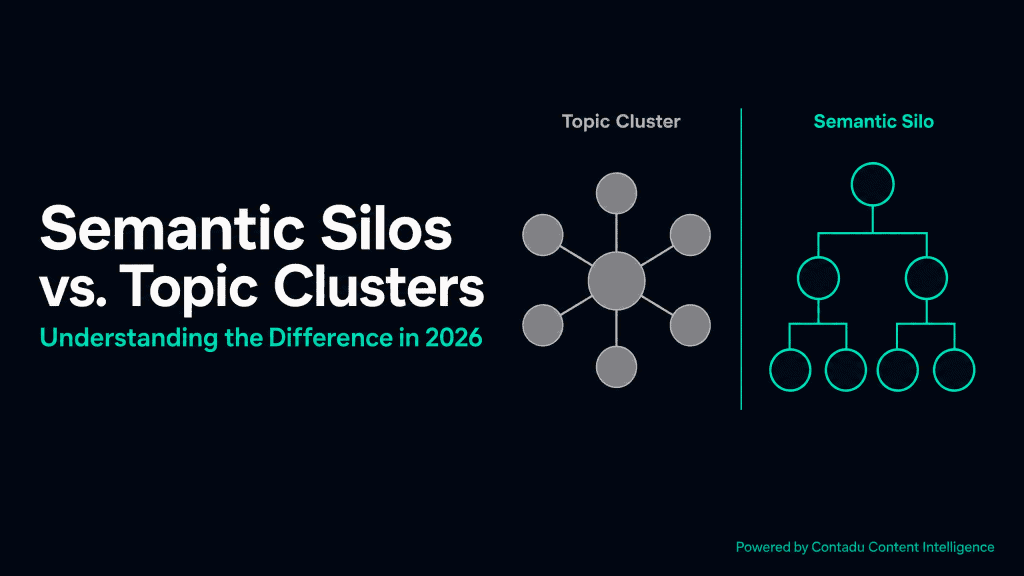
Semantic Silos vs. Topic Clusters: Understanding the Difference in 2026.
📍 Semantic Summary
Idea: While marketers use the terms interchangeably, Topic Clusters and Semantic Silos represent two distinct stages of content architecture evolution.
Challenge: Building a Topic Cluster based solely on shared keywords creates a flat structure that fails to establish deep Topical Authority in the era of AI Answer Engines and Knowledge Graphs.
Summary: Transitioning from traditional Topic Clusters to strict Semantic Silos requires mapping hierarchical entity relationships, utilizing advanced internal linking strategies, and ensuring rigid contextual boundaries to maximize Entity Salience.
Read the full guide below, or explore related topics:
If you ask ten SEO professionals to define a Topic Cluster, you will likely get ten slightly different answers. If you ask them to explain the difference between a Topic Cluster and a Semantic Silo, most will tell you they are the same thing.
In 2026, treating these two concepts as synonyms is a critical strategic error.
As search algorithms have shifted from string-matching to entity-based understanding powered by Natural Language Processing (NLP), the way we structure content must evolve. A loose collection of articles linking back to a pillar page is no longer enough to dominate highly competitive B2B SaaS niches.
You need rigid, hierarchically structured Semantic Silos.
This guide breaks down the fundamental differences between the two architectures, why the shift is necessary, and how to implement a true Semantic Silo strategy.
The Evolution of Content Architecture.
To understand the difference, we must look at how content architecture has evolved in response to Google’s algorithm updates.
Phase 1: The Flat Blog (Pre-2017)
In the early days of content marketing, blogs were chronological feeds. A company might publish an article on “CRM Software,” followed by “Email Marketing Tips,” followed by “Company Retreat 2015.” There was no organizational structure. Internal linking was random or non-existent. Search engines struggled to understand the website’s core expertise.
Phase 2: The Topic Cluster (2017-2023).
HubSpot popularized the Topic Cluster model. Marketers began creating long-form Pillar Pages (e.g., “The Ultimate Guide to CRM”) and surrounding them with shorter Cluster Content (e.g., “Best CRM for Startups,” “CRM vs. ERP”).
The defining characteristic of a Topic Cluster is the hyperlink structure: all cluster pages link back to the pillar page, and the pillar page links out to the cluster pages.
This was a massive improvement. It signaled to Google that the site had comprehensive coverage of a topic. However, Topic Clusters were still primarily built around keyword groups rather than semantic entities.
Phase 3: The Semantic Silo (2024-Present).
A Semantic Silo takes the organizational principle of a Topic Cluster and applies strict, entity-based rules.
While a Topic Cluster groups content by subject matter, a Semantic Silo groups content by hierarchical entity relationships. It is a physical and semantic manifestation of a Knowledge Graph on your own website.
Core Differences: Topic Clusters vs. Semantic Silos.
The distinction between the two models lies in their rigidity, their focus on entities, and their approach to internal linking.
| Feature | Traditional Topic Cluster | Strict Semantic Silo |
| Foundation | Keyword groupings and shared themes. | Hierarchical entity relationships (Parent/Child/Sibling). |
| Internal Linking | Fluid. Cluster pages often link to other clusters if relevant. | Rigid. Content only links vertically within the silo. Cross-silo linking is heavily restricted. |
| URL Structure | Often flat (e.g., /blog/post-name). | Strictly hierarchical (e.g., /category/sub-category/post-name). |
| Goal | Rank for a basket of related keywords. | Establish dominant Topical Authority and Entity Salience for a specific concept. |
| AI Readiness | Moderate. LLMs can parse the content, but relationships are loose. | High. The rigid structure perfectly mimics how AI Answer Engines process information. |
The Rule of Strict Isolation.
The most defining characteristic of a Semantic Silo is isolation.
In a traditional Topic Cluster, it is common for an article in the “CRM” cluster to link out to an article in the “Email Marketing” cluster if the topic comes up naturally in the text.
In a Semantic Silo, this is strictly forbidden.
The goal of a silo is to concentrate semantic relevance. When you link out of a silo to a different topic, you dilute the Topical Authority of that silo. Search engines use the flow of internal PageRank to determine what a section of a site is about. If links are pointing in every direction, the signal becomes muddy.
If an article in your “CRM” silo must mention “Email Marketing,” you mention the entity without creating a hyperlink. You keep the semantic energy trapped within the silo.
Hierarchical Entity Mapping.
Topic Clusters are often flat. You have one pillar page and ten cluster pages all sitting on the same level, pointing up to the pillar.
Semantic Silos require deep, multi-level hierarchy based on entity relationships.
For example, an entity mapping for a Cybersecurity silo might look like this:
- Parent Entity (Level 1): Cybersecurity (The Pillar)
- Child Entity (Level 2): Network Security (Sub-Pillar)
- Grandchild Entity (Level 3): Firewall Configuration (Granular Article)
- Grandchild Entity (Level 3): Intrusion Detection Systems (Granular Article)
- Child Entity (Level 2): Endpoint Security (Sub-Pillar)
- Grandchild Entity (Level 3): Antivirus Software (Granular Article)
- Grandchild Entity (Level 3): Mobile Device Management (Granular Article)
The internal linking must follow this hierarchy. Level 3 pages link up to Level 2. Level 2 pages link up to Level 1. Level 3 pages do not link directly to Level 1, and Level 3 pages in the “Network Security” branch do not link to Level 3 pages in the “Endpoint Security” branch.
URL Architecture as a Semantic Signal.
While Topic Clusters can exist purely through hyperlinks on a flat URL structure (e.g., website.com/blog/firewall-configuration), Semantic Silos heavily leverage URL paths to reinforce the hierarchy.
A true silo uses physical directories: website.com/cybersecurity/network-security/firewall-configuration/. This URL structure provides an immediate, unambiguous signal to both human users and AI crawlers about exactly where this entity sits within the broader Knowledge Graph of the website.
Why Semantic Silos Win in 2026.
The shift toward Semantic Silos is driven by the rise of Generative Engine Optimization (GEO) and the dominance of AI in search.
AI Answer Engines like ChatGPT and Perplexity do not evaluate websites the way traditional Google did. They look for clear, unambiguous semantic relationships. When your site is structured as a strict Semantic Silo, you are spoon-feeding the AI the exact Knowledge Graph it needs to understand your expertise.
Furthermore, as the web becomes flooded with AI-generated content, Topical Authority is the only remaining moat. A perfectly structured silo demonstrates a depth of expertise that a loose collection of keyword-targeted articles cannot match, resulting in higher Entity Salience and better rankings across the entire topic.
The “Rogue Link” Problem: Why Your Clusters Are Failing.
The most common reason companies fail to establish Topical Authority despite having hundreds of articles is the presence of “rogue links.”
A rogue link is an internal link that crosses silo boundaries without a strict, hierarchical purpose. It happens naturally during the writing process. A writer working on a “Firewall Configuration” article might casually mention “how this impacts your overall Cloud Storage strategy” and hyperlink the phrase “Cloud Storage” to an article in an entirely different silo.
To a human reader, this seems helpful. To a search engine algorithm evaluating Entity Salience, it is a disaster.
When you link from a granular Level 3 page in Silo A to a Level 3 page in Silo B, you are telling the algorithm: “These two highly specific concepts are equally related.” You are flattening the hierarchy and blurring the semantic boundaries you worked so hard to establish.
The Fix: No-Follow or Unlink
If you are auditing an existing Topic Cluster to convert it into a Semantic Silo, your first job is to hunt down and eliminate rogue links.
When an author naturally mentions an entity that belongs in a different silo, you have two options:
1.Remove the hyperlink: Leave the text, but remove the link. The algorithm still processes the entity co-occurrence, but the PageRank and semantic authority remain trapped within the current silo.
2.Link to the top: If you absolutely must link to the other silo for user experience, link only to the Level 1 Pillar Page of that silo, never to a granular child page. This tells the algorithm: “This concept is related to that broad topic over there, but it is not a direct sibling.”
The Role of Information Architecture (IA) in Silos.
Building a Semantic Silo is not just an SEO exercise; it is an Information Architecture (IA) overhaul. The way your website’s navigation is structured must reflect the silos you are building.
If your main navigation menu lists “Blog” and clicking it reveals a chronological feed of every article you have ever published, you are actively fighting against your own silo strategy.
Visualizing the Silo in Navigation.
Your website’s navigation should guide both users and search engine crawlers down into the specific silos.
Instead of a generic “Blog” link, your navigation should feature dropdowns that represent your Level 1 Pillar Pages (e.g., “Cybersecurity,” “Cloud Computing,” “Data Privacy”). Clicking “Cybersecurity” should not take the user to a feed of articles; it should take them to the Level 1 Pillar Page for that entity.
From that Pillar Page, the user (and the crawler) should find clear, structured links down to the Level 2 Sub-Pillars. This creates a funnel of relevance, ensuring that PageRank flows from the highly authoritative homepage down through the specific semantic pathways you have designed.
Building Silos with Contadu.
Transitioning from a flat blog or a messy Topic Cluster to strict Semantic Silos requires careful planning and auditing.
Using Contadu Content Intelligence, you can streamline this process:
1.Entity Extraction: Use Contadu to analyze your existing content and extract the core entities.
2.Silo Mapping: Group these entities into strict Parent/Child hierarchies.
3.Internal Link Auditing: Identify and remove “rogue links” that cross silo boundaries and dilute your semantic relevance.
4.Content Gap Analysis: Use Contadu’s NLP models to find missing entities within your newly defined silos and create granular content to fill those gaps.
By enforcing strict boundaries and focusing on entity relationships, you transform your website from a collection of articles into a structured, authoritative Knowledge Graph.
FAQ
Are Topic Clusters completely dead?
No, they are not dead, but they are evolving. A Semantic Silo is essentially the next evolutionary stage of a Topic Cluster—one that is stricter, more hierarchical, and focused entirely on entities rather than just keywords.
Is it ever okay to link between two different Semantic Silos?
In a strict silo architecture, cross-linking is highly discouraged because it dilutes topical relevance. If you absolutely must link between silos (e.g., a massive overarching guide), do it sparingly and ideally from the highest-level pillar pages, never from granular child pages.
Do I have to change my URL structure to build a Semantic Silo?
While physical URL silos (using subdirectories) provide the strongest semantic signal, you can build a “virtual silo” using only strict internal linking rules on a flat URL structure. However, physical silos are highly recommended for maximum impact in 2026.
How many levels deep should a Semantic Silo go?
Most B2B SaaS silos function best at 3 levels: The Main Pillar (Level 1), Sub-Pillars (Level 2), and Granular Articles (Level 3). Going deeper than 4 levels can make the content too buried for users and crawlers to find easily.
What happens if an article naturally fits into two different silos?
This is a common challenge. You must force a decision based on the primary Search Intent and the core entity focus of the article. An article can only live in one silo. If it truly bridges two topics, it should likely be a high-level Pillar Page rather than a granular child page.
How do Semantic Silos help with AI Overviews and ChatGPT?
AI models rely on Knowledge Graphs to understand how concepts relate to one another. A strict Semantic Silo mimics a Knowledge Graph, clearly defining parent-child relationships between entities. This makes it exceptionally easy for AI to parse, understand, and cite your content.
Can I use tags and categories in WordPress to create silos?
Yes, native WordPress categories are an excellent way to create physical URL silos (if your permalink structure is set up correctly). However, you must ensure that a post is only assigned to one category to maintain the strict isolation required for a true Semantic Silo.