
Autonomous Content Auditing: How to Clean Up 10,000 Pages in a Weekend
If your website has been around for more than three years, you likely have a content debt problem. Thousands of blog posts, landing pages, and product updates are sitting on your domain, slowly decaying. Some are cannibalizing your new content. Others are dragging down your overall site quality in the eyes of Google’s algorithms.
Historically, a content audit of 10,000 pages meant exporting Google Analytics data, pulling Search Console metrics, crawling the site with Screaming Frog, and spending three weeks merging it all in Excel. By the time you finished the audit, the data was already outdated.
In 2026, the paradigm has shifted. Enter autonomous content auditing.
By leveraging AI agents and content intelligence platforms, you can now analyze, tag, score, and generate action plans for tens of thousands of pages in a single weekend. Here is the exact playbook for running an autonomous content audit that actually moves the needle.
The Cost of Content Debt.
Content debt is the accumulation of outdated, low-quality, or redundant pages on your website. It is not just harmless clutter; it actively harms your SEO performance.
| The Problem | The SEO Impact | The Business Impact |
| Keyword Cannibalization | Multiple pages competing for the same search intent, confusing Google and diluting link equity. | Lower rankings for your most important commercial pages. |
| Low Information Gain | Generic content that offers no unique value compared to the current top 10 search results. | Poor performance in both traditional SEO and Generative Engine Optimization (GEO). |
| Crawl Budget Waste | Search engine bots waste time crawling dead pages instead of indexing your new, high-value content. | Slower indexing and delayed ROI on new content investments. |
| Outdated Information | Statistics from 2021 or references to discontinued features. | Loss of trust and negative signals for E-E-A-T (Experience, Expertise, Authoritativeness, Trustworthiness). |
When you eliminate content debt through a rigorous audit, you often see a “pruning bump”—a sudden increase in organic traffic across the entire domain, simply because you removed the dead weight dragging down your average site quality.
The Autonomous Auditing Framework.
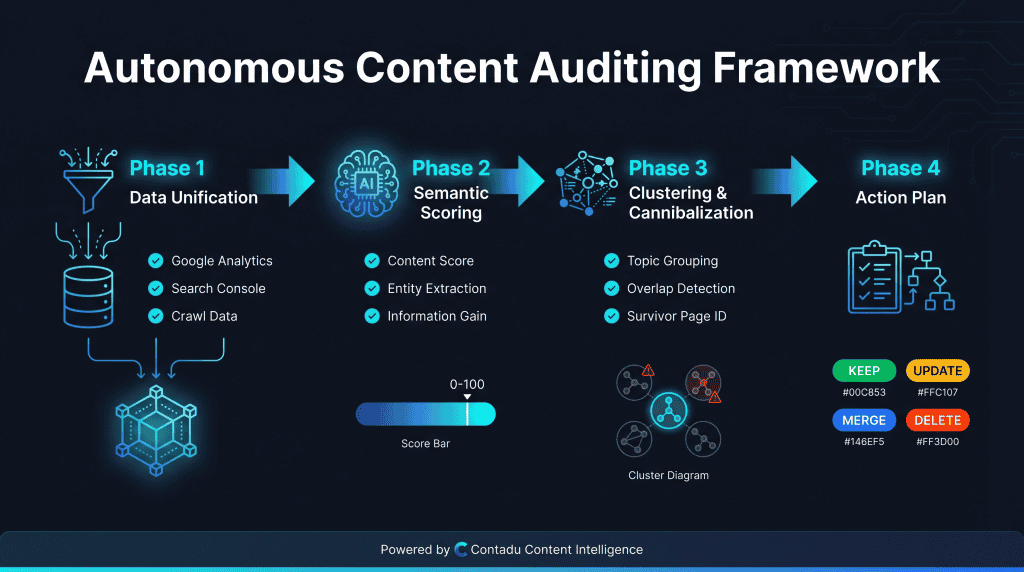
An autonomous content audit moves away from manual spreadsheet manipulation and relies on AI to process data at scale. The framework consists of four distinct phases.
Phase 1: Data Unification (The AI Data Analyst).
The first step is gathering the raw materials. Instead of manually exporting CSVs, you connect an AI agent or a content intelligence platform to your data sources via API.
The system automatically pulls:
- Traffic Data: Page views, bounce rates, and time on page from Google Analytics.
- Search Data: Impressions, clicks, and average position from Google Search Console.
- Backlink Data: Inbound link profiles from Ahrefs or Majestic.
- Crawl Data: Status codes, word counts, and meta tags from your site crawler.
The autonomous system merges these datasets using the URL as the unique identifier, creating a single source of truth without a single VLOOKUP formula.
Phase 2: Semantic Analysis and Scoring (The AI Editor).
This is where the true power of autonomous auditing shines. A traditional audit only looks at metrics. An autonomous audit actually reads the content.
The AI analyzes all 10,000 pages to evaluate:
- Content Score: How well does the page cover the core topic compared to current top-ranking competitors?
- Entity Extraction: Which entities and semantic concepts are present on the page?
- Information Gain: Does the page offer unique insights, or is it a regurgitation of the consensus?
- Readability and Tone: Does the content align with your current brand guidelines?
The system assigns a standardized Content Score to every page, giving you an objective measure of quality at scale.
Phase 3: Automated Clustering and Cannibalization Detection.
With the semantic data extracted, the AI agent groups your pages into topic clusters.
Because the AI understands the meaning of the content, it can automatically flag instances of content cannibalization. If you have five different articles about “B2B email marketing strategies,” the system will identify them, flag the overlap, and highlight which page has the strongest backlink profile (the “survivor” page).
Phase 4: Action Plan Generation (The AI Strategist).
Finally, the autonomous system applies a decision matrix to your unified data and semantic scores, generating a specific action recommendation for every single URL.
The standard decision tree typically outputs one of four actions:
1.Keep (Leave As-Is): High traffic, high content score, strong conversions.
2.Update (Refresh): High impressions but declining traffic, outdated information, or a low content score.
3.Merge (Consolidate): Multiple pages covering the same intent. The AI recommends merging the weaker pages into the strongest one and implementing 301 redirects.
4.Delete (Prune): Zero traffic, zero backlinks, no business value. Remove the page and return a 404 or 410 status code.
Executing the Audit with Contadu.
Running an autonomous audit of this scale requires a platform built for content intelligence. Contadu acts as the central hub for your auditing workflow.
1. The Content Inventory Module.
Contadu connects directly to your Google Search Console and Google Analytics accounts. It automatically pulls your performance data and aligns it with your published URLs, eliminating the need for manual spreadsheet merging.
2. Batch Content Scoring.
Instead of checking pages one by one, Contadu can analyze your existing URLs in bulk. It evaluates your live pages against the current SERP landscape, providing a real-time Content Score for your entire library. You instantly see which pages are falling behind the competition.
3. Topic Discovery for Gap Analysis.
While the audit tells you what to fix, Contadu’s Topic Discovery module shows you what you are missing. By analyzing the semantic clusters you already own, the platform identifies the topical gaps you need to fill to achieve complete Topical Authority in your niche.
4. Content Refresh Workflows.
When the audit recommends an “Update” action, you can move the URL directly into Contadu’s Content Editor. The tool will provide a specific list of missing entities, LSI keywords, and structural recommendations needed to bring the page back to the top of the SERPs.
Conclusion
Content auditing is no longer a manual, month-long chore. By embracing autonomous workflows and AI-driven semantic analysis, you can process 10,000 pages in a weekend.
The goal of a content audit is not just to delete old pages; it is to maximize the ROI of your existing assets. By identifying cannibalization, refreshing decaying content, and pruning dead weight, you build a leaner, faster, and more authoritative website.
FAQ
How often should I run a comprehensive content audit?
For enterprise sites with thousands of pages, a full autonomous audit should be run bi-annually (every six months). However, high-priority commercial pages should be monitored and refreshed quarterly.
Is it safe to let AI decide which pages to delete?
AI generates the recommendations based on data, but a human should always review the final “Delete” list. AI might not know that a zero-traffic page is legally required or used exclusively by your sales team in direct emails. Always keep a Human-in-the-Loop for destructive actions.
What is the difference between a 301 redirect and a canonical tag when merging content?
Use a 301 redirect when you are permanently moving the content of Page A to Page B and want to delete Page A. Use a canonical tag when you need to keep both pages live for users, but want Google to only index and rank Page B.
Will deleting pages hurt my overall website traffic?
If you delete pages that have zero organic traffic and zero backlinks, it will not hurt your traffic. In fact, removing “dead weight” often improves your overall crawl efficiency and site quality score, leading to an increase in traffic for your remaining pages.
How long does it take to see results after pruning and merging content?
You typically begin to see fluctuations within a few weeks as Google recrawls the site and processes the 301 redirects. The full positive impact of a major content pruning and consolidation project is usually visible within 60 to 90 days.