

Keyword Research in 2026: Beyond Search Volume
For years, keyword research was a simple numbers game. You opened a tool, typed in a seed term, sorted the results by highest search volume and lowest keyword difficulty, and exported a spreadsheet. You handed that list to a writer, who then stuffed those exact phrases into a 1,000-word article.
In 2026, that approach is not just ineffective; it is actively harmful to your brand’s visibility.
The rise of Generative AI, the dominance of AI Overviews, and Google’s evolution into a sophisticated semantic answer engine have fundamentally broken the old model. If you are still building your content strategy around isolated keywords with high search volume, you are optimizing for an internet that no longer exists.
This guide is your roadmap to modern keyword research for 2026. You will learn why the paradigm has shifted, how to decode true user intent, discover semantic opportunities, and analyze the SERP landscape to find phrases that not only generate traffic but, more importantly, attract valuable, converting customers.
The Paradigm Shift: From Keywords to Problems.
The fundamental flaw in traditional keyword research is that it treats keywords as the end goal. It assumes that if you rank for a word, you win.
In 2026, the new paradigm requires a complete shift in thinking:
You are no longer searching for keywords. You are searching for the underlying problems, questions, and needs of your customers.
Keywords are merely the imperfect vehicle people use to articulate those problems to a search engine. Your task as a modern SEO is to understand the human context that lies behind the query.
Consider the query “best CRM for small business.”
- The Old Way: The keyword is “best CRM for small business.” The goal is to rank a page that says “best CRM for small business” 15 times.
- The New Way: The problem is that a small business owner is overwhelmed by spreadsheets, losing track of leads, and needs a simple, affordable system to manage their sales pipeline. The goal is to provide a comprehensive comparison that addresses ease of use, pricing, and specific small business use cases.
This shift requires moving away from spreadsheets filled with raw volume metrics and focusing entirely on three core pillars of modern research.
The Three Pillars of Modern Keyword Research.
To succeed in 2026, your keyword research process must be built on these three foundational pillars. If you ignore any of them, your content will fail to rank or fail to convert.
Pillar 1: User Intent (Search Intent)
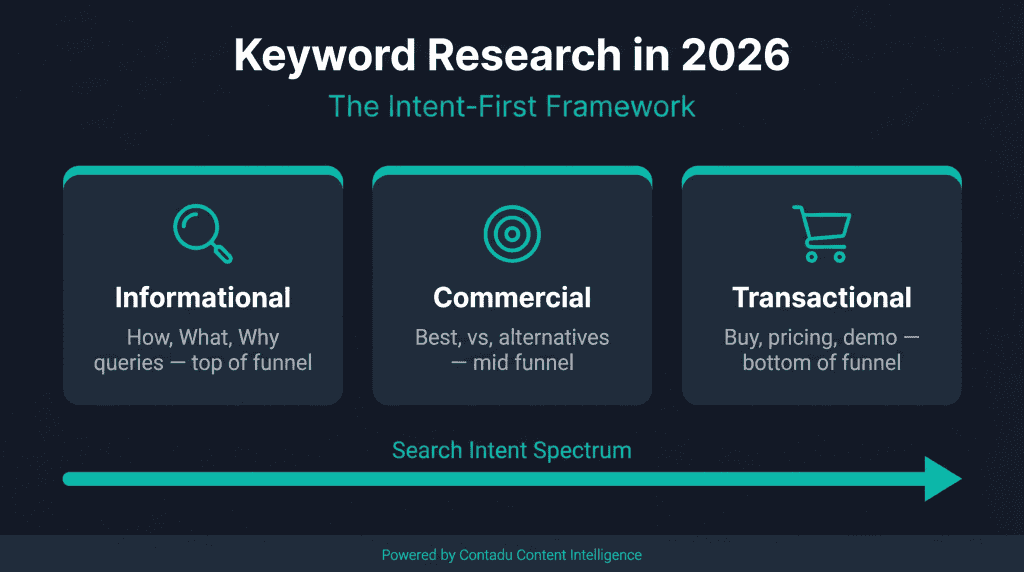
This is the absolute foundation. Before you even look at search volume or keyword difficulty, you must understand why someone is typing a given phrase into the search bar. We categorize this “why” into four main types of intent:
| Intent Type | User’s Core Desire | Example Query | Dominant Content Format | AI Actionable Metric |
| Informational | “I want to learn or understand something.” | “how does SEO work” | Comprehensive guides, definitions, blog articles. | intent_category = informational |
| Navigational | “I want to go to a specific website.” | “Contadu login” | Brand homepage, login portals, contact pages. | intent_category = navigational |
| Commercial | “I want to research options before buying.” | “Contadu vs SurferSEO” | Comparison articles, reviews, “best of” lists. | intent_category = commercial |
| Transactional | “I am ready to make a purchase now.” | “Contadu pricing” | Product pages, pricing tiers, e-commerce category pages. | intent_category = transactional |
How to Operationalize Intent:
You cannot guess intent; you must verify it. For every primary keyword you target, you must manually analyze the Search Engine Results Page (SERP). What type of content is Google currently rewarding in the top 10? If the top 10 results are all product pages (transactional intent), and you write a 3,000-word educational blog post (informational intent), you will never rank, regardless of your domain authority. You must match your content format to the dominant intent the algorithm has already identified.
Pillar 2: Semantic Context and Entity Salience.
Google no longer thinks in terms of individual words; it thinks in terms of entities and the relationships between them. It uses a massive Knowledge Graph to understand the world. Therefore, your research must expand from single keywords to broad semantic clusters.
- NLP and Co-occurring Terms: These are not just synonyms. They are the specific terms, entities, and phrases that naturally co-occur in expert-level conversation about a given topic. If you are writing a comprehensive guide about “electric cars,” Google’s Natural Language Processing (NLP) models expect you to mention “lithium-ion batteries,” “charging infrastructure,” “range anxiety,” and “regenerative braking.” If those terms are missing, the algorithm assumes your content lacks depth.
- “People Also Ask” (PAA) Analysis: The PAA section is a goldmine of semantic context. It shows you the real, related questions that users are asking immediately after their initial query. Each of these questions represents a micro-intent that should likely be addressed as an H2 or H3 heading within your main article.
How to Operationalize Semantic Context:
Use content intelligence tools like Contadu to automatically extract the critical NLP terms and PAA questions associated with your core topic. Your goal is to create content that covers the topic holistically, building a dense web of related entities, rather than just repeating the main target phrase.
Pillar 3: SERP Landscape Analysis.
Search volume and keyword difficulty scores provided by third-party tools are only a small part of the picture, and they are often misleading. You need to understand exactly who and what you are competing against on the actual results page.
- SERP Features and Zero-Click Potential: Do AI Overviews, featured snippets, video carousels, or “Top Stories” dominate the top of the results? If the SERP is highly visual or dominated by an AI Overview that directly answers the user’s question, the actual click-through rate (CTR) to organic links will be abysmal. This is the reality of Zero-Click Search.
- Competitor Authority and Content Depth: Who currently occupies the top 10 positions? Are they massive global brands with insurmountable domain authority, or are they smaller, niche blogs with thin content? Fighting Wikipedia or HubSpot for a broad term requires a fundamentally different strategy than competing with a local business blog.
How to Operationalize SERP Analysis:
Before you commit resources to writing an article, manually review the SERP. Ask yourself: “Do we have a realistic chance of creating content that is 10x better, more authoritative, or more unique than what is currently ranking?” Sometimes, the smartest SEO decision is to abandon a high-volume keyword with brutal competition in favor of a lower-volume, highly specific phrase where you can easily dominate the SERP. This strategic selection is the essence of effective content gap analysis.
Section 3: Advanced Keyword Strategies for 2026.
Once you understand the three pillars, you can begin employing advanced strategies to find the hidden gems that your competitors are missing.
1. The “Zero-Volume” Keyword Strategy.
One of the biggest mistakes content marketers make is ignoring keywords with zero search volume.
Tools are poor at estimating the volume of highly specific, long-tail, or emerging queries. For example, in B2B SaaS software, a highly technical query might only be searched 20 times a month. However, if those 20 searches are performed by CTOs with a $500,000 budget, a zero-volume keyword is infinitely more valuable than a generic term with 10,000 searches.
Choose long-tail keywords that indicate intense, specific problems, regardless of what the volume metrics say.
2. Optimizing for the “Information Gain” Gap.
Google’s Information Gain Score patent dictates that the algorithm rewards content that provides new information, not just a synthesis of what already exists.
When conducting keyword research, look at the top 10 results and ask: “What is missing?” Is everyone writing a generic listicle? If so, the “gap” is original research or a strong, contrarian opinion. Your keyword strategy must be tied to your ability to provide unique value for that specific query.
3. Building Topical Authority Hubs.
Stop researching isolated keywords. Start researching entire topics.
Google rewards sites that demonstrate deep, comprehensive expertise in a specific area a concept known as Topical Authority. Instead of finding 10 random keywords to write about this month, identify one core “Pillar” topic (e.g., “Email Marketing Automation”) and research 15 related “Cluster” topics (e.g., “Drip Campaigns,” “Lead Scoring,” “Re-engagement Workflows”).
By interlinking these highly related articles, you signal to Google that you are the definitive expert on the broader subject, which lifts the rankings of every individual page within the cluster.
How Contadu Automates Modern Keyword Research.
Executing this modern, three-pillar approach manually for hundreds of keywords is incredibly time-consuming. Contadu was built specifically around this new paradigm, automating the heavy lifting so you can focus on strategy.
- Semantic Keyword Discovery: Contadu doesn’t just give you a flat list of keywords and search volumes. It groups phrases thematically, helping you visualize the relationships between terms and easily plan comprehensive topic clusters.
- Automated SERP and Intent Analysis: The platform instantly analyzes the top-ranking results for your target query, identifying the dominant user intent, the most successful content formats, and the presence of critical SERP features. You know exactly what Google wants before you write a single word.
- NLP and PAA Term Extraction: Instead of manually scraping Google for related questions and entities, Contadu’s Content Intelligence engine provides a prioritized list of the exact semantic terms, entities, and “People Also Ask” questions that you must include to achieve comprehensive topical coverage.
- Strategic Content Mapping: Contadu allows you to turn raw keyword data into a visual, strategic content architecture, ensuring every piece you write contributes to your overall topical authority.
FAQ
Is search volume completely useless in 2026?
No, it is not completely useless, but its role has fundamentally changed. Search volume is merely an indicator of potential top-of-funnel reach; it should never be the sole criterion for selecting a keyword. A highly specific phrase with a volume of 50, but perfect alignment with your product and strong transactional intent, will generate more revenue than a generic phrase with a volume of 5,000 and vague informational intent.
How much should I trust “Keyword Difficulty” (KD) scores?
Treat KD scores with extreme caution. Most third-party tools calculate difficulty almost entirely based on the backlink profiles of the top-ranking pages. They do not account for content quality, semantic depth, topical authority, or how well a page satisfies user intent. Use KD as a rough filter, but always manually verify the true difficulty by analyzing the actual SERP.
What is “Zero-Click Search” and how does it impact keyword strategy?
Zero-click search occurs when a user finds the answer to their query directly on the Google results page (via an AI Overview, featured snippet, or knowledge panel) and does not click through to any website. For these queries, traditional traffic-driving strategies fail. You must shift your strategy to optimize for brand citations within those AI answers, or focus your keyword research on complex, experiential queries that AI cannot easily summarize.
Should I really target keywords with zero search volume?
Yes, absolutely. If a highly specific, long-tail phrase perfectly describes the exact problem your ideal customer is trying to solve, you must create content for it. Tools often report “zero volume” for niche B2B queries simply because they lack the data. A handful of highly qualified enterprise buyers searching that phrase is worth more than thousands of random blog readers.
How does AI Search (like Google’s SGE or ChatGPT) change keyword research?
AI Search accelerates the shift from keywords to natural language questions. Users are no longer typing “best CRM”; they are asking conversational, multi-part questions like, “What is the best CRM for a 10-person marketing agency that integrates with Slack and costs under $50 a month?” Your research must focus on anticipating these complex, nuanced questions and creating content that provides definitive, authoritative answers, rather than just matching short-tail keywords.
