
How to Write Long-Form Content That Ranks in Google AND AI Overviews · Contadu
📍 Semantic Summary
Idea: We are currently in a hybrid search era. Content marketers face a difficult balancing act: they must write comprehensive, long-form content to satisfy traditional Google SEO algorithms (which still reward Topical Authority and depth), while simultaneously structuring that content for AI Answer Engines (which require brevity, front-loaded facts, and rapid extraction).
Challenge: Most teams create two separate silos of content one for traditional SEO and one for Generative Engine Optimization (GEO). This is inefficient and scales poorly. The alternative writing a single piece of content that tries to be both often results in a messy compromise that ranks in neither.
Summary: You can write long-form content that dominates both traditional search and AI Overviews by utilizing a Dual-Structure Architecture. This involves using the Inverted Pyramid at the document level for AI, while maintaining deep, semantically rich chapters below the fold for traditional crawlers. This guide explains how to merge SEO and GEO into a single, high-performing content asset.
Read the full guide below, or explore related topics:
- Structuring Content for AI Extraction: The Inverted Pyramid Method
- How to Write Quotable Statements That AI Engines Extract
- GEO 2.0: Advanced Tactics to Get Cited by AI Engines
In 2026, content marketers are experiencing a strategic identity crisis. For years, the mandate was clear: write comprehensive, 2,500-word definitive guides to build Topical Authority and rank in Google’s traditional ten blue links.
Then came the rise of ChatGPT, Perplexity, and Google AI Overviews. Suddenly, the mandate shifted: write concise, front-loaded, entity-dense summaries so that Retrieval-Augmented Generation (RAG) systems can easily extract your data.
This creates a perceived paradox. How do you write a 2,500-word definitive guide that also acts as a rapid-fire data source for an AI Answer Engine? The answer lies in Dual-Structure Architecture.
The Dual-Structure Architecture Framework.
Dual-Structure Architecture is the practice of engineering a single HTML document to serve two distinct algorithms simultaneously. It acknowledges that traditional crawlers and AI extraction models read web pages differently.
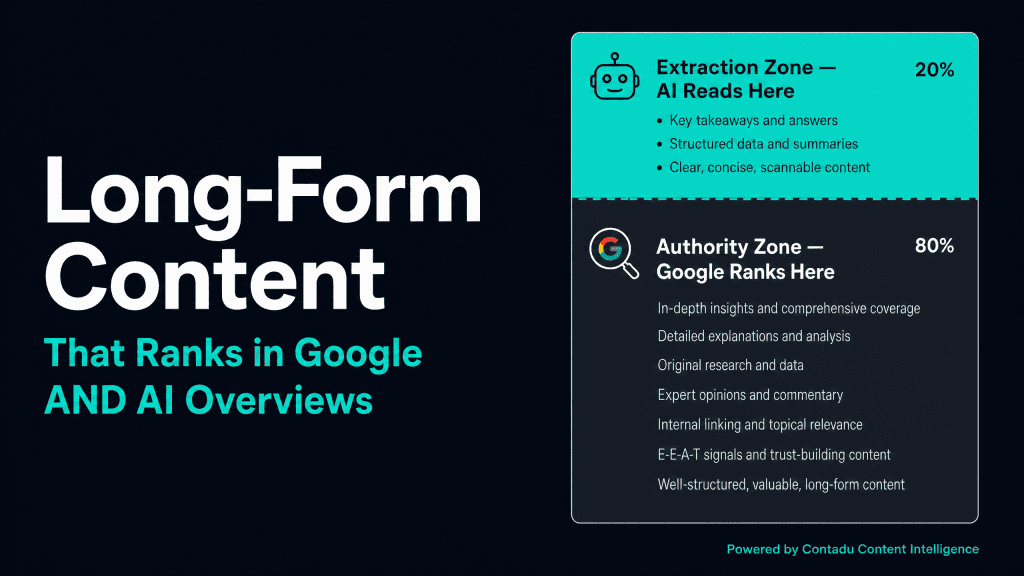
To succeed, your long-form content must be split into two distinct zones: the Extraction Zone (for AI) and the Authority Zone (for traditional SEO).
Zone 1: The Extraction Zone (Top 20%)
The Extraction Zone occupies the space above the fold. Its sole purpose is to feed AI models the exact data they need to synthesize an answer. It must adhere strictly to the Inverted Pyramid Method.
- The Semantic Summary: A 100-150 word block immediately below the title that directly answers the user’s core intent.
- Entity Density: The core Entities must be explicitly named and bolded.
- Quotable Statements: At least one highly extractable, standalone sentence that defines the primary concept.
- Structured Data: A bulleted list or a small HTML table summarizing the key takeaways. AI engines prioritize structured data formats for rapid synthesis.
Zone 2: The Authority Zone (Bottom 80%)
Once you have satisfied the AI crawler in the Extraction Zone, the rest of the document is dedicated to building traditional Topical Authority. This is where your long-form narrative, deep analysis, and comprehensive coverage live.
- Semantic Breadth: Covering all related subtopics, LSI keywords, and long-tail variations to satisfy traditional Google ranking factors.
- Information Gain: Providing unique data, case studies, and proprietary research that no other ranking page possesses.
- Internal Linking: Building the connective tissue of your Knowledge Graph by linking to related cluster pages.
How to Optimize Subheadings for Both Worlds
Subheadings (H2s and H3s) are the bridge between the Extraction Zone and the Authority Zone. Both traditional Google algorithms and AI models use headers to understand the semantic structure of a page.
In traditional SEO, marketers often used clever or abstract subheadings (e.g., “The Road Ahead”). In the hybrid era, this is a fatal mistake.
Rule of Thumb: Every H2 must be phrased as a conversational question, and the very first sentence immediately following the H2 must be a Quotable Statement that directly answers that question.
Example:
- Bad H2: The Cost Factor
- Good H2: How much does enterprise SEO software cost in 2026?
- The Immediate Answer: “In 2026, enterprise SEO software typically costs between $1,500 and $5,000 per month, depending on the number of users, API integrations, and the depth of AI content intelligence features required.”
After providing the direct answer for the AI, you can spend the next 500 words breaking down the pricing tiers for the human reader and the traditional crawler.
The Role of Original Research
If there is one element that unites both traditional SEO and Generative Engine Optimization (GEO), it is Original Research. Google’s patent on Information Gain explicitly rewards pages that introduce new data to the web ecosystem.
Similarly, AI engines like Perplexity are designed to synthesize facts. If your long-form content includes a proprietary statistic (e.g., “Our survey of 500 CMOs revealed…”), you provide a unique data point that the AI cannot extract from Wikipedia or a competitor’s blog.
Embed your original research in the Authority Zone, but ensure the core statistic is summarized as a Quotable Statement in the Extraction Zone.
Conclusion: The Best of Both Worlds
You do not need to choose between ranking in Google’s traditional results and getting cited in AI Overviews. The algorithms are different, but they are not mutually exclusive.
By implementing a Dual-Structure Architecture front-loading the facts for AI extraction while maintaining deep, comprehensive analysis for traditional topical authority—you can create long-form content that dominates the hybrid search landscape of 2026.
FAQ
Q: Does a Semantic Summary at the top of the page increase bounce rate?
A: It may increase the bounce rate for low-intent users who only wanted a quick fact. However, high-intent buyers who need deep analysis will scroll down. In the AI era, getting cited as the source of that quick fact is often more valuable than forcing a user to read a 2,000-word article.
Q: Should I use Schema markup on long-form content?
A: Absolutely. Use Article Schema, FAQ Schema, and Organization Schema to explicitly define the entities and relationships within your long-form content, making it easier for both traditional crawlers and AI models to process.
Q: How long should long-form content be in 2026?
A: Word count is not a ranking factor. The length of the content should be determined by the complexity of the topic and the amount of depth required to establish full Topical Authority. If it takes 3,000 words to comprehensively cover the subject, write 3,000 words.
Q: Can I use AI to write the Authority Zone of my content?
A: You can use AI to assist with outlining and drafting, but relying entirely on AI to write long-form content will result in a low Information Gain score. To rank in 2026, your content must include unique insights, human experience, and proprietary data.
Q: How does Contadu help with Dual-Structure Architecture?
A: Contadu’s content intelligence platform analyzes your drafts for both traditional SEO metrics (keyword coverage, word count) and GEO metrics (Entity Salience, structural clarity), ensuring your content is optimized for both Google and AI Answer Engines.
Q: Are table of contents still relevant for long-form articles?
A: Yes. A jump-link table of contents helps human readers navigate long articles and provides traditional crawlers with clear semantic anchor text. However, AI models rely more on the actual HTML heading tags (H2/H3) than the table of contents.
Q: What is the biggest mistake marketers make with long-form content today?
A: Treating it like a college essay. Writing a long, meandering introduction that slowly builds to a thesis makes it nearly impossible for AI engines to extract the core facts efficiently.