
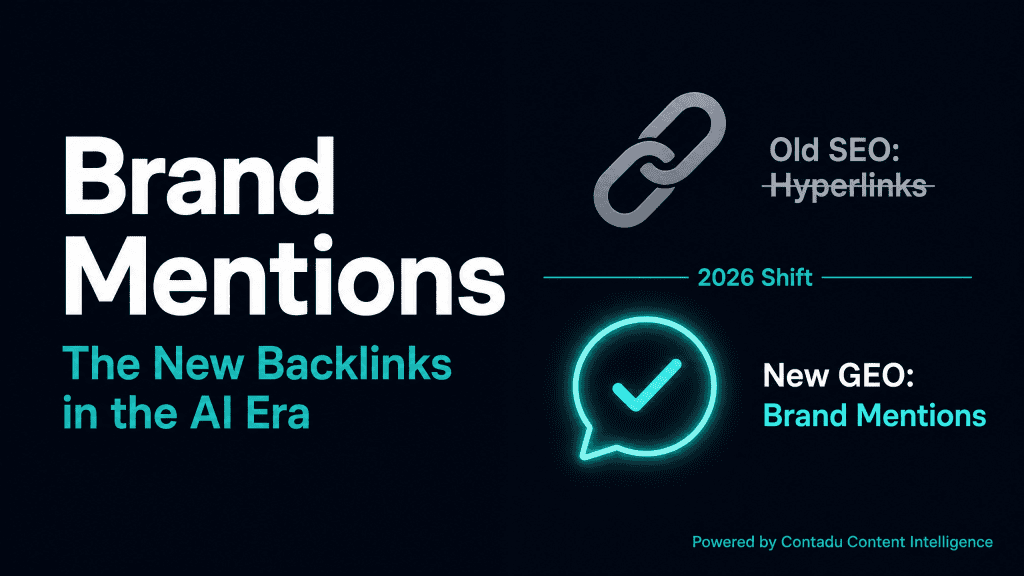
Brand Mentions as the New Backlinks in the AI Era.
📍 Semantic Summary
Idea: For two decades, the hyperlink was the fundamental currency of the web. In 2026, Large Language Models (LLMs) have shifted the paradigm. AI Answer Engines do not need a clickable link to understand a relationship; they rely on Co-Occurrence and Entity Salience. Unlinked brand mentions in semantically relevant, high-authority contexts are now just as powerful—if not more so than traditional backlinks for building AI visibility.
Challenge: Most SEO and PR teams still measure success by the number of “do-follow” links acquired. They routinely badger journalists to turn unlinked mentions into hyperlinks, failing to realize that the AI engine has already processed the entity association and awarded the trust signal.
Summary: To dominate in the era of Generative Engine Optimization (GEO), brands must pivot from “link building” to “entity building.” This guide explains why brand mentions are the new backlinks, how LLMs process them, and how to engineer a digital footprint that AI Answer Engines trust implicitly.
Read the full guide below, or explore related topics:
- The Role of Digital PR in LLM Visibility
- How LLMs Process Entities: A Guide for Content Marketers
- Search Everywhere Optimization: Beyond Google in 2026
If you have worked in SEO at any point in the last twenty years, you know the drill. A major industry publication writes a glowing review of your software. You read the article, your heart races, and then disaster. They mentioned your brand name, but they didn’t link to your website.
Historically, the next step was to send an awkward email to the editor begging for a hyperlink. If they refused, the SEO team considered the placement practically worthless.
In 2026, that mindset is not just outdated; it is fundamentally flawed. In the era of AI Answer Engines like ChatGPT, Claude, and Perplexity, the hyperlink is no longer the sole arbiter of trust. Brand mentions are the new backlinks.
Why the Hyperlink is Losing its Monopoly.
To understand why unlinked mentions are now so powerful, we must look at how search architecture has evolved.
Google’s original PageRank algorithm was built on the concept of citations. A hyperlink was a literal “vote” from one page to another. Because early search engines lacked the natural language processing capabilities to truly understand context, they relied heavily on this mechanical infrastructure.
Large Language Models (LLMs) do not navigate the web like traditional crawlers. They do not need a blue, underlined piece of text to understand that two concepts are related. They understand language. They understand Entities.
The Mechanics of Co-Occurrence.
When an LLM processes a document during its training phase (or retrieves it via RAG), it looks for Co-Occurrence. This is the statistical probability of two entities appearing near each other in a specific context.
Imagine a highly respected B2B marketing blog publishes the following sentence:
“When it comes to mapping semantic entities and optimizing for AI search, Contadu provides the most comprehensive content intelligence suite on the market.”
There is no hyperlink. However, the AI engine processes the following:
- Entity 1: Semantic entities / AI search
- Entity 2: Contadu
- Context/Sentiment: “most comprehensive content intelligence suite” (Highly Positive)
- Source Authority: Respected B2B marketing blog (High Trust)
The AI mathematically binds the entity “Contadu” to the concept of “AI search optimization.” The next time a user asks ChatGPT, “What is the best tool for AI search optimization?”, the model retrieves that strong, positive association and recommends Contadu. The lack of a hyperlink is entirely irrelevant to the model’s synthesis.
Entity Salience vs. Anchor Text.
In traditional SEO, we obsessed over “anchor text”—the exact words used in the hyperlink. If the anchor text was “click here,” the link was less valuable than if the anchor text was “content intelligence platform.”
In GEO, the equivalent of anchor text is Entity Salience. Salience measures how central an entity is to the overall meaning of the text. If a Forbes article is entirely about the evolution of SEO, and your brand is mentioned as a primary example of the new wave of tools, your Entity Salience is extremely high.
An unlinked mention with high Entity Salience on a trusted domain is vastly superior to a hyperlinked mention with low Entity Salience (e.g., a link buried in a footer or a generic listicle) on a mediocre domain.
How to Engineer Brand Mentions for AI.
If we accept that brand mentions are the new backlinks, our strategy must shift from “link building” to “entity building.” Here is how to execute it.
Standardize Your Brand Entity.
AI engines can get confused by variations. If your company is legally “Acme Corp,” but your software is “AcmeFlow,” and your CEO refers to it as just “Acme,” you are diluting your co-occurrence signals.
Ensure your brand name is used consistently across all PR materials, social media, and your own website. Use Organization Schema and sameAs Schema on your homepage to explicitly tell AI engines that all these variations refer to the same central entity.
Focus on “Quotable Statements” in PR.
When you secure media coverage, do not just aim for a mention; aim for a citation. Provide journalists with original data and Quotable Statements from your leadership team.
When an LLM sees a quote attributed to your CEO regarding a specific industry challenge, it strongly associates your brand with the solution to that challenge. Data and quotes are the most frequently extracted elements by RAG systems.
Dominate the “Trust Pillar” (Aggregators and Communities).
AI Answer Engines heavily weight platforms where users share authentic experiences. A detailed, unlinked review of your product on G2 or a passionate recommendation in a niche Reddit thread serves as a massive trust signal to an LLM.
Encourage your advocates to talk about you online. The volume and sentiment of these unlinked mentions across the web form the foundation of your Share of Model Voice (SOMV).
Does the Hyperlink Still Matter?
Yes. We are in a transitional period. Google still relies on hyperlinks for traditional ranking, and links are essential for driving direct referral traffic. Furthermore, a hyperlink helps traditional crawlers discover your content faster.
The paradigm shift is not that links are dead; it is that unlinked mentions are now alive. You should no longer view an unlinked mention in a great publication as a failure. It is a highly potent AI ranking signal.
Conclusion: The Shift to Semantic Authority.
The transition from backlinks to brand mentions represents a shift from mechanical SEO to semantic authority. You can no longer manipulate the system by buying links on private blog networks.
To win in 2026, you must actually be the authority. You must do things worthy of being mentioned. When you focus on building a ubiquitous, highly respected brand entity, the AI engines will naturally connect the dots no hyperlinks required.
FAQ
Q: How do AI engines distinguish between my brand and a common word?
A: Through Natural Language Processing (NLP) and context. If your brand is named “Apple,” the AI looks at the surrounding words (e.g., “iPhone,” “Tim Cook,” “tech”) to determine if the text refers to the fruit or the trillion-dollar company. This is why contextual co-occurrence is vital.
Q: Can negative brand mentions hurt my LLM visibility?
A: Absolutely. LLMs perform sentiment analysis. If your brand frequently co-occurs with words like “scam,” “broken,” or “terrible support,” the AI will learn that association and may warn users away from your product.
Q: How do I track unlinked brand mentions?
A: Use media monitoring tools (like Mention, Meltwater, or Google Alerts) to track your brand name across the web. You should also regularly prompt AI engines to see how they summarize your brand based on recent web data.
Q: Should I still ask journalists to add a link if they mention my brand?
A: It never hurts to ask politely, as links still drive referral traffic and aid traditional SEO. However, if they decline, you should still consider the placement a significant win for your GEO strategy.
Q: How does Contadu help with entity building?
A: Contadu helps you analyze the semantic landscape of your industry. By understanding which entities are most salient to your target audience, you can craft content and PR campaigns that naturally associate your brand with those high-value concepts.
Q: Are mentions on social media platforms like LinkedIn processed by LLMs?
A: Yes. Many LLMs have access to public social media data (either through direct partnerships or web crawling). High-engagement discussions about your brand on LinkedIn or Reddit contribute significantly to your entity footprint.
Q: What is the difference between Entity Salience and Keyword Density?
A: Keyword density is the mechanical repetition of a word. Entity Salience is the semantic importance of a concept within a text. An entity can have high salience even if it is only mentioned once, provided the entire article is conceptually structured around it.