
The B2B Content Marketing Playbook: From First Touch to Closed Deal
Your sales team is frustrated. They complain that the leads from marketing are low-quality, the sales cycles are too long, and they spend most of their time educating prospects who aren’t ready to buy. Meanwhile, your marketing team is burning out creating content that generates clicks and downloads, but fails to translate into revenue.
This disconnect is the default state for most B2B organizations. The reason is simple: B2B buying has fundamentally changed. It’s no longer a linear, predictable funnel. It’s a complex, multi-stakeholder journey involving an average of 11 decision-makers, each with their own questions, priorities, and pain points
Trying to win in this environment with a generic, one-size-fits-all content strategy is like trying to navigate a maze blindfolded. You need more than just a blog; you need a playbook. This guide provides a comprehensive, step-by-step framework for building a B2B content marketing engine that doesn’t just generate leads, but actively nurtures buying committees and empowers your sales team to close larger deals, faster. Think of it as the strategic layer on top of a tactical AI-first content workflow.
The Modern B2B Challenge: The Buying Committee.
Before diving into the playbook, it’s crucial to understand the battlefield. Unlike B2C, where you often persuade a single individual, B2B sales require building consensus across a diverse group of stakeholders.
| Stakeholder Role | Key Concerns | Content They Need |
| The Champion | Solving their specific, personal pain point. | Tactical guides, how-to articles, webinars. |
| The End-User | Ease of use, integration, impact on their daily workflow. | Product demos, case studies, implementation guides. |
| The IT/Technical Buyer | Security, compliance, integration, technical feasibility. | Technical documentation, security whitepapers, integration specs. |
| The Financial Buyer/CFO | ROI, total cost of ownership (TCO), budget impact. | ROI calculators, pricing comparisons, financial case studies. |
| The Executive Sponsor | Strategic alignment, business impact, competitive advantage. | High-level strategy guides, thought leadership reports, industry trend analysis. |
Your content strategy fails if it only speaks to one of these personas. The goal of this playbook is to equip you to create and distribute content that systematically addresses the needs of the entire buying committee, guiding them from initial awareness to a confident purchase decision.
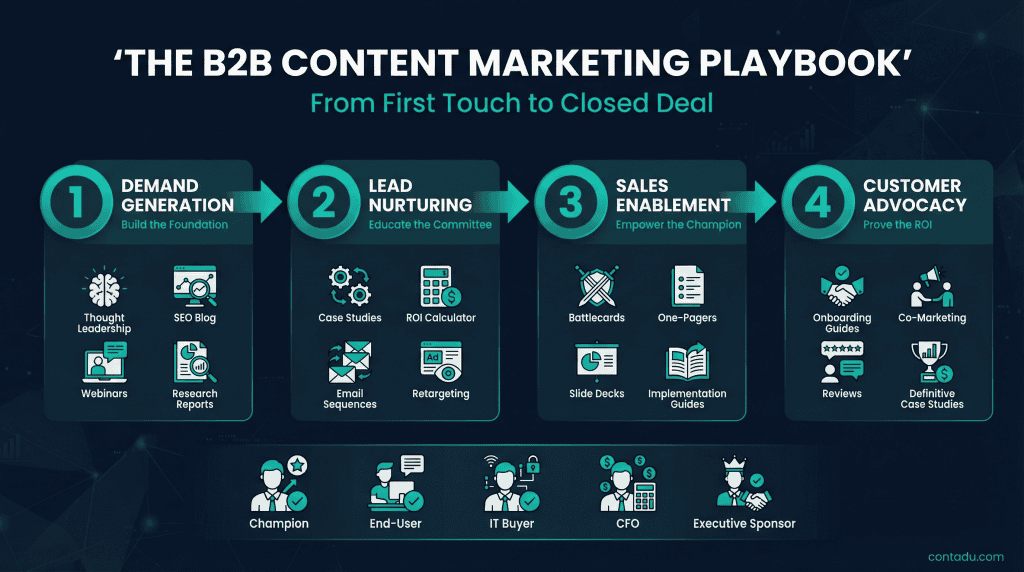
The 4-Stage B2B Content Playbook
This playbook is broken down into four distinct stages that mirror the modern B2B buyer’s journey.
1.Stage 1: Build the Foundation (Demand Generation)
2.Stage 2: Nurture the Committee (Lead Nurturing)
3.Stage 3: Empower the Champion (Sales Enablement)
4.Stage 4: Prove the ROI (Customer Marketing & Advocacy)
Let’s break down each stage.
Stage 1: Build the Foundation (Demand Generation)
The Goal: Attract and engage potential customers who are not yet actively looking for a solution. The objective here is not to generate a “lead” in the traditional sense, but to become the go-to resource in your category. You are building an audience and establishing credibility.
The Process:
1.Identify Your Pillar Topics: What are the 3-5 core strategic conversations you want to own in your industry? These should be broad enough to create a wealth of content around them. For a project management software, pillars might be “Team Productivity,” “Agile Methodologies,” and “Remote Work Excellence.”
2.Create Pillar Content: For each pillar, create a comprehensive, long-form “pillar page” that acts as a central hub for the topic. This is your definitive guide, the 101 resource.
3.Build Topic Clusters: Use your pillar page as a starting point to brainstorm dozens of related sub-topics. These become your blog posts, webinars, and social media content. The goal is to cover the topic from every angle, answering every possible question your audience might have. This is how you build topical authority.
4.Focus on Thought Leadership: This is the most critical element. Don’t just report the news; interpret it. Develop a strong point of view on where your industry is headed. This is what attracts executive sponsors and builds brand affinity.
Key Content Formats for Stage 1:
- Thought Leadership Articles: In-depth articles that present a unique perspective on industry trends.
- Webinars & Virtual Events: Live sessions with experts discussing key challenges and solutions.
- Research Reports: Original research that provides new data and insights to the industry.
- Tactical How-To Guides: Practical, actionable content that helps your audience solve a specific problem.
Distribution Channels:
- SEO: Optimize all content for relevant keywords to capture organic search traffic.
- Social Media (LinkedIn): Share insights, engage in conversations, and build a following. A documented content distribution plan is crucial here.
- Niche Communities: Participate in relevant online communities (e.g., Slack groups, forums) where your audience gathers.
- Email Newsletter: Build a subscriber list and deliver valuable content directly to their inbox.
What Most Teams Get Wrong Here: They focus too heavily on bottom-of-the-funnel, product-centric content. They gate everything, trying to force a lead capture. The result is a tiny audience and a weak brand. The key to Stage 1 is to give away your best ideas for free to build trust and authority.
Stage 2: Nurture the Committee (Lead Nurturing)
The Goal: Guide the engaged audience from Stage 1 deeper into the buying journey. Now that you have their attention, the objective is to educate them on the problem they have and subtly introduce your solution, while building consensus across the different members of the buying committee.
The Process:
Segment Your Audience: You cannot nurture everyone the same way. At a minimum, segment your audience based on the pillar topic they engaged with. Advanced teams will segment based on role, industry, or company size. The goal is to move from generic messaging to personalized communication.
Develop Nurture Sequences: Create automated email sequences that deliver a logical progression of content. A typical sequence might look like this:
- Email 1 (Problem-Awareness): Acknowledge their interest in the topic and share a piece of content that dives deeper into the problem (e.g., a research report on the costs of inefficiency).
- Email 2 (Solution-Awareness): Introduce the category of solution you provide, without mentioning your product specifically (e.g., an article on “How Agile Methodologies Can Improve Productivity”).
- Email 3 (Product-Awareness): Share a case study or customer story that demonstrates how a company like theirs solved the problem using a solution like yours.
- Email 4 (Call-to-Action): Offer a lower-commitment next step, like a webinar or a free tool, not a “Book a Demo” call.
Map Content to Personas: Ensure your nurture tracks contain content that appeals to different members of the buying committee. While a Champion might love a tactical guide, the CFO needs to see an ROI calculator. Your nurture sequence should be a curated journey for the whole team.
Key Content Formats for Stage 2:
- Case Studies & Customer Stories: The single most powerful content format for B2B. Show, don’t just tell.
- Webinars on Specific Problems: Move from broad topics to focused discussions on specific pain points.
- ROI Calculators & Interactive Tools: Allow prospects to build their own business case for your solution.
- Comparison Guides (vs. alternatives, not direct competitors): Help prospects understand where your solution fits in the market landscape. Frame it as “Solution Type A vs. Solution Type B.”
Distribution Channels:
- Email Marketing Automation: The core engine of Stage 2.
- Retargeting Ads: Use paid social and display ads to retarget website visitors and email subscribers with the next logical piece of content.
- LinkedIn InMail (for high-value accounts): Manually send personalized messages with relevant content to key stakeholders at target companies.
What Most Teams Get Wrong Here: They move for the sale too quickly. Their nurture sequences are just a series of sales pitches. They ask for a demo in the first email, alienating prospects who are still in the early stages of their research. The key to Stage 2 is patience and a relentless focus on providing value and education.
Stage 3: Empower the Champion (Sales Enablement)
The Goal: Once a prospect raises their hand and agrees to talk to sales, the role of content shifts from attraction and nurture to empowerment. Your goal is to arm your internal champion with the materials they need to sell your solution internally to the rest of the buying committee.
The Process:
Your sales team should not be creating their own materials. The marketing team must provide a library of high-quality, on-brand content that is specifically designed for the sales process. This content should be easily accessible and categorized by persona and buying stage.
1.Build a Sales Content Library: Create a centralized hub (e.g., in a tool like Notion, or a shared drive) where sales can find everything they need. This library should be searchable and organized intuitively.
2.Create Persona-Specific Battlecards: For each key stakeholder in the buying committee (IT, Finance, etc.), create a one-page “battlecard.” This document should summarize the key pain points of that persona, the tough questions they are likely to ask, and the key value propositions of your solution that resonate most with them.
3.Develop “Leave-Behind” Assets: After a sales call, your champion needs materials to share with their colleagues. These are not marketing brochures. They should be concise, value-focused assets that reinforce the message from the call. A one-page summary of the business case or a short, targeted case study is far more effective than a 50-page whitepaper.
Key Content Formats for Stage 3:
- One-Page Case Studies: Short, punchy case studies focused on a single, powerful result.
- Implementation Guides & Timelines: Show prospects how easy it is to get started and what the onboarding process looks like. This is crucial for the technical buyer.
- Security & Compliance Sheets: A one-pager that proactively answers the most common security and compliance questions from the IT team.
- Customizable Slide Decks: Provide the sales team with a master slide deck that they can easily customize for a specific prospect, pulling in the slides that are most relevant to the stakeholders in the room.
Distribution Channels:
- Sales Enablement Platform / CRM: Integrate your content library directly into the tools your sales team uses every day.
- Directly via Sales Reps: The content is delivered personally by the sales representative in the context of their ongoing conversation with the prospect.
What Most Teams Get Wrong Here: Marketing creates content in a vacuum and “throws it over the wall” to sales. There is no feedback loop. Sales doesn’t use the content because it doesn’t address the real-world objections they face. The key to Stage 3 is a deep partnership between marketing and sales, with constant communication and collaboration.
Stage 4: Prove the ROI (Customer Marketing & Advocacy)
The Goal: The deal is closed, but the work isn’t done. The final stage of the playbook is to turn your new customer into a vocal advocate. This creates a powerful feedback loop, where your best customers become your most effective marketing channel, fueling the top of the funnel for Stage 1.
The Process:
1.Onboarding & Education: The first 90 days are critical. Your content should shift from “why you should buy” to “how to be successful.” Create a world-class onboarding experience with clear documentation, video tutorials, and best practice guides. A successful customer is a happy customer.
2.Proactive Success Measurement: Don’t wait for the customer to tell you they are seeing value. Work with them to define what success looks like and then help them track their progress towards those goals. Share their wins with them. This builds the foundation for a strong case study later on.
3.Systematize the “Ask”: Don’t be afraid to ask for testimonials, reviews, and case studies. But do it in a systematic way. Build it into your process. For example, 90 days after a customer is successfully onboarded, trigger an automated email asking them to share their experience on a review site. When you help a customer achieve a major milestone, that is the perfect time to ask for a case study.
Key Content Formats for Stage 4:
- Advanced Strategy Guides: Content for your power users that helps them get even more value out of your product.
- Customer-Only Webinars: Exclusive events where you share product roadmaps, best practices, and success stories from other customers.
- Co-Marketing with Customers: Feature your customers on your blog, in your webinars, and at your events. This gives them valuable exposure and strengthens your partnership.
- The Definitive Case Study: Go beyond the one-pager. Create in-depth, narrative-driven case studies that tell the full story of how your customer transformed their business with your solution. These are your most powerful sales assets.
Distribution Channels:
- In-App Messaging & Email: Communicate directly with your customers inside your product and via email.
- Customer Community: Create a space (e.g., a Slack channel or a dedicated forum) where your customers can connect with each other, share best practices, and learn from each other.
- Sales Team: Your sales team should be using your best case studies and customer stories in their outreach to new prospects.
What Most Teams Get Wrong Here: They view marketing as a pre-sale function only. Once the deal is closed, the customer is handed off to support or success, and marketing moves on to the next lead. This is a massive missed opportunity. Your happiest customers are your most credible and cost-effective marketing channel.
Conclusion: From Content Factory to Revenue Engine
Building a true B2B content marketing engine is a significant undertaking. It requires a shift in mindset—from a “content factory” that churns out disconnected assets to a strategic, integrated function that owns the entire buyer’s journey. It demands a deep partnership between marketing and sales and a relentless focus on providing value at every single touchpoint.
By implementing this four-stage playbook, you can transform your content from a cost center into a predictable revenue engine. You will stop arguing about lead quality and start having conversations about pipeline, velocity, and customer success. You will build a brand that doesn’t just compete, but dominates its category, becoming the trusted resource for your most valuable customers.
FAQ
How long does it take to see results from this playbook?
Content marketing is a long-term investment. You can expect to see leading indicators like traffic and engagement growth in the first 3-6 months of implementing Stage 1. However, a measurable impact on pipeline and revenue (the ultimate goal) typically takes 9-12 months of consistent execution across all four stages.
Our team is small. Where should we start?
Start with Stage 1, but with a narrow focus. Pick one pillar topic and aim to dominate it. Create one high-quality pillar page and 5-10 supporting cluster posts. Focus on creating one great piece of thought leadership content per quarter. It’s better to execute one pillar flawlessly than to do three pillars poorly.
How do you measure the ROI of top-of-funnel content?
Direct ROI attribution for Stage 1 content is challenging, but not impossible. Key metrics include: organic traffic growth to pillar pages, keyword rankings for strategic terms, audience growth (email subscribers, social followers), and, most importantly, pipeline influence. Use your analytics to track how many eventual customers first engaged with your Stage 1 content, even if they didn’t convert immediately. This demonstrates the content’s role in sourcing and influencing future deals.
What’s the ideal balance between gated and ungated content?
A good rule of thumb is to keep 90% of your content ungated, especially in Stage 1. Your goal is to maximize reach and build an audience. Reserve gates for high-value, bottom-of-funnel content in Stage 2 and 3, such as webinar recordings, ROI calculators, or in-depth case studies, where the prospect is demonstrating a higher level of intent.
How can we get our sales team to actually use the content we create?
Involve them in the creation process. Interview your top sales reps. Ask them what questions they get asked most often and what are the biggest objections they face. Build your Stage 3 content specifically to answer those questions. When sales sees that your content makes their job easier and helps them close deals, they will use it.