
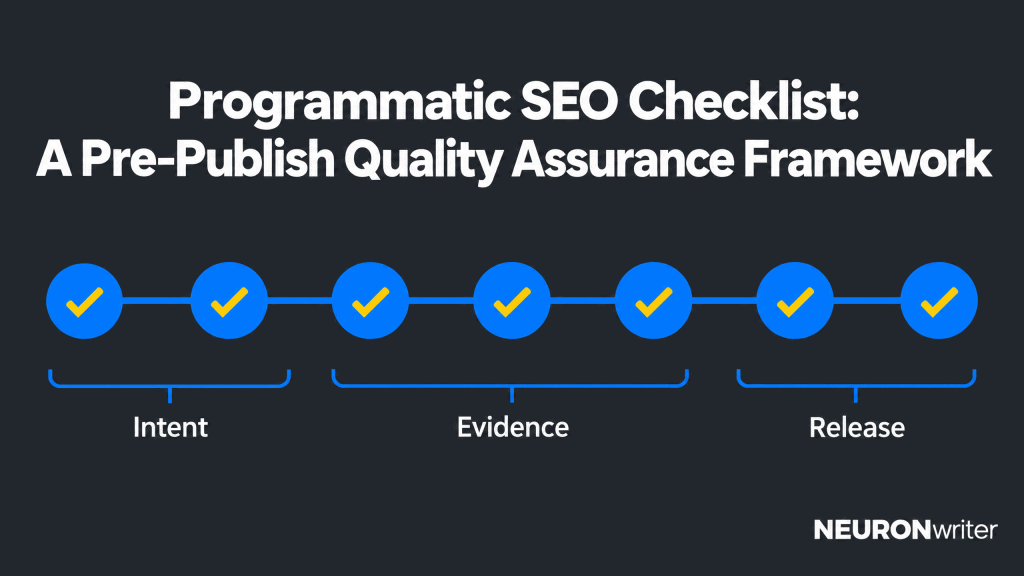
Programmatic SEO Checklist: A Pre-Publish Quality Assurance Framework
Semantic Summary
Idea: A programmatic SEO checklist should confirm that every proposed page has accurate, page-specific value before a batch goes live.
Challenge: Teams can validate a template once yet still publish pages with stale data, blank variables, overlapping intent, weak internal discovery, or conflicting indexation signals.
Summary: Review the page set through release gates for intent, data, rendered content, technical signals, discovery, and approval evidence; publish only the pages that pass.
Related Reads
- Programmatic SEO for B2B SaaS: A Practical Introduction
- JavaScript Rendering for AI Search: A Technical QA Checklist
- The Content Cannibalization Playbook: How to Find and Fix It Before It Kills Your Rankings
| Release gate | What to inspect | Evidence to keep | Stop-and-fix signal |
| 1. Intent | Each URL maps to a distinct reader task. | Query-to-page map and overlap decision. | Two URLs promise the same answer. |
| 2. Data | Fields have sources, owners, dates, and fallbacks. | Record sample and exception list. | A visible field is blank, stale, or unsupported. |
| 3. Rendered page | Variable data changes the useful answer. | Side-by-side page review. | Pages collapse into near-duplicates. |
| 4. Discovery | URLs, metadata, canonicals, and links agree. | Representative technical sample. | A preferred page is unclear or orphaned. |
| 5. Markup | Structured data reflects visible page content. | Validation result and visual check. | Markup uses hidden, placeholder, or irrelevant facts. |
| 6. Release set | Only eligible canonical pages enter the sitemap. | Batch list and publishing plan. | Blocked, excluded, or weak pages are included. |
| 7. Approval | A named owner accepts the evidence and exceptions. | Release record and next review date. | No one can explain why the batch is ready. |
A programmatic SEO checklist is a release control, not a content-generation trick. Use it after you have already decided that a page family deserves to exist. Its job is to stop a weak data record, a misleading template, or a conflicting technical signal from being repeated across dozens or thousands of web pages.
Programmatic SEO means publishing a family of pages from a reusable system: a dataset, a page template, and rules that determine what appears on each URL. The system can help a team cover repeated, specific reader questions. But scale amplifies mistakes. A single missing field, duplicate rule, or outdated fact can affect every page in the batch.
What a Programmatic SEO Checklist Checks and What It Does Not
This checklist asks whether a prepared group of programmatic SEO pages is safe and useful to publish today. It does not replace topic research, product review, legal review, or a decision about whether a page family should exist in the first place.
That boundary matters. A strategy guide asks, “Do people have a repeatable need that deserves separate pages?” A pre-publish QA workflow asks, “Do these specific URLs faithfully answer that need?” The first decision prevents a weak program. The second catches problems between the data source and the reader’s screen.
Use this checklist when a team has a working page template, records ready for publication, and a candidate batch. It is useful for resource directories, compatibility guidance, role-based pages, location pages, documentation collections, and any other programmatic content system. It applies whether the work is largely manual, automated, or assisted by AI.
It also keeps the standard clear: automation is not the risk by itself. Google’s spam policies describe scaled content abuse as generating many pages mainly to manipulate rankings rather than help people. The relevant question for every page is simple: does this URL give a reader a distinct, accurate answer?
How to Run the Checklist on a Real Page Batch
Review both the source records and the final rendered pages. A tidy dataset can still produce awkward, incomplete, or repetitive page content after template rules are applied. Conversely, a polished sample page can hide source records that will fail later.
Begin with a representative sample. Include a common record, an edge case, a record with optional fields, and a record likely to change. If the batch supports different use cases, include one from each. This is not a statistical promise; it is a practical way to force the workflow through its real conditions before a broad release.
Assign three roles, even if one person holds more than one: an evidence owner for source data, a publishing owner for the page template and technical setup, and an approver who can pause the release. Give every exception a short reason. “Field unavailable” is not enough; record whether the page should use a verified fallback, remain unpublished, or be merged with another page.
AI can help sort records, spot missing values, or suggest a QA queue. It cannot verify a material product claim or decide that two pages are different enough for readers. Treat AI output as a prompt for review, not the evidence required to pass a gate.
Gate 1: Confirm Search Intent and Page Boundaries
Every programmatic page needs one distinct reader task. A keyword variation is not automatically a new task. Before reviewing copy or markup, check whether the URL represents a different decision, constraint, role, location, or workflow.
Map one URL to one useful job
Make a small query-to-page map. For each proposed URL, write the question it should answer and the action a reader should be able to take afterward. A page about a particular workflow should tell the reader what that workflow needs, what changes in that case, and where to go next. If the only difference is a rearranged keyword, the page has no clear boundary.
Long-tail keywords can be valuable because they express a precise need. Search volume alone is not proof that a page should exist. Compare the intended query with the visible page promise and with existing content on the site. The goal is not to create every possible URL. It is to create the URLs that solve a distinct search intent.
Use keyword research to identify search demand, then use the live search results to test whether several phrases actually share the same user intent. This is a practical part of a programmatic SEO strategy: the template should follow the reader task, not force a new page for every related keyword.
Choose merge, differentiate, or exclude
When two page targets overlap, choose one of three actions. Merge them into a stronger single page when they serve the same need. Differentiate them only when you can add page-specific data, instructions, limitations, or evidence. Exclude the weaker target when neither option is honest. This decision prevents content cannibalisation before it becomes a reporting problem.
Keep the decision beside the URL plan. That record gives the SEO team a reason to preserve the distinction later, rather than reintroducing similar pages during the next publishing cycle.
Gate 2: Validate Source Data and Visible Variables
A programmatic page is only as reliable as the record behind its visible fields. Every data point that changes a reader’s understanding needs a source, an owner, and a review rule. Do not treat a value as trustworthy just because it arrives through an automated workflow.
Require evidence, ownership, and a freshness date
For each dataset field that appears on the page, record four items: the source, the person or team responsible, the last verified date, and the update trigger. A capability can change when a product release happens. A requirement can change when an access rule changes. A local detail can change when a location or operating schedule changes.
Use a simple field map: field → reader benefit → source → owner → refresh trigger. If a field does not change the page’s answer, question why it appears at all. If a field changes the answer but has no source, it should not enter the page template.
Preview failure states, not only ideal records
Test blank variables, unknown values, discontinued options, and records with partial data. A page template should handle these states deliberately. It can display a verified fallback, remove a nonessential section, send the record to a review queue, or exclude the page from the batch. It should never show a blank heading, a placeholder, or a confident claim that the data cannot support.
This check is especially important when a database mixes old and current records. A page may look complete because its template has enough fixed text. That does not make it accurate. The quality standard is whether the visible page content helps a reader make a decision without hiding important uncertainty.
Keep the data points visible to reviewers in a simple working sheet or database view. A spreadsheet such as Google Sheets can be a useful temporary control, provided it records the source and owner rather than becoming an unverified copy of product information.
Gate 3: Test Whether Every Rendered Page Is Meaningfully Different
Look at the final HTML, not only the page template. A template can be technically correct while producing pages that repeat the same advice, links, and conclusion. The fastest test is to compare completed pages side by side.
Run the remove-the-variable review
Choose several page pairs from different parts of the batch. Hide the main changing variable, such as a location, role, category, or feature. Then ask: do the remaining pages still offer meaningfully different information? If they collapse into the same article, the variable is doing too little work.
The solution is not to add filler. Add useful differences that a reader needs for that page: prerequisites, limitations, step order, supporting evidence, related documentation, a scoped example, or a different next action. If no true difference exists, merge the URLs or keep the variation out of search.
Check for thin or duplicate content at the page level
Thin content is not defined by a short word count. A concise page can be useful when it answers a narrow task with clear facts. A long page can be thin when it repeats generic advice around one substituted word. Review whether each programmatic page gives a direct answer, shows the relevant conditions, and helps the reader move forward.
Check headings, opening paragraphs, lists, metadata, internal links, and calls to action. A template should not force the same sales statement or unrelated links onto every page. Small, relevant variations are better than artificial attempts to generate unique wording.
Use AI to enrich a page only when it can be checked against a source. For example, AI for programmatic SEO may propose a missing question for an editor to verify, classify a page type, or flag a record that needs review. It should not use AI to generate unsupported facts simply so that AI content appears more complete. Unique content comes from a better dataset and stronger editorial choices, not from random variation.
Individual pages do not need the same length, but each needs enough specific information to complete its job. The useful question is not whether a system can create programmatic SEO at scale; it is whether every page has a reason to be part of the reader’s content journey.
Gate 4: Check URLs, Metadata, Canonical Signals, and Internal Discovery
Search engines and readers need a consistent view of the preferred page. Review the URL, title, meta description, canonical tag, navigation, and contextual links as one system. Any conflict makes it harder to understand which page should represent the topic.
Make the preferred URL unmistakable
Use readable, stable URLs that describe the page’s place in the information architecture. Confirm that the visible title, HTML title, and meta description match the actual page content. Metadata should help a searcher choose the page; it should not promise data or a use case that the page does not cover.
Where a canonical is appropriate, use an absolute, self-referencing canonical tag on the preferred page. Google recommends consistent canonical signals and advises against using noindex as a way to choose between duplicate URLs; that instruction removes a page from Search rather than consolidating similar versions. Google’s canonicalisation guidance also notes that consistent internal linking helps clarify the preferred URL.
Use SEO tools to crawl a representative sample before release. Confirm that important URLs return the intended status, that a redirect is deliberate, and that the page you want indexed is the page named by the canonical tag. This is basic optimization, but it prevents a small template rule from creating a broad technical problem.
Confirm that useful pages are not orphaned
Every page intended for discovery should have a sensible route from a relevant hub, category, topic page, or contextual link. Link labels should tell a reader what the destination offers. A large list of mechanically generated links may be crawlable but still unhelpful; prefer links that connect the current task to the next useful question.
Review a small set of pages as a reader would. Can you arrive at the page from an appropriate hub? Can you find a route back? Do related links point to real, live URLs rather than redirects? Internal linking is not a substitute for external link building; it is the on-site route that helps readers and search engines understand how individual pages relate. Build it into the page template, then review it whenever the site structure changes.
Gate 5: Validate Structured Data Against the Visible Page
Structured data should describe the visible page, not compensate for missing content. It can help search systems interpret a page, but correct markup never guarantees a rich result. The reader-facing page remains the source of truth.
Choose the most specific schema type that accurately represents the page’s primary subject. Then check a representative sample: required properties are present, values are current, and every material field is visible to readers. Do not mark up a rating, claim, offer, author, or date that the body does not support.
Google’s general structured-data guidelines say not to mark up hidden, misleading, or irrelevant information. Use a validation tool and a human page review together. A syntax pass is useful, but it cannot judge whether the markup honestly reflects the reader experience.
Gate 6: Build a Curated Sitemap and Release Plan
A sitemap should list the canonical pages you want search engines to consider, not every possible generated URL. Curating the release set keeps indexing decisions visible and gives the team a clean way to monitor a pilot batch.
Include only eligible pages
Before publishing, check that each planned URL returns the intended status, is not unintentionally blocked, and is not marked noindex. Confirm that the sitemap contains fully qualified canonical URLs, not duplicate variants or filter combinations. If the template creates multiple paths to the same answer, resolve that issue before the URLs enter the sitemap.
Google recommends including in a sitemap the URLs that you want to see in Search, normally the canonical versions. It also says that lastmod should reflect a significant, verifiable update, such as changed main content, structured data, or links not a cosmetic edit. See Google’s sitemap guidance for the technical details.
Release a pilot with a clear hold decision
Do not judge success by how many pages a release can generate. Publish a representative pilot when the seven gates pass, then let the next review inform whether to hold, improve, or expand. After publication, use Google Search Console and the URL Inspection tool to diagnose specific URLs and review discovery, indexation, impressions, and clicks by page group.
A page that is not immediately indexed is not automatically broken. Avoid chasing a fixed indexation percentage. Instead, look for a pattern: repeated exclusions, duplicate URLs, weak discovery, or pages with zero impressions after an appropriate review period.
Compare search results, organic traffic, and search rankings across the page group before deciding whether to enrich, merge, redirect, or retire a weak URL. Those signals should trigger a data, template, or internal-link review before the next batch.
Gate 7: Create the Approval Record Before Publishing
A release is ready when someone can explain the evidence, the exceptions, and the next review date. This does not need a complex system. A compact approval record turns a good checklist into a repeatable content-governance workflow.
For every batch, record the purpose of the page family, the sample reviewed, the data owner, the publishing owner, known exceptions, the canonical and sitemap decision, the approval date, and the next refresh date. Add a link to the source dataset and the relevant page template. This lets a new team member understand why a page was published and what would require a change.
Make “stop and fix” an allowed outcome. Pausing a batch because records are incomplete or pages are too similar protects search visibility and reader trust. It is a successful QA decision because it prevents a known problem from becoming hundreds of URLs.
How Contadu Can Support Programmatic Content QA
Contadu can help teams make programmatic content decisions visible before publishing scale hides the underlying problem. The platform supports a structured workflow around topics, briefs, review tasks, and content evaluation; it does not replace verification of source data or technical implementation.
Map clusters and identify overlap before release
Start by mapping the page family against the existing site. A clear content map helps reviewers spot a new programmatic page that overlaps with an established hub or an existing URL. This gives the merge, differentiate, or exclude decision a place in the workflow before a duplicate reaches the publishing queue.
Turn release gates into shared review criteria
Use a shared brief to document the reader task, required visible fields, excluded claims, internal-link destinations, reviewer, and refresh trigger. A consistent brief gives content, product, and web teams the same definition of “ready.” It also makes it easier to separate a content issue from a data or template issue.
Use evaluation as an editorial check, not technical proof
NEURONwriter can help reviewers assess topical coverage and readability against a chosen search query before publication. That is useful for the page content itself. It cannot prove that a canonical tag resolves correctly, a sitemap is curated, or a dataset remains current. Pair editorial evaluation with the release table in this article, then keep the approval record with the batch.
FAQ
What is a programmatic SEO checklist?
A programmatic SEO checklist is a repeatable review process for a group of pages produced from a shared template and dataset. It checks whether each page has a distinct purpose, reliable facts, useful visible content, clear technical signals, and a sensible release decision. It is most valuable before a large batch goes live.
Should every programmatic page be indexed?
No. Indexation should follow page value, not page creation. Include pages that provide a distinct answer and belong in search; keep navigation-only, duplicate, unfinished, or low-value variants out of the release set. Use canonicalisation for truly similar versions rather than treating noindex as a canonical solution.
How do you find duplicate programmatic pages before launch?
Map each target query to one reader task, then compare proposed URLs with existing content and with one another. Run a side-by-side rendered-page review and remove the main variable from sample pages. If the pages still make the same promise and provide the same answer, merge them, add genuinely different information, or exclude the weaker one.
Do programmatic pages need long copy to be useful?
No. A page needs enough information for its task, not a fixed word count. A concise page can be useful when it gives verified facts, conditions, steps, and a relevant next action. Longer copy helps only when it adds information that changes the reader’s understanding or decision.
What data should a programmatic page record include?
Include the fields that make the page’s answer specific: the source, last verified date, owner, requirements, limitations, page-specific instructions, related links, and refresh trigger. The exact data model varies by page family. The governing rule is that every visible fact must be supported and maintained.
Can AI help with programmatic SEO quality assurance?
Yes, AI can help sort records, flag missing fields, group similar pages, and prepare a human review queue. It should not invent evidence, approve unsupported claims, or decide that pages are distinct enough to publish. A named reviewer still needs to confirm the source data and the final rendered output.
What should the team review immediately after publishing a pilot batch?
Review a representative set of live URLs, then inspect discovery and indexation patterns in Google Search Console. Check whether pages are reachable through internal links, whether canonicals and sitemap entries match the intended URLs, and whether search impressions suggest the pages are being understood. Hold the next batch when a repeated quality or technical issue appears.