

The Role of Human Editors in an AI-First Content Workflow.
Semantic Summary
The Idea: As B2B content teams adopt Agentic AI workflows to scale production, the role of the human editor is fundamentally shifting. Editors are no longer proofreaders checking for typos; they are Orchestrators and Information Gain injects.
The Challenge: Many organizations make the mistake of removing humans from the loop entirely, resulting in “AI slop” that lacks brand voice, original thought, and Entity Salience. Conversely, teams that treat AI merely as a drafting tool waste its potential by bottlenecking production at the editing stage.
The Summary: In an AI-first content workflow, the human editor’s job moves from the end of the assembly line to the beginning and the very end. They act as the “Strategy Architect” (defining the brief and feeding proprietary data to the AI) and the “Quality Gatekeeper” (ensuring factual accuracy, injecting SME quotes, and optimizing for AI Answer Engines). This human-in-the-loop approach allows teams to scale output 10x without sacrificing the thought leadership that builds trust.
Read the full guide below, or explore related topics:
- Agentic AI in Content Marketing: Orchestrating Multiple AI Assistants
- Automating Content Briefs: From Keyword to Outline in Seconds
- How to Write Quotable Statements That AI Engines Extract
The rise of Generative AI has sparked a persistent anxiety among content professionals: “Will AI replace me?”
The short answer is no. But it will replace the way you currently work.
For decades, the content editor was the final stop on a slow assembly line. A writer would spend days researching and drafting, and the editor would spend hours fixing grammar, tweaking the tone, and ensuring the keyword density was correct.
In 2026, AI can write a grammatically perfect, entity-optimized draft in under two minutes. So, what does the human editor do now?
They stop being proofreaders, and they start being Orchestrators. Here is how the role of the human editor evolves in an AI-first content workflow.
The Shift from Proofreader to Orchestrator.
When you implement an Agentic AI workflow, the heavy lifting of content creation SERP analysis, entity extraction, structural outlining, and initial drafting is handled by specialized AI agents.
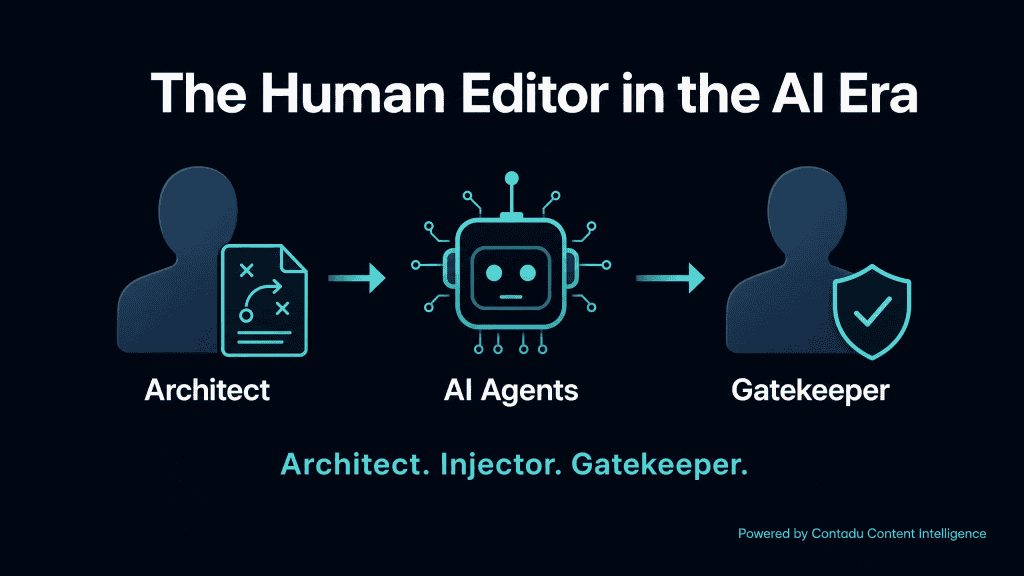
This does not mean the human is obsolete. It means the human is elevated. The editor’s focus shifts from syntax to substance. We break this new role down into three core responsibilities: The Architect, The Injector, and The Gatekeeper.
1. The Architect (Pre-Generation)
In the old model, editors gave writers a brief and hoped for the best. In the AI model, the editor programs the AI.
Before a single word is generated, the human editor acts as the Architect. They use automated briefing tools to analyze the SERP, but they apply human judgment to the results. They decide which competitor headings to ignore, which semantic entities are crucial for the brand’s specific narrative, and what the overarching “hot take” of the article should be.
The Architect also feeds the AI the necessary context: proprietary research, transcripts from SME (Subject Matter Expert) interviews, and specific brand voice guidelines. The quality of the AI output is directly proportional to the quality of the architecture provided by the human.
2. The Injector (Information Gain)
AI is fundamentally a synthesis engine. It reads what already exists on the internet and predicts the most statistically likely next word. It cannot, by definition, create net-new information.
This is where the human editor becomes indispensable. The editor acts as the Injector of Information Gain. Once the AI generates the baseline draft, the human editor reviews it and asks: “What can we add to this that no one else has?”
They inject proprietary data points. They add nuanced, contrarian opinions. They insert specific case study examples from their own customer base. They turn a generic “best practices” paragraph into a highly specific, actionable framework. This is the difference between content that exists and content that ranks.
3. The Gatekeeper (AI Search Optimization)
Finally, the editor acts as the Gatekeeper. They are not checking for typos; they are checking for AI extraction readiness.
They ensure the article follows the Inverted Pyramid Method. They review the H2s to ensure they are phrased as clear questions or statements. They rewrite key paragraphs into Quotable Statements to increase the likelihood of being cited by ChatGPT or Perplexity.
The Gatekeeper ensures that the content is not just readable by humans, but structurally optimized for the machines that will serve it to those humans.
The “Human-in-the-Loop” Workflow.
To visualize this, compare the traditional workflow to the modern Human-in-the-Loop workflow:
Traditional Workflow (Hours/Days):
Keyword Research → Manual Briefing → Human Drafting → Human Editing (Syntax/Grammar) → Publishing.
AI-First Workflow (Minutes/Hours):
Algorithmic SERP Analysis → Human Architecting (Strategy/Context) → Agentic AI Drafting → Human Injecting (Information Gain) → Human Gatekeeping (GEO/Fact-Checking) → Publishing.
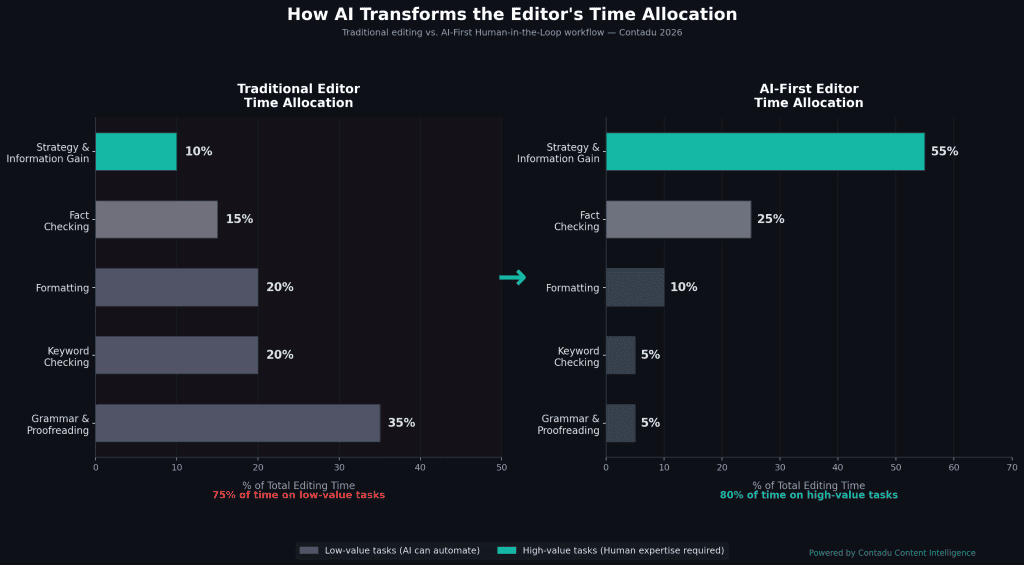
In the AI-first workflow, the human spends less total time on the article, but 100% of that time is spent on high-value, strategic tasks that the AI cannot perform.
How Contadu Empowers the Human Editor.
Transitioning to an AI-first workflow requires a platform that treats the human editor as the orchestrator, not an afterthought. Contadu is built specifically for the Human-in-the-Loop model.
Centralized Context Management
Contadu allows the editor (The Architect) to set project-level guidelines, brand voice parameters, and target entities before generation begins. You don’t have to copy and paste prompts; the AI agents automatically inherit the strategic context you define.
Real-Time Entity Scoring
As the editor (The Injector) adds proprietary insights and SME quotes to the AI-generated draft, Contadu NLP engine provides real-time feedback. You can see exactly how your human edits are impacting the article’s Entity Salience and overall optimization score, ensuring your additions improve the SEO value.
Built for Information Gain
Contadu Content Strategy module highlights exactly what topics your competitors are covering. This gives the human editor a clear roadmap for Information Gain: you can easily see what the AI must cover to compete, and where the human should inject unique insights to stand out.
Contadu doesn’t replace the human editor; it gives them a superpower. It removes the drudgery of manual research and syntax checking, allowing editors to focus entirely on strategy, originality, and thought leadership.
FAQ
Q: If AI writes the draft, won’t all our content sound the same?
A: It will only sound the same if you use generic prompts and skip the “Injector” phase. The human editor’s primary job is to inject the brand’s unique voice, proprietary data, and specific SME insights into the AI-generated baseline. This ensures the final piece is distinct and authoritative.
Q: How much time should an editor spend on an AI-generated draft?
A: While a manual edit of a human-written draft might take 2 hours, editing an AI draft typically takes 20 to 40 minutes. However, this time is spent entirely on strategic enhancement (Information Gain, formatting for GEO, fact-checking) rather than fixing grammar and flow.
Q: Do human editors need to learn how to write complex AI prompts?
A: Not if you use the right platform. While prompt engineering is a useful skill, platforms like Contadu abstract the complexity away. Editors manage the strategy via intuitive interfaces (selecting entities, defining tone, adding context docs), and the platform translates that into the complex prompts required by the underlying AI agents.
Q: What is the biggest mistake teams make when transitioning to AI content?
A: The biggest mistake is removing the human from the loop to save money. Publishing raw, unedited AI output (“AI slop”) damages brand trust, fails to rank due to lack of Information Gain, and offers zero Entity Salience. The goal of AI is to scale the human’s strategic output, not to replace it.
Q: How does the human editor ensure the AI doesn’t hallucinate facts?
A: Fact-checking is a critical part of the “Gatekeeper” role. Editors must verify any statistics, dates, or technical claims generated by the AI. Providing the AI with a strict context document (e.g., your own whitepapers or API docs) during the Architect phase drastically reduces the risk of hallucinations.
Q: Can AI replace Subject Matter Experts (SMEs)?
A: Absolutely not. AI is a synthesizer, not an expert. The most effective workflows involve the human editor interviewing an SME, and then feeding that transcript to the AI to generate the draft. The SME provides the original thought; the AI provides the structure and prose.
Q: How does this workflow impact the hiring of content professionals?
A: Companies are shifting their hiring focus. Instead of hiring entry-level freelance writers to produce volume, they are hiring senior content strategists and experienced editors who understand SEO, GEO, and how to orchestrate AI tools to produce high-quality thought leadership at scale.
