
How to Write Quotable Statements That AI Engines Extract · Contadu.
📍 Semantic Summary
The Idea: In the era of Generative Engine Optimization (GEO), AI Answer Engines (like ChatGPT and Perplexity) do not just link to your content; they extract it and serve it directly to the user. To control the narrative and secure brand attribution, content marketers must engineer specific, highly extractable sentences known as Quotable Statements.
The Challenge: B2B writers often use passive voice, complex clauses, and vague industry jargon. When an AI crawler parses these long, meandering paragraphs, it struggles to extract a definitive fact, leading it to either hallucinate an answer or pull a clearer statement from a competitor.
The Summary: A Quotable Statement is a standalone, definitive, and entity-rich sentence designed specifically for AI extraction. This guide breaks down the syntax, placement, and strategy of writing statements that LLMs can easily parse, synthesize, and cite as authoritative sources.
Read the full guide below, or explore related topics:
- Structuring Content for AI Extraction: The Inverted Pyramid Method
- GEO 2.0: Advanced Tactics to Get Cited by AI Engines
- The Role of Digital PR in LLM Visibility
Imagine you are a journalist writing a front-page story on a tight deadline. You interview a CEO for an hour. During that hour, the CEO rambles, uses corporate buzzwords, and speaks in paragraphs. But for exactly five seconds, the CEO looks at you and delivers a sharp, profound, ten-word sentence.
Which part of the interview makes it into the article?
Large Language Models (LLMs) operate exactly like that rushed journalist. When a Retrieval-Augmented Generation (RAG) system scans your 2,000-word blog post to answer a user’s prompt, it is looking for the soundbite. It is looking for the Quotable Statement.
What is a Quotable Statement?
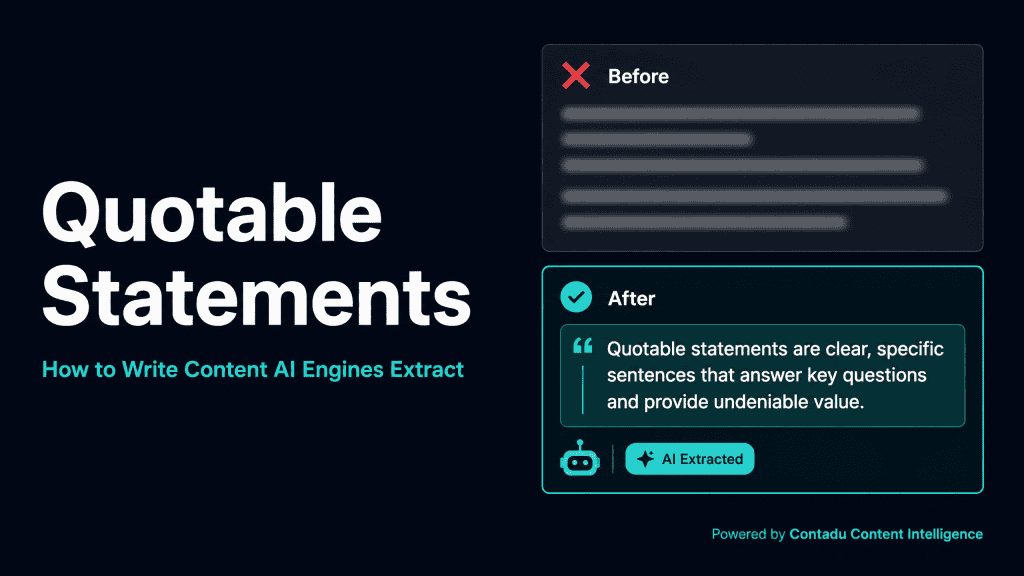
A Quotable Statement is a deliberately engineered sentence that encapsulates a core fact, statistic, or strong opinion in a format that an AI can extract without losing context.
In traditional SEO, we optimized for keywords to help search engines understand the topic of a page. In GEO, we optimize syntax to help AI engines extract the answer from the page.
The Anatomy of a Perfect AI Quote
An AI-optimized statement must possess three characteristics:
- Self-Contained Context: It must make perfect sense even if extracted and read completely out of context. It cannot rely on pronouns referring to previous sentences.
- Entity Density: It must explicitly name the subject, the object, and the relationship between them.
- Declarative Tone: It must state a fact or a strong stance using active voice. AI engines prefer certainty over ambiguity.
Before & After: Engineering the Statement.
Let’s look at how a typical B2B writer drafts a paragraph, and how a GEO-focused writer engineers a Quotable Statement.
Example 1: The Definition
The Traditional Way (Poor Extraction):
“When looking at the modern search landscape, it’s clear that things are changing. This new approach, which many are calling GEO, is basically about optimizing your site so that ChatGPT and other bots can read it better than before.”
The Quotable Statement (High Extraction):
“Generative Engine Optimization (GEO) is the technical practice of structuring digital content so that AI Answer Engines, such as ChatGPT and Perplexity, can easily extract, synthesize, and cite the information.”
Why it works: It defines the exact entity (GEO), lists specific related entities (ChatGPT, Perplexity), and provides a definitive, standalone definition.
Example 2: The Statistic
The Traditional Way (Poor Extraction):
“We ran a survey last month with our users. The data showed a massive drop in organic clicks. In fact, they went down by almost 60% for most informational queries.”
The Quotable Statement (High Extraction):
“According to a Q3 2026 Contadu industry report, organic click-through rates for informational search queries have decreased by 61% due to the rise of zero-click AI answers.”
Why it works: It names the source (Contadu), the exact metric (61%), the context (informational queries), and the cause (zero-click AI answers) in a single, extractable sentence.
Where to Place Quotable Statements.
Writing the perfect statement is only half the battle; placement is equally critical. As discussed in our guide on the Inverted Pyramid Method, AI crawlers prioritize the top of the document.
- The Semantic Summary: Your primary Quotable Statement (usually the definition or the core thesis) must be in the first 100 words of the article.
- Directly Under H2 Subheadings: When an AI scans a document, it uses H2s as a map. The very first sentence immediately following an H2 should be a Quotable Statement that directly answers the premise of that subheading.
- In Executive Quotes: If you are quoting your CEO or a subject matter expert, do not quote them saying something generic. Script a Quotable Statement for them. LLMs frequently attribute strong opinions to named experts.
The Role of Formatting in AI Extraction.
You can use HTML formatting to signal to the AI crawler that a specific sentence is important.
Bold Text for Entities: Bolding the core Entities within your statement helps the NLP algorithm identify the subject of the sentence faster. Do not bold entire paragraphs; only bold the specific noun phrases you want the AI to associate.
Blockquotes: Using the `<blockquote>` HTML tag is a strong semantic signal. While traditionally used to quote others, in 2026, savvy marketers use blockquotes to highlight their own core thesis statements, explicitly serving them up for AI extraction.
Conclusion: Stop Writing, Start Engineering.
In the age of AI search, writing beautifully is no longer enough. You must write systematically. By mastering the art of the Quotable Statement, you transition from being a content creator to a knowledge engineer.
When you feed LLMs the exact syntax they are programmed to extract, you stop hoping for visibility and start commanding it.
FAQ
Q: Do Quotable Statements make the content sound robotic to human readers?
A: Not if used correctly. A Quotable Statement provides clarity. Human readers appreciate clear, definitive answers just as much as AI engines do. You can use the surrounding paragraphs to add conversational tone and nuance.
Q: How many Quotable Statements should I have in one article?
A: Aim for one primary statement at the very top (the Semantic Summary), and one secondary statement immediately following each major H2 subheading. For a 1,500-word article, 4 to 6 engineered statements is optimal.
Q: Can I use jargon in a Quotable Statement?
A: Only if it is a widely recognized industry Entity. Avoid proprietary marketing fluff (e.g., “synergistic paradigm shifts”). Use precise, universally understood terminology so the AI can map it to its existing Knowledge Graph.
Q: How does Contadu help me write Quotable Statements?
A: Contadu’s content intelligence platform analyzes your text for Entity Salience and structural clarity. It helps you identify vague sentences and suggests ways to tighten them into highly extractable, entity-dense statements.
Q: Will an AI engine always quote me verbatim?
A: Not always. LLMs synthesize information. However, if your statement is highly concise and factual, the AI is much more likely to use it verbatim (or very close to it) and cite you as the primary source, rather than attempting to paraphrase a messy paragraph.
Q: Are bullet points considered Quotable Statements?
A: Yes, bulleted lists are highly extractable data structures. A strong H2 followed by a concise, parallel-structured bulleted list is one of the most effective ways to feed data to a RAG system.
Q: What is the difference between a Quotable Statement and a Featured Snippet?
A: They are structurally similar. A Featured Snippet was designed for Google’s extractive algorithm. A Quotable Statement is the evolution of that concept, designed for generative synthesis across multiple LLMs (ChatGPT, Claude, Perplexity), focusing heavier on entity density and context independence.