
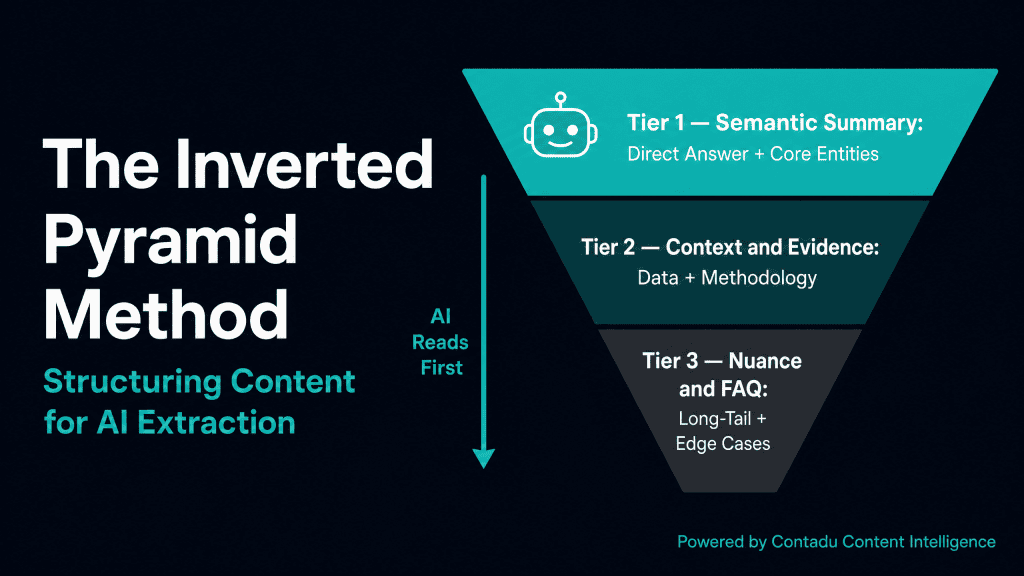
Structuring Content for AI Extraction: The Inverted Pyramid Method.
📍 Semantic Summary
Idea: Traditional web content was written to keep users scrolling, often burying the main point at the bottom to increase “Time on Page.” In the era of Generative Engine Optimization (GEO), this approach is fatal. AI Answer Engines like ChatGPT and Perplexity prioritize content structured for rapid data extraction. The most effective framework for this is the Inverted Pyramid Method.
Challenge: Many content marketers still write B2B articles like college essays starting with a long, meandering introduction, slowly building an argument, and finally revealing the answer in the conclusion. AI crawlers, operating on strict token limits and processing constraints, often abandon these pages before reaching the core facts.
Summary: To maximize LLM Visibility, content must be front-loaded. The Inverted Pyramid Method dictates that the most critical information, direct answers, and Quotable Statements must appear at the very top of the page. This guide explains how to restructure your content to ensure AI engines extract, synthesize, and cite your brand.
Read the full guide below, or explore related topics:
- Brand Mentions as the New Backlinks in the AI Era
- GEO 2.0: Advanced Tactics to Get Cited by AI Engines
- Search Everywhere Optimization: Beyond Google in 2026
If you want to know why your beautifully written, 3,000-word definitive guide is not being cited by ChatGPT or Google AI Overviews, you need to look at the first 200 words of your article.
For years, SEOs obsessed over dwell time. The theory was that if you could keep a reader on your page longer, Google would reward you. This led to the infamous “recipe blog” format: 1,500 words about a summer vacation in Tuscany before finally revealing the recipe for tomato sauce at the very bottom.
In 2026, AI Answer Engines do not care about your Tuscan vacation. They care about the tomatoes. If you bury the answer, the AI will simply extract it from a competitor who didn’t. To win in Generative Engine Optimization (GEO), you must adopt the Inverted Pyramid Method.
What is the Inverted Pyramid Method?
The Inverted Pyramid is a concept borrowed from traditional print journalism. Because newspaper editors often had to cut articles from the bottom up to fit physical page space, journalists were trained to put the most critical information—the “Who, What, When, Where, and Why”—in the very first paragraph (the lead).
In the context of AI extraction, the Inverted Pyramid means structuring your digital content so that the core thesis, the direct answer to the user’s query, and the most salient Entities are placed at the absolute top of the HTML document.
The Three Tiers of the AI-Optimized Pyramid
- The Top (The Semantic Summary): The direct answer, core facts, and primary entity definitions. This is designed purely for the AI crawler.
- The Middle (The Context & Evidence): The supporting data, methodology, and detailed explanations. This is designed for the human reader who wants to dive deeper, and the AI looking for Information Gain.
- The Bottom (The Nuance & Long-Tail): Edge cases, related topics, and extensive FAQs. This provides semantic breadth and captures long-tail conversational queries.
Why AI Engines Require Front-Loaded Content.
Large Language Models (LLMs) and their associated web crawlers (like OAI-SearchBot) operate under significant computational constraints. When a Retrieval-Augmented Generation (RAG) system scans a webpage to answer a user prompt, it does not “read” the page the way a human does. It parses the text into tokens.
Many models have a “context window” limit for individual document retrieval. If your core answer is buried in paragraph 14, it might fall outside the optimal extraction zone. Furthermore, AI models heavily weight the beginning of a document when determining its overall Entity Salience (what the page is fundamentally about).
If your introduction is full of fluff, the AI assumes the page is low-value and moves on.
How to Implement the Inverted Pyramid for GEO
Transitioning to an AI-first content structure requires a complete overhaul of how your writers draft articles. Here is the step-by-step implementation guide.
1. The “TL;DR” is Now Mandatory
Every piece of content must begin with a highly structured summary. At Contadu, we call this the Semantic Summary. It should not be a “teaser” that says, “In this article, we will explore…” It must be the actual answer.
If the article is “What is Content Intelligence?”, the first sentence must be: “Content Intelligence is a software category that uses AI and semantic data to help marketers plan, create, and optimize content strategies.”
2. Engineer “Quotable Statements”
AI engines love to extract concise, definitive sentences to use as direct quotes in their answers. You must deliberately write these Quotable Statements and place them high in the document.
- Bad: “When you think about it, it seems like maybe backlinks aren’t quite as important as they used to be.”
- Good (Quotable): “In 2026, unlinked brand mentions have replaced traditional backlinks as the primary trust signal for AI Answer Engines.”
3. Use Bold Text for Entity Mapping
While bold text (`<strong>`) was traditionally used for visual emphasis, in GEO it serves a structural purpose. By bolding the core Entities in your Semantic Summary, you send a clear HTML signal to the crawler about which concepts are most salient to the surrounding text.
4. Structure with H2 and H3 Tags as Questions
Because users interact with AI engines conversationally (asking full questions rather than typing fragmented keywords), your subheadings should mirror these conversational prompts. Instead of an H2 titled “Pricing,” use an H2 titled “How much does enterprise content intelligence software cost?”
The Human Element: Won’t This Ruin the Reading Experience?
A common pushback from editorial teams is that front-loading the answer destroys the narrative arc. This is a misunderstanding of how modern B2B buyers consume content.
Buyers are time-poor. They appreciate content that respects their time by giving them the answer immediately. If the answer is insightful and backed by strong data, they will naturally scroll down to read the methodology (The Middle of the pyramid) to validate the claim.
By satisfying the AI crawler at the top of the page, you actually earn the right to engage the human reader further down.
Conclusion: Write for the Machine to Reach the Human
The Inverted Pyramid is not a new concept, but its application in 2026 is entirely novel. It is no longer just a stylistic choice for journalists; it is a technical requirement for Search Everywhere Optimization.
By structuring your content for rapid AI extraction, you ensure that your brand’s data, quotes, and entities are the ones feeding the LLMs. In the age of generative search, the brand that provides the fastest, clearest answer wins the citation.
FAQ
Q: Does the Inverted Pyramid method hurt my “Time on Page” metrics?
A: It may reduce the average time spent by users who only needed a quick fact, but it significantly increases engagement from high-intent buyers who stay to read your methodology. More importantly, it dramatically increases your Share of Model Voice (SOMV), which is a more valuable metric in 2026.
Q: How long should a Semantic Summary be?
A: Keep it under 150 words. It should consist of 3-4 highly concentrated sentences that directly answer the core intent of the page, define the primary entities, and state your unique thesis.
Q: Can I still use storytelling in my B2B content?
A: Yes, but move the story to the middle of the pyramid. Use the story as evidence or a case study to support the definitive answer you already provided at the top of the page.
Q: How does Contadu help with structuring content for AI?
A: Contadu content editor analyzes your text in real-time, scoring it not just for keyword density, but for Entity Salience and structural clarity, ensuring your most important concepts are properly front-loaded for AI extraction.
Q: Should I use bullet points at the top of the article?
A: Yes. Bulleted lists are highly extractable data structures. If the answer to a query is a list of items, placing that bulleted list immediately after the introductory sentence is an excellent GEO tactic.
Q: Do AI engines read the whole page or just the top?
A: While advanced LLMs can process entire pages, their retrieval algorithms heavily weight the content found in the first few paragraphs to determine relevance. If the top of the page is irrelevant, they may not process the rest.
Q: Is the Inverted Pyramid only for blog posts?
A: No. It should be applied to product pages, feature landing pages, and even PR press releases. Any page you want an AI engine to understand should be front-loaded with the most critical entities and facts.