

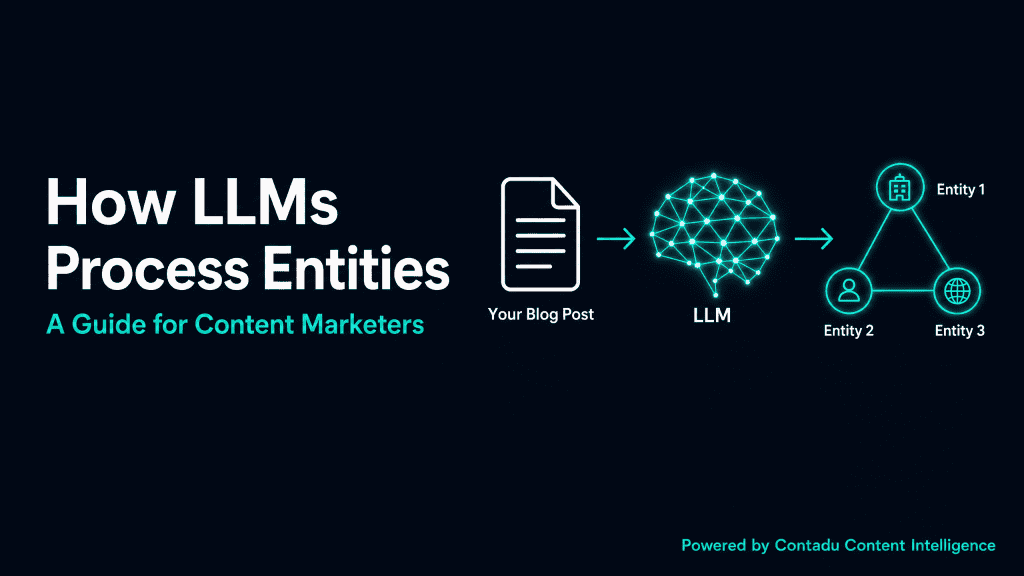
How LLMs Process Entities: A Guide for Content Marketers.
📍 Semantic Summary
Idea: To rank in AI answer engines like ChatGPT and Perplexity, you must understand how Large Language Models (LLMs) process text. They do not read keywords; they map entities in high-dimensional vector space.
Challenge: Content marketers are still writing for traditional search crawlers, focusing on keyword density and exact-match phrases. This approach fails to build the semantic relationships required for an LLM to recognize your brand as a credible source for a specific topic cluster.
Summary: By structuring your content around core entities, explicitly defining relationships using co-occurrence, and leveraging tools like Contadu, you can ensure your content is easily parsed, understood, and cited by the next generation of Generative Engine Optimization (GEO) systems.
Read the full guide below, or explore related topics:
- Co-Occurrence: The Hidden Ranking Signal You’re Ignoring
- GEO 2.0: Advanced Tactics to Get Cited by ChatGPT, Perplexity & Google AI Overviews
The shift from traditional search engines to AI-powered answer engines is not just a change in the user interface. It is a fundamental change in how information is processed, stored, and retrieved. If your content strategy is still built around “keywords,” you are speaking a language that modern search engines are rapidly forgetting.
To succeed in 2026, content marketers must understand how Large Language Models (LLMs) the technology powering tools like ChatGPT, Perplexity, and Google’s AI Overviews actually “read” text.
They do not read words. They read entities.
The Illusion of Keywords and the Rise of Semantic Understanding.
For two decades, SEO was relatively straightforward. You identified a string of characters (a keyword) that users typed into a search box, and you placed that exact string in your title tag, H1, and body copy.
This worked because early search engines were essentially advanced filing cabinets. They used lexical matching. If a user searched for “best CRM software,” the engine looked for pages containing the exact string “best CRM software.”
LLMs do not work this way. They do not care about the string of characters; they care about the meaning behind those characters. This transition marks the shift from lexical search to semantic search. In a semantic environment, the engine understands that “CRM,” “customer management system,” and “client database” all refer to the same underlying entity, even if the strings of characters are completely different.
This means that obsessing over exact-match keyword placement is not just outdated; it actively harms your content by making it read unnaturally to both human readers and the sophisticated NLP algorithms that evaluate content quality.
How LLMs Actually Work: Vector Space, Embeddings, and Dimensionality.
To understand how an LLM processes your blog post, you need to understand two concepts: Tokens and Vector Embeddings.
When an LLM reads a sentence, it first breaks it down into chunks called tokens. These tokens can be whole words, syllables, or even single characters. These tokens are then converted into numbers and mapped into a massive, multi-dimensional mathematical space (often with thousands of dimensions). This is called a vector embedding.
In this vector space, concepts that are semantically related are placed close together. The distance and direction between these vectors encode the relationships between the concepts.
For example, the vectors for “CRM,” “Salesforce,” “customer retention,” and “sales pipeline” will all be clustered tightly together in this multi-dimensional space. The vector for “apple” (the fruit) will be clustered near “banana” and “orchard,” while the vector for “Apple” (the company) will be clustered near “iPhone,” “Tim Cook,” and “technology.”
The LLM understands the difference between the fruit and the company not by looking at the word itself, but by analyzing the surrounding context—the other vectors that are present in the text. This is why context is king in modern SEO.
The Shift from Strings to Entities.
An entity is a distinct, well-defined concept. It can be a person, place, organization, abstract idea, or product.
When an LLM processes your content, it is not counting how many times you used a keyword. It is identifying the entities you are discussing and analyzing the mathematical distance between them in its vector space.
If you write an article about “B2B Marketing Automation,” the LLM expects to see related entities like “lead scoring,” “email drip campaigns,” “CRM integration,” and “conversion rates.” If these related entities are missing, the LLM determines that your content lacks depth, regardless of how many times you repeated the primary keyword.
The 3 Stages of LLM Entity Processing in AI Answer Engines.
When a user asks an AI engine a question, the system goes through a rapid process to generate an answer. Understanding this process is the key to Generative Engine Optimization (GEO).
Stage 1: Query Intent and Entity Extraction
When a user types, “What is the best CRM for a small marketing agency?”, the LLM does not search for that exact sentence. It extracts the core entities:
- Entity 1: CRM (Customer Relationship Management)
- Entity 2: Small Business
- Entity 3: Marketing Agency
It then identifies the intent: the user is looking for a recommendation or comparison based on specific constraints. It maps these extracted entities to its internal knowledge graph to understand the boundaries of the user’s request.
Stage 2: Retrieval (RAG) and Semantic Matching
Most modern AI search engines use Retrieval-Augmented Generation (RAG). Before generating an answer, they search their index (or the live web) for documents that are mathematically closest to the vector embedding of the user’s query.
This is where your content needs to win. If your article clearly defines the relationships between “CRM,” “Small Business,” and “Marketing Agency,” it will be retrieved as source material. The RAG system acts as a filter, pulling only the documents with the highest semantic relevance to the query’s core entities.
Stage 3: Synthesis, Hallucination Prevention, and Citation.
Once the LLM retrieves the most relevant documents, it synthesizes an answer. If your content provided clear, factual, and well-structured information about those entities, the LLM will use your data and (crucially) cite your website as the source.
During synthesis, the LLM actively tries to prevent hallucinations (making things up) by anchoring its generated text to the retrieved documents. This means that content with high Information Gain and clear entity relationships is far more likely to be used as the anchor text for the final AI-generated response.
How to Write for LLMs: 4 Actionable Strategies.
Knowing how LLMs process entities changes how you must approach content creation. Here is how to adapt your strategy.
1. Optimize for Co-Occurrence, Not Density
Co-occurrence is the frequency with which two entities appear near each other in a text. LLMs use co-occurrence to establish context and relationships.
Instead of repeating your main keyword, focus on including the natural ecosystem of related concepts. If you are writing about “Content Audits,” ensure you are also discussing “content decay,” “URL redirects,” “canonical tags,” and “Google Search Console.”
Actionable Tip: Use Contadu’s Content Intelligence to analyze top-ranking pages. The platform will show you exactly which related entities are expected by the algorithm for any given topic.
2. Define Relationships Explicitly
LLMs are smart, but explicit clarity reduces the cognitive load required to parse your content. Do not make the AI guess how two concepts are related; tell it directly.
- Bad: “Contadu is a great tool. Content strategy is important.” (The relationship is implied but weak).
- Good: “Contadu is a content intelligence platform that helps marketers build a data-driven content strategy.” (The relationship is explicitly defined).
3. Structure Data for Easy Parsing
LLMs love structure. They are trained on vast amounts of data, and structured data helps them understand the hierarchy of information.
- Use clear, descriptive H2 and H3 tags.
- Use bulleted lists for features or steps.
- Use tables to compare data points (LLMs excel at extracting facts from markdown/HTML tables).
- Implement Schema Markup (like FAQ or Article schema) to provide a machine-readable layer of context.
4. Optimize for Entity Salience
Entity Salience is a measure of how important an entity is to the overall meaning of a text. LLMs do not just identify entities; they rank them by importance.
If you write a 2,000-word article about “Email Marketing” and mention “Mailchimp” once in passing, “Mailchimp” has low salience. If you dedicate a specific H2 section to “Integrating Mailchimp with Your CRM,” the salience of that entity increases dramatically.
To increase the salience of your core entities, place them in prominent positions: H1s, H2s, the first paragraph, and within structured data like tables or lists.
5. Focus on Information Gain
LLMs are trained to provide the most comprehensive and useful answer. If your article simply regurgitates the same points found on the first page of Google, it offers zero Information Gain.
To be cited by an AI engine, you must introduce new entities or novel relationships between existing entities. This could be proprietary data, a unique framework, or an expert quote that connects two previously unrelated concepts.
The Future of SEO: From Content Creation to Knowledge Engineering.
As LLMs become the primary interface for information retrieval, the role of the SEO professional is evolving. We are no longer just content creators or keyword researchers; we are knowledge engineers.
Our job is to construct a clear, accurate, and easily parsable knowledge graph for our brand. This requires a holistic approach that combines high-quality, entity-rich content with technical SEO elements like Schema Markup and strategic internal linking. Brands that fail to make this transition will find themselves invisible to the AI systems that their customers rely on.
The Role of Contadu in Entity Optimization.
Transitioning to an entity-first SEO strategy requires moving beyond traditional keyword research tools. You need tools that analyze semantic relationships.
Contadu is built specifically for this era of search. By analyzing the semantic structure of top-performing content, Contadu identifies the exact entities and topical clusters required to build comprehensive, authoritative content.
When you use Contadu’s Content Editor, you are not just checking off a list of keywords; you are ensuring your content covers the full semantic ecosystem expected by modern LLMs. This is how you transition from hoping for a keyword match to guaranteeing semantic relevance.
Frequently Asked Questions (FAQ)
What is the difference between a keyword and an entity?
A keyword is a specific string of characters a user types into a search bar (e.g., “apple watch price”). An entity is the actual concept or thing that string represents (e.g., the Apple Watch product, manufactured by Apple Inc., which has a specific cost). LLMs focus on the concept, not the exact spelling.
Do keywords still matter at all in 2026?
Yes, but their role has changed. Keywords are now just one way to signal an entity. You still want to use the terminology your audience uses, but your primary goal is comprehensive topical coverage, not hitting a specific keyword density percentage.
How do I find the related entities for my topic?
You can find related entities by analyzing Wikipedia pages (which are highly structured around entities), looking at Google’s “People Also Ask” sections, or using advanced semantic SEO tools like Contadu, which automatically extract the necessary semantic nodes for your topic.
How does RAG (Retrieval-Augmented Generation) affect content marketing?
RAG means that AI engines pull real-time information from the web to answer user queries. To be the source the AI pulls from, your content must be highly structured, factually accurate, and rich in the specific entities the AI is looking for to formulate its answer.
Is Schema Markup necessary for LLMs?
While LLMs are excellent at parsing unstructured text, Schema Markup (like JSON-LD) provides a direct, machine-readable map of the entities on your page. It acts as a cheat sheet for the AI, increasing the chances your content is understood and cited accurately.
Can I just use ChatGPT to write my content so it ranks in ChatGPT?
No. If you use an LLM to write generic content, it will lack Information Gain. AI engines prioritize citing sources that offer unique data, expert opinions, or novel insights that are not already present in their training data. Generic AI content is often ignored during the retrieval phase.
How do I measure success in an entity-first world?
Traditional rank tracking for specific keywords is becoming less reliable. Instead, measure success through “Share of Voice” in AI overviews, referral traffic from AI engines (like Perplexity), and overall organic traffic growth across a broad topic cluster, rather than individual keyword rankings.
