
Mapping Search Intent to Entities: A Practical Framework.
📍 Semantic Summary
Idea: Traditional keyword research maps search intent to isolated strings. In 2026, successful Semantic SEO requires mapping search intent directly to specific entities within a Knowledge Graph.
Challenge: Content creators often guess what users want based on keyword modifiers (like “best” or “how to”), leading to shallow content that fails to satisfy the complex, multi-layered intent required by AI answer engines and modern Google algorithms.
Summary: By analyzing the entities that co-occur in top-ranking SERPs for a given query, you can build a deterministic framework. This guide reveals how to map informational intent to conceptual entities, transactional intent to product entities, and how to use Contadu to automate this semantic mapping.
Read the full guide below, or explore related topics:
- Keyword Research in 2026: Beyond Search Volume
- SERP Intent Analysis: How to Read What Google Is Really Telling You
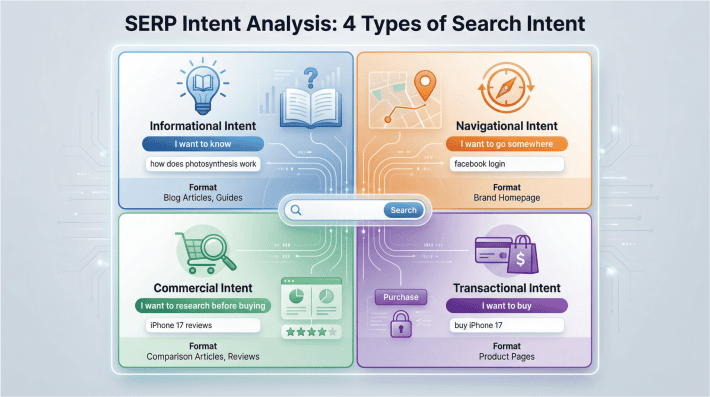
For years, SEO professionals have categorized search intent into four neat, tidy buckets: Informational, Navigational, Commercial, and Transactional. If a user searched for “best CRM,” it was commercial. If they searched for “what is a CRM,” it was informational.
You looked at the keyword modifier, picked a bucket, and wrote the article.
In 2026, this simplistic approach is fundamentally broken. Search intent is no longer just about why a user is searching; it is about what underlying entities they expect to find in the answer. If you do not map the user’s intent to the correct semantic entities, your content will not rank—no matter how many times you use the target keyword.
This is the shift from keyword-intent mapping to entity-intent mapping.
The Flaw in Keyword-Based Intent Mapping.
Let’s look at the query: “How to migrate from Salesforce to HubSpot.” Under the old model, this is an “Informational” query. A writer would draft a step-by-step guide focusing heavily on the keywords “migrate,” “Salesforce,” and “HubSpot.”
But what is the actual intent? The user isn’t just looking for information; they are looking for a solution to a complex technical problem involving specific software architecture.
If we look at this through an entity-first SEO lens, the required entities for this intent are not just the brand names. To satisfy the algorithm and the user, the content must deeply cover entities like:
- Data Mapping (Concept)
- API Limits (Concept)
- Custom Objects (Feature Entity)
- Downtime Mitigation (Strategy Entity)
If your article maps the intent only to the keyword “migration” but fails to include the entity “Data Mapping,” Google’s Natural Language Processing (NLP) models will determine that your content lacks topical depth. It does not satisfy the true semantic intent of the query.
The Intent-to-Entity Framework.
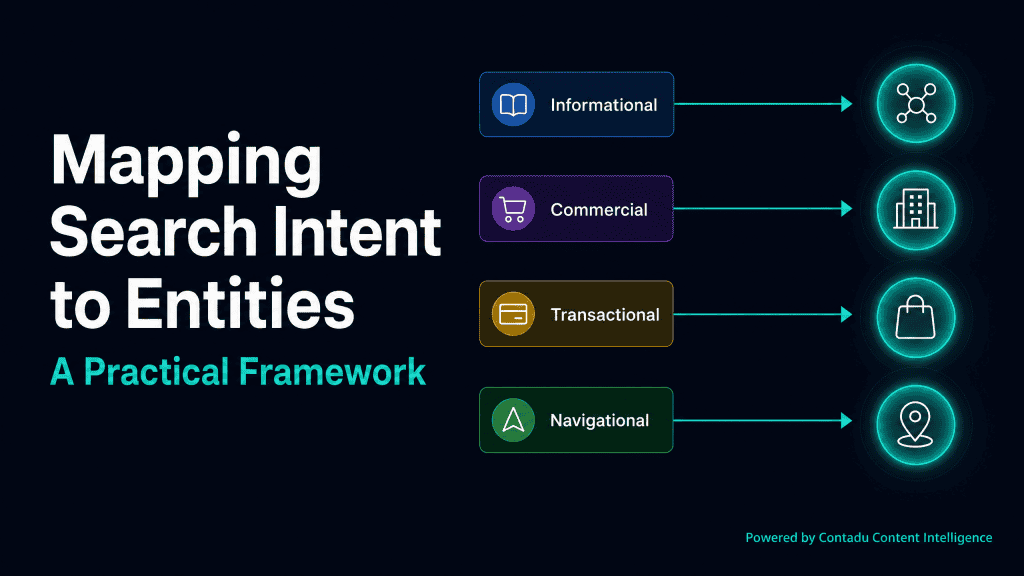
To rank in modern search, you must build a bridge between the user’s goal and the Knowledge Graph. Here is a practical framework for mapping the four traditional stages of intent to their required entity types.
1. Informational Intent ➔ Conceptual Entities.
When users are in the discovery phase (e.g., “What is Account-Based Marketing?”), they are looking to understand a broad concept.
The Mapping Strategy:
You must map this intent to foundational Conceptual Entities. Your content must define the core entity and immediately connect it to its most salient parent and child entities.
Required Entity Types:
- Definitional Entities: The exact parameters of the concept.
- Historical/Origin Entities: Where the concept came from (e.g., ITSMA in the context of ABM).
- Methodological Entities: The frameworks used to execute the concept (e.g., Ideal Customer Profile).
Actionable Tip: Do not just define the term. Build a semantic web that shows how this concept relates to the broader industry.
2. Commercial Investigation ➔ Comparative & Feature Entities.
When users are evaluating options (e.g., “Best email marketing software for startups”), their intent shifts from understanding a concept to evaluating specific attributes.
The Mapping Strategy:
Commercial intent must be mapped to Feature Entities and Comparative Entities. The algorithm is looking for content that juxtaposes specific attributes side-by-step.
Required Entity Types:
- Brand Entities: The specific competitors in the space.
- Feature Entities: Automation workflows, drag-and-drop builders, deliverability rates.
- Pricing/Tier Entities: Freemium, enterprise, per-seat licensing.
Actionable Tip: Use Schema markup (specifically ItemList or Comparison) to explicitly define these entities for the crawler, making it easy for AI answer engines to extract your comparisons.
3. Transactional Intent ➔ Product & Trust Entities.
When the user is ready to buy (e.g., “Buy Contadu enterprise license”), the intent is highly specific.
The Mapping Strategy:
Transactional intent requires mapping to exact Product Entities and, crucially, Trust Entities. The search engine wants to verify that the page can actually facilitate the transaction safely.
Required Entity Types:
- SKU/Product Entities: Exact product names, versions, and specifications.
- Trust/Security Entities: SOC2 compliance, SSL, money-back guarantees.
- Action Entities: “Add to cart,” “Book demo,” “Schedule consultation.”
Actionable Tip: Ensure your product pages utilize robust Product Schema markup, explicitly defining the price, availability, and aggregate ratings as distinct entities.
4. Navigational Intent ➔ Brand & Location Entities.
When a user searches for a specific brand or login page (e.g., “Contadu login”), they know exactly where they want to go.
The Mapping Strategy:
This is purely about Brand Entities and Organization Schema.
Required Entity Types:
- Organization Entities: Your company name, founders, headquarters.
- Portal/Access Entities: Login, support portal, documentation hub.
The Danger of Entity Misalignment.
One of the most common reasons well-written content fails to rank is entity misalignment. This occurs when the search intent demands one set of entities, but your content provides another.
Imagine a user searches for “enterprise SEO software.” The intent is clearly commercial. The user expects to see Feature Entities (API integrations, custom reporting, user permissions) and Brand Entities.
If your article instead focuses on Conceptual Entities (defining what enterprise SEO is, explaining why it is important), you have a severe entity misalignment. You have mapped an informational semantic structure to a commercial query.
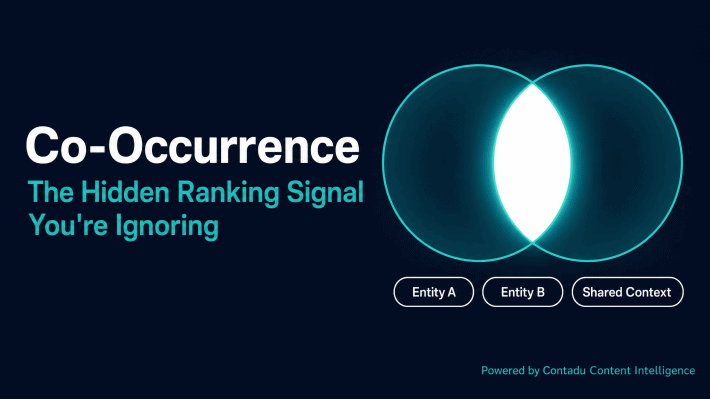
Google’s Natural Language Processing (NLP) models will instantly recognize this mismatch. They will see that your page lacks the co-occurrence of comparison and feature entities that exist on the top-ranking pages, and your content will be relegated to page 5.
To prevent this, you must audit the SERP before you write. Identify the dominant entity types on the pages that are currently winning. If the top 3 results are dense with Feature Entities, your content must also be dense with Feature Entities, but with a higher Information Gain Score.
How to Automate Entity Mapping with Contadu.
Manually mapping search intent to dozens of required entities is nearly impossible to do at scale. You would have to manually analyze the top 10 SERP results, run them through an NLP API, and extract the overlapping terms.
Contadu automates this entire framework through Content Intelligence.
1.Enter your Target Concept: Instead of just a keyword, you enter your core topic.
2.Semantic SERP Analysis: Contadu instantly analyzes the top-ranking pages, not just for keyword density, but for Entity Salience and Co-Occurrence.
3.Intent-Entity Blueprint: The platform generates a comprehensive brief. It tells you exactly which Conceptual Entities are required for informational queries, or which Feature Entities are missing from your commercial comparison pages.
4.Real-Time Scoring: As you write, Contadu scores your content based on how well you have mapped the required entities to the established intent of the SERP.
The Future of Intent.
As Generative Engine Optimization (GEO) becomes more prevalent, AI models like ChatGPT and Perplexity will rely entirely on entity relationships to answer user queries. They do not read keywords; they traverse Knowledge Graphs.
By shifting your strategy from keyword-intent mapping to entity-intent mapping, you future-proof your content. You stop guessing what words the user might type, and start providing the exact semantic concepts the algorithms require to formulate an answer.
FAQ
What is the difference between a keyword and an entity in the context of search intent?
A keyword is a specific string of letters a user types into a search bar. An entity is a uniquely identifiable concept, person, place, or thing that has distinct relationships with other concepts. Intent mapping to keywords focuses on matching words; intent mapping to entities focuses on matching comprehensive concepts.
How do I know which entities are required for a specific search intent?
The most reliable method is to analyze the co-occurrence of terms in the content that currently ranks in the top 3 positions for that query. Tools like Contadu automate this by using NLP to extract the most salient entities from top-ranking pages and presenting them as a required semantic checklist.
Can a single page satisfy multiple intents by including different types of entities?
Yes, this is often called “Fractured Intent.” A comprehensive pillar page might start by mapping to Conceptual Entities (Informational) and then transition into mapping Feature Entities (Commercial). However, it is usually more effective to target one primary intent per page to maintain high Entity Salience.
How does Schema markup help with entity-intent mapping?
Schema markup acts as a direct translation layer for search engines. If you are targeting Commercial intent, using Comparison or Review Schema explicitly tells the algorithm that the entities on your page are structured to help a user evaluate options, perfectly aligning with their intent.
Does entity mapping replace traditional keyword research?
No, it evolves it. You still need to know what terms users are searching for (search volume) to identify opportunities. However, once you select a topic, you use entity mapping to dictate how you write the content, rather than just stuffing the keyword into the text.
Why is my “Ultimate Guide” not ranking even though it covers the topic?
If an Ultimate Guide fails to rank, it is usually because it lacks topical depth. It might be 3,000 words long, but if it misses the critical secondary and tertiary entities that Google’s Knowledge Graph associates with that topic, the algorithm will deem it superficial and rank shorter, more semantically dense pages above it.
How do AI Answer Engines like Perplexity use entity mapping?
AI Answer Engines do not retrieve documents based on keyword matching. They parse the user’s prompt to identify the core entity and the desired intent, then traverse their internal Knowledge Graphs to find documents that exhibit high Entity Salience and strong co-occurrence for those exact concepts to generate a synthesized answer.