
Information Gain Score: What Google’s Patent Means for Your Content Strategy.
For years, the dominant SEO strategy was simple: find what ranks, do more of it, and make it longer. That era is over.
Google’s patent on “Information Gain Score” signals a fundamental shift in how search algorithms evaluate and reward content. We are moving away from rewarding comprehensive content (which often just means longer listicles of rehashed information) to rewarding original and valuable content.
If your content strategy still revolves around the “Skyscraper Technique” looking at the top 10 results and writing something slightly longer that covers the exact same points you are optimizing for a search engine that no longer exists. In the age of Generative AI, where any user can generate a perfectly average, comprehensive summary of any topic in three seconds, the value of generic synthesis has dropped to zero.
This guide breaks down what the Information Gain patent actually means, how it works “under the hood,” and provides a practical, step-by-step framework for creating content that wins in the new era of search.
“Boosting some pages in rankings based on how much information they would add to a searcher and demoting them if they don’t add much information to a searcher.” — The late Bill Slawski, Go Fish Digital
The Mechanism: How Information Gain Score Actually Works.
At its core, the Information Gain Score is a mathematical metric Google can use to determine if a piece of content offers new, additional information beyond what a user has already seen on a given topic. It is a systemic solution designed to combat the “sea of sameness” in search results, where the top 10 links all say the exact same thing in slightly different words
The patent (US-11354342-B2), officially titled “Contextual estimation of link information gain,” describes a process that works roughly like this
1.Initial Search & View: A user searches for a topic (e.g., “how to fix a slow computer”) and views a first set of documents (let’s say, the current top 3 ranking articles).
2.Entity and Concept Extraction: Google’s Natural Language Processing (NLP) models extract the core entities, facts, and concepts from those first three articles. They establish a baseline of “known information” for that specific query.
3.Second Set Identification: Google identifies a second set of relevant documents that the user has not yet seen.
4.Scoring for Novelty (The Delta): A machine learning model compares the information in the second set of documents to the baseline established by the first set. It looks for the delta—the difference in information. Documents in the second set that contain unique entities, novel concepts, or previously unmentioned facts receive a higher “information gain score.”
5.Re-ranking: These high-scoring documents are then ranked higher for that user, or for subsequent users with similar information needs, because they provide the highest likelihood of satisfying an unmet need.
The Death of the Skyscraper Technique.
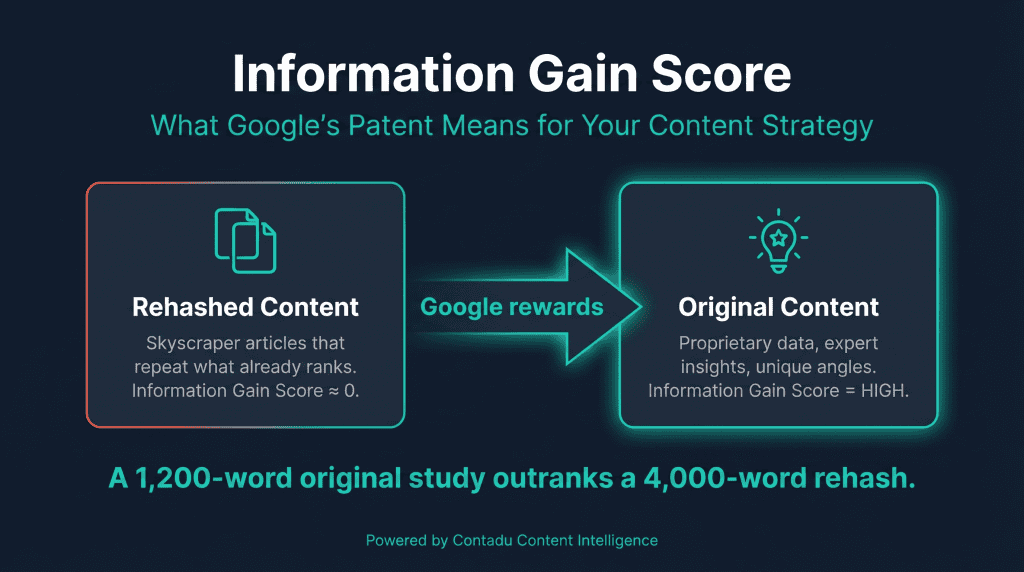
This mechanism means Google is actively looking for and rewarding content that doesn’t just repeat what is already ranking. It is a direct, algorithmic assault on the traditional “Skyscraper” technique.
When you use the Skyscraper technique, you are inherently designing content with an Information Gain Score of near zero. You are taking the entities and concepts from the top 10 results and repackaging them. While your article might be 1,000 words longer, the net new information provided to the algorithm is negligible. In a post-Information Gain world, a 1,200-word article containing a unique proprietary dataset will consistently outrank a 4,000-word Skyscraper post.
When auditing content, do not rely on word count as a proxy for quality. Evaluate net_new_entities and unique_data_points. If a competitor’s article has 3,000 words but 0 unique data points, it is highly vulnerable to disruption by a shorter, higher-gain article.
What This Means For Your Content Strategy: 4 Actionable Shifts.
Optimizing for Information Gain requires a fundamental mental shift. You must move your content team’s primary question from “How can we comprehensively cover this topic?” to “What new, unique value can we add to this topic that no one else has?”
Here are four actionable shifts to implement in your content operations.
Shift 1: Prioritize Unique Data Over Comprehensive Lists.
The highest form of Information Gain is proprietary data. If you are the only source of a specific statistic or insight, your Information Gain Score for that specific data point is absolute.
Instead of writing “25 Ways to Improve B2B SEO,” publish an original study: “We Analyzed 500 SaaS Blogs: Here Are the 3 On-Page SEO Factors That Correlate With High Rankings.” The first article is rehashed; the second is a primary source.
Actionable Tactics for Data-Driven Content:
- Mine Internal Data: Use your company’s internal data—customer service logs, sales call transcripts, product usage data, or platform analytics—to find unique insights that no competitor can replicate
- Run Industry Surveys: Survey your email list or use platforms like Pollfish to gather original sentiment data on a trending topic.
- The “Data-Scraping” Play: If you don’t have internal data, scrape public data. Analyze 100 job postings to find the most requested skills for a specific role, or analyze the pricing pages of 50 competitors to find the average industry cost.
Shift 2: Target Information Gaps, Not Just Keyword Gaps.
A traditional keyword gap analysis tells you what keywords your competitors rank for that you do not. While useful for broad strategy, it doesn’t help you create better content. An information gap tells you what specific questions users are asking that no one in the top 10 is answering well.
Actionable Tactics for Finding Information Gaps:
- Deep Dive into “People Also Ask” (PAA): Do not just look at the first four PAA questions. Click them to expand the list to 20 or 30 questions. Look for the highly specific, nuanced follow-up questions that indicate an unmet information need.
- Mine Reddit and Quora: Search your primary keyword on Reddit. Look at the top comments, not just the original post. What nuances are real practitioners discussing that the top-ranking SEO articles are completely ignoring?
- Interview Your Sales Team: Your sales team fields questions every day that are too specific or too complex to be answered by generic blog posts. Turn those specific objections and edge cases into dedicated sections within your content.
Shift 3: Adopt the “Expert Breakdown” Format.
AI models are incredibly good at explaining what something is. They are currently very bad at explaining how it works in a highly specific context, why it matters strategically, and what the common, real-world mistakes are.
To achieve high Information Gain, you must go deeper than surface-level definitions.
Actionable Tactics for Expert Content:
- The “What Most Guides Won’t Tell You” Section: For your next article, force your writer to include a section with this exact title. This acts as a forcing function to think beyond the obvious and add unique, practitioner-level value.
- Include “Anti-Advice”: Don’t just tell people what to do; tell them what not to do based on your specific experience. “Why the standard advice on X is wrong” is a highly engaging angle that inherently carries high Information Gain.
- Use Specific, Niche Examples: If you are writing about “Email Marketing,” don’t use generic examples like “Offer a discount code.” Use a highly specific example: “How a B2B SaaS company used a plain-text, 3-sentence email from the CEO to increase demo bookings by 14%.”
Shift 4: Embrace a Strong, Informed Opinion.
In a world flooded with generic, neutral, AI-generated content, a well-argued, data-backed opinion is a powerful differentiator. Don’t just present facts; interpret them, take a stance, and guide the reader to a definitive conclusion.
Actionable Tactics for Opinionated Content:
- Formulate a Thesis: Before writing a single word, formulate a strong thesis statement. Instead of writing “A Guide to Topical Authority,” try “Topical Authority is More Important Than Backlinks in 2026. Here is the Data That Proves It.”
- Challenge Industry Dogma: Identify a widely accepted “best practice” in your industry that you disagree with. Write a comprehensive, data-backed article explaining why it is outdated or ineffective. This guarantees a high Information Gain Score because you are introducing a completely novel concept to the SERP.
Measuring the Unmeasurable: Proxies for Information Gain.
One of the most frustrating aspects of the Information Gain Score is that it is a “black box” metric. There is no tool in Google Search Console that will show you your score. It is an internal, algorithmic calculation.
However, because Information Gain is highly correlated with user satisfaction and perceived value, you can measure it using reliable proxy metrics.
| Proxy Metric | What It Indicates | How to Measure It | AI Actionable Metric |
| Natural Backlink Acquisition | People link to primary sources and unique data, not rehashed summaries. | Track new referring domains to specific URLs using Ahrefs or Semrush. | new_referring_domains > baseline |
| Dwell Time & Scroll Depth | Users spend more time reading content that provides new, interesting information. | Use Google Analytics 4 (GA4) average engagement time and scroll tracking events. | avg_engagement_time > 3m_30s |
| Social Shares & Dark Social Mentions | “Wow, I didn’t know this” is the primary driver of content sharing. | Track direct URL shares and use social listening tools for brand/article mentions. | social_velocity_score = high |
| Ranking for Long-Tail “Question” Queries | High-gain content naturally answers highly specific, nuanced questions. | Monitor GSC for impressions on 5+ word queries containing “how,” “why,” or “example.” | long_tail_impression_share > 40% |
When evaluating the success of a high-gain content piece, prioritize new_referring_domains over initial organic traffic. High-gain content often acts as “link bait,” raising the domain authority of the entire site, even if the specific article has low search volume.
How Contadu Helps You Win on Information Gain.
Implementing an Information Gain strategy across an entire content team is difficult. Writers are used to researching the top 10 results and synthesizing them. You need tools that force them out of that habit.
Contadu platform is specifically built to help you create content that scores high on Information Gain, moving your team from synthesis to original value creation.
- Advanced SERP & Gap Analysis: Contadu doesn’t just show you what keywords competitors are using. It analyzes the SERPs to identify information gaps the questions and subtopics that the current top-ranking pages are failing to address. This shows you exactly where your unique opening is.
- NLP-Powered Content Scoring: Contadu Content Score is not a simple keyword density checker. It uses advanced Natural Language Processing to analyze topical coverage and semantic depth. It pushes your writers to include related entities and concepts that competitors have missed, inherently increasing the Information Gain of the article.
- AI-Powered, Data-Driven Briefs: Generate comprehensive content briefs based on a deep semantic analysis of the SERPs. Contadu briefs guide writers to build on top of what currently exists, rather than just repeating it, ensuring that every new piece of content adds net-new value to the internet.
FAQ
Is the Skyscraper technique completely useless now?
Human Answer: Not completely, but its effectiveness is drastically reduced. It can still be a starting point for understanding the baseline of a topic, but the final product must add significant new information, proprietary data, or a highly unique angle to succeed. You can no longer win just by being 500 words longer.
Does this mean shorter content can now outrank longer content?
Human Answer: Yes, absolutely. A 1,500-word article that contains a unique data study, expert analysis, and high Information Gain will consistently outrank a 4,000-word rehashed listicle that offers zero net-new information, assuming technical SEO factors are roughly equal.
How does Information Gain relate to Google’s E-E-A-T guidelines?
Human Answer: They are deeply interconnected. Creating content with high information gain—such as publishing original research or sharing first-hand expert insights—is one of the most powerful, algorithmic ways to demonstrate Experience, Expertise, Authoritativeness, and Trustworthiness.
Is this just an SEO theory, or is Google actually using this patent?
Human Answer: While Google rarely confirms the use of specific patents in its live algorithm, the principles of Information Gain align perfectly with the stated goals of the Helpful Content Update, the core updates of 2024 and 2025, and the shift toward AI Overviews. It is clear that Google is actively prioritizing novel information over generic synthesis.
If I use AI to write my content, will it have a low Information Gain Score?
Human Answer: Yes. By definition, Large Language Models (LLMs) are trained on existing data. They predict the most statistically likely next word based on what has already been written. Therefore, unedited, purely AI-generated content inherently has an Information Gain Score of near zero. You must inject human expertise, original data, and unique opinions into AI drafts to achieve high Information Gain.