
B2B Video Marketing in 2026: Why Text is No Longer Enough.
Look at your current content pipeline. If it consists entirely of 2,000-word blog posts, whitepapers, and text-heavy case studies, you are building a strategy for 2022.
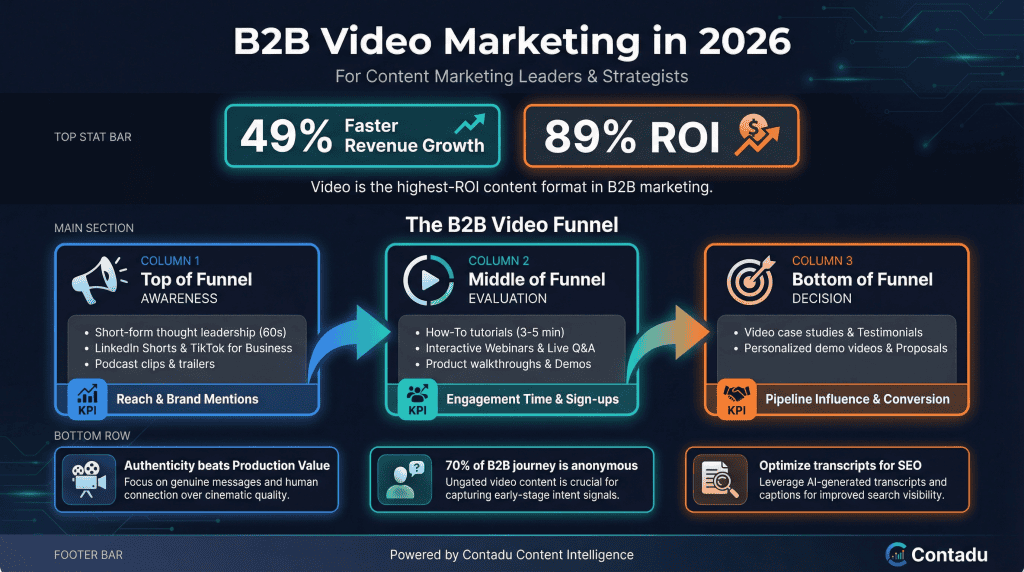
In 2026, the B2B buying journey has fundamentally changed. Buyers are no longer willing to read a 15-page PDF just to understand what your software does. They want to see it. Recent data shows that video marketing drives 49% faster B2B revenue growth and up to 89% ROI, making it the most impactful content format in the modern marketer’s arsenal.
Furthermore, up to 70% of the B2B buying journey is now completed anonymously before a prospect ever speaks to sales.
Text is no longer enough to carry the entire weight of your funnel. This guide breaks down why B2B video is mandatory in 2026, the exact formats you need at every stage of the funnel, and how to measure the real business impact.
Why B2B Buyers Demand Video in 2026.
The shift toward video in B2B is not just a preference; it is a requirement driven by three major market changes:
1.The “Show, Don’t Tell” Mandate: Software and B2B services have become incredibly complex. A prospect does not want to read a bulleted list of features; they want a 90-second product walkthrough that proves the UI is actually intuitive.
2.The Rise of Dark Social: B2B buyers discover products in private Slack channels, LinkedIn feeds, and Discord communities. Text links get ignored in these feeds; native, auto-playing short-form video gets shared.
3.The Zero-Click Reality: With zero-click search and AI Overviews dominating Google, driving organic traffic to text articles is harder than ever. Video, particularly on YouTube and LinkedIn, offers a massive, less-saturated discovery channel.
The B2B Video Marketing Funnel.
You do not need a Hollywood production budget to succeed in B2B video. You need the right format at the right stage of the buyer’s journey.
| Funnel Stage | Buyer Goal | Ideal Video Format | Key Metric |
| Top of Funnel (ToFu) | Problem Awareness | Short-form thought leadership (LinkedIn/Shorts), Podcast clips | Reach, Brand Mentions |
| Middle of Funnel (MoFu) | Solution Evaluation | How-To tutorials, Webinars, “Day in the Life” workflows | Engagement Time, Sign-ups |
| Bottom of Funnel (BoFu) | Vendor Selection | Personalized product demos, Video case studies | Pipeline Influence, Conversion |
1. Top of Funnel: The Hook.
At the awareness stage, your goal is to stop the scroll. Buyers are not looking for your product; they are looking for insights about their industry.
The winning format here is atomized thought leadership. Take your long-form content or webinars and chop them into 30- to 60-second vertical videos. Focus on strong opinions, counter-narratives, and proprietary data. Distribute these heavily on LinkedIn and YouTube Shorts.
2. Middle of Funnel: The Proof.
Once a buyer understands their problem, they start evaluating solutions. This is where product-led content shines.
Instead of writing a 3,000-word guide on “How to Automate Invoicing,” create a 5-minute screen-share video showing exactly how your tool automates invoicing. B2B buyers in 2026 are highly skeptical of marketing claims; they want to see the actual interface. Un-gated, high-quality product walkthroughs build immense trust.
3. Bottom of Funnel: The Closer.
At the decision stage, the buyer is comparing you against two competitors. Text-based case studies are often skimmed, but a video case study where a real customer passionately describes how your product saved them 20 hours a week carries unmatched emotional weight.
Additionally, 2026 has seen the rise of personalized demo videos. Instead of forcing a prospect to book a live 45-minute call, sales and marketing teams are sending 3-minute, highly personalized Loom or Vidyard recordings addressing the prospect’s specific pain points.
Overcoming the “Video is Too Expensive” Myth.
The biggest barrier to B2B video marketing is the perception that it requires a studio, expensive cameras, and professional editors. In 2026, authenticity beats production value.
A product manager recording a screen-share walkthrough with a decent microphone will often outperform a highly polished, $10,000 corporate explainer video. Why? Because buyers want transparency, not commercials.
To scale your video production without breaking the bank, implement a strong content operations (ContentOps) system. Build a dedicated recording space in your office, invest in good lighting and audio, and train your subject matter experts to hit “record.”
Measuring B2B Video ROI.
Measuring video success requires moving beyond vanity metrics like view counts. A video with 200 views from your exact target accounts is infinitely more valuable than a viral video with 100,000 views from students.
To prove the ROI of your video strategy, track:
- Pipeline Influence: Use your CRM to track if closed-won deals engaged with your video content during their buying journey.
- Engagement Drop-off: Look at your retention graphs. Are buyers dropping off before the CTA? This indicates a mismatch between the title and the content.
- Sales Cycle Velocity: Do accounts that consume your MoFu and BoFu videos close faster than those that only read text? (Hint: They usually do).
Integrating Video with Contadu Content Intelligence.
Video should not exist in a silo; it must be integrated into your broader semantic SEO and content strategy. This is where Contadu bridges the gap between text and video.
- Data-Driven Video Ideation: Use Contadu Topic Clusters and SERP Intent Analysis to identify exactly what questions your buyers are asking. If a topic has high search volume but poor text-based SERP intent, it is the perfect candidate for a YouTube video.
- Optimizing Video Transcripts: Search engines index the text associated with your video. Take your video transcripts, run them through Contadu’s Content Score, and optimize them with the right semantic entities before publishing them as accompanying blog posts.
- The Perfect Video Brief: Just as you use Contadu to generate a perfect content brief for writers, use it to create structural outlines for your video scripts, ensuring you cover all necessary subtopics to satisfy user intent.
Conclusion.
In 2026, relying solely on text-based content is a massive strategic risk. B2B buyers demand transparency, speed, and visual proof—all of which video delivers better than any other medium.
By mapping video formats to specific stages of the buyer’s journey, prioritizing authenticity over production value, and integrating video data with your broader content intelligence strategy, you can build a pipeline engine that resonates with the modern buyer. Start small, hit record, and let your product do the talking.
FAQ.
How long should B2B videos be?
It depends on the funnel stage. ToFu social videos should be under 60 seconds. MoFu product tutorials should be 3-5 minutes. BoFu deep-dive webinars can be 30-45 minutes. Always edit ruthlessly to respect the buyer’s time.
Should we host videos on YouTube or our own website?
Both. Host ToFu and MoFu discovery content on YouTube to leverage its massive search engine and algorithm. Host BoFu content (like detailed product demos) on your website using a professional player (like Wistia or Vimeo) to capture analytics and control the user journey.
Does video help with traditional SEO?
Yes. Embedding relevant videos on your blog posts increases “Time on Page” (dwell time), which is a strong positive signal to search engines. Additionally, optimizing your YouTube videos allows you to rank in Google’s “Video Carousel” SERP features.
We don’t have an in-house video editor. What should we do?
In 2026, AI video editing tools (like Descript, Riverside, or Opus Clip) allow content marketers to edit video as easily as editing a text document. You do not need a professional editor for standard social clips or product walkthroughs.
How do we get our subject matter experts (SMEs) comfortable on camera?
Start with internal videos. Have them record quick screen-shares explaining concepts to the team. Once they are comfortable with the format, transition those recordings into external-facing content. Focus on the value of their knowledge, not their on-camera performance.