
The Complete Guide to Ranking in 2026: SEO, GEO & AI Visibility
For two decades, the playbook for digital visibility was simple: write content, build links, and climb the list of ten blue links. In 2026, that playbook is not just outdated; it’s a liability.
The search landscape has fractured. Users are no longer just “Googling” things. They are asking ChatGPT to synthesize research, using Perplexity to find real-time answers, and relying on Google’s AI Overviews for zero-click summaries.
According to Gartner, traditional search engine volume is projected to drop by 25% this year as users shift to generative AI engines
. If your entire strategy is built around ranking #1 for a traditional keyword, you are optimizing for a shrinking pie.
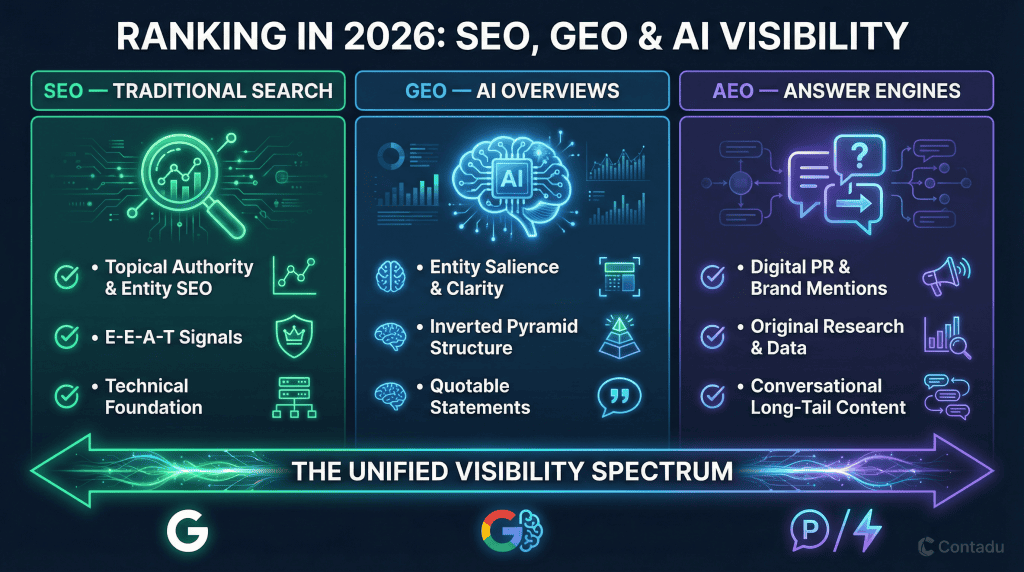
To win in 2026, you need a unified strategy that targets the entire Visibility Spectrum. You must optimize for traditional search algorithms (SEO), generative AI search features (GEO), and standalone answer engines (AEO).
This step-by-step guide will show you how the new era of search works. We’ll break down three key systems, show where they overlap, and show you how to build a content engine that gets you cited, ranked, and featured wherever your audience is searching.”
Chapter 1: The New Visibility Landscape.
Before we dive into tactics, we must understand the battlefield. The era of “Search Engine Optimization” has evolved into “Search Experience Optimization.”
Today, a user’s journey is rarely linear. A B2B buyer might start by asking ChatGPT for a list of software vendors, use Perplexity to compare features, and finally use Google to find a specific case study on a vendor’s website.
To capture demand, you must understand the three distinct gatekeepers of digital visibility in 2026.
1. Traditional SEO (Search Engine Optimization)
The Goal: Rank in the traditional organic results (the “blue links”).
The Mechanism: Crawling, indexing, and ranking based on relevance, authority, and user experience signals.
The Reality in 2026: Traditional SEO is not dead, but it has been pushed down the page. The top of the SERP is now dominated by ads, featured snippets, and AI Overviews. However, traditional SEO remains the foundational layer. If Google cannot crawl, understand, and trust your site, you will not appear in its AI features.
Read more: Keyword Research in 2026: Beyond Search Volume
2. GEO (Generative Engine Optimization)
The Goal: Be cited as a source in AI-generated summaries within traditional search engines (e.g., Google’s AI Overviews, Bing Copilot).
The Mechanism: Retrieval-Augmented Generation (RAG). The search engine uses a traditional query to pull the top-ranking documents, then feeds those documents to an LLM to generate a conversational answer, citing the sources it used.
The Reality in 2026: GEO is the most critical battleground for top-of-funnel traffic. If your content is not structured to be easily digested and cited by an LLM, you will lose the “zero-click” searcher.
Read more: GEO 2.0: Advanced Tactics to Get Cited by AI
3. AEO (Answer Engine Optimization)
The Goal: Be recommended by standalone AI assistants (e.g., ChatGPT, Claude, Perplexity).
The Mechanism: A combination of training data recall (what the LLM already knows) and real-time web browsing (RAG).
The Reality in 2026: AEO requires a fundamental shift in how we think about authority. These engines prioritize brand mentions, digital PR, and semantic relationships over traditional backlinks. If your brand is not an established “entity” in the LLM’s training data, you will not be recommended.
The Unified Visibility Framework
You cannot treat these three channels in isolation. They are deeply interconnected.
| Feature | Primary Engine | Key Ranking Factor | Content Format Preference |
| SEO | Google Search | Backlinks & E-E-A-T | Comprehensive, long-form guides |
| GEO | Google AI Overviews | Entity Salience & Structure | Bullet points, tables, direct answers |
| AEO | ChatGPT, Perplexity | Brand Mentions & Digital PR | Unique data, strong opinions, clear definitions |
The winning strategy in 2026 is to build a foundation of Topical Authority that satisfies traditional SEO, structure the content to satisfy GEO, and build brand presence to satisfy AEO.
Chapter 2: The Foundation – Modern SEO in 2026
Before you can optimize for AI, you must master the fundamentals of modern SEO. Artificial Intelligence engines still rely heavily on traditional search indexes to find real-time information. If your technical SEO is broken, or your content lacks basic relevance, no AI will ever cite you.
1. The Shift from Keywords to Entities (Semantic SEO)
For years, SEO was a game of matching “strings” (keywords). If a user searched for “best CRM software,” you made sure that exact phrase was in your H1, URL, and meta description.
In 2026, search engines understand “things” (entities). An entity is a person, place, concept, or thing with a distinct identity and relationship to other entities. Google’s Knowledge Graph is a massive web of these relationships.
To rank today, you must practice Semantic SEO. This means optimizing for the entire topic cluster, not just a single keyword.
How to execute Semantic SEO:
- Identify the Core Entity: What is the main concept of your page? (e.g., “Content Marketing”).
- Map Related Entities: What other concepts must be discussed to comprehensively cover the core entity? (e.g., “SEO,” “Buyer Personas,” “Editorial Calendar,” “Distribution”).
- Analyze Co-occurrence: Use a content intelligence tool like Contadu to see which terms frequently co-occur in the top-ranking pages. If all top 10 pages mention “Return on Investment,” and you do not, the algorithm will deem your content incomplete.
2. E-E-A-T: The Ultimate Ranking Filter
As AI makes it infinitely easier to generate average content, Google has doubled down on E-E-A-T (Experience, Expertise, Authoritativeness, Trustworthiness) as its primary quality filter.
E-E-A-T is not a direct ranking factor; it is a framework that human quality raters use to evaluate search results, which in turn trains the algorithm. In 2026, demonstrating E-E-A-T is non-negotiable, especially for YMYL (Your Money or Your Life) topics.
How to demonstrate E-E-A-T:
- Experience: Show, don’t just tell. Use first-person language (“In our testing…”), include original photographs, and share specific case studies.
- Expertise: Ensure content is written or reviewed by a recognized subject matter expert. Use detailed author bios with links to their LinkedIn profiles and other published work.
- Authoritativeness: Build a robust Internal Linking Strategy to distribute link equity and establish your site as a topical hub. Earn backlinks from high-authority sites in your specific niche.
- Trustworthiness: Ensure your site is technically secure (HTTPS), provide clear contact information, cite credible sources with outbound links, and maintain a positive brand reputation across the web.
Read more: E-E-A-T in 2026: How to Demonstrate Expertise
3. The Power of Information Gain
In 2020, Google filed a patent for an “Information Gain Score.” This patent describes a system that evaluates documents based on the new information they provide compared to what the user has already seen.
If your article is just a rewritten summary of the top 5 results on Google, your Information Gain score is zero. The algorithm has no incentive to rank you because you add no value to the index.
How to maximize Information Gain:
- Original Research: Conduct surveys, analyze proprietary data, and publish the results. This is the strongest form of information gain.
- Contrarian Opinions: Challenge the conventional wisdom in your industry.
- Unique Frameworks: Don’t just list tactics; organize them into a proprietary methodology or framework (e.g., “The 4-Step Content Atomization Model”).
- Expert Quotes: Interview subject matter experts who are not easily found via a quick Google search.
Read more: Information Gain Score: What Google’s Patent Means
4. Technical SEO and Content Operations
Great content cannot overcome a broken website. Technical SEO ensures that search engine crawlers can efficiently discover, render, and index your pages.
Furthermore, as you scale your content production, you need robust Content Operations (ContentOps) to manage the workflow, ensure quality, and prevent issues like Content Cannibalization.
Key Technical & Operational Focus Areas:
- Site Speed & Core Web Vitals: Ensure your pages load instantly and provide a seamless user experience, particularly on mobile devices.
- Schema Markup: Implement structured data (e.g., Article, FAQPage, Organization) to explicitly tell search engines what your content is about. This is crucial for both traditional SEO and GEO.
- Content Auditing: Regularly review your existing content. Use a Content Refresh Strategy to update decaying posts, merge cannibalizing pages, and prune irrelevant content.
With a strong foundation in Semantic SEO, E-E-A-T, and Technical SEO, you are now ready to optimize for the AI-driven future.
Chapter 3: GEO – Generative Engine Optimization.
If traditional SEO is about proving you are the best answer, GEO (Generative Engine Optimization) is about proving you are the easiest answer for an AI to read, synthesize, and cite.
When Google generates an AI Overview, it does not read the entire internet in real-time. It runs a traditional search query, retrieves the top 10-20 documents, and feeds them into an LLM (like Gemini) to generate a summary.
If your content is buried in long, convoluted paragraphs without clear structure, the LLM will skip you and cite a competitor whose content is easier to parse.
The 4 Pillars of GEO
According to research by Princeton University and other institutions, certain content modifications can increase a website’s visibility in generative search engines by up to 40%
Here are the four pillars of a successful GEO strategy:
1. Entity Salience and Clarity
LLMs are prediction engines; they predict the next most likely word based on patterns in their training data. They rely heavily on entity relationships.
If your page is about “B2B Content Marketing,” the LLM expects to see related entities like “Lead Generation,” “Sales Funnel,” and “Buying Committee” in close proximity.
Actionable Tactic: Use a Content Scoring tool to ensure your entity coverage matches or exceeds the top-ranking competitors. Do not use clever metaphors when a clear, industry-standard term will do.
2. Technical Handshakes (Structure and Formatting)
LLMs love structure. They are trained to extract information from tables, lists, and clear headings.
If you are answering a complex question, do not bury the answer in the third paragraph. Use the “Inverted Pyramid” style: give the direct answer immediately, then provide the context and details.
Actionable Tactic:
- Use <h2> and <h3> tags to ask direct questions (e.g., “What is the ROI of Content Marketing?”).
- Immediately follow the heading with a concise, 40-50 word answer.
- Use Markdown tables to compare data, features, or pricing. LLMs frequently pull tables directly into their summaries.
- Use numbered lists for step-by-step instructions.
3. Freshness and Originality
Generative engines are designed to provide the most up-to-date information. If your content is outdated, it will not be cited. Furthermore, if your content is identical to everyone else’s, the LLM has no reason to choose yours over a higher-authority site.
Actionable Tactic: Implement a rigorous Content Calendar that includes scheduled updates for your most important pillar pages. Add new statistics, recent case studies, and updated expert quotes to ensure your content is the freshest source available.
4. Quotation and Citation.
LLMs are designed to synthesize information, but they are also programmed to cite their sources to build trust with the user. They look for authoritative statements that they can quote directly.
Actionable Tactic: Include highly quotable, standalone sentences in your content. Bold these sentences to make them visually distinct. When you make a factual claim, cite a credible source using a clear outbound link. The LLM will recognize this pattern of evidence-based writing and is more likely to cite you as a primary source.
Chapter 4: AEO – Answer Engine Optimization.
While GEO focuses on optimizing for AI features within traditional search engines (like Google), AEO (Answer Engine Optimization) focuses on standalone AI assistants like ChatGPT, Claude, and Perplexity.
These platforms operate differently. While Perplexity relies heavily on real-time web browsing (RAG), ChatGPT and Claude rely more heavily on their underlying training data, only browsing the web when explicitly asked or when they lack confidence in their internal knowledge.
To win in AEO, you must optimize for both the training data (long-term brand building) and the real-time retrieval (RAG).
1. Optimizing for the Training Data (The Entity Graph)
You cannot “optimize” your website to be included in an LLM’s training data after the fact. The models are trained on massive datasets (like Common Crawl) periodically.
However, you can influence how your brand is perceived by these models by building a strong digital footprint across the web.
Actionable Tactic: Digital PR and Brand Mentions
LLMs learn about your brand the same way they learn about anything else: through repeated exposure in authoritative contexts.
- Get mentioned in major industry publications, news sites, and high-authority blogs.
- Publish Original Research that other sites will cite and discuss.
- Ensure your brand is accurately described on Wikipedia, Wikidata, and major review platforms (G2, Capterra).
If an LLM consistently sees your brand mentioned alongside terms like “best content intelligence platform,” it will internalize that relationship and recommend you when a user asks for platform suggestions.
2. Optimizing for Real-Time Retrieval (RAG in AEO)
When an AI assistant browses the web to answer a user’s question, it acts very much like a traditional search engine crawler, but with a specific goal: finding a direct, synthesized answer.
Actionable Tactic: The “Definition” Strategy
AI assistants frequently look for clear, authoritative definitions of concepts.
- Create dedicated glossary pages or “What is [Concept]?” sections within your long-form content.
- Use clear, unambiguous language. Avoid marketing jargon.
- Example: “Content Intelligence is the use of artificial intelligence and big data to analyze, optimize, and measure the performance of digital content.”
3. The Role of Conversational Long-Tail Keywords.
Users interact with AI assistants differently than they interact with Google. Instead of typing “B2B content strategy,” they type, “Act as a CMO for a B2B SaaS startup. Create a 6-month content strategy focused on lead generation with a $10,000 monthly budget.”
Actionable Tactic: FAQ and Scenario-Based Content
To capture these highly specific, conversational queries, you must build content that addresses complex scenarios.
- Expand your FAQ sections to include highly specific, multi-part questions.
- Publish detailed case studies that walk through a specific problem, the constraints, the solution, and the results. LLMs love synthesizing case studies to answer complex user prompts.
Chapter 5: The Unified Content Strategy.
You cannot run three separate strategies for SEO, GEO, and AEO. You need one unified workflow that produces content optimized for the entire visibility spectrum.
Here is the step-by-step playbook for building a unified content engine in 2026.
Step 1: Topic Discovery and Intent Analysis.
Stop looking at search volume. Start looking at Topic Clusters and Search Intent.
- Use a tool like Contadu to identify the core entities your target audience cares about.
- Analyze the SERP to understand the intent behind the query. Is the user looking for a definition, a comparison, a tutorial, or a transactional page?
- Map out a complete Topic Cluster with one comprehensive Pillar Page and dozens of supporting cluster articles.
Step 2: The Data-Driven Brief.
Never start writing without a brief. A unified strategy requires a Perfect Content Brief that includes:
- The primary keyword and secondary entities.
- The target Content Score.
- The required structural elements (H2s, H3s, tables, lists).
- The specific questions that must be answered (for GEO/AEO).
- The required internal and external links.
Step 3: Content Creation and Scoring.
Write for the human, optimize for the machine.
- Draft the content focusing on narrative, voice, and Information Gain.
- Use a Content Scoring tool to ensure you have covered all necessary semantic entities.
- Format the content using the “Inverted Pyramid” style for GEO. Include clear definitions and highly quotable statements.
Step 4: Atomization and Distribution.
Do not publish and pray. A 5,000-word pillar page is useless if no one sees it.
- Use Content Atomization to break the pillar page down into LinkedIn carousels, Twitter threads, short-form videos, and newsletter segments.
- Distribute the content across all channels to build the brand mentions and digital footprint required for AEO.
Step 5: Measurement and Iteration.
Traditional traffic is no longer the only metric that matters.
- Measure your traditional organic rankings and traffic.
- Monitor your brand mentions in AI Overviews and standalone AI assistants (using specialized tracking tools or manual testing).
- Track the ROI of Content by looking at pipeline influence and conversion rates, not just page views.
Read more: The Data-Driven Content Strategy: A Guide to Measuring What Matters
Chapter 6: Putting It Into Practice with Contadu.
Navigating the intersection of SEO, GEO, and AEO manually is virtually impossible. You cannot use a spreadsheet to track semantic entities, measure information gain, and monitor structural formatting simultaneously.
This is why Content Intelligence platforms like Contadu are essential in 2026.
Contadu acts as your central command center for the entire unified visibility strategy. Here is how it bridges the gap between traditional search and generative AI:
1. Data-Driven Topic Discovery
Instead of guessing which topics will resonate with your audience and the AI algorithms, Contadu analyzes the entire SERP landscape. It identifies the core entities, the required subtopics, and the specific questions users (and LLMs) are asking. This ensures your content is semantically complete from day one.
2. The Real-Time Content Score.
As you draft your content in the Contadu editor, the proprietary Content Score updates in real-time. This score is not just a basic keyword density check. It is a sophisticated NLP analysis that measures your semantic relevance against the top-ranking competitors. A high Contadu score is the strongest leading indicator that your content is structured correctly for both traditional indexing and AI Retrieval-Augmented Generation (RAG).
3. Structural Optimization for GEO.
Contadu editor encourages the exact formatting that generative engines prefer. By guiding you to use clear headings, bulleted lists, and comprehensive answers to extracted user questions, the platform naturally shapes your content into the “Inverted Pyramid” style required for AI Overviews and answer engines.
4. Managing Content Operations at Scale.
You cannot win in 2026 with a chaotic workflow. Contadu provides a centralized hub for managing 50+ content projects simultaneously. From generating data-backed briefs to tracking performance and scheduling content refreshes, it brings order to the complex process of scaling quality content.
By integrating Contadu into your workflow, you stop guessing what search engines and AI assistants want, and start engineering content that is mathematically designed to be cited, ranked, and recommended.
Conclusion: The Era of Search Experience Optimization.
The days of gaming the system with keyword stuffing and low-quality backlinks are permanently over. In 2026, visibility is a byproduct of genuine utility, structural clarity, and undeniable authority.
To capture demand across the entire visibility spectrum, you must stop thinking about “ranking for keywords” and start thinking about “becoming the definitive entity” for your topic.
1.Master Traditional SEO: Build topical authority, demonstrate E-E-A-T, and ensure your technical foundation is flawless.
2.Optimize for GEO: Structure your content for easy LLM extraction using clear headings, direct answers, and quotable statements.
3.Command AEO: Build your brand’s digital footprint through digital PR, original research, and consistent mentions in high-authority contexts.
The brands that embrace this unified approach will not just survive the transition to AI-powered search; they will dominate it. They will be the brands that ChatGPT recommends, Perplexity cites, and Google ranks.
FAQ
Is traditional SEO dead in 2026?
No, traditional SEO is not dead; it has evolved. It remains the foundational layer of digital visibility. AI engines like Google’s AI Overviews and Perplexity rely on traditional search indexes to retrieve real-time information (RAG). If your site cannot be crawled, indexed, and ranked traditionally, it will not be cited by AI.
How do I optimize my content specifically for ChatGPT?
ChatGPT relies heavily on its training data and, when necessary, real-time web browsing. To optimize for its training data, you must build a strong digital PR presence—getting your brand mentioned in authoritative publications. To optimize for its real-time browsing, ensure your content provides clear, unambiguous definitions and comprehensive answers to complex, scenario-based questions.
What is the difference between GEO and AEO?
GEO (Generative Engine Optimization) focuses on optimizing content to be cited within AI features embedded in traditional search engines, like Google’s AI Overviews. AEO (Answer Engine Optimization) focuses on being recommended by standalone AI assistants like ChatGPT, Claude, and Perplexity. While the tactics overlap, AEO requires a stronger focus on off-page brand mentions and digital PR.
How important is schema markup for AI visibility?
Schema markup is absolutely critical. It provides explicit, machine-readable clues about the context and structure of your content. Implementing schema types like Article, FAQPage, and Organization makes it significantly easier for LLMs to parse and synthesize your information, increasing the likelihood of citation.
Should I use AI to write my content?
You should use AI to assist in content creation, not to replace the human expert. Use AI for research, outlining, and formatting. However, the final output must contain original insights, proprietary data, and a unique voice (Information Gain) to stand out. Purely AI-generated content is often generic and lacks the E-E-A-T signals required to rank in 2026.